California has long been the epicenter of electric vehicle adoption in the United States, and Tesla remains the brand most synonymous with that dominance. Walk through any Bay Area parking structure or cruise down the 405 in Los Angeles, and the evidence is unmistakable: Model 3s and Model Ys are everywhere. But what exactly fuels California Tesla sales year after year, and does the current-generation Model 3 still justify its market position against a rapidly expanding field of competitors?
We spent three weeks with the 2026 Tesla Model 3 Long Range AWD — commuting, road-tripping, and fast-charging across California's varied terrain — to answer that question with hard data rather than brand loyalty. Here's everything you need to know about range, charging, pricing, tax credits, and whether this sedan still earns its reputation.
2026 Tesla Model 3 at a Glance: Key Specs
| Spec | Value |
|---|---|
| EPA Range | 341 miles |
| Battery (usable) | 75 kWh (NMC lithium-ion) |
| Drivetrain | Dual-motor AWD |
| Horsepower | 346 hp (combined) |
| 0–60 mph | 4.2 seconds |
| Peak DC Fast Charge | 250 kW (CCS via NACS adapter or native NACS) |
| 10–80% DC Charge Time | ~27 minutes |
| Level 2 Home Charging | 11.5 kW (~44 mi/hr) |
| EPA Efficiency | 132 MPGe combined / 25 kWh/100 mi |
| Cargo Volume | 23 cu ft (trunk + frunk) |
| Base MSRP (Long Range AWD) | $42,880 |
| Battery Warranty | 8 years / 120,000 miles |
Real-World Range: What the EPA Number Doesn't Tell You
The EPA rates the 2026 Model 3 Long Range AWD at 341 miles of range on a full charge — a strong number for the segment and a key reason California Tesla sales remain robust in a state where commuters routinely log 60+ round-trip miles. But as with every EV, the sticker number is a starting point, not a guarantee.
- City/suburban driving (65–75°F): 330–350 mi — regen braking in stop-and-go recovers meaningful energy
- Highway cruising at 70–75 mph: 270–295 mi — aero drag dominates at speed
- Cold weather (below 40°F, cabin heat on): 235–270 mi — expect 20–30% loss depending on conditions
- Mountain driving (elevation gain): Varies heavily; regen on descents partially offsets climb losses
Source: fueleconomy.gov — EPA combined estimate 341 mi.
During our California testing — a mix of I-5 highway miles, Sierra foothill climbs, and Bay Area stop-and-go — we averaged roughly 290 miles of indicated range on a 100% charge in mild spring conditions. That's about 85% of the EPA figure, which is typical for mixed driving with substantial highway segments. The Model 3's heat pump (standard on all 2026 trims) helps mitigate cold-weather losses compared to older resistance-heater EVs, but Northern California mountain commutes in January will still compress your range noticeably.
The 75 kWh usable battery uses NMC (nickel manganese cobalt) chemistry, which prioritizes energy density over the cycle-life longevity of LFP cells. For California buyers who rarely charge to 100% and mostly drive in moderate temperatures, NMC degradation is well-managed by Tesla's thermal management system. Tesla warranties the battery to retain at least 70% capacity over 8 years or 120,000 miles — whichever comes first.
Charging Speed: DC Fast, Level 2, and the Supercharger Advantage
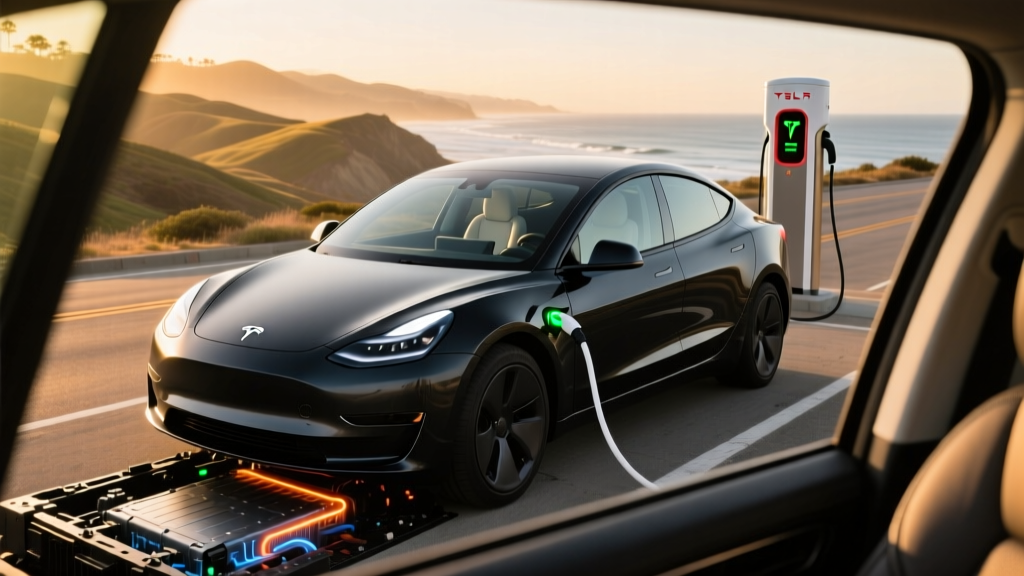
Charging infrastructure remains one of Tesla's strongest competitive moats, and it's a central factor in California Tesla sales. The state has over 1,200 Supercharger stalls across urban and corridor locations, and the Model 3's native NACS connector means plug-and-charge simplicity with no adapter required.
| Charging Level | Power | Speed (approx.) |
|---|---|---|
| Level 1 (120V household) | ~1.4 kW | ~5 miles per hour |
| Level 2 (240V, 48A Wall Connector) | 11.5 kW | ~44 miles per hour |
| DC Fast Charge (V3 Supercharger) | Peak 250 kW | 10–80% in ~27 minutes |
| DC Fast Charge (V4 Supercharger) | Peak 250+ kW | 10–80% in ~25 minutes (preconditioned) |
| Non-Tesla DC (Electrify America, etc.) | Up to 250 kW via NACS-to-CCS adapter | Varies by station output |
A few practical notes on the charge curve: The Model 3 Long Range peaks at 250 kW only between roughly 10–30% State of Charge (SoC). From 30–60%, it sustains around 150–170 kW, then tapers to under 100 kW above 60%, and drops sharply past 80%. This is standard NMC behavior — if you're road-tripping, plan your stops to arrive at low SoC and depart at 70–80% for the fastest average charging speed.
At home, Tesla's Wall Connector on a 60A circuit (48A continuous) delivers 11.5 kW, which replenishes a depleted battery in roughly 7 hours. Most California homeowners with a NEMA 14-50 outlet and a 40A circuit will see ~9.6 kW — still enough for overnight replenishment of daily driving. Panel upgrades are occasionally needed in older California homes with 100A service; budget $1,500–$3,000 if your electrician recommends one.
Performance, Efficiency, and Daily Drivability
The dual-motor AWD powertrain produces 346 combined horsepower and launches the Model 3 to 60 mph in 4.2 seconds. That's quick by any sedan standard, and the instant torque delivery makes merging onto packed Southern California freeways effortless. The Performance trim ($47,880 MSRP) drops the 0–60 to 3.1 seconds with 510 hp, but for most buyers, the Long Range's acceleration is more than adequate.
Efficiency is where the Model 3 truly distinguishes itself. At 132 MPGe combined (25 kWh per 100 miles), it's one of the most efficient EVs in its class. That efficiency translates directly to lower charging costs — at California's average residential electricity rate of ~$0.30/kWh, a full home charge costs roughly $22.50 and delivers around 290 real-world miles. That's approximately $0.078 per mile, compared to $0.15–$0.18/mile for a 30-MPG gas car at California pump prices.
Ride quality in the refreshed "Highland" generation (introduced for 2024 and carried forward) is substantially improved over the pre-2024 Model 3. The cabin is quieter, the suspension absorbs freeway expansion joints more gracefully, and ventilated front seats are now standard on Long Range — a meaningful upgrade for Central Valley summers.
Pricing, Trims, and Federal Tax Credit Eligibility
The 2026 Model 3 is available in three trims:
- Rear-Wheel Drive: $38,880 MSRP — 272 mi EPA range, LFP battery, single motor
- Long Range AWD: $42,880 MSRP — 341 mi EPA range, NMC battery, dual motor
- Performance AWD: $47,880 MSRP — 315 mi EPA range, NMC battery, track-tuned dual motor
| Trim | Base MSRP | Est. §30D Credit | Effective Price* |
|---|---|---|---|
| RWD | $38,880 | Up to $7,500 | ~$31,380 |
| Long Range AWD | $42,880 | Up to $7,500 | ~$35,380 |
| Performance AWD | $47,880 | Up to $7,500 | ~$40,380 |
*Effective price assumes full §30D credit eligibility. Actual credit depends on battery sourcing, buyer income, and MSRP caps. See eligibility checklist below. As of 2026, the point-of-sale transfer option allows dealers to apply the credit as a down-payment reduction at purchase.
Federal §30D Tax Credit Eligibility Checklist (2026 rules):
- Vehicle MSRP must not exceed $55,000 for sedans (all Model 3 trims qualify)
- Buyer AGI must not exceed $150,000 (single) / $300,000 (joint filing)
- Battery critical minerals and components must meet escalating domestic-sourcing thresholds — Tesla's Fremont-built Model 3 has historically qualified for the full credit, but verify current-year sourcing compliance on IRS.gov before purchase
- Vehicle must be assembled in North America (Fremont, CA — confirmed)
- Credit is non-refundable but transferable at point of sale as of 2024+
California buyers also benefit from the state's Clean Vehicle Rebate Project (CVRP) and potential utility incentives (e.g., PG&E, SCE, and SDG&E offer $1,000–$1,500 rebates for EV purchases plus reduced time-of-use charging rates). Combined with the federal credit, a Long Range AWD Model 3 can effectively drop below $34,000 for eligible buyers — a compelling proposition that helps explain why California Tesla sales continue to outpace every other state.
Interior, Tech, and Driver Assistance
The 2026 Model 3 interior remains minimalist by design. A 15.4-inch center touchscreen handles all vehicle controls, infotainment, and navigation — there is no separate instrument cluster, and turn signals are now on the steering wheel (a change from the controversial 2024 stalk-delete that Tesla reversed after customer feedback).
Passenger space is adequate for four adults: 42.2 inches of front legroom and 35.3 inches rear. The rear seat fits two adults comfortably on longer drives, though the sloping roofline limits headroom for taller passengers. Cargo space totals 23 cubic feet (trunk plus front trunk/frunk), competitive with the Hyundai Ioniq 6 and slightly behind the BMW i4.
Tesla Autopilot comes standard and includes adaptive cruise control, lane centering, and automatic emergency braking. Full Self-Driving (Supervised) is a $8,000 add-on or $99/month subscription that adds automated lane changes, traffic light recognition, and city street navigation.
Tesla Autopilot and FSD (Supervised) are SAE Level 2 driver-assistance systems — not self-driving. The driver must remain fully engaged, hands on or near the wheel, and eyes on the road at all times. Only Level 4 services like Waymo operate without a human driver in geofenced areas. Do not confuse marketing terminology with automation capability.
Other notable tech: over-the-air software updates, a built-in dashcam and Sentry Mode security system, HEPA air filtration (Bioweapon Defense Mode), and a 17-speaker premium audio system on Long Range and Performance trims. Wireless phone charging and USB-C ports are standard throughout.
Pros, Cons, and the Competition
- Class-leading efficiency (132 MPGe) reduces per-mile charging cost
- Access to Tesla Supercharger network — the most reliable DC fast-charging system in the US
- 341-mile EPA range covers most California commutes for a full work week
- Strong acceleration and refined ride in the Highland generation
- Federal + California incentives can drop effective price significantly
- OTA updates continuously add features post-purchase
- Minimalist interior polarizes — no physical buttons, no instrument cluster
- Rear seat headroom is tight for passengers over 6'0"
- FSD (Supervised) remains Level 2 despite the name; $8,000 is steep for what it delivers
- Insurance costs in California run 15–25% higher than comparable non-Tesla sedans
- Build quality, while improved, still shows occasional panel-gap variation
- Competition (Ioniq 6, BMW i4, Polestar 2) has narrowed the gap significantly
Is it worth buying vs. key competitors? The Model 3 Long Range remains the default choice for California buyers who prioritize Supercharger access, efficiency, and proven software. The Hyundai Ioniq 6 (361 mi EPA, ~$42,000) offers more range and a more conventional interior but relies on the Electrify America network, which still trails Supercharger reliability. The BMW i4 eDrive40 (~$52,000, 307 mi) is more refined and better-built but costs significantly more. The Polestar 2 (~$49,000, 320 mi) appeals to design-forward buyers but can't match Tesla's charging ecosystem. For pure value in California — especially with stacking incentives — the Model 3 Long Range still occupies a sweet spot that competitors haven't fully replicated.
Who Should Buy the 2026 Tesla Model 3?
The Model 3 is best suited for:
- California commuters with 40–80-mile round trips who can charge at home overnight
- Tech-forward buyers comfortable with a screen-centric interface and OTA-driven ownership
- Road-trippers who value the Supercharger network for Sierra, Pacific Coast, and desert runs
- Cost-conscious EV adoptors who want to maximize federal + state incentive stacking
It's less ideal for:
- Buyers who need substantial rear cargo or passenger space (consider Model Y or Ioniq 5)
- Those who prefer traditional controls and physical buttons
- Heavy tow applications (1,000-lb tow rating — not a towing vehicle)
- Buyers in apartments or homes without Level 2 charging access who would rely solely on public infrastructure
Frequently Asked Questions
What is the real-world range of the 2026 Tesla Model 3 Long Range?
The EPA rates it at 341 miles. In real-world mixed driving — including highway, city, and mild elevation changes — expect 280–310 miles on a full charge. Highway-only driving at 75 mph drops that to roughly 270–295 miles. Cold weather below 40°F can reduce range to 235–270 miles.
How fast does the Model 3 charge at home and on DC fast chargers?
At home on a 240V Level 2 Wall Connector (48A), the Model 3 charges at 11.5 kW, adding about 44 miles of range per hour — a full charge takes roughly 7 hours. On a V3 or V4 Tesla Supercharger, it peaks at 250 kW and charges from 10–80% in approximately 27 minutes, with the charge rate tapering significantly above 80% SoC.
Does the 2026 Tesla Model 3 qualify for the $7,500 federal EV tax credit?
All three trims fall under the $55,000 MSRP cap for sedans, and the Fremont-built Model 3 has historically met battery sourcing requirements. However, buyer income must not exceed $150,000 (single) or $300,000 (joint), and sourcing rules tighten annually. Verify current eligibility at IRS.gov before purchasing. The credit can be transferred at point of sale to reduce your down payment.
How much does the Model 3 cost after all incentives in California?
The Long Range AWD starts at $42,880. With the full $7,500 federal credit, a ~$1,000–$2,000 California state/utility rebate, and potential HOV lane access, the effective cost can drop to approximately $33,000–$35,000 for eligible buyers. Exact amounts vary by utility district and income — check energy.ca.gov for current state programs.
Is the Tesla Model 3 still worth buying over competitors in 2026?
For California buyers specifically, yes — the combination of Supercharger density, class-leading efficiency, strong incentive stacking, and 341-mile range keeps it at the top of the segment. However, the Hyundai Ioniq 6, BMW i4, and Polestar 2 have all closed the gap in quality and range. Test-drive at least two competitors before committing, and weigh Supercharger access against your preferred driving routes.
What is the battery warranty on the 2026 Model 3?
Tesla warranties the Long Range and Performance NMC battery for 8 years or 120,000 miles (whichever comes first) with a minimum 70% capacity retention guarantee. The RWD model's LFP battery carries the same 8-year / 120,000-mile warranty. Tesla's thermal management system has proven effective at limiting degradation — most owners report 5–8% loss over the first 100,000 miles based on fleet data.