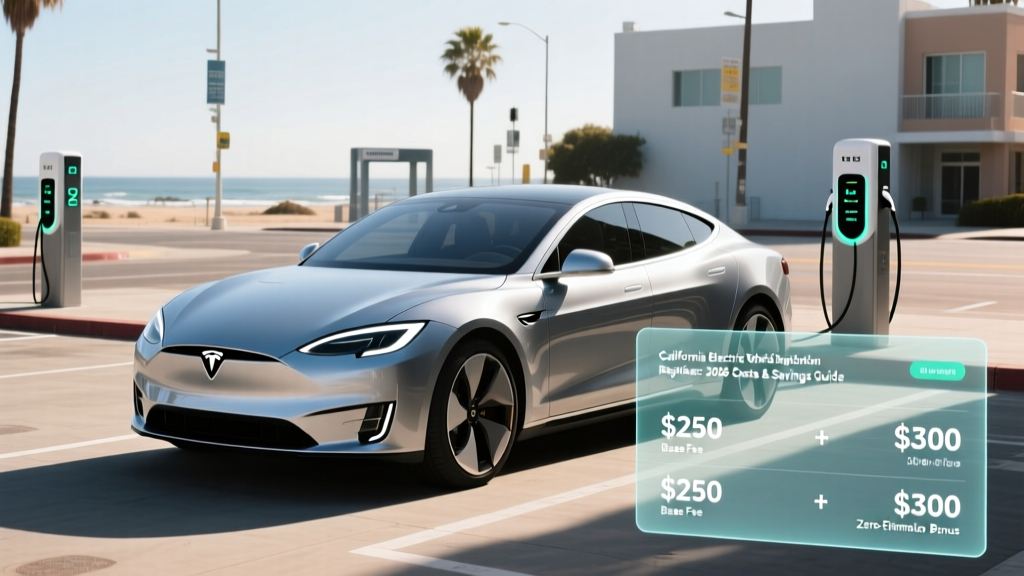
If you own or plan to buy an electric vehicle in California, you'll pay an additional $100 annual EV registration fee on top of the standard vehicle registration costs that all Californians pay. This fee, established under Senate Bill 1 (Road Repair and Accountability Act of 2017), applies to every zero-emission vehicle registered in the state and is designed to offset the gas-tax revenue that EVs don't contribute at the pump.
Quick Answer: What You'll Actually Pay
Standard registration (all vehicles): ~$60–$300+ depending on vehicle value and weight
Additional EV fee: $100/year (zero-emission vehicles only)
Typical total annual registration for an EV: $160–$400+
Effective date: January 1, 2020 — ongoing, adjusted periodically for inflation
Applies to: BEVs, FCEVs (hydrogen). PHEVs pay a reduced additional fee of $25–$50 depending on model year rules.
The Full Cost Picture: Registration in Context
The $100 EV fee stings when you first see it on your DMV renewal notice, but it's one line item in a much larger ownership equation. California's standard registration fees already rank among the highest in the nation, calculated as a percentage of the vehicle's value (the Vehicle License Fee, or VLF, at 0.65% of depreciated value) plus weight fees, county/district fees, and a $25–$30 CHP fee.
For a $45,000 Tesla Model Y in its first registration year, here's what the DMV bill actually looks like:
| Fee Component | EV (Model Y, ~$45k) | Gas Car (RAV4, ~$35k) |
|---|---|---|
| Vehicle License Fee (VLF, 0.65%) | ~$293 | ~$228 |
| Registration Fee (base) | $67 | $67 |
| Weight Fee | $40–$80 | $30–$50 |
| CHP Fee | $28 | $28 |
| County/District Fees | $15–$40 | $15–$40 |
| Additional EV Road Usage Fee | $100 | $0 |
| Estimated Total Year 1 | ~$543–$608 | ~$368–$413 |
The gap narrows in subsequent years as the VLF drops with depreciation, but the $100 EV surcharge remains flat. For a five-year-old EV worth $20,000, your total registration might be around $250, with that $100 representing 40% of the bill.
Why the EV Fee Exists: The Gas Tax Gap
California's gas tax currently sits at 68.1 cents per gallon (as of fiscal year 2025–2026), funding road maintenance through the California Department of Transportation. A driver averaging 12,000 miles per year in a 28-MPG gas car buys roughly 429 gallons annually, contributing about $292 in state gas tax.
An EV driver covering the same 12,000 miles pays zero gas tax. The $100 annual EV fee was intended as a partial equalizer — though at current gas-tax rates, it only recovers roughly a third of what a typical gas-car driver contributes. California's legislature has periodically discussed raising the EV fee or implementing a per-mile road usage charge (RUC), and pilot programs like CalSTREc have tested mileage-based alternatives.
Common Misconceptions About California EV Fees
| Myth | Fact |
|---|---|
| "EVs pay no road taxes at all" | EV owners pay the $100 annual fee plus all standard registration fees; they also contribute to gas-tax revenue indirectly through California's electricity rates funding grid maintenance |
| "The fee will go away" | The fee is indexed to inflation under SB 1 and is more likely to increase than disappear as EV adoption grows and gas-tax revenue declines |
| "PHEVs get the full $100 fee" | Plug-in hybrids pay a reduced additional fee because they still burn gasoline and contribute gas-tax revenue |
| "The fee cancels out EV savings" | At ~$100/year, the fee is offset by fuel and maintenance savings within the first month of typical driving |
EV vs. Gas: Total Annual Operating Cost in California
Registration is a fixed cost. The variable costs — fuel, maintenance, insurance — are where EVs typically win or lose the math. Here's a realistic annual comparison for a California driver covering 12,000 miles per year, based on 2026 averages:
| Cost Category | EV (e.g., Hyundai Ioniq 6 SE, 140 MPGe) | Gas Car (e.g., Toyota Camry LE, 32 MPG combined) |
|---|---|---|
| Fuel/Energy | $480–$720 (home charging at $0.25–$0.38/kWh CA avg) | $1,688 (at $4.50/gal CA avg) |
| Public DC Fast Charging (10% of miles) | $120–$200 additional | N/A |
| Oil Changes | $0 | $180–$280 (3–4 per year) |
| Maintenance (brakes, fluids, filters) | $100–$200 | $400–$600 |
| Tires (EVs wear faster due to weight/torque) | $250–$400 | $180–$300 |
| Registration (total estimated) | $350–$550 | $300–$450 |
| Insurance (CA average) | $2,200–$2,800 | $1,800–$2,300 |
| Estimated Annual Total | $3,500–$5,070 | $4,548–$6,018 |
The EV wins on energy and maintenance by a wide margin — roughly $900–$1,400 in annual fuel savings and $200–$400 in maintenance savings. Higher insurance premiums ($300–$500 more annually for many EV models) and the registration surcharge partially offset this, but the net advantage typically remains $500–$1,000 per year in California.
Source: Energy cost estimates based on fueleconomy.gov efficiency data and EIA electricity pricing; gas prices from EIA weekly California regular gasoline averages.
First-Time California EV Buyer: What to Budget Beyond the Sticker
The registration fee is minor compared to the other upfront and ongoing costs new EV buyers frequently underestimate. Here's the realistic first-year budget for a mid-range EV purchase in California:
Purchase and Setup Costs
- Vehicle MSRP: $38,000–$55,000 for mainstream models (Model Y, Ioniq 5, Equinox EV, Prologue)
- Federal §30D tax credit: Up to $7,500 if eligible — subject to MSRP caps ($55,000 SUVs/trucks, $25,000 sedans), buyer income limits ($150k single / $300k joint AGI), and critical-mineral/battery-component sourcing requirements. Point-of-sale transfer available. Check current rules at IRS.gov.
- California Clean Fuel Rebate: Program status changes frequently — check the California Air Resources Board for current availability and income-qualified amounts.
- Home Level 2 charger: $500–$700 for a quality 48-amp hardwired unit (ChargePoint Home Flex, Emporia V2, Tesla Wall Connector) plus $800–$2,500 for electrician installation depending on panel capacity and run length. A 200-amp panel upgrade adds $1,500–$3,500 if needed.
- Registration & taxes: Sales tax (7.25%–10.75% depending on county) plus first-year registration ($400–$600+).
Ongoing Costs Unique to EV Ownership
- Electricity: Budget $50–$80/month for home charging at California's average residential rate of ~$0.30/kWh. Time-of-use plans can cut this 30–40% by charging overnight.
- Tire replacement: EVs are 500–1,000 lbs heavier than equivalent gas cars and deliver instant torque, wearing tires 20–30% faster. Budget for replacement every 30,000–40,000 miles instead of 50,000+.
- Battery degradation: Modern NMC and LFP packs lose roughly 1–2% capacity per year in moderate climates. California's warm climate can slightly accelerate this. Federal warranty mandates 8 years/100,000 miles minimum at 70% capacity retention.
Real-World Considerations: Does an EV Make Sense in Your Situation?
The registration fee is a rounding error compared to whether your daily life supports EV ownership. These factors matter far more:
Home Charging Access
If you can install a Level 2 charger at home (or already have a 240V outlet in your garage), the economics strongly favor an EV in California. If you rely entirely on public charging — especially in apartments without charging infrastructure — your energy cost can double or triple, and the convenience penalty is significant. Roughly 30% of California households lack dedicated off-street parking, making this a genuine barrier.
Climate and Range Reality
California's climate is one of the most EV-friendly in the US. You won't see the 20–30% cold-weather range loss that Upper Midwest drivers face in winter. However, air conditioning use in Central Valley summers (110°F+) can reduce range 10–15%. A vehicle EPA-rated at 300 miles may deliver 255–270 miles in sustained 100°F highway driving with A/C at full blast.
Driving Patterns
For daily commutes under 80 miles round-trip, any modern EV with 250+ miles of EPA range will handle your week on a single charge. For frequent 300+ mile road trips (LA to SF, San Diego to Bay Area), you'll need a vehicle with DC fast charging above 150 kW and access to reliable fast-charging corridors — Tesla Superchargers and the expanding Electrify America network cover most major California routes adequately.
Decision Framework: Is the EV Fee a Dealbreaker?
Choose an EV in California If:
- You have home charging access or a workplace charger — the $100 fee is recovered in fuel savings within the first 3–4 weeks of driving
- Your daily driving is under 100 miles round-trip with occasional longer road trips
- You qualify for the §30D federal credit (up to $7,500) — this dwarfs 75 years' worth of the $100 annual EV fee
- You want to avoid California's gas prices ($4.30–$5.00/gallon in metro areas) and reduce operating costs
- You're buying a vehicle you'll keep 5+ years, allowing the fuel savings to compound
Consider a PHEV or Hybrid Instead If:
- You live in an apartment or condo without charging access and your complex won't install chargers
- You regularly drive 300+ miles in remote areas (Eastern Sierra, far Northern California) where fast-charging infrastructure is sparse
- Your budget is under $30,000 and you need a used vehicle — the used EV market has limited inventory at this price point
- You want zero range anxiety without planning charging stops — a PHEV like the Toyota RAV4 Prime (42 miles electric-only, then 38 MPG on gas) gives you electric commuting with gas-car flexibility, and the reduced PHEV registration fee
Frequently Asked Questions
Do I pay the $100 EV fee on a plug-in hybrid (PHEV)?
No. The full $100 additional fee applies only to zero-emission vehicles (BEVs and FCEVs). Plug-in hybrids pay a smaller additional road usage fee because they still consume gasoline and contribute gas-tax revenue. Check your DMV renewal notice for the exact amount, as it varies by model year.
Is the California EV registration fee tax-deductible?
The Vehicle License Fee (VLF) portion of your registration — the 0.65% of vehicle value — is deductible as a personal property tax on your federal Schedule A if you itemize. The $100 EV-specific fee is generally not deductible as a personal property tax because it's a flat fee not based on vehicle value. Consult a tax professional for your specific situation.
Will the fee increase in the future?
Under SB 1, the EV road usage fee is adjusted annually based on the California Consumer Price Index. Modest year-over-year increases are expected. California has also been exploring a per-mile road usage charge pilot program that could eventually replace flat fees with mileage-based taxation — potentially benefiting low-mileage drivers while increasing costs for high-mileage ones.
Do I pay this fee if I lease an EV?
Yes, but it's typically rolled into your monthly lease payment rather than billed separately. The leasing company (the registered owner) receives the DMV renewal and passes the cost through. Check your lease agreement for how registration fees are handled.
What about the Clean Air Vehicle (CAV) sticker and HOV lane access?
California's CAV sticker program for single-occupant HOV lane access has specific eligibility requirements and application deadlines. New EV purchases may qualify depending on current program rules and income caps. The CAV decal is separate from registration fees and requires a separate application through the DMV. Check the California Energy Commission and DMV for current program status.
How does the $100 fee compare to other states?
California's $100 EV fee is moderate by national standards. States like Ohio ($200), Alabama ($200), and Arkansas ($200) charge double. Washington state charges $225 for EVs. Some states, like Colorado, have moved toward per-mile road usage charges instead. California's fee is on the lower end, partly because the state's gas tax is also among the highest, so the gap between gas-tax contribution and the EV fee is relatively large.
Bottom Line: The Fee Is Real but the Math Still Favors EVs
California's $100 annual electric vehicle registration fee is a legitimate cost that adds to an already expensive registration bill. But in the context of total EV ownership in a high-gas-price state, it's a small figure. A typical California EV owner saves $900–$1,400 annually on fuel and maintenance compared to a gas car — meaning the EV fee represents roughly one month's worth of those savings.
The factors that actually determine whether an EV is the right financial decision in California are home charging access, your daily mileage, federal tax credit eligibility, and whether you'll keep the vehicle long enough for the operating savings to offset the higher upfront purchase price. The registration fee shouldn't drive your decision either way — but you should budget for it, because it's not going away.