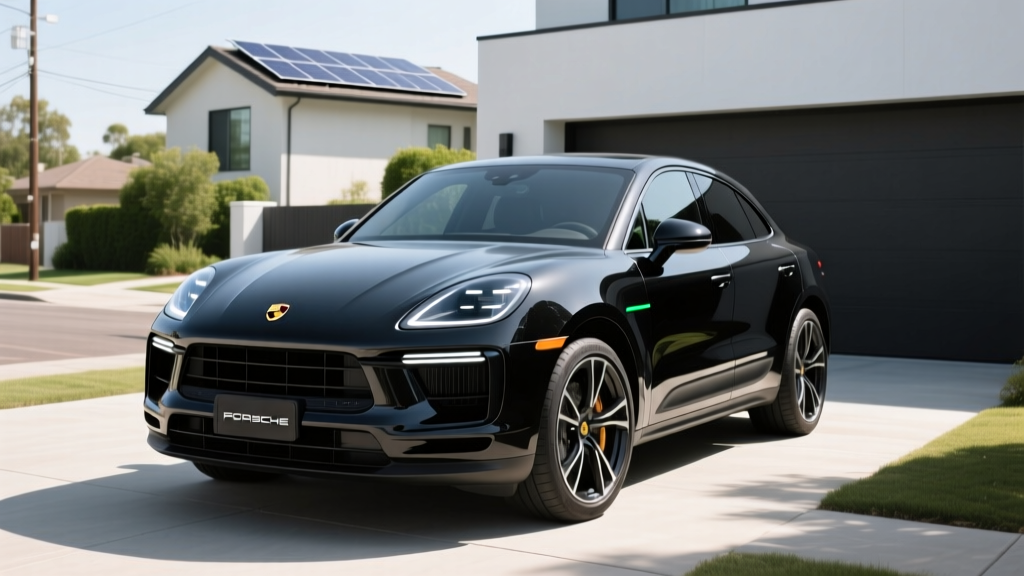
If you are browsing Porsche dealer inventories or luxury EV forums right now, the phrase Porsche Macan EV lease is probably showing up a lot — and for good reason. The all-electric Macan, which debuted for the 2024 model year and has been refreshed with additional trims and battery options through 2026, is Porsche's volume play in the electric luxury compact SUV segment. It sits on the PPE (Premium Platform Electric) architecture co-developed with Audi, packs an 800-volt system, and delivers the kind of driving dynamics Porsche buyers expect.
But luxury EV ownership is a math problem, not a vibes problem. Before you sign a 36-month lease or drop six figures on a purchase, you need to know what the Macan EV actually costs to run, charge, insure, and eventually sell — and whether any of the federal or state incentives apply to a vehicle in this price bracket. This guide walks through the real numbers.
2026 Porsche Macan EV: The Specs That Matter
Let's start with the hard data. The 2026 Macan EV lineup currently includes the base Macan, Macan 4, Macan 4S, and Macan Turbo trims. Battery chemistry is NMC (nickel-manganese-cobalt), and the usable pack capacity is approximately 95 kWh across the range.
| Spec | Macan (Base) | Macan 4 | Macan 4S | Macan Turbo |
|---|---|---|---|---|
| Base MSRP | $79,900 | $84,900 | $94,900 | $112,900 |
| EPA Range | 308 mi | 288 mi | 283 mi | 268 mi |
| Usable Battery | 95 kWh (NMC) | 95 kWh (NMC) | 95 kWh (NMC) | 95 kWh (NMC) |
| Horsepower | 335 hp | 402 hp | 509 hp | 630 hp |
| 0–60 mph | 5.4 sec | 4.9 sec | 3.9 sec | 3.1 sec |
| Peak DC Fast Charge | 270 kW | 270 kW | 270 kW | 270 kW |
| 10–80% DCFC Time | ~21 min | ~21 min | ~21 min | ~21 min |
| Level 2 Charge Rate | 11 kW | 11 kW | 11 kW | 11 kW |
| MPGe (Combined) | 84 MPGe | 80 MPGe | 79 MPGe | 75 MPGe |
| Battery Warranty | 8 yr / 100k mi | 8 yr / 100k mi | 8 yr / 100k mi | 8 yr / 100k mi |
Lease vs. Buy: How the Macan EV Deal Actually Works
Most Macan EVs on the road are leased, and the reasons are structural rather than emotional. A luxury EV with a starting price near $80,000 — and well over $100,000 in Turbo trim — carries significant depreciation risk, and leasing transfers that risk to the lessor (typically Porsche Financial Services).
Here's what a typical 2026 Macan 4 lease looks like based on current market offers:
- Term: 36 months
- Annual mileage allowance: 10,000 miles (12k and 15k options available at higher monthly cost)
- Money factor: ~0.0025 (equivalent to roughly 6% APR)
- Residual value: ~52–55% of MSRP at 36 months
- Estimated monthly payment (Macan 4, $84,900 MSRP): $1,250–$1,450/month depending on dealer markup, incentives applied, and trade-in equity
The key advantage of leasing the Macan EV specifically: you avoid the worst of the depreciation curve (luxury EVs tend to lose 45–55% of value in the first three years), you stay under the battery warranty for the entire term, and you can upgrade when Porsche inevitably refreshes the platform or introduces solid-state battery options later this decade.
The disadvantage: you build no equity, you pay a disposition fee (~$595) at lease end, and excess wear or mileage overages cost $0.25–$0.30 per mile.
The Federal EV Tax Credit: Does the Macan EV Qualify?
This is where the math gets complicated — and where many luxury EV buyers get surprised. Under the current IRS §30D rules, the federal Clean Vehicle Credit offers up to $7,500 for qualifying new EVs. However, the Macan EV faces several eligibility hurdles:
- ✅ Vehicle must be a new BEV or PHEV with ≥7 kWh battery — Macan EV qualifies (95 kWh)
- ✅ Final assembly in North America — Macan EV does NOT qualify (assembled in Bratislava, Slovakia)
- ⬜ MSRP cap: ≤$80,000 for SUVs — only the base Macan at $79,900 clears this, and only just
- ⬜ Buyer income cap: ≤$300,000 MFJ / ≤$150,000 single
- ⬜ Battery critical-mineral and component sourcing requirements must be met (varies by build date)
The critical disqualifier for most Macan EV buyers is the North American final assembly requirement. The Macan EV is built at Porsche's facility in Bratislava, Slovakia — not in the US, Canada, or Mexico. This means the Macan EV does not qualify for the new-vehicle §30D purchase credit, regardless of trim or buyer income.
However, there is a lease loophole. Under the IRS's commercial clean vehicle credit (§45W), vehicles leased through a qualified lessor may pass through a credit of up to $7,500 as a capitalized cost reduction — meaning it reduces your lease payment rather than going to you as a tax credit. Porsche Financial Services has historically applied this credit to Macan EV leases, effectively lowering the monthly payment by roughly $150–$200/month over a 36-month term. Confirm with your dealer whether this is currently being applied, as lessor policies change.
For the latest rules, always check the IRS Clean Vehicle Credits page and the DOE/FuelEconomy.gov tax credit lookup tool before signing anything.
5-Year Total Cost of Ownership: Macan EV vs. Gas Macan
To understand what you're really signing up for, let's compare the 5-year cost of owning a 2026 Macan 4 EV against a gasoline Macan GTS (MSRP ~$85,600). Both vehicles are in the same price neighborhood, but their operating costs diverge sharply.
| Cost Category | Macan 4 EV ($84,900) | Gas Macan GTS ($85,600) |
|---|---|---|
| Purchase/Lease (cap cost) | $84,900 | $85,600 |
| Lease credit / incentive applied | −$7,500 (§45W lease) | $0 |
| Fuel / Charging (60k mi) | $4,800 | $10,500 |
| Maintenance (5 years) | $2,200 | $5,800 |
| Insurance (5 years) | $18,500 | $14,200 |
| Estimated Depreciation (5 yr) | $38,000 | $34,000 |
| Total 5-Year Cost | $~102,900 | $~116,100 |
The Macan EV comes out roughly $13,200 cheaper over five years in this comparison, driven primarily by fuel and maintenance savings that partially offset higher insurance and slightly steeper depreciation. But that gap narrows or widens depending on three variables: your local electricity rate, your annual mileage, and whether the lease credit is applied.
Charging vs. Gasoline: The Per-Mile Math
The Macan 4 EV consumes approximately 33 kWh per 100 miles (based on its 80 MPGe combined rating). The gas Macan GTS returns about 19 MPG combined. Here's what that translates to in dollars:
| Scenario | Macan 4 EV | Gas Macan GTS |
|---|---|---|
| Home charging (Level 2, $0.14/kWh national avg) | $0.046/mi | — |
| Public DCFC ($0.48/kWh avg) | $0.158/mi | — |
| Blended (70% home / 30% DCFC) | $0.080/mi | — |
| Premium gasoline ($4.35/gal, 19 MPG) | — | $0.229/mi |
| Annual fuel cost (12,000 mi/yr) | $960 | $2,748 |
At a blended charging rate, the Macan EV saves roughly $1,788 per year on energy compared to the gas Macan — or about $8,940 over five years. If you can charge exclusively at home on a time-of-use plan (off-peak rates as low as $0.08–$0.10/kWh in some regions), savings increase further. If you rely entirely on public DC fast charging at $0.48–$0.55/kWh, the gap shrinks to around $800/year.
Maintenance Savings: Where the EV Really Wins
The Macan EV eliminates the most expensive recurring maintenance items on the gas Macan:
| Service Item | Macan 4 EV | Gas Macan GTS |
|---|---|---|
| Oil changes (synthetic, ~$250 each) | $0 | $1,500 (6 changes) |
| Transmission fluid | $0 (single-speed) | $450 |
| Brake pads & rotors | $600 (regen extends life) | $2,200 |
| Spark plugs | $0 | $800 |
| Coolant flush | $300 | $400 |
| Cabin air filter | $250 | $250 |
| Tire rotation & replacement | $1,050 (EV tires wear faster) | $800 |
| Total (5 yr) | $2,200 | $5,800+ |
Regenerative braking is the hidden hero here. Because the Macan EV's motors handle most deceleration — recovering energy back into the 95 kWh battery — the friction brakes are used far less. Many EV owners report original brake pads lasting 80,000–100,000 miles. The trade-off: EV-specific tires (which are heavier and carry more torque) tend to wear 15–25% faster than tires on equivalent gas vehicles. Budget for a set of four tires around year 3 or 4.
Insurance: The Cost Nobody Talks About
Here's the unwelcome truth: insuring a Macan EV costs more than insuring the gas Macan, typically 25–35% more. Based on aggregated quotes from major carriers, expect annual premiums of $3,200–$4,200 for the Macan 4 EV versus $2,400–$3,200 for the gas Macan GTS (assuming a 40-year-old driver with a clean record, $100k/$300k liability, and $1,000 deductible).
Why the premium? Several factors:
- Repair costs: EV battery packs and 800V power electronics are expensive to replace after collision damage. Insurers factor in higher total-loss thresholds.
- Specialized labor: High-voltage system repairs require certified technicians, and fewer body shops have that certification.
- Parts availability: Porsche EV-specific parts (battery modules, power electronics, e-axles) have longer lead times and higher unit costs.
- Vehicle price: Even at similar MSRPs, the EV's battery alone represents $15,000–$20,000 in replacement cost that doesn't exist on the gas model.
Shop around aggressively. Some insurers (USAA, State Farm, Progressive) have started offering EV-specific policies with lower premiums, and bundling with homeowners insurance can shave 10–15% off. Always get quotes before committing to a lease.
Depreciation and Resale Value Trends
Luxury EVs have experienced steeper depreciation than their gas counterparts over the past three years, driven by rapid technology obsolescence, aggressive price competition from Tesla and Chinese brands, and consumer uncertainty about long-term battery health.
Based on current resale data for 3-year-old luxury EVs:
- Average 3-year EV retention: 45–55% of MSRP
- Average 3-year gas luxury SUV retention: 55–65% of MSRP
- Macan EV projected 3-year retention: ~50–54% (benefiting from the Porsche badge and limited supply)
- Gas Macan projected 3-year retention: ~58–63%
The Porsche brand helps. Macan EVs hold value better than most luxury EVs (Jaguar I-PACE, Audi e-tron) because of brand cachet, limited production, and strong certified pre-owned demand. But they still trail the gas Macan by 5–10 percentage points at the 3-year mark.
If you lease, this is the lessor's problem, not yours. The residual is baked into your payment. If you buy, plan for a 5-year hold to ride out the steepest part of the depreciation curve.
The Verdict: Who Should Lease the Macan EV?
- You want the latest EV tech without 5-year depreciation risk
- You can charge at home (Level 2) for most daily driving
- Your dealer applies the $7,500 commercial lease credit as a cap-cost reduction
- You value the 270 kW DC fast charging for road trips (10–80% in ~21 minutes on a 350 kW station)
- You want Porsche driving dynamics with zero tailpipe emissions
- You cannot install a home charger and rely on public infrastructure
- You live in a region with high electricity rates ($0.30+/kWh) and no utility rebates
- Insurance quotes come in significantly above $4,000/year
- You plan to keep the vehicle 7+ years (buy gas, avoid battery replacement risk)
Frequently Asked Questions
How much does a Porsche Macan EV lease cost per month in 2026?
Expect $1,250–$1,650/month on a 36-month lease with 10,000 miles/year, depending on trim, dealer fees, and whether the $7,500 commercial lease credit is applied as a cap-cost reduction. The Macan 4 at ~$84,900 MSRP typically lands around $1,350/month with the credit applied.
Does the Macan EV qualify for the $7,500 federal tax credit if I buy it?
No. The Macan EV is assembled in Slovakia, not in North America, which disqualifies it from the §30D new-vehicle purchase credit under current IRS rules. However, leasing through Porsche Financial Services may allow the lessor to claim the commercial clean vehicle credit (§45W) and pass savings through as a lower lease payment.
What is the real-world range of the Macan EV on a road trip?
The EPA rates the Macan 4 at 288 miles. In real-world highway driving at 70–75 mph, expect 240–255 miles. In cold weather (below freezing), plan for 200–220 miles. The 270 kW peak DC charging rate means a 10–80% recharge takes about 21 minutes at a compatible 350 kW station — but note that charging speed tapers significantly above 80% SoC to protect the NMC battery.
Are EVs more expensive to insure than gas cars?
Yes, typically 25–35% more for luxury EVs. The Macan EV costs roughly $3,200–$4,200/year to insure versus $2,400–$3,200 for the gas Macan GTS. Higher repair costs, specialized labor, and expensive battery components drive the premium. Always get quotes from multiple carriers before committing.
How well will the Macan EV hold its value?
Projected 3-year retention is approximately 50–54% of MSRP, which is strong for a luxury EV but trails the gas Macan (58–63%). Porsche brand strength and limited production help. If you lease, depreciation risk belongs to the lessor. If you buy, a 5-year hold is advisable.
What does Macan EV maintenance cost over 5 years?
Approximately $2,200 over 60,000 miles — roughly 60% less than the gas Macan GTS (~$5,800). Savings come from eliminated oil changes, fewer moving parts, and extended brake life via regenerative braking. The main added cost is EV-specific tires, which wear 15–25% faster due to vehicle weight and instant torque.