The Short Answer on California's EV Registration Fee
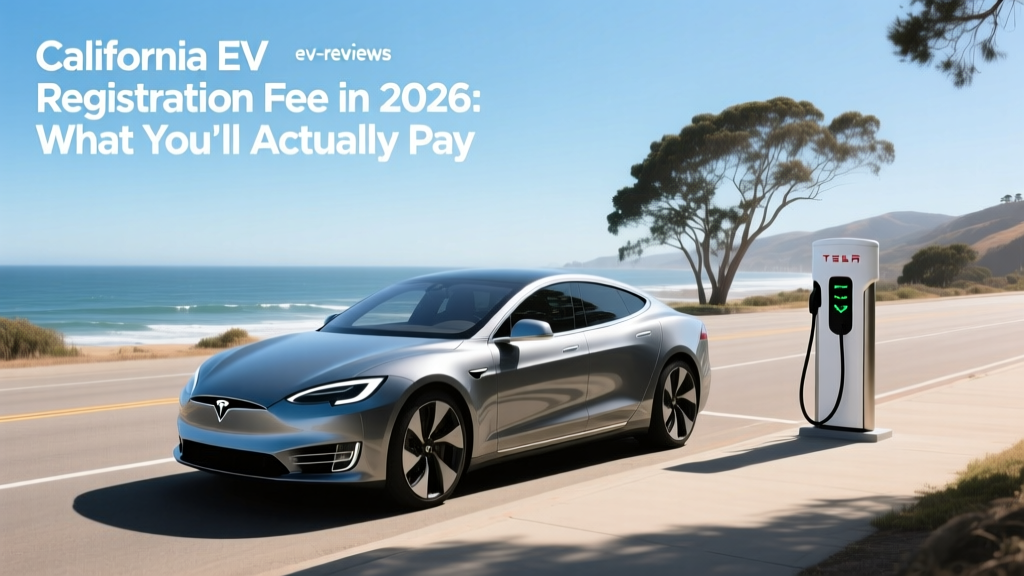
California charges battery electric vehicle (BEV) owners an additional $100 annual registration fee on top of standard DMV registration costs. This surcharge, established under the Road Charge Pilot Program and subsequent legislation (SB 844), is meant to offset the gas-tax revenue EVs don't contribute. Plug-in hybrid (PHEV) and conventional hybrid owners pay no extra EV-specific fee. In total, expect your annual California BEV registration to land between $350 and $900+ depending on vehicle value, weight, and county — the $100 EV surcharge is just one line item on the bill.
If you're shopping for an EV in California — the largest EV market in the U.S. with over 2.3 million registered electric vehicles as of early 2026 — the registration surcharge is a real but manageable ownership cost. Let's put it in full context alongside fuel savings, insurance, maintenance, and the federal §30D tax credit so you can decide whether going electric still pencils out in your driveway.
How California's EV Registration Fee Is Calculated
Your annual registration bill from the California DMV includes several components. Here's how they stack up for a typical BEV like the 2026 Tesla Model Y Long Range (base MSRP $44,990):
| Fee Component | Approximate Cost | Notes |
|---|---|---|
| Vehicle License Fee (VLF) | $250–$600 | 0.65% of depreciated vehicle value; declines each year |
| Registration Fee (base) | $46–$70 | Varies by vehicle weight and type |
| County/District Fees | $25–$100 | Depends on your registration county |
| California Highway Patrol (CHP) Fee | $23–$27 | Standard for all vehicles |
| Zero-Emission Vehicle (ZEV) Surcharge | $100 | Applies to BEVs only; not PHEVs or HEVs |
| Smog Abatement Fee | $20 | First six registration years (replaces smog check) |
| Estimated Total | $464–$917 | Declines in subsequent years as VLF drops |
The $100 ZEV surcharge is a flat fee — it applies equally whether you drive a $28,000 Chevrolet Equinox EV or a $100,000+ Mercedes EQS. This makes it proportionally more noticeable on lower-priced EVs, but it remains a small fraction of total ownership costs.
California's approach differs from states like Texas ($200 EV fee), Ohio ($200), and Georgia (repealed its $200 fee in 2024). At $100, California's surcharge is among the more moderate in the nation, though it may be subject to legislative changes. Always verify current amounts on the California DMV fee schedule.
EV vs Gas Car: Does the Fee Erase the Savings?
The logical question: does paying an extra $100/year in registration wipe out the fuel savings of driving electric? Let's run the numbers for a realistic California scenario.
| Cost Category | 2026 Tesla Model Y LR (BEV) | 2026 Toyota RAV4 AWD (Gas) |
|---|---|---|
| Base MSRP | $44,990 | $32,450 |
| Federal §30D Tax Credit | –$7,500 (if eligible) | $0 |
| Effective Purchase Price | $37,490 | $32,450 |
| Fuel / Electricity (5 yrs) | $3,600 (home L2, $0.28/kWh avg) | $10,800 ($4.50/gal, 28 MPG combined) |
| Maintenance (5 yrs) | $1,200 (tires, cabin filter, wipers) | $3,800 (oil, brakes, filters, belts) |
| Registration (5 yrs, est.) | $3,200 (includes $500 in ZEV surcharges) | $2,700 (no EV surcharge) |
| Insurance (5 yrs, avg) | $9,500 | $7,800 |
| 5-Year Total Cost | $55,090 | $57,550 |
| Cost Per Mile | $0.92 | $0.96 |
The $100 annual EV fee adds $500 over five years. Meanwhile, the Model Y saves roughly $7,200 in fuel and $2,600 in maintenance over the same period. Even after accounting for higher EV insurance premiums (typically 15–25% above comparable gas models), the BEV still wins on total cost — by about $2,460 in this scenario.
The comparison shifts if you can't charge at home. Public DC fast charging in California averages $0.40–$0.55/kWh, which could raise 5-year electricity costs to $5,400–$7,200. If you're 100% reliant on public charging, the savings advantage narrows considerably, and a PHEV like the Toyota RAV4 Prime (42 miles EPA electric range, 38 MPG combined after depletion) may offer a better bridge.
Why Does California Charge EV Owners Extra?
California funds road maintenance primarily through the gasoline excise tax — currently about $0.68 per gallon (federal + state combined). Every gallon a gas car burns contributes to highway upkeep. A BEV uses zero gasoline, so it contributes zero gas-tax revenue, even though it adds the same wear to roads (and EVs are typically 500–1,000 lbs heavier than gas equivalents, causing marginally more pavement wear).
The $100 ZEV surcharge was designed as a stopgap. For context, a gas car averaging 25 MPG and driving 12,000 miles/year burns 480 gallons and pays roughly $326 in state and federal gas taxes annually. So the $100 EV surcharge actually undercharges EV drivers relative to the gas-tax equivalent — a point that may invite future legislative adjustment.
California has been piloting a road-usage charge (RUC) program, which would assess drivers per mile driven rather than per gallon consumed. If adopted statewide in coming years, the flat $100 ZEV fee could be replaced by a mileage-based system. The California Integrated Travel Project and Caltrans Road Charge programs are actively testing this approach.
Real-World Ownership Considerations for California EV Buyers
The registration fee is a small piece of a larger ownership picture. Here's what actually determines whether an EV works for your life in California:
Home Charging Access
If you own a home with a garage or driveway, a Level 2 (240V) home charger installation typically costs $800–$2,500 (equipment + electrician + permit), assuming your electrical panel has capacity. This delivers 25–44 miles of range per hour of charging — more than enough to wake up with a full battery every morning. If you live in an apartment or street-park, you'll depend on workplace charging or public infrastructure, which is more expensive per kWh and less predictable.
Climate and Range Reality
California's climate is one of the most EV-friendly in the nation. Unlike Midwest or Northeast states where cold-weather range loss can reach 20–30%, most of coastal and Southern California sees minimal temperature-related degradation. A Model Y with an EPA range of 320 miles will realistically deliver 280–310 miles in mixed California driving. Inland areas like the Central Valley or mountain routes (I-5 through the Grapevine, Highway 395) can see elevated A/C usage in summer, reducing range by roughly 5–10%.
Driving Patterns
If your commute is under 80 miles round-trip, virtually any modern BEV (250+ mile EPA range) will handle it without mid-day charging. For frequent Bay Area–LA corridor trips (~380 miles), you'll need one DC fast-charge stop. Vehicles with 250+ kW peak charging capability — like the Hyundai Ioniq 5 (peak 240 kW, 10–80% in ~18 minutes) or the Tesla Model Y (peak 250 kW, 10–80% in ~20 minutes on V3 Superchargers) — make this a 15–20 minute break, not a disruption.
Common Misconceptions About California EV Fees and Costs
| Myth | Fact |
|---|---|
| "The EV fee is $500+ per year" | The ZEV surcharge is exactly $100/year. Total registration is $464–$917, but most of that applies to gas cars too. |
| "PHEVs pay the same EV fee" | Plug-in hybrids (RAV4 Prime, Prius Prime, Wrangler 4xe) are exempt from the ZEV surcharge — only pure BEVs pay it. |
| "EVs save nothing because electricity is expensive" | At California's residential average of ~$0.28/kWh, a 75 kWh battery costs ~$21 to charge fully. That's 250+ miles for the price of ~4.7 gallons of gas ($21 at $4.50/gal). |
| "The federal tax credit covers the whole price difference" | The §30D credit is up to $7,500, but requires meeting income caps ($150K single / $300K joint), MSRP caps ($55K cars / $80K SUVs/trucks), and battery sourcing requirements. Many buyers qualify for less or none. |
| "California will raise the EV fee dramatically soon" | No legislation is currently enacted to increase the $100 fee for 2026. The road-usage charge pilot could eventually replace it, but that's likely years away from implementation. |
Federal Tax Credit Interaction: The Bigger Financial Picture
The IRS §30D Clean Vehicle Credit remains the most impactful financial factor for California EV buyers — far outweighing the $100 state registration surcharge. For 2026, the rules are:
- Credit amount: Up to $7,500 ($3,750 for meeting critical-minerals requirements + $3,750 for battery-component requirements)
- Income caps: Modified AGI ≤ $150,000 (single), $225,000 (head of household), $300,000 (joint)
- MSRP caps: $55,000 for sedans/coupes; $80,000 for SUVs, trucks, and vans
- Point-of-sale transfer: You can apply the credit as a down-payment reduction at the dealer rather than waiting to claim it on your tax return
- Battery sourcing: Increasingly strict critical-mineral and component sourcing requirements may disqualify some models — always verify eligibility on the IRS qualifying vehicles list before purchasing
For a California buyer who qualifies for the full $7,500 credit, the effective purchase price of a $44,990 Model Y drops to $37,490. That single incentive offsets 75 years of the $100 ZEV registration surcharge. Consult a tax professional to confirm your eligibility — the rules are specific and change periodically.
Decision Framework: Is a BEV, PHEV, or Gas Car Right for You in California?
Choose a Battery Electric Vehicle (BEV) If:
- You have reliable home or workplace Level 2 charging access
- Your daily driving is under 150 miles round-trip
- You qualify for the §30D tax credit (income + vehicle eligibility)
- You want the lowest per-mile fuel cost (~$0.04–$0.07/mile on home electricity vs ~$0.16/mile on gas)
- You can absorb slightly higher insurance premiums and the $100 annual ZEV fee
Choose a Plug-In Hybrid (PHEV) If:
- You lack home charging but want some electric driving (25–42 miles EPA electric range on most PHEVs)
- You regularly take trips exceeding 300+ miles where charging infrastructure is sparse
- You want to avoid the $100 ZEV registration surcharge entirely
- You're not ready to commit to full electric but want to reduce gas consumption
Stick With a Gas Vehicle If:
- You have zero access to home, workplace, or reliable public charging
- You frequently tow heavy loads (towing can cut EV range by 30–50%)
- Your budget is under $28,000 and you need the lowest possible purchase price now
- You drive in extreme remote areas where DC fast chargers are scarce (e.g., far Northern California, Eastern Sierra)
Frequently Asked Questions
Do I pay the $100 EV fee if I lease an EV in California?
Yes. The ZEV surcharge is assessed on the vehicle registration, not the purchase method. Whether you buy, finance, or lease, the $100 fee appears on your annual DMV registration renewal. However, if the leasing company (lessor) holds the registration, the fee is typically passed through to you in your monthly payment or annual billing.
Does a Tesla registered in California pay the same EV fee as other brands?
Yes. The $100 ZEV surcharge is brand-neutral. It applies to all battery electric vehicles regardless of manufacturer — Tesla, Hyundai, Ford, BMW, Rivian, etc. The fee is based on propulsion type (zero-emission), not brand or price.
Are there any California EV registration fee exemptions?
Currently, the only exemptions are for vehicles that are not pure BEVs. Plug-in hybrids (PHEVs), conventional hybrids (HEVs), and fuel-cell vehicles (FCVs, like the Toyota Mirai) are not subject to the $100 ZEV surcharge as of 2026. Some legislative proposals have discussed income-based exemptions, but none have been enacted.
How does the EV registration fee compare to what I'd save on gas?
If you drive 12,000 miles per year in a BEV getting 3.5 miles/kWh and charge at home at $0.28/kWh, you'll spend about $960/year on electricity. A comparable gas car at 28 MPG and $4.50/gallon costs about $1,929/year in fuel. That's a $969 annual fuel savings — nearly 10× the $100 EV registration surcharge.
Will California's EV registration fee increase in the future?
There is no enacted legislation raising the fee for 2026 or 2027. However, as EV adoption grows and gas-tax revenue declines, the state is exploring mileage-based road-usage charges that could eventually replace both the gas tax and the ZEV surcharge. Monitor updates from Caltrans Road Charge for future changes.