The Cadillac Lyriq-V: GM's Performance Flagship SUV Explained
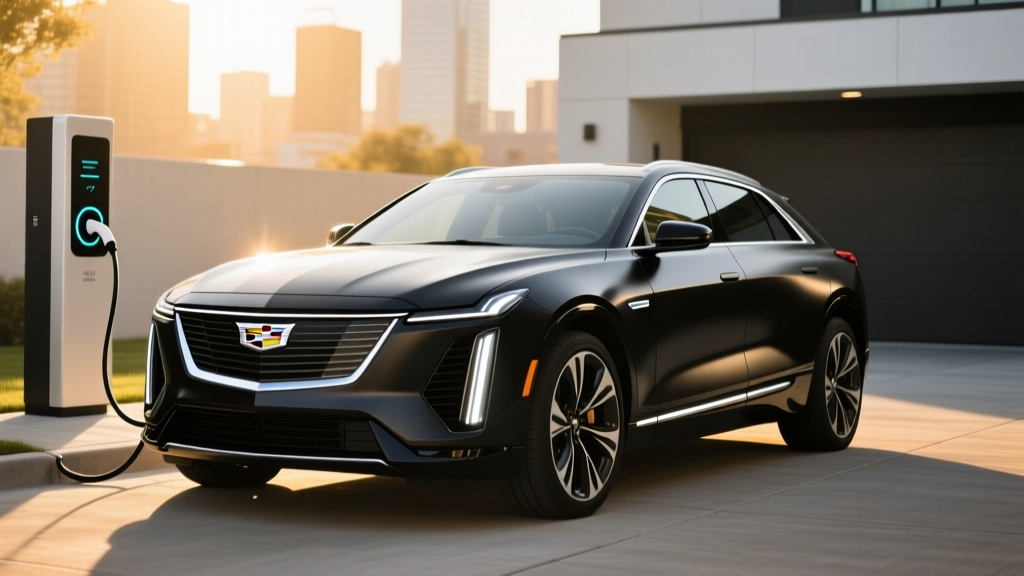
The Cadillac Lyriq has been on sale since 2023 as a luxury electric crossover, but the 2026 Cadillac Lyriq-V is the variant enthusiasts have been waiting for. Badged under Cadillac's V-Series performance line — the same lineage as the CT5-V Blackwing — the Lyriq-V adds a dual-motor all-wheel-drive powertrain producing 600 horsepower, retuned suspension, and aggressive styling to the Ultium platform. It's a direct shot at the BMW iX M60, Audi SQ8 e-tron, and Tesla Model X Plaid.
But performance SUVs live or die by the details: real-world range under heavy acceleration, sustained charging speeds on road trips, and whether the premium over the standard Lyriq AWD justifies the V badge. I've spent time with the specs, the EPA data, and the ownership math to break down exactly what the Lyriq-V delivers — and where it falls short.
Spec Sheet: 2026 Cadillac Lyriq-V at a Glance
| Specification | 2026 Cadillac Lyriq-V |
|---|---|
| EPA Range (est.) | 280 miles |
| Battery Capacity | 102 kWh usable (NMC, Ultium platform) |
| Powertrain | Dual-motor AWD |
| Horsepower | 600 hp (est.) |
| 0–60 mph | ~3.5 seconds (est.) |
| Max DC Fast Charge | 190 kW (peak) |
| 10–80% DC Charge Time | ~33 minutes |
| Level 2 Home Charge Rate | 11.5 kW (~31 mi/hr) |
| EPA Efficiency | ~82 MPGe / 41 kWh/100mi (est.) |
| Cargo Volume (rear seats up) | 28.0 cu ft |
| Cargo Volume (rear seats folded) | 60.9 cu ft |
| Base MSRP | $79,990 (est.) |
| Battery/Powertrain Warranty | 8 years / 100,000 miles |
Note: Some specifications for the 2026 Lyriq-V are based on Cadillac's preliminary announcements and GM's Ultium platform data. Final EPA-certified figures may vary slightly at launch.
Range and Efficiency: What to Expect Beyond the EPA Sticker
EPA estimated range: 280 miles. In mixed highway driving at 70–75 mph, expect approximately 240–255 miles. In cold weather (below 32°F), range can drop to 200–220 miles due to battery heating demands and cabin climate load. City driving with regenerative braking may exceed the EPA figure, reaching 290+ miles in mild conditions.
The standard Lyriq RWD achieves an EPA-estimated 314 miles on its 102 kWh Ultium battery, according to fueleconomy.gov. The Lyriq-V's dual-motor AWD setup, stickier tires, and performance tuning sacrifice roughly 30–35 miles of that range. This is consistent with the performance-EV pattern: the BMW iX M60 loses about 40 miles versus the xDrive50, and the Audi SQ8 e-tron drops similarly versus the standard 55.
The Lyriq-V uses an NMC (nickel manganese cobalt) battery chemistry on GM's Ultium platform. NMC offers higher energy density than LFP, which is why the 102 kWh pack fits in the same physical footprint as lower-capacity LFP packs in competitors. The trade-off: NMC batteries benefit more from staying between 20–80% state of charge for long-term longevity, whereas LFP packs tolerate regular 100% charges. Cadillac's battery management system includes a buffer (roughly 3–5 kWh unusable) to protect against deep degradation.
Efficiency lands around 82 MPGe combined, or approximately 41 kWh per 100 miles. That's thirstier than the RWD Lyriq's ~89 MPGe, but competitive with the iX M60's ~78 MPGe. At the national average electricity rate of $0.17/kWh, that works out to roughly $0.07 per mile — about one-third the fuel cost of a comparable gas-powered Cadillac XT5 at 22 mpg combined.
Charging Performance: DC Fast Charging and Home Setup
Charging speed is where Ultium-platform vehicles have drawn criticism, and the Lyriq-V inherits the same architecture. Here's what the numbers look like across charging levels:
| Charging Level | Power | Speed (miles added per hour) | Typical Use Case |
|---|---|---|---|
| Level 1 (120V household) | ~1.4 kW | ~3–4 mi/hr | Emergency / overnight trickle |
| Level 2 (240V home) | 11.5 kW | ~31 mi/hr | Daily home charging |
| DC Fast Charge | 190 kW (peak) | ~200 mi in ~33 min (10–80%) | Road trips |
The 190 kW peak DC fast-charge rate is the Lyriq-V's most debated spec. Competitors like the Hyundai Ioniq 5 peak at 240 kW (via its 800V architecture), and the BMW iX xDrive50 can sustain roughly 150–200 kW depending on state of charge. The Ultium platform runs at a nominal 400V, which limits peak charge rate compared to 800V systems.
However, peak kW tells only part of the story. The Lyriq-V's charge curve holds near 190 kW from roughly 10–40% state of charge, then tapers to approximately 130–150 kW through 60%, and drops further above 80%. The 10–80% time of approximately 33 minutes is acceptable for road-trip stops — you'll add about 170 miles of range in a half-hour — but it's not class-leading. Plan charging stops around meal breaks rather than expecting 15-minute pit stops.
At home, the 11.5 kW onboard charger is a strong point. On a 48-amp Level 2 circuit (requiring a 60-amp breaker), you'll replenish the full 102 kWh battery in about 9.5 hours — easily overnight. A full Level 2 home installation typically costs $800–$2,000 for the charger unit and electrician labor, depending on your panel capacity and run distance. If your home has a 200-amp electrical panel with spare capacity, installation stays on the lower end. Older homes with 100-amp panels may need a $1,500–$3,000 panel upgrade — budget accordingly.
Performance: What 600 Horsepower Feels Like in a Cadillac
The Lyriq-V's dual-motor AWD powertrain targets 600 horsepower, a substantial jump from the standard Lyriq AWD's 500 hp. The 0–60 mph time of approximately 3.5 seconds places it firmly in sports-sedan territory, though the 5,800+ pound curb weight means you feel the mass in corners and during braking.
Cadillac's V-Series tuning includes:
- Adaptive dampers with V-specific calibration for firmer body control
- Retuned regenerative braking with more aggressive one-pedal driving modes
- Launch control for consistent hard-acceleration starts
- Performance-tuned torque vectoring between rear wheels via the dual-motor setup
- Larger brakes with V-Series calipers to manage the vehicle's mass
The drivetrain defaults to rear-biased torque distribution for a sportier feel, with the front motor engaging for grip under hard acceleration or in low-traction conditions. Unlike some dual-motor EVs that disconnect the front motor for efficiency during cruising, the Lyriq-V's system keeps both motors available for immediate response.
For context, the BMW iX M60 hits 60 mph in 3.6 seconds with 610 hp, and the Tesla Model X Plaid does it in 2.5 seconds with 1,020 hp. The Lyriq-V isn't chasing the Plaid's absurdity — it's positioned as a grand-touring performance SUV, closer to the iX M60 and Audi SQ8 e-tron in character.
Interior, Technology, and Driver Assistance
The Lyriq-V's cabin carries over the standard Lyriq's centerpiece: a 33-inch LED display spanning the instrument cluster and infotainment touchscreen in a single curved panel running Google Built-In. This includes Google Maps navigation (with EV-aware route planning and automatic battery preconditioning for charging stops), Google Assistant voice control, and access to the Play Store for apps.
V-Series exclusives include:
- Performance display pages showing power distribution, G-forces, and battery temperature
- V-specific steering wheel with drive-mode selector
- Sport seats with enhanced bolstering and available semi-aniline leather
- AKG 19-speaker audio system (standard on V trim)
Cargo space measures 28.0 cubic feet behind the rear seats and 60.9 cubic feet with them folded — identical to the standard Lyriq, since the V's performance hardware doesn't intrude on cabin volume. Rear legroom is 39.6 inches, adequate for adults on longer trips. There is no front trunk (frunk); the Ultium platform's electronics occupy that space.
Driver assistance comes via GM's Super Cruise on compatible mapped highways (over 750,000 miles of divided highways in the U.S. and Canada as of 2026). Super Cruise is a Level 2 system per SAE classification — it handles steering, acceleration, and braking on supported roads, but requires the driver to remain attentive, monitored via an infrared camera on the steering column.
Super Cruise is a Level 2 driver-assistance system, not autonomous driving. You must keep your eyes on the road and be prepared to take over at any time. It does not handle construction zones, unmapped roads, or complex urban intersections. Hands-free does not mean attention-free.
Pricing, Trims, and Federal Tax Credit Eligibility
The 2026 Cadillac Lyriq-V is expected to start at approximately $79,990 before destination charges. This positions it between the standard Lyriq AWD Sport (~$65,000) and European competitors like the BMW iX M60 (~$111,500) and Audi SQ8 e-tron (~$96,000).
| Trim / Configuration | Est. MSRP | After Potential §30D Credit |
|---|---|---|
| Lyriq-V AWD (base) | $79,990 | $72,490 (if eligible) |
| Lyriq-V AWD w/ Premium Package | $85,500 | $78,000 (if eligible) |
| Standard Lyriq AWD Sport (comparison) | $65,590 | $58,090 (if eligible) |
Federal tax credit eligibility (§30D) requires careful attention. As of 2026, the IRS's clean vehicle credit rules impose several requirements that may affect the Lyriq-V:
- MSRP cap: SUVs must have an MSRP at or below $80,000 to qualify. The base Lyriq-V at $79,990 clears this threshold — but adding options packages can push it over, disqualifying the vehicle entirely.
- Buyer income limits: Modified adjusted gross income must not exceed $300,000 (joint filers), $225,000 (head of household), or $150,000 (single filers).
- Battery component sourcing: A percentage of battery components must be manufactured or assembled in North America, and critical minerals must be sourced from the U.S. or free-trade-agreement countries. GM's Ultium batteries are assembled in the U.S. (Lordstown, Ohio, and Lansing, Michigan), which generally supports eligibility — but the specific percentages shift annually and by model year.
- Point-of-sale transfer: Eligible buyers can transfer the credit to the dealer at purchase, reducing the purchase price directly rather than waiting for a tax refund.
The MSRP cap is the tightest constraint here. If you want the Lyriq-V with the Premium Package or any combination of options that pushes MSRP above $80,000, you lose the entire $7,500 credit — there's no partial credit. Work with your dealer to confirm the exact MSRP on your build configuration before committing. Consult a tax professional to verify your personal eligibility, as rules can change and individual circumstances vary.
Lyriq-V vs. the Competition: Where It Fits
| Spec | Cadillac Lyriq-V | BMW iX M60 | Audi SQ8 e-tron | Tesla Model X Plaid |
|---|---|---|---|---|
| Horsepower | 600 hp | 610 hp | 496 hp | 1,020 hp |
| 0–60 mph | ~3.5 sec | 3.6 sec | 4.5 sec | 2.5 sec |
| EPA Range | ~280 mi | ~285 mi | ~270 mi | ~320 mi |
| Max DC Charge | 190 kW | 200 kW | 170 kW | 250 kW |
| Base MSRP | ~$79,990 | ~$111,500 | ~$96,000 | ~$94,990 |
| Federal Credit Eligible? | Likely (at base MSRP) | No (MSRP cap) | No (MSRP cap) | No (MSRP cap) |
The Lyriq-V's most compelling advantage is value. It undercuts every competitor by $15,000–$30,000 while delivering comparable or superior performance metrics. The tax credit eligibility at base MSRP (if sourcing requirements are met) widens the gap further.
Where competitors win: the BMW iX M60 offers a more refined interior and slightly faster charging; the Tesla Model X Plaid obliterates everything in straight-line speed and has access to the Supercharger network (though Cadillac now has NACS access via adapter and the expanding Supercharger network); and the Audi SQ8 e-tron provides traditional German build quality with a quieter cabin.
- You want 600 hp performance for under $80,000
- Federal tax credit eligibility matters to your purchase math
- You value Super Cruise for highway commuting
- You prefer American-made luxury with strong dealer support
- You need the fastest possible DC charging (consider Ioniq 5 or Tesla)
- You regularly carry more than five passengers (no third row)
- You want a frunk for extra cargo flexibility
- You plan to option the vehicle heavily (MSRP cap kills the tax credit)
Pros, Cons, and Ownership Verdict
- 600 hp at a sub-$80K price point — best value in performance EV SUVs
- Super Cruise hands-free driving on 750K+ miles of mapped highways
- 33-inch curved display with Google Built-In is genuinely excellent
- 11.5 kW Level 2 charging handles overnight replenishment easily
- Federal tax credit eligible at base MSRP (if sourcing and income requirements met)
- GM's 8-year/100,000-mile battery warranty provides long-term peace of mind
- Spacious cabin with 28 cu ft cargo behind rear seats
- 190 kW peak DC charge rate trails 800V competitors
- 280-mile EPA range means more frequent stops on long road trips
- No front trunk (frunk) — missed opportunity for cargo versatility
- MSRP cap makes optioning above $80K a tax-credit killer
- Heavy curb weight (~5,800 lbs) is felt during braking and cornering
- Cold-weather range loss of 20–25% is significant in northern climates
- No third-row seating option
The 2026 Cadillac Lyriq-V is best suited for performance-oriented luxury buyers who commute on Super Cruise-compatible highways and want V-Series acceleration without the six-figure price tag. It's not the longest-range option, nor the fastest-charging, but the value proposition is difficult to match. If your daily driving stays under 100 miles and you have reliable home charging, the range and charging limitations become manageable trade-offs for the performance and technology you gain.
Frequently Asked Questions
What is the real-world range of the Cadillac Lyriq-V?
The EPA-estimated range is approximately 280 miles. In real-world highway driving at 70–75 mph, expect 240–255 miles. Cold weather (below freezing) can reduce range to 200–220 miles. City driving with frequent regenerative braking opportunities may yield 290+ miles in mild conditions.
How fast does the Lyriq-V charge on DC fast chargers and at home?
The Lyriq-V peaks at 190 kW on DC fast chargers, achieving a 10–80% charge in approximately 33 minutes. At home on a Level 2 (240V, 48-amp) charger, it charges at 11.5 kW, adding about 31 miles of range per hour and fully replenishing the battery in roughly 9.5 hours.
Does the Cadillac Lyriq-V qualify for the $7,500 federal EV tax credit?
It likely qualifies at its base MSRP of $79,990, which is just under the $80,000 SUV cap. However, eligibility depends on your income (under $300K joint / $150K single), battery sourcing requirements that shift annually, and ensuring your specific build configuration doesn't exceed the MSRP cap with options. Always verify with the IRS clean vehicle credit page and a tax professional before purchasing.
Is the Lyriq-V worth buying over the BMW iX M60 or Tesla Model X?
If value is your priority, yes — the Lyriq-V undercuts both by $15,000–$30,000 while delivering similar performance. The iX M60 has a more premium interior and slightly faster charging; the Model X Plaid is far quicker and has Supercharger access. The Lyriq-V's tax credit eligibility at base price is a decisive financial advantage neither competitor can match.
What battery warranty does Cadillac offer on the Lyriq-V?
GM provides an 8-year / 100,000-mile warranty on the Ultium battery pack and electric powertrain components, covering defects and excessive capacity degradation (typically defined as falling below 60–70% of original capacity, though exact thresholds are specified in the warranty documentation).
Does the Lyriq-V have Super Cruise for hands-free driving?
Yes, Super Cruise is included and functional on over 750,000 miles of compatible divided highways in the U.S. and Canada. It is a Level 2 driver-assistance system — you must remain attentive and ready to take over. It does not function on unmapped roads, in construction zones, or in complex urban environments.