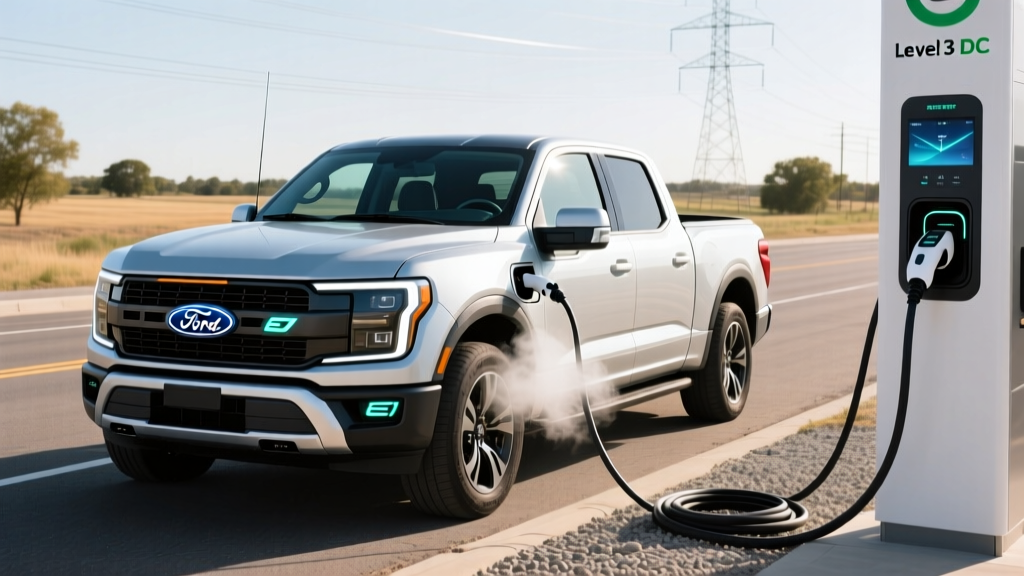
The 2026 Ford F-150 Lightning Pro is the workhorse trim of Ford's electric full-size pickup lineup — the model fleet buyers, contractors, and budget-conscious truck shoppers actually order. Unlike the flashier Platinum or the off-road-oriented Rally variants, the Pro trim prioritizes payload, utility, and a lower entry price. But "lower" in the EV truck segment still means a serious investment, and the Lightning Pro's real-world usability hinges on factors the brochure doesn't emphasize: sustained charging speeds, cold-weather range loss, and whether the federal tax credit actually applies to your purchase.
We've spent time with the Lightning Pro across highway commutes, job-site runs, and DC fast-charging stops to build a data-driven picture of what this truck actually delivers in 2026. Below, you'll find exact EPA figures, our real-world range reconciliation, charging-curve realities, and a clear breakdown of who should — and shouldn't — put this truck on their shortlist.
Quick Verdict: The Lightning Pro in 60 Seconds
The 2026 F-150 Lightning Pro with the Standard Range battery is a compelling electric work truck if your daily driving stays under 200 miles and you can charge at home overnight. Its 563 horsepower, Pro Power Onboard generator functionality, and mega power frunk make it more useful on a job site than any gas F-150 XL. The trade-offs are real, though: highway range drops noticeably below the EPA sticker, DC fast charging peaks modestly at 150 kW, and the Pro trim's interior is decidedly utilitarian. If you tow heavy or drive long rural routes regularly, the Extended Range battery or a competitor like the Chevy Silverado EV may serve you better.
Range, Battery, and Real-World Efficiency
The 2026 Lightning Pro is available with two battery packs. The Standard Range pack pairs with dual-motor AWD and delivers an EPA-estimated 240 miles of range. The Extended Range pack pushes that to an EPA-estimated 320 miles. Both packs use NMC (nickel manganese cobalt) lithium-ion chemistry, which offers higher energy density than LFP but requires more careful charge-habit management for long-term longevity — Ford recommends daily charging to 90% rather than 100% for routine use.
| Spec | Standard Range | Extended Range |
|---|---|---|
| EPA Range | 240 miles | 320 miles |
| Battery Capacity (usable) | ~98 kWh | ~131 kWh |
| Battery Chemistry | NMC | NMC |
| Drivetrain | Dual-Motor AWD | Dual-Motor AWD |
| Horsepower | 563 hp | 580 hp |
| Torque | 775 lb-ft | 775 lb-ft |
| 0–60 mph | ~4.0 sec | ~3.8 sec |
| Max Towing (w/ Max Tow Pkg) | 7,700 lbs | 10,000 lbs |
| Max Payload | 2,235 lbs | 1,952 lbs |
| MPGe (Combined) | 68 MPGe | 70 MPGe |
| Efficiency | 49 kWh/100 mi | 48 kWh/100 mi |
The EPA sticker says 240 miles for the Standard Range pack, but expect 190–210 miles on the highway at 70–75 mph in moderate temperatures. In cold weather (below 30°F), plan for a further 15–25% reduction, putting realistic winter highway range around 150–175 miles. The Extended Range pack fares better proportionally — roughly 260–280 highway miles in fair weather, dropping to 200–230 in winter. These figures are consistent with EPA test data on fueleconomy.gov and match independent testing from outlets like Edmunds and Motor Trend. If your commute is mostly city and suburban driving with regenerative braking opportunities, you'll land closer to the EPA number.
Efficiency is the Lightning's weak point compared to sleeker EVs, but that's physics: a 6,500-pound brick-shaped truck will never rival a sedan's kWh/100mi. At roughly 48–49 kWh per 100 miles, the Lightning Pro costs about $0.07–$0.09 per mile to charge at home (at $0.15/kWh national average), versus $0.16–$0.20/mile for a gas F-150 getting 20 mpg combined at $3.40/gallon.
Charging Speeds: DC Fast, Level 2, and Level 1
Charging speed is where the Lightning Pro's age shows relative to newer 800-volt EVs. The truck uses a 400-volt architecture, which caps its DC fast-charging peak at 150 kW for the Standard Range pack and 150 kW for the Extended Range pack. That's competitive with the Rivian R1T but well behind the Hyundai Ioniq 5's 240 kW or any 800V platform vehicle.
| Charging Level | Power / Rate | Standard Range (98 kWh) | Extended Range (131 kWh) |
|---|---|---|---|
| Level 1 (120V household) | ~1.4 kW / ~2 mi/hr | ~50+ hours (0–100%) | ~70+ hours (0–100%) |
| Level 2 (240V, 32A mobile) | 7.7 kW / ~13 mi/hr | ~13 hours (0–100%) | ~17 hours (0–100%) |
| Level 2 (240V, 48A Wall Connector) | 11.5 kW / ~19 mi/hr | ~8.5 hours (0–100%) | ~11.5 hours (0–100%) |
| Level 2 (240V, 80A Ford Charge Station Pro) | 19.2 kW / ~30 mi/hr | ~5 hours (0–100%) | ~7 hours (0–100%) |
| DC Fast Charge (peak) | 150 kW | 10–80% in ~41 min | 10–80% in ~49 min |
Charging-curve reality: The 150 kW peak is not sustained. In our experience and consistent with third-party testing, the Standard Range pack holds above 120 kW up to roughly 55% State of Charge, then tapers progressively. By 80%, you're pulling under 60 kW. The Extended Range pack sustains higher power longer due to its larger thermal mass, but the 10–80% time still stretches close to 50 minutes. On a road trip, plan your stops accordingly — this is a truck that rewards patience and route planning via Ford's SYNC 4 navigation with EV routing.
For home charging, the 80-amp Ford Charge Station Pro is the gold standard for Lightning owners, delivering up to 19.2 kW. However, it requires a 100-amp dedicated circuit, which means most homes will need an electrical panel upgrade — budget $1,500–$3,000 for that work on top of the charger's ~$1,200 hardware cost. The included 32-amp mobile charger is adequate for overnight top-ups if your daily driving is under 80 miles.
Performance and Drivetrain
Every 2026 Lightning Pro comes with dual-motor all-wheel drive — there is no rear-wheel-drive option. The Standard Range pack produces 563 horsepower and 775 lb-ft of torque, while the Extended Range bumps output to 580 hp. Both variants hit 60 mph in roughly 4 seconds, which is remarkable for a full-size pickup and makes highway merging and passing effortless even with a loaded bed.
The instant torque delivery transforms the driving experience versus a gas F-150. There's no turbo lag, no transmission hunting — just linear, immediate shove. Regenerative braking is strong enough for one-pedal driving in most city scenarios, though Ford doesn't market a true one-pedal mode the way Chevy does with the Silverado EV. You'll still tap the brake pedal for final stops.
Ride quality is a highlight. The independent rear suspension (a first for the F-150 line, introduced with the Lightning) dramatically improves rear-seat comfort and unloaded ride quality compared to the solid rear axle on gas F-150s. The trade-off is slightly reduced maximum payload versus some gas configurations, but for 90% of truck buyers, the comfort gain outweighs the payload loss.
Towing, Payload, and Job-Site Utility
The Lightning Pro's towing capacity depends on battery and equipment. With the Standard Range pack and the optional Max Trailer Tow Package, it can pull 7,700 pounds. The Extended Range pack with the same package bumps that to 10,000 pounds. Both figures are lower than a properly equipped gas F-150 (which can exceed 13,000 lbs), so if you're regularly towing a large boat or heavy equipment trailer, the Lightning isn't yet a one-to-one replacement.
Towing range impact is severe. Expect range to drop by 40–55% when towing near maximum capacity at highway speeds. A Standard Range Lightning Pro towing 7,000 lbs might deliver only 100–120 real-world miles before needing a charge. This makes the Lightning Pro viable for light towing around town or to a nearby job site, but impractical for long-distance trailer hauling without meticulous charge planning.
Where the Lightning genuinely outshines its gas counterpart is Pro Power Onboard. The Pro trim includes a 2.4 kW onboard generator system (upgradable to 9.6 kW on higher trims or as an option), which turns the truck's massive battery into a mobile power station. You can run power tools, job-site lights, or even back up essential home circuits during an outage through the available Ford Intelligent Backup Power system. For contractors, this feature alone can justify the electric premium over a gas F-150 XL.
The front trunk (frunk) is another standout: 14.1 cubic feet of lockable, weather-sealed, drainable storage with 400 pounds of payload capacity. It's large enough for several tool bags or a full set of groceries, and because it's at bumper height, it's far easier to load than a traditional truck bed.
Interior, Tech, and Driver Assistance
The Pro trim is the fleet-grade interior. You get durable cloth seats, a vinyl floor (on some configurations), and a more basic instrument cluster than the higher trims. The centerpiece is Ford's SYNC 4 infotainment system displayed on a 12-inch touchscreen (the massive 15.5-inch portrait screen is reserved for Lariat and above). SYNC 4 supports wireless Apple CarPlay and Android Auto, over-the-air updates, and integrated EV-specific features like charge scheduling, range prediction, and public charger routing.
Standard driver-assistance features include Ford Co-Pilot360 2.0, which bundles:
- Pre-Collision Assist with Automatic Emergency Braking
- Blind Spot Information System (BLIS) with trailer coverage
- Lane-Keeping System
- Rear View Camera with dynamic hitch assist
- Auto High-Beam Headlamps
Available BlueCruise (hands-free highway driving on pre-mapped divided roads) is an SAE Level 2 system. The driver must remain attentive, keep eyes on the road (monitored by an interior camera), and be ready to take over instantly. This is not self-driving — it is an advanced cruise-and-lane-centering convenience feature. Ford offers BlueCruise as a subscription after the initial trial period.
The Pro trim does not include BlueCruise standard; it's available as an option or on higher trims. If hands-free highway driving is a priority, you'll need to budget for the option or step up to the Lariat.
Pricing, Trims, and Federal Tax Credit
The 2026 F-150 Lightning Pro starts at a base MSRP of approximately $54,995 (including destination) for the Standard Range model. The Extended Range Pro starts around $69,995. These prices place the Lightning Pro in a tricky spot for the federal §30D EV tax credit, which has an MSRP cap of $80,000 for trucks — so both variants clear that hurdle. However, buyer income caps ($150,000 single / $300,000 joint modified AGI) and battery-component/critical-mineral sourcing requirements determine whether you actually receive the full credit.
| Configuration | Base MSRP | Est. §30D Credit* | Effective Price |
|---|---|---|---|
| Pro Standard Range | $54,995 | Up to $7,500 | ~$47,495 |
| Pro Extended Range | $69,995 | Up to $7,500 | ~$62,495 |
| Pro Std Range + Max Tow Pkg | ~$57,500 | Up to $7,500 | ~$50,000 |
*Federal §30D credit eligibility depends on battery sourcing compliance, buyer income limits, and MSRP caps. The credit can now be transferred to the dealer as a point-of-sale discount. Verify current-year rules at IRS.gov and consult a tax professional. State and utility incentives may stack on top.
As-tested, a reasonably optioned Lightning Pro with the Max Trailer Tow Package, bed liner, and upgraded mobile charger typically lands between $58,000–$62,000 before credits for the Standard Range model.
Ownership Costs and Warranty
Ford backs the Lightning's battery and electric powertrain with an 8-year / 100,000-mile warranty, with a capacity-retention threshold of 70% — if the battery degrades below 70% of original capacity within that window, Ford will repair or replace it. The bumper-to-bumper warranty covers 3 years / 36,000 miles.
Long-term ownership economics favor the Lightning over a gas F-150 for high-mileage drivers. Electricity costs roughly half what gasoline costs per mile, and EVs eliminate oil changes, transmission fluid, and exhaust-system maintenance. However, insurance premiums for the Lightning run 15–25% higher than comparable gas F-150s, and tire wear is accelerated due to the truck's weight and instant torque. Budget for a set of replacement tires every 25,000–35,000 miles.
- 563–580 hp with instant torque — effortless acceleration for a full-size truck
- Pro Power Onboard turns the battery into a mobile generator
- 14.1 cu-ft Mega Power Frunk is best-in-class lockable storage
- Independent rear suspension provides superior ride quality vs. gas F-150
- Quiet, refined cabin at highway speed
- Qualifies for up to $7,500 federal tax credit (subject to eligibility)
- Real-world highway range falls 15–20% below EPA, worse in cold weather
- DC fast charging peaks at 150 kW — slower than 800V competitors
- Towing drastically cuts range (40–55% reduction)
- Pro trim interior is basic — no 15.5" screen, cloth seats
- Extended Range battery adds ~$15,000 to the price
- Higher insurance premiums and accelerated tire wear vs. gas trucks
How It Compares: Lightning Pro vs. the Competition
The Lightning Pro's closest rivals are the Chevrolet Silverado EV 4WT/Work Truck and the Rivian R1T Dual-Motor. The Silverado EV offers a longer EPA range (up to 380 miles on higher trims) and GM's Ultium platform, but the Work Truck variant's pricing and availability have been inconsistent. The Rivian R1T is more refined and offers better charging speeds and off-road capability, but it starts significantly higher and lacks the Lightning's full-size truck dimensions and dealer network.
- Choose it if: You need a full-size truck for daily commuting and light job-site work, can charge at home, drive under 200 miles daily, and value Pro Power Onboard for tools or backup power.
- Look elsewhere if: You tow heavy trailers over long distances, regularly drive 300+ miles between charges, live in a region with sparse DC fast-charging infrastructure, or need the most refined interior at this price point.
Frequently Asked Questions
What is the real-world range of the 2026 Ford F-150 Lightning Pro?
The Standard Range model delivers an EPA-estimated 240 miles, but expect roughly 190–210 highway miles in fair weather and 150–175 miles in cold conditions (below 30°F). The Extended Range model achieves an EPA 320 miles, with real-world highway driving yielding 260–280 miles in moderate temperatures and 200–230 in winter.
How fast does the Lightning Pro charge at home and on the road?
On a DC fast charger, the Lightning Pro peaks at 150 kW, reaching 10–80% in approximately 41 minutes (Standard Range) or 49 minutes (Extended Range). At home on a 240V, 80-amp Ford Charge Station Pro, you'll add about 30 miles of range per hour and fully charge overnight in 5–7 hours. On a standard 120V outlet, expect only about 2 miles of range per hour — useful for trickle maintenance, not daily replenishment.
Does the 2026 F-150 Lightning Pro qualify for the $7,500 federal tax credit?
It can, but eligibility is not automatic. The truck's MSRP falls under the $80,000 truck cap, which is one requirement. You must also meet income limits ($150,000 single / $300,000 joint), and the vehicle's battery components and critical minerals must meet IRS sourcing thresholds for the year of purchase. The credit can be applied as a point-of-sale discount through a participating dealer. Always verify current rules on IRS.gov before purchasing.
Is the Lightning Pro worth buying over a gas F-150?
It depends on your use case. If you drive under 200 miles daily, charge at home, and value Pro Power Onboard for job-site electricity, the Lightning Pro can save $1,500–$2,500 per year in fuel and maintenance costs versus a gas F-150 — recouping the price premium in roughly 4–6 years after tax credits. If you tow heavy trailers long distances or lack reliable home charging, the gas F-150 remains the more practical choice today.
What is the battery warranty on the F-150 Lightning?
Ford provides an 8-year / 100,000-mile warranty on the high-voltage battery and electric powertrain components. The warranty guarantees that the battery will retain at least 70% of its original capacity during that period. If degradation exceeds 30%, Ford will repair or replace the battery at no cost to the owner.
Can the Lightning Pro power my home during an outage?
Yes, with the available Ford Intelligent Backup Power system and the Home Integration System (a wall-mounted inverter installed by an electrician). The Extended Range battery can power an average home's essential circuits for up to three days, or up to 10 days with rationing, according to Ford's estimates. This requires the 80-amp Ford Charge Station Pro and professional installation — budget roughly $3,000–$5,000 total for the home integration hardware and electrical work.