Where Rivian Builds Its EVs — And Why It Matters for Buyers
When you're spending $75,000+ on an electric truck or SUV, knowing where and how it's built isn't trivia — it directly affects build quality, delivery timelines, parts availability, and even federal tax credit eligibility under IRS §30D battery-sourcing rules. Rivian manufacturing locations have expanded significantly since the company's 2021 launch, and by 2026, the footprint spans two major U.S. facilities with a third on the horizon.
This guide breaks down every active and announced Rivian plant, then dives deep into the 2026 R1T (truck) and R1S (SUV) — the vehicles rolling off those lines — with exact range, charging, pricing, and ownership data you need before buying.
Rivian's Manufacturing Footprint: Normal, Stanton, and Beyond
Normal, Illinois — The Original Hub
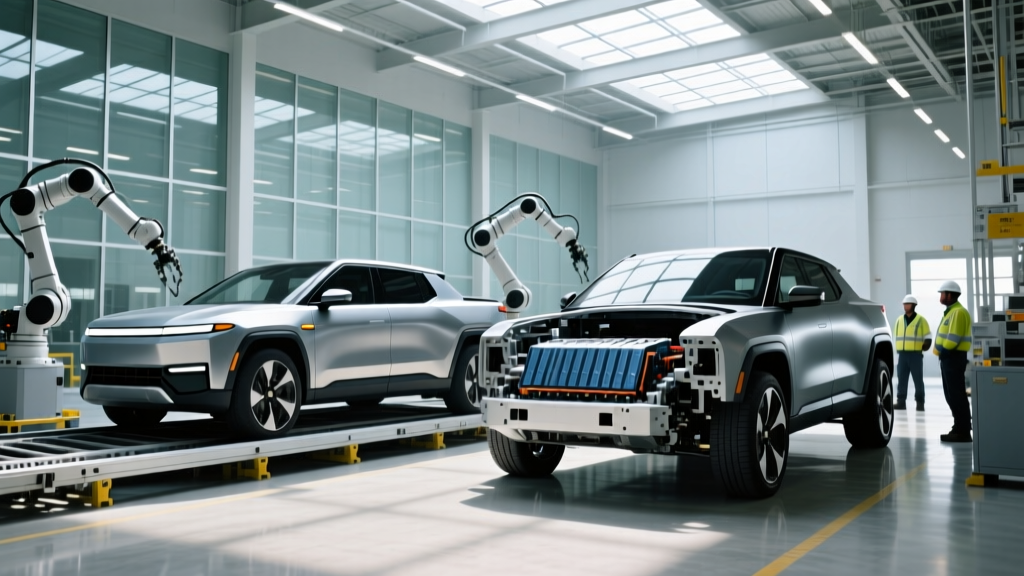
Rivian's primary manufacturing facility occupies the former Mitsubishi plant in Normal, Illinois. Spanning over 3.3 million square feet, this is where every R1T, R1S, and earlier EDV (Electric Delivery Van) for Amazon has been assembled. By 2026, Normal has undergone multiple retooling phases to support the second-generation R1 platform (introduced for the 2025 model year), which brought a new electrical architecture, updated battery packs, and the company's in-house Enduro drive unit.
Key facts about the Normal facility:
- Capacity: Approximately 150,000–200,000 vehicles annually after recent expansions
- Workforce: Over 9,000 employees as of late 2025
- Vertical integration: Battery module and pack assembly on-site, plus Enduro motor production
- Significance: U.S. assembly is critical for §30D tax credit compliance — vehicles must be assembled in North America to qualify
Stanton, Georgia — The Future High-Volume Plant
Rivian's second manufacturing campus, announced in 2024 and under construction near Stanton, Georgia, is targeted for production of the company's upcoming, more affordable midsize platform (often referred to as the R2/R3 line). As of early 2026, the Stanton facility is in advanced construction with production expected to begin in late 2026 or early 2027. This plant is designed for higher volume and lower cost, but it does not yet produce any currently available model.
For buyers shopping today, all 2026 R1T and R1S vehicles come from Normal, Illinois — and that matters for delivery logistics, service-center proximity, and quality consistency as the second-generation platform matures past its first model year.
2026 Rivian R1T: Range, Battery, and Real-World Efficiency
The 2026 R1T continues with the second-generation platform introduced last year, offering three battery configurations. Rivian uses lithium iron phosphate (LFP) chemistry for the Standard pack and nickel manganese cobalt (NMC) for the Large and Max packs — a split that balances cost, longevity, and energy density.
| Configuration | Usable Capacity | Chemistry | EPA Range | Efficiency |
|---|---|---|---|---|
| Standard (Dual-Motor) | ~95 kWh | LFP | 270 mi | ~2.0 kWh/mi (50 MPGe) |
| Large (Dual-Motor) | ~117 kWh | NMC | 352 mi | ~1.9 kWh/mi (53 MPGe) |
| Max (Dual-Motor) | ~149 kWh | NMC | 420 mi | ~1.85 kWh/mi (55 MPGe) |
Charging Speed: DC Fast, Level 2, and the Charge Curve
Rivian's second-generation architecture upgraded the electrical system to support faster DC charging. Here's what each pack delivers at the charger:
| Charge Type | Standard (LFP) | Large (NMC) | Max (NMC) |
|---|---|---|---|
| Peak DC Fast Charge | ~200 kW | ~220 kW | ~220 kW |
| 10–80% DC Time | ~28 min | ~30 min | ~38 min |
| Level 2 Home (11.5 kW) | ~16 mi/hr | ~19 mi/hr | ~21 mi/hr |
| Connector | NACS (Tesla Supercharger native access) | ||
The Max pack's larger battery means longer charge sessions despite the same peak rate — a classic trade-off between range and charging time. On a road trip, the Large pack's ~30-minute 10–80% session often proves the best balance. Rivian's native NACS port means direct access to the Tesla Supercharger network without an adapter, which is a significant practical advantage in 2026.
Charge curve reality: Peak kW is sustained roughly from 10–40% SoC. Expect tapering to ~150 kW by 60% and ~80 kW above 80%. If you're planning highway stops, charging to 80% and driving on is significantly faster than topping off to 100%.
Performance and Drivetrain
Every 2026 R1T comes standard with AWD via Rivian's dual-motor Enduro drive unit. The quad-motor configuration from the first generation has been retired in favor of the more efficient and cost-effective dual-motor setup across all trims.
| Metric | Dual-Motor (All Packs) |
|---|---|
| Horsepower | 533 hp (Performance Dual-Motor: 665 hp) |
| Torque | 610 lb-ft (Performance: 829 lb-ft) |
| 0–60 mph | 4.5 sec (Performance: 3.4 sec) |
| Towing Capacity | 11,000 lbs |
| Payload | ~1,760 lbs |
| Ground Clearance | Up to 14.9 in (with air suspension) |
Even the base dual-motor delivers sports-car acceleration in a truck that can tow 11,000 lbs. The Performance variant's 3.4-second 0–60 time is genuinely startling for a vehicle this size. Rivian's air suspension with adjustable ride height makes it a credible off-roader without sacrificing on-road comfort.
Pricing, Trims, and Federal Tax Credit Eligibility
| Configuration | Base MSRP | Typical As-Tested | §30D Credit Eligible? |
|---|---|---|---|
| Dual-Motor Standard | $69,900 | $73,000–$76,000 | Yes (subject to rules) |
| Dual-Motor Large | $75,900 | $80,000–$86,000 | Yes (subject to rules) |
| Dual-Motor Max | $84,900 | $89,000–$96,000 | Yes (subject to rules) |
| Performance Dual-Motor Large | $81,900 | $86,000–$92,000 | Yes (subject to rules) |
- Income caps: AGI must not exceed $150,000 (single), $225,000 (head of household), or $300,000 (joint)
- Battery sourcing: Critical minerals and battery component requirements phase in more strictly each year — verify current-year compliance on the IRS qualified vehicles list before purchasing
- Point-of-sale transfer: You can transfer the credit to the dealer at purchase for an immediate price reduction (up to $7,500)
- Assembled in North America: ✓ Built in Normal, Illinois
The Standard and Large packs are most likely to fall under the $80,000 MSRP cap at base pricing. The Max pack's $84,900 base MSRP exceeds the cap, making it ineligible for the credit unless optioned below the threshold (which is not possible — MSRP is determined by the base model). Always confirm eligibility with a tax professional and the latest fueleconomy.gov listings.
Interior, Cargo, and Tech
The R1T seats five with a crew-cab layout. Interior materials have improved noticeably with the second generation — soft-touch surfaces, genuine wood and aluminum trim, and standard heated/ventilated front seats.
- Front legroom: 41.3 in
- Rear legroom: 38.2 in
- Bed length: 4.5 ft (54 in) — compact for a truck, but supplemented by the Gear Tunnel
- Gear Tunnel: 11.7 cu ft of lockable, pass-through storage behind the rear seats (a Rivian-exclusive feature)
- Frunk (front trunk): 11.0 cu ft — drainable, useful for wet gear or groceries
- Tonneau: Available powered tonneau cover secures the bed
Tech highlights:
- 15.6-inch center touchscreen with Rivian's in-house OS (no Apple CarPlay or Android Auto — a deliberate choice that frustrates some buyers)
- 12.3-inch digital driver display
- Rivian Driver+ (Level 2 ADAS): adaptive cruise, lane centering, automatic lane change on highways — not self-driving; driver must remain engaged at all times
- Over-the-air updates continue to add features post-purchase
- Camp Kitchen accessory available for the Gear Tunnel
Notable drawbacks: No phone mirroring (CarPlay/Android Auto), the bed is shorter than a conventional full-size truck, rear-seat comfort is good but not class-leading for long trips, and the R1T's width makes tight parking garages challenging.
Warranty, Ownership Costs, and Who the R1T Suits Best
Rivian's warranty package is competitive with the EV segment:
- Basic vehicle: 5 years / 60,000 miles
- Battery & drive system: 8 years / 175,000 miles (with ≥70% capacity retention threshold)
- Roadside assistance: 5 years / 60,000 miles
The 175,000-mile battery warranty is generous — most competitors offer 100,000 miles. Rivian's service network has expanded considerably, with mobile service vans handling many repairs at your location, though major body or drivetrain work still requires a service center visit.
Who the R1T is for: Outdoor enthusiasts who want a credible off-roader and tow rig with daily-driver refinement. The Gear Tunnel and frunk make it uniquely practical for camping, skiing, and gear-heavy lifestyles. If you need a long bed for lumber or a work-truck duty cycle, a Ford F-150 Lightning or a conventional truck may serve better. For road-trip range priority, the Max pack's 420 EPA miles is the segment leader.
Who should look elsewhere: Budget-conscious buyers (the R1T starts near $70K), those who need Apple CarPlay/Android Auto, commercial fleet buyers needing a long bed, and anyone who wants the lowest possible cost-per-mile commuter (a smaller, lighter EV like the Tesla Model Y or Hyundai Ioniq 5 wins on efficiency).
Pros and Cons at a Glance
Pros
- Class-leading 420-mile Max range (EPA)
- Native NACS — Supercharger access without adapter
- Gear Tunnel and frunk offer unmatched storage versatility
- 11,000-lb towing with genuine off-road capability
- 175,000-mile battery warranty exceeds most competitors
- U.S.-built in Normal, IL — supports §30D eligibility
- Strong OTA update track record adding real features
Cons
- No Apple CarPlay or Android Auto
- 4.5-ft bed is short for traditional truck work
- Max pack exceeds $80K MSRP cap — no tax credit
- Real-world highway range drops significantly vs. EPA
- Service center network still growing in rural areas
- Wide body (81.8 in) makes urban parking difficult
- Insurance premiums run higher than segment average
Frequently Asked Questions
What is the real-world range of the 2026 Rivian R1T?
The EPA rates the Max pack at 420 miles, but real-world highway driving at 75 mph yields approximately 340–370 miles. In cold weather below 30°F, expect 290–335 miles from the Max pack. The Standard LFP pack delivers roughly 220–240 real-world highway miles. Your results will vary with terrain, temperature, speed, and payload.
How fast does the R1T charge at home and on the road?
On a DC fast charger, the Large pack peaks at ~220 kW and charges 10–80% in about 30 minutes. At home on a Level 2 charger (11.5 kW / 48A), expect roughly 19 miles of range added per hour — a full overnight charge is easy for the Standard and Large packs, while the Max pack may need 12–14 hours from near-empty.
How much does the R1T cost after tax credits?
The Dual-Motor Standard starts at $69,900 MSRP and is eligible for up to $7,500 in federal credits (if you meet income, sourcing, and MSRP-cap requirements), bringing the effective price to ~$62,400 before state incentives. The Large pack at $75,900 also qualifies. The Max pack at $84,900 exceeds the $80,000 truck MSRP cap and does not qualify for §30D.
Does the R1T qualify for the federal EV tax credit?
The Standard and Large configurations qualify under 2026 §30D rules, provided the buyer meets income caps ($150K single / $300K joint), the vehicle's battery components and critical minerals meet current-year sourcing thresholds, and the MSRP stays under $80,000. The Max pack is ineligible due to its MSRP. Always verify on the fueleconomy.gov tax credit lookup and consult a tax professional.
Is the Rivian R1T worth buying vs. the Ford F-150 Lightning or Chevy Silverado EV?
The R1T wins on adventure lifestyle features (Gear Tunnel, off-road suspension, frunk), efficiency per mile, and battery warranty. The F-150 Lightning offers a longer bed, Pro Power Onboard for job-site use, and a lower starting price. The Silverado EV (4WT trim) targets commercial fleets with a massive 24,000-lb max tow rating. For lifestyle and recreation, the R1T is the strongest choice. For work duty, look at Ford or Chevy.
Where are Rivian vehicles manufactured?
All 2026 R1T and R1S vehicles are manufactured at Rivian's plant in Normal, Illinois. The upcoming Stanton, Georgia facility is under construction and expected to produce the smaller, more affordable R2/R3 platform starting late 2026 or early 2027. U.S. manufacturing supports federal tax credit eligibility under the North American assembly requirement.