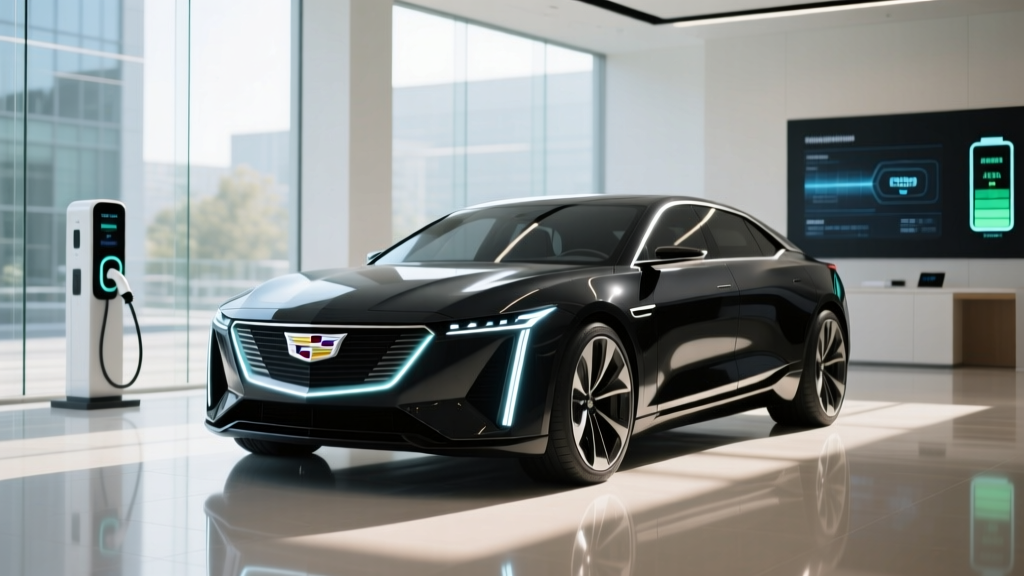
Leasing a Cadillac EV — whether the midsize Lyriq crossover or the newer, more compact Optiq — sits at a fascinating intersection of luxury, federal incentives, and long-term cost dynamics. In 2026, the Cadillac electric car lease proposition is shaped by GM's Ultium platform maturity, evolving IRS §30D tax credit rules, and the reality that luxury EVs depreciate differently than their gas counterparts. This guide cuts through marketing to give you exact numbers: what a 5-year ownership cycle actually costs, whether you qualify for up to $7,500 in federal credits, and where the Lyriq and Optiq save (or cost) you money versus a gas-powered Cadillac XT5 or XT4.
The 2026 Cadillac EV Lineup: Lyriq and Optiq at a Glance
Before running the cost math, here are the two Cadillac EVs you can lease or buy in 2026:
| Spec | 2026 Cadillac Lyriq (RWD) | 2026 Cadillac Lyriq (AWD) | 2026 Cadillac Optiq (AWD) |
|---|---|---|---|
| EPA Range | 314 mi | 307 mi | 300 mi (est.) |
| Battery (usable) | 102 kWh, NMC (Ultium) | 102 kWh, NMC (Ultium) | 85 kWh, NMC (Ultium) |
| Peak DC Fast Charge | 190 kW | 190 kW | 150 kW |
| 10–80% DCFC Time | ~30 min | ~30 min | ~28 min |
| Level 2 Rate | 19.2 kW (77 mi/hr) | 19.2 kW (77 mi/hr) | 11.5 kW (~45 mi/hr) |
| 0–60 mph | 6.3 sec | 4.6 sec | ~5.5 sec (est.) |
| Horsepower | 340 hp | 500 hp | 400 hp (est.) |
| MPGe (combined) | 89 MPGe | 87 MPGe | ~90 MPGe (est.) |
| Base MSRP | $58,590 | $61,590 | $52,990 (est.) |
| Battery/Powertrain Warranty | 8 yr / 100,000 mi | 8 yr / 100,000 mi | 8 yr / 100,000 mi |
Sources: fueleconomy.gov, Cadillac Lyriq official page. Optiq figures are preliminary estimates for the 2026 model year; confirm with your dealer.
5-Year Total Cost of Ownership: Cadillac Lyriq vs. Gas Cadillac XT5
The most common cross-shop for a Cadillac electric car lease is the gas XT5 (the Lyriq's closest internal-combustion sibling in size and price). Here's a 5-year / 75,000-mile TCO comparison using national averages:
| Cost Category | 2026 Lyriq RWD (Lease + Buyout Scenario) | 2026 XT5 AWD (Gas, Purchase) |
|---|---|---|
| Purchase/Lease Cost (5 yr) | $34,200 (lease: ~$570/mo × 36 mo + $12,000 residual buyout) | $52,000 (purchase, after typical negotiation) |
| Federal Tax Credit Applied | −$7,500 (if eligible, via point-of-sale transfer) | $0 |
| Net Vehicle Cost | $26,700 | $52,000 |
| Fuel / Charging (75k mi) | $3,375 (home L2 at $0.15/kWh, 2.8 mi/kWh) | $9,375 (24 MPG combined, $3.00/gal) |
| Maintenance (5 yr) | $1,500 (tire rotations, cabin filter, fluid top-offs) | $4,200 (oil, filters, brakes, spark plugs) |
| Insurance (5 yr) | $12,500 (~$2,500/yr avg) | $9,500 (~$1,900/yr avg) |
| Depreciation (est.) | $14,000 (~40% over 5 yr on net cost) | $22,000 (~42% over 5 yr) |
| 5-Year Total | $58,075 | $97,075 |
Key takeaway: Even with higher insurance premiums, the Lyriq can save $35,000–$40,000 over five years versus the XT5 when the full §30D credit applies. If you don't qualify for the credit (due to income or sourcing rules), the gap narrows to roughly $27,000–$32,000 — still substantial, but less dramatic.
Assumptions: Electricity at $0.15/kWh national residential average; gas at $3.00/gal. Actual costs vary by region, driving habits, and utility rate structure. Insurance figures based on national luxury-SUV averages from industry data. Depreciation estimates reflect current EV resale trends. Consult IRS §30D guidelines for credit eligibility.
Federal Tax Credit (§30D): Do You Qualify for Up to $7,500?
The federal clean vehicle credit remains the single largest financial variable in a Cadillac electric car lease or purchase. Under current 2026 IRS rules, the credit is worth up to $7,500 — but qualification depends on a stack of requirements that eliminate many buyers:
- Income Caps (Modified AGI): $150,000 single filer / $225,000 head of household / $300,000 joint filers
- MSRP Caps: Vans, SUVs, and pickups ≤ $80,000; sedans and other vehicles ≤ $55,000. The Lyriq and Optiq qualify as SUVs — all trims fall under $80,000.
- Battery Component Manufacturing: A percentage of battery components must be manufactured or assembled in North America (threshold increases annually; 100% for 2029+). The Ultium platform is built in Tennessee and Michigan, which currently satisfies this requirement.
- Critical Minerals Sourcing: A percentage of critical minerals must be sourced from the U.S. or FTA-partner nations (threshold also increases annually). GM has been actively diversifying supply chains, but specific model-year compliance can shift — verify with your dealer at signing.
- Foreign Entity of Concern (FEOC) Exclusion: Battery components and critical minerals cannot be sourced from designated FEOC entities (primarily targeting certain Chinese suppliers). This is the rule most likely to disqualify vehicles year-over-year as thresholds tighten.
- Point-of-Sale Transfer: Since 2024, you can transfer the credit to the dealer at purchase, reducing your out-of-pocket cost immediately rather than waiting to claim it on your tax return. This applies to both purchases and certain lease structures.
- Lease Loophole (§45W Commercial Credit): If the leasing entity (the bank/finance company) claims the commercial clean vehicle credit under §45W, they may pass savings to you via lower lease payments. This route has fewer sourcing restrictions but is at the lessor's discretion — ask your Cadillac dealer whether the lease quote already reflects this.
Critical caveat: Tax credit rules have changed multiple times since the Inflation Reduction Act passed, and further legislative adjustments are possible. Always verify current eligibility at irs.gov and consult a tax professional before structuring your deal around the credit.
Charging vs. Gas: The Per-Mile Cost Math
The operational savings of a Cadillac EV come primarily from energy costs. Here's the concrete math for the Lyriq RWD versus a comparable gas luxury SUV:
| Scenario | Cost per Mile | Annual Cost (15,000 mi) |
|---|---|---|
| Lyriq — Home Level 2 ($0.15/kWh, 2.8 mi/kWh) | $0.054 | $810 |
| Lyriq — Public DCFC ($0.40/kWh average) | $0.143 | $2,145 |
| Lyriq — Blended (80% home / 20% DCFC) | $0.072 | $1,080 |
| XT5 AWD Gas (24 MPG, $3.00/gal) | $0.125 | $1,875 |
| Gas SUV (20 MPG, $3.50/gal — premium fuel) | $0.175 | $2,625 |
If you charge predominantly at home on a residential rate, the Lyriq costs roughly 5–7 cents per mile versus 12–18 cents for gas. That's $800–$1,800 in annual fuel savings. But if you rely entirely on public DC fast charging at $0.35–$0.50/kWh (common on Electrify America or EVgo), the advantage shrinks or even disappears. Home Level 2 access is the make-or-break variable for EV operating economics.
Utility rebates and time-of-use rates: Many utilities offer off-peak EV charging rates as low as $0.06–$0.08/kWh overnight. If your utility participates, your per-mile cost can drop below $0.03. Check with your local provider — these programs vary significantly by region and are not available everywhere.
Maintenance Savings: What You Actually Skip
EVs eliminate several recurring maintenance items that gas vehicles require. For a Cadillac luxury SUV, the savings are meaningful:
| Maintenance Item | Gas XT5 (5 yr / 75k mi) | Lyriq EV (5 yr / 75k mi) |
|---|---|---|
| Oil Changes (synthetic) | $750 (5–7 changes) | $0 |
| Transmission Fluid | $250 | $0 (single-speed reduction gear) |
| Engine Air Filter | $150 | $0 |
| Spark Plugs | $400 | $0 |
| Brake Pads & Rotors | $1,200 (1–2 replacements) | $200 (regen braking extends pad life to 100k+ mi) |
| Cabin Air Filter | $250 | $250 |
| Tire Rotation & Replacement | $1,200 | $1,500 (EVs are heavier; tires wear ~15% faster) |
| Coolant & Misc. Fluids | $200 | $100 |
| Total Estimated | $4,400 | $2,050 |
The Lyriq saves roughly $2,000–$2,500 in maintenance over five years. The biggest offset: EVs are 500–700 lbs heavier than equivalent gas SUVs, which accelerates tire wear. Budget for premium tire replacements every 35,000–45,000 miles rather than the 50,000+ miles you might get on a lighter gas vehicle. Regenerative braking, however, is a genuine long-term win — one-pedal driving dramatically reduces friction brake use, and many EV owners report original brake pads lasting 100,000+ miles.
Insurance: The Cost Category Where EVs Lose
This is the line item that catches new EV owners off guard. Luxury electric vehicles typically cost 20–35% more to insure than their gas counterparts. For the Lyriq, expect annual premiums in the $2,200–$2,800 range nationally, compared to $1,700–$2,100 for the XT5.
Why EV insurance costs more:
- Higher repair costs: Battery pack damage (even minor undercarriage impacts) can total a vehicle. Specialized high-voltage training is required for body shops, limiting repair options.
- Higher replacement parts cost: Ultium battery modules, power electronics, and EV-specific suspension components are more expensive than conventional drivetrain parts.
- Total-loss frequency: Insurers are more likely to declare an EV a total loss after collision damage due to battery inspection requirements and limited certified repair networks.
- Vehicle MSRP: Insurance premiums correlate with replacement value, and EVs in this segment carry higher MSRPs.
Mitigation strategies: Shop quotes from at least three insurers before signing your lease. Companies like State Farm, Geico, and Progressive have varying EV-specific rate structures. Some insurers offer discounts for vehicles with advanced ADAS (the Lyriq's Super Cruise qualifies in some programs). Bundling home and auto, maintaining a clean driving record, and choosing higher deductibles can narrow the gap.
Depreciation and Resale: The EV Value Curve in 2026
EV depreciation has been the most volatile ownership variable over the past three years. After steep drops in 2023–2024 (driven by Tesla price cuts, rapid battery tech improvements, and market oversupply), luxury EV resale values have partially stabilized as the market matures.
Current 5-year depreciation estimates for Cadillac EVs:
- Lyriq: ~40–45% over 5 years (comparable to luxury gas SUVs like the BMW X5, though slightly worse than the Porsche Cayenne or Lexus RX)
- Optiq: ~42–48% over 5 years (newer nameplate with less established demand)
- Gas XT5: ~42–46% over 5 years
The Lyriq's depreciation is roughly on par with gas luxury SUVs — not the catastrophic drop that early EVs like the Chevy Bolt experienced, but not the strong residual values of a Toyota Land Cruiser either. If you're leasing, depreciation is the lessor's problem — your monthly payment reflects the projected residual value at lease signing. A lease can actually insulate you from unexpected depreciation swings, which is one reason Cadillac electric car leases have become popular.
Factors that could shift depreciation:
- Federal credit reductions or eliminations would pressure used EV prices downward
- Battery health data becoming standardized in used-vehicle reports could help well-maintained EVs hold value
- Solid-state battery introductions (expected late this decade) could accelerate depreciation of current NMC-pack vehicles
- GM's 8-year/100,000-mile battery warranty provides a floor — vehicles within warranty coverage tend to depreciate more slowly
Beyond the federal §30D credit, many states and utilities offer additional rebates that can stack:
- California: Up to $2,000 CVRP rebate (income-dependent) + utility rebates of $500–$1,500 for home charger installation
- Colorado: State tax credit up to $5,000 for EVs under $80,000 MSRP (phasing down through 2028)
- New York: Drive Clean Rebate up to $2,000 (point-of-sale)
- Utility programs: Many utilities (PG&E, ConEd, Xcel Energy, etc.) offer $300–$1,000 rebates for Level 2 charger purchase and installation, plus time-of-use rate discounts
These incentives vary by jurisdiction, change frequently, and often have income or vehicle-price caps. Check your state energy office and local utility for current programs. This is not tax advice — consult a tax professional for your specific situation.
Lease vs. Buy: Which Structure Works for a Cadillac EV?
For the Cadillac electric car lease specifically, there are structural advantages worth considering:
Leasing advantages:
- Depreciation protection: If residual values drop further (due to tech advances or credit changes), the lessor absorbs the loss, not you.
- §45W commercial credit pass-through: Some GM Financial leases allow the lessor to claim the commercial clean vehicle credit and reflect it as a capitalized-cost reduction, effectively giving you the $7,500 benefit even if you wouldn't qualify under §30D personal rules (e.g., if your income exceeds caps). Ask your dealer explicitly whether this applies.
- Battery warranty coverage: A 36-month lease keeps you well within the 8-year/100,000-mile battery warranty. You'll never face a $15,000+ out-of-warranty battery replacement.
- Technology refresh: EV tech is evolving rapidly. A lease lets you upgrade to newer battery chemistry, faster charging, or improved ADAS in 3 years without the hassle of selling a used EV.
Buying advantages:
- Full §30D credit: If you qualify, the point-of-sale transfer reduces your purchase price by $7,500 immediately.
- No mileage restrictions: Leases typically cap at 10,000–15,000 miles/year. Heavy drivers (20,000+ mi/yr) will face expensive overage penalties.
- Equity building: If you keep the vehicle 7–10 years, the total cost of ownership becomes very favorable as maintenance savings compound and the vehicle is paid off.
- Home charging investment: If you're installing a Level 2 charger ($800–$2,500 including electrical work), buying makes more sense — you'll use that infrastructure for years.
Frequently Asked Questions
How much does it really cost to own a Cadillac Lyriq over 5 years?
Based on our TCO model, a 2026 Lyriq RWD costs approximately $58,000 over five years / 75,000 miles when you factor in net vehicle cost (after the $7,500 federal credit), home charging, maintenance, insurance, and depreciation. Without the federal credit, expect roughly $65,500. This compares favorably to the gas XT5 at ~$97,000 over the same period, though individual results depend heavily on your local electricity rates, insurance premiums, and whether you qualify for incentives.
Do I qualify for the $7,500 federal EV tax credit on a Cadillac Lyriq?
You may qualify if your modified adjusted gross income is below $150,000 (single) or $300,000 (joint), the vehicle MSRP is under $80,000 (all Lyriq and Optiq trims qualify as SUVs), and the battery meets current-year critical-mineral and component-sourcing requirements. The Ultium platform's North American manufacturing currently satisfies component rules, but critical-mineral thresholds tighten annually. Always verify at irs.gov and with your dealer at the time of purchase or lease signing.
How much do I save on fuel and maintenance with a Cadillac EV?
Fuel savings range from $800–$1,800 per year depending on your electricity source — home Level 2 charging at $0.15/kWh saves the most, while exclusive public DCFC use at $0.35–$0.50/kWh narrows the gap. Maintenance savings add another $400–$500 annually from eliminated oil changes, spark plugs, and reduced brake wear. Combined, expect $1,200–$2,300 in annual operational savings versus a gas Cadillac SUV.
Are Cadillac EVs more expensive to insure than gas models?
Yes, typically 20–35% more. A Lyriq owner can expect $2,200–$2,800 annually versus $1,700–$2,100 for the XT5. The higher cost reflects expensive battery repairs, specialized body-shop requirements, and higher total-loss frequency. Shop multiple insurers and ask about ADAS discounts — Super Cruise eligibility can reduce premiums with some carriers.
How well do Cadillac EVs hold their resale value?
The Lyriq is projected to depreciate approximately 40–45% over five years, which is on par with luxury gas SUVs in this segment and significantly better than early-generation EVs. Leasing insulates you from residual-value risk entirely. Long-term depreciation will depend on battery health trajectories, future solid-state battery introductions, and whether federal incentives remain in place for new EV buyers (which supports used-EV demand).
What's the difference between leasing and buying a Cadillac EV in terms of the tax credit?
When you buy, you claim the §30D credit (up to $7,500) on your personal tax return or transfer it to the dealer at point of sale — but you must meet income and sourcing requirements. When you lease, the lessor (the finance company) may claim the §45W commercial clean vehicle credit, which has fewer sourcing restrictions. If the lessor passes this savings through as a cap-cost reduction, you effectively get the benefit regardless of your personal income level. Not all leases structure this the same way — ask your dealer specifically whether the quoted lease payment reflects any credit pass-through.
Is home Level 2 charging necessary to make a Cadillac EV economical?
It's strongly recommended. Home Level 2 charging at residential rates ($0.10–$0.18/kWh) delivers the lowest per-mile cost and the most convenience. Relying entirely on public DCFC ($0.35–$0.50/kWh) can double or triple your energy costs and erode the fuel-savings advantage. A Level 2 home charger installation typically costs $800–$2,500 (equipment + electrician), which pays for itself within 1–2 years of fuel savings for most drivers.