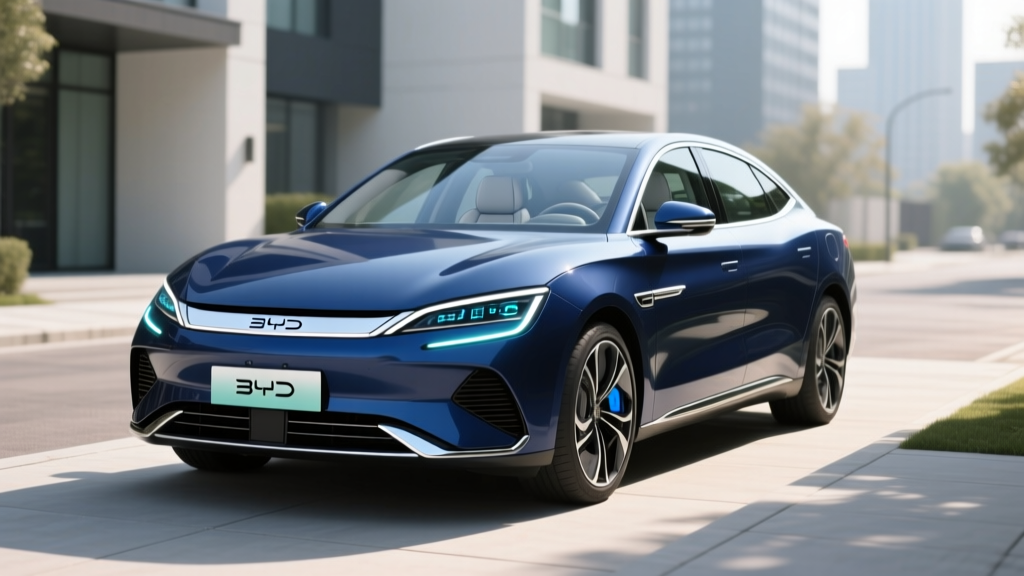
The BYD Stella Li (also known as the BYD Seagull in some markets) has become one of China's best-selling electric vehicles, with over 400,000 units sold in 2024 alone. But for US-based EV shoppers searching for affordable electric transportation, the question remains: can you actually buy one, and should you?
This review examines the BYD Stella Li's specifications, real-world performance, charging capabilities, and the practical realities of ownership for American drivers. We'll also address the critical question of US availability and federal tax credit eligibility.
US Availability: The Critical Reality Check
As of 2026, the BYD Stella Li is not officially sold in the United States. BYD (Build Your Dreams) has not established a US dealer network or begun importing vehicles for consumer purchase. This means:
- No official MSRP in US dollars
- No eligibility for the federal §30D EV tax credit
- No US-spec EPA range testing or certification
- No authorized service centers or warranty coverage
- No access to US-based parts supply chains
While you may find gray-market imports or see the vehicle discussed in international EV forums, purchasing a BYD Stella Li in the US involves significant risks: no warranty protection, potential incompatibility with US charging infrastructure (the vehicle uses China's GB/T charging standard), and uncertain long-term parts availability.
For this review, we'll examine the vehicle's specifications as sold in China and other export markets, with appropriate caveats about real-world US ownership.
Range and Battery Specifications
| Specification | Value |
|---|---|
| Battery Capacity | 44.9 kWh (usable) |
| Battery Chemistry | LFP (Lithium Iron Phosphate) |
| WLTP Range (China/Export) | 252 miles (405 km) |
| Estimated EPA Range | ~210-225 miles (unofficial) |
| Real-World Highway Range | ~170-190 miles |
| Real-World Cold Weather Range | ~140-160 miles (below 32°F) |
| Energy Consumption | ~28-32 kWh/100 miles |
Range Reality Check: The BYD Stella Li's WLTP rating of 252 miles translates to approximately 210-225 miles under EPA testing methodology (WLTP tends to be 15-20% more optimistic). In real-world highway driving at 70-75 mph, expect 170-190 miles before needing to charge. Cold weather (below freezing) can reduce range by 25-35%, bringing practical range down to 140-160 miles. The LFP battery chemistry offers excellent longevity but lower energy density than NMC alternatives.
Charging Speed and Infrastructure Compatibility
| Charging Level | Power | Time (10-80%) | US Compatibility |
|---|---|---|---|
| Level 1 (120V) | 1.4 kW | ~30 hours | Requires adapter |
| Level 2 (240V) | 7 kW | ~5.5 hours | Requires GB/T adapter |
| DC Fast Charge | 40 kW peak | ~50 minutes | GB/T standard only |
The Stella Li's 40 kW peak DC charging rate is modest by 2026 standards—most contemporary EVs offer 150-250 kW capability. This means longer charging stops on road trips: a 10-80% charge takes approximately 50 minutes, compared to 18-25 minutes for vehicles with 150+ kW charging.
The charging curve is relatively flat, sustaining 30-35 kW through most of the charge cycle before tapering above 85% state of charge. This is typical for LFP chemistry, which can handle frequent 100% charging without degradation concerns.
Critical US Infrastructure Issue: The Stella Li uses China's GB/T charging connector standard, which is incompatible with North America's NACS (Tesla) and CCS1 networks. While adapters exist for AC charging, DC fast-charging adapters are expensive ($500-800), unreliable, and may void any remaining warranty. This severely limits practical US ownership.
Performance and Drivetrain
| Performance Metric | Value |
|---|---|
| Motor Type | Single front-mounted |
| Drivetrain | FWD (Front-Wheel Drive) |
| Horsepower | 75 hp (55 kW) |
| Torque | 100 lb-ft |
| 0-60 mph | ~13.5 seconds |
| Top Speed | 81 mph (electronically limited) |
The Stella Li prioritizes efficiency and affordability over performance. With 75 horsepower and a 13.5-second 0-60 time, acceleration is leisurely—adequate for city driving and moderate highway merging, but noticeably underpowered compared to most US-market EVs. The single-speed transmission and front-wheel-drive layout keep costs down and efficiency high.
Regenerative braking offers two modes (standard and strong), with the stronger mode providing near one-pedal driving capability in stop-and-go traffic. The system recovers energy effectively but lacks the aggressive deceleration found in Tesla or Hyundai/Kia systems.
Pricing and Value Proposition
| Market | Base Price | USD Equivalent | Tax Credit | Net Cost |
|---|---|---|---|---|
| China (2025) | ¥73,800 | ~$10,200 | N/A | ~$10,200 |
| Export Markets | Varies | $12,000-16,000 | Varies | Varies |
| US (if available) | N/A | Estimated $18,000-22,000 | Ineligible | $18,000-22,000 |
In China, the BYD Stella Li starts at approximately ¥73,800 (around $10,200 USD), making it one of the most affordable EVs globally. Export markets see higher pricing due to shipping, tariffs, and local compliance costs—typically $12,000-16,000 USD equivalent.
If BYD were to officially import the Stella Li to the US, estimated pricing would likely fall in the $18,000-22,000 range after accounting for:
- US safety and emissions compliance modifications
- Dealer network and support infrastructure
- Import tariffs (currently 27.5% for Chinese EVs, potentially higher under proposed 2026 trade policies)
- Warranty and service obligations
Federal Tax Credit Reality: Even if officially sold in the US, the Stella Li would likely be ineligible for the §30D federal EV tax credit due to battery component and critical mineral sourcing requirements. The IRA's "foreign entity of concern" rules specifically target Chinese battery supply chains, making BYD vehicles unlikely to qualify for the $7,500 credit. Additionally, the vehicle's low price point would fall well below the $25,000 MSRP cap for the used-EV credit.
Interior, Cargo, and Practical Features
| Dimension | Value |
|---|---|
| Seating Capacity | 5 passengers |
| Cargo Volume (rear seats up) | 11.3 cu ft |
| Cargo Volume (rear seats folded) | 36.5 cu ft |
| Front Legroom | 41.5 inches |
| Rear Legroom | 35.8 inches |
| Infotainment Screen | 10.1-inch touchscreen |
| Instrument Cluster | 5-inch digital display |
The Stella Li's interior reflects its budget positioning: hard plastics dominate, but fit and finish are acceptable for the price point. The 10.1-inch infotainment screen supports Bluetooth and USB connectivity but lacks Apple CarPlay and Android Auto—a significant omission for US buyers accustomed to smartphone integration.
Cargo space is modest at 11.3 cubic feet behind the rear seats, expanding to 36.5 cubic feet with the 60/40-split rear bench folded. This is comparable to a Honda Fit or Toyota Yaris—adequate for groceries and small luggage, but limited for larger cargo needs.
Standard features include:
- Keyless entry and push-button start
- Automatic climate control
- Rear parking sensors
- Tire pressure monitoring
- Basic driver assistance (lane departure warning, forward collision alert)
Notable omissions include adaptive cruise control, blind-spot monitoring, and any form of semi-autonomous driving assistance.
Warranty and Long-Term Ownership
BYD offers the following warranty coverage in export markets:
| Component | Coverage |
|---|---|
| Basic Vehicle | 3 years / 60,000 miles |
| Battery Pack | 8 years / 100,000 miles (70% capacity retention) |
| Electric Motor | 8 years / 100,000 miles |
| Power Electronics | 8 years / 100,000 miles |
The LFP battery chemistry offers excellent cycle life—typically 3,000+ charge cycles before reaching 80% capacity, compared to 1,500-2,000 cycles for NMC chemistry. This translates to 600,000+ miles of theoretical battery life, far exceeding the vehicle's expected service life.
However, US ownership presents warranty challenges: no authorized service centers, limited parts availability, and potential language barriers when dealing with Chinese customer support. Battery replacement costs (if needed outside warranty) would likely exceed $8,000-12,000 including shipping and installation.
Pros and Cons
Pros
- Extremely low purchase price (in markets where available)
- LFP battery offers exceptional longevity and safety
- Low operating costs (~$0.04-0.06 per mile on US electricity rates)
- Compact size ideal for urban parking
- Adequate range for daily commuting (150-200 miles real-world)
Cons
- Not officially available in the United States
- GB/T charging connector incompatible with US infrastructure
- Slow 40 kW DC charging rate
- Underpowered 75 hp motor
- No Apple CarPlay or Android Auto
- Likely ineligible for US federal tax credits
- No US dealer network or authorized service centers
- Uncertain long-term parts and support availability
Who Should Consider the BYD Stella Li?
Not recommended for US buyers in 2026. The combination of charging infrastructure incompatibility, lack of official support, and tax credit ineligibility makes the Stella Li impractical for American drivers, despite its attractive price point.
Who it suits in other markets:
- Urban commuters with short daily drives (under 100 miles) and reliable home charging
- Budget-conscious buyers prioritizing low purchase price over performance or features
- Second-car households needing an affordable local errand vehicle
- Rideshare/fleet operators in markets where BYD has official support
US alternatives to consider:
- Chevrolet Bolt EV (used market, $15,000-20,000, eligible for $4,000 used-EV credit)
- Nissan Leaf (new, ~$28,000, limited range but US-supported)
- Upcoming affordable EVs from Tesla, Hyundai, and others (2027-2028 model years)
Frequently Asked Questions
Can I legally import a BYD Stella Li to the United States?
Technically yes, through the 25-year import rule (not applicable to a 2024-2026 vehicle) or by meeting all FMVSS safety standards independently (extremely costly). Gray-market imports exist but come with no warranty, potential registration difficulties, and insurance challenges.
Why is the BYD Stella Li so cheap compared to US EVs?
Several factors: China's lower manufacturing costs, government subsidies for domestic EV production, smaller battery capacity (44.9 kWh vs 60-100 kWh in US models), minimal features and performance, and BYD's vertical integration (they manufacture their own batteries and components).
Will BYD ever sell cars in the US?
BYD has expressed interest in the US market but faces significant hurdles: 27.5% import tariffs (potentially increasing), political opposition to Chinese EVs, the need to establish a dealer network and parts supply chain, and the challenge of meeting US safety standards. As of 2026, no official US launch timeline has been announced.
How does the Stella Li's range compare to a Tesla Model 3?
The Tesla Model 3 RWD offers 272 miles EPA range vs the Stella Li's estimated 210-225 miles EPA. More importantly, the Model 3 charges at 170 kW (10-80% in ~25 minutes) vs the Stella Li's 40 kW (10-80% in ~50 minutes), making the Tesla far more practical for road trips.
Is the LFP battery in the Stella Li safe?
Yes—LFP chemistry is exceptionally stable and resistant to thermal runaway. It's considered safer than NMC chemistry and offers longer cycle life. However, LFP has lower energy density (heavier for the same capacity) and reduced cold-weather performance.
What charging adapter would I need for US use?
For Level 1/2 AC charging, you'd need a GB/T to J1772 adapter ($150-300). For DC fast charging, a GB/T to CCS or NACS adapter would cost $500-800 and may not work reliably with all US charging networks. Many DC adapters also limit charging speed to 30-50 kW.
Bottom Line
The BYD Stella Li represents an impressive achievement in affordable electric transportation—for markets where it's officially sold with proper support infrastructure. Its combination of low price, efficient LFP battery, and adequate urban range makes it a compelling choice for budget-conscious buyers in China and select export markets.
However, for US-based EV shoppers in 2026, the Stella Li remains impractical despite its attractive specifications. The lack of official availability, charging infrastructure incompatibility, absence of federal tax credits, and uncertain long-term support create too many ownership risks.
American buyers seeking affordable EV transportation are better served by the used Chevrolet Bolt EV, upcoming affordable models from established manufacturers, or waiting for BYD's potential future US entry with proper dealer support and US-spec vehicles.
For now, the BYD Stella Li remains an interesting case study in global EV market dynamics rather than a practical purchase option for US drivers.