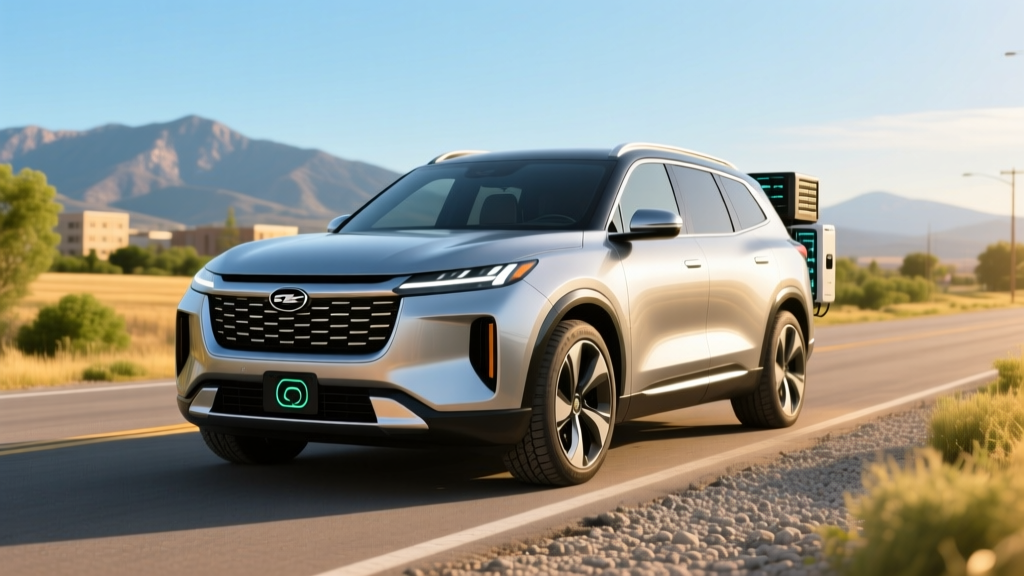
The GMC Sierra EV slots into GM's electric-truck lineup as the premium sibling to the Chevrolet Silverado EV, built on the same Ultium platform but wrapped in more upscale styling and GMC's Denali heritage. For 2026, the lineup expands with the Elevation trim — a mid-tier option that sits above the work-oriented WT and below the luxury-focused Denali, targeting buyers who want serious range, towing, and tech without paying Denali prices.
We spent time examining the 2026 Sierra EV Elevation's specs, charging behavior, and ownership proposition to answer the question every electric-truck shopper asks: does it actually work as a daily driver and a workhorse? Here's what the numbers say.
2026 Sierra EV Elevation at a Glance: Key Specs
| Specification | 2026 Sierra EV Elevation |
|---|---|
| EPA Est. Range | ~390 miles (Large Battery AWD) |
| Battery Capacity (Usable) | ~200 kWh (NMC, Ultium platform) |
| Drivetrain | Dual-motor AWD |
| Horsepower | ~510 hp (e4 AWD) |
| 0-60 mph | ~5.5 seconds (est.) |
| Max DC Fast Charge | ~350 kW (peak) |
| 10-80% DC Fast Charge | ~35 minutes (est.) |
| Level 2 Home Charging | 19.2 kW / ~52 mi/hr |
| Max Towing Capacity | Up to 12,500 lbs (with Max Trailering pkg) |
| Bed Length | 5 ft 11 in (MultiPro MidGate open: ~9 ft) |
| Base MSRP | ~$57,900 (Elevation std battery) |
| Battery/Powertrain Warranty | 8 years / 100,000 miles |
Note: GMC has released preliminary specifications for the 2026 Sierra EV Elevation. Final EPA certification figures and trim-level pricing may shift slightly before deliveries. Always confirm with your dealer and check fueleconomy.gov for certified numbers.
Range and Efficiency: EPA Sticker vs. Real-World Expectations
Real-World Expectation: Plan for 280–320 miles on sustained highway driving at 70+ mph. In cold weather (below 32°F), expect a 20–30% reduction, bringing usable range to roughly 270–310 miles in winter conditions. City driving with regenerative braking can match or slightly exceed the EPA number.
Efficiency: Estimated ~48 MPGe combined / ~70 kWh per 100 miles. For a truck of this mass (~9,000 lbs curb weight), that figure is competitive — but it's no compact crossover. Energy consumption rises sharply when towing; expect 1.5–2.0 kWh per mile under heavy load, effectively halving your range.
The Sierra EV Elevation's large Ultium battery pack is among the largest in any production passenger vehicle. That ~200 kWh of usable capacity (GM uses an NMC — nickel manganese cobalt — chemistry across the Ultium lineup) is what enables the ~390-mile EPA figure. But physics always wins: a truck with this much battery mass will consume more energy per mile than lighter EVs, and highway speeds punish aerodynamics that no amount of battery can fully offset.
For daily commuting under 80 miles round-trip, the Elevation's range is essentially a non-issue — you'll charge at home every few days and never think about it. For road trips, the 390-mile EPA number means realistic 280–320 mile legs between DC fast-charger stops, which aligns well with typical rest-stop cadence if you plan around 350 kW-capable stations.
Charging Speed: DC Fast, Level 2, and the Curve Reality
| Charging Level | Power | Speed (Miles Added) | Notes |
|---|---|---|---|
| Level 1 (120V) | ~1.4 kW | ~3 mi/hr | Emergency/top-up only; full charge takes days |
| Level 2 (240V, 48A) | 11.5 kW | ~31 mi/hr | Standard home setup; ~12.5 hr for 10-100% |
| Level 2 (240V, 80A) | 19.2 kW | ~52 mi/hr | Requires hardwired 100A circuit; ~7.5 hr for 10-100% |
| DC Fast (Peak) | ~350 kW | ~100 mi in ~10 min | Peak rate, not sustained; requires 800V-capable station |
| DC Fast (10-80%) | Varies (tapers) | ~35 minutes | Charge curve slows above ~60% SoC |
GMC engineers designed the Sierra EV around GM's 800-volt Ultium architecture, which enables the headline ~350 kW peak DC fast-charging rate. Here's what that actually means in practice: you'll see peak charge rates only in a narrow State of Charge (SoC) window — roughly 10% to 40%. Above 60%, the charge curve tapers significantly to protect battery health, which is why the 10-80% time stretches to approximately 35 minutes rather than the ~18 minutes that peak-rate marketing might imply.
For home charging, the 19.2 kW onboard charger is a standout feature — it's among the fastest AC chargers in any EV, meaning a full overnight replenishment is realistic even after a heavy driving day. However, you'll need a dedicated 100-amp circuit and hardwired Level 2 station (such as a ChargePoint Home Flex or FLO Home X8) to unlock that rate. Most homes will require an electrical panel assessment; a 200-amp service panel is typically required. Budget $1,200–$2,500 for a professional Level 2 installation depending on your panel proximity and local permit costs.
One critical note: to access the full 350 kW peak, you need a CCS-equipped DC fast charger rated for 350 kW or higher — Electrify America and select EVgo stations support this, but many public chargers cap at 50–150 kW, where your 10-80% time will extend to 50–80 minutes. Always check station ratings in your charging app before routing.
Performance, Towing, and Payload
The Sierra EV Elevation's dual-motor e4 all-wheel-drive system produces an estimated 510 horsepower, delivering a 0-60 mph time in the ~5.5-second range. That's brisk for a full-size truck and makes highway merging effortless, though it trails the Denali trim's available 754 hp (which dips into the 4-second range).
Where the Elevation earns its keep is towing. With the available Max Trailering package, GMC rates the Sierra EV at up to 12,500 pounds — competitive with half-ton gas trucks and significantly more than the Ford F-150 Lightning's 10,000-pound max. The Sierra EV's integrated trailer brake controller, ProGrade trailering system, and camera-based trailer visibility suite make hookup and highway towing manageable even for less experienced operators.
The tradeoff, as with every electric truck, is range under load. Towing 10,000+ pounds at highway speeds will cut your range roughly in half — plan for 180–200 miles between charging stops when towing heavy. For local towing (boat to the lake, equipment to a job site within 50 miles), range is a non-issue.
Interior, Cargo, and the MultiPro MidGate
The Sierra EV rides on GM's dedicated BT1 electric-truck platform, which eliminates the transmission tunnel and allows a flat floor throughout the cabin. Rear-seat legroom is generous — estimated at ~43 inches — and the rear floor is completely flat, a noticeable improvement over gas-platform trucks with their drivetrain hump.
Cargo versatility is where the Sierra EV differentiates. The MultiPro MidGate is GMC's version of the pass-through between the cab and bed: fold down the MidGate and the rear cabin wall, and you can extend the effective load floor from the standard ~5 ft 11 in bed to nearly 9 feet — long enough to carry lumber, kayaks, or ladders while keeping the tailgate closed. The 60/40 split rear seat lets you carry one rear passenger while still using the pass-through.
The front trunk (frunk) adds approximately 10.7 cubic feet of lockable, weather-sealed storage — useful for charging cables, tools, or groceries you want separated from the bed. The eTrunk includes a power-operated lid and a 120V outlet.
Infotainment runs on a 16.8-inch diagonal center touchscreen with Google Built-In (Google Maps, Google Assistant, Play Store apps), wireless Apple CarPlay and Android Auto, and a 12.3-inch digital driver cluster. GMC's Super Cruise hands-free driver assistance (SAE Level 2 — you must remain attentive and keep eyes on the road) is available on compatible mapped highways, covering over 750,000 miles of divided roads in North America.
Pricing, Trims, and Federal Tax Credit Eligibility
| Trim / Config | Est. MSRP | After Est. §30D Credit | Notes |
|---|---|---|---|
| Elevation (Std Battery, AWD) | ~$57,900 | ~$50,400 | If eligible for full $7,500 credit |
| Elevation (Large Battery, AWD) | ~$67,900 | ~$60,400 | ~390-mi range; under $80K truck MSRP cap |
| Elevation (Large Battery + Max Trailering) | ~$72,500 | ~$65,000 | 12,500-lb tow rating |
| Denali (Large Battery, AWD) | ~$87,900+ | Not eligible | Exceeds $80,000 MSRP cap for trucks |
The 2026 Sierra EV Elevation's positioning is deliberate: it undercuts the Denali by a wide margin while offering nearly the same battery and range. The Elevation Large Battery at ~$67,900 stays under the IRS §30D MSRP cap of $80,000 for trucks, vans, and SUVs — a critical threshold that the Denali trim may exceed.
- MSRP Cap: Must be ≤$80,000 for trucks (Elevation qualifies; Denali may not)
- Buyer Income Cap: AGI ≤$150,000 (single) / ≤$300,000 (joint) / ≤$225,000 (head of household)
- Battery Sourcing: Critical minerals and battery components must meet phased-in percentage thresholds from US/FTA countries — GM has worked to localize Ultium supply chains, but verify current-year compliance on the IRS approved vehicles list
- Point-of-Sale Transfer: You can transfer the credit to the dealer at purchase, reducing your out-of-pocket cost immediately rather than waiting for tax filing
- Final Assembly: Must be assembled in North America (Sierra EV is built at GM's Factory ZERO in Michigan — qualifies)
How Does the Sierra EV Elevation Compare?
The electric full-size truck segment has matured considerably. The Sierra EV Elevation competes directly with the Ford F-150 Lightning (Lariat/XLT), the Chevrolet Silverado EV 4WT and RST, the Rivian R1T (smaller but premium), and indirectly with the Tesla Cybertruck. Here's how the Elevation stacks up on the metrics that matter:
- vs. Ford F-150 Lightning (Extended Range): The Lightning tops out at ~320 miles EPA and 10,000 lbs towing. The Sierra EV wins on range (~390 vs ~320) and towing (12,500 vs 10,000 lbs), but the Lightning has broader availability, a lower starting price (~$55,000 for XLT Extended Range), and a more established dealer network for service.
- vs. Chevrolet Silverado EV RST: Mechanically identical platform. The Sierra EV trades on premium styling and GMC branding; the Silverado EV offers a slightly lower entry price. If badge prestige matters, Sierra; if value matters, Silverado.
- vs. Rivian R1T (Dual-Motor Max): The R1T is smaller (midsize) and more expensive at ~$80,000+, but offers superior off-road capability, a more refined interior, and quad-motor options. The Sierra EV wins on bed length, towing, and range-per-dollar.
Pros, Cons, and Who Should Buy
Pros
- ~390-mile EPA range — best in the electric truck segment
- 350 kW peak DC fast charging (800V architecture)
- 19.2 kW Level 2 onboard charger — fastest home charging available
- 12,500-lb max towing capacity
- MultiPro MidGate extends bed to ~9 feet
- Flat floor, spacious rear seat, 10.7 cu ft frunk
- Super Cruise hands-free driving on 750K+ miles of highway
- Under $80K MSRP cap on Elevation trims (tax credit eligible)
Cons
- ~9,000-lb curb weight impacts efficiency (70 kWh/100 mi)
- Range halves when towing at highway speed (~180-200 mi)
- Requires 100A circuit for max 19.2 kW home charging
- 350 kW public chargers still sparse in many regions
- NMC chemistry degrades faster than LFP if routinely charged to 100%
- 5-ft-11-in bed is short without MidGate deployed
- No Apple/Google ecosystem integration beyond Google Built-In
- Availability limited; expect waitlists into mid-2026
- Home-charging homeowners with 200A panels who can install a high-power Level 2 and wake up to a full "tank" every morning
- Commuters with occasional towing needs — daily driving is effortless; local towing (under 50 miles) doesn't stress range
- Truck buyers who want EV economics without sacrificing bed utility or towing — the MidGate and 12,500-lb rating are genuinely useful
- High-mileage drivers who can leverage low per-mile electricity costs (~$0.04–0.06/mile on home charging vs $0.15+/mile for gas)
- Frequent long-distance towers — plan on 180-mile legs and 35-minute charging stops
- Apartment dwellers without reliable home or workplace charging access
- Buyers in regions with sparse 350 kW DC fast-charger infrastructure
Frequently Asked Questions
What is the real-world range of the 2026 Sierra EV Elevation?
The EPA rates the Large Battery AWD Elevation at approximately 390 miles. In real-world highway driving at 70+ mph, expect 280–320 miles. In cold weather (below freezing), plan for 270–310 miles due to battery efficiency loss and cabin heating demands. City driving with regenerative braking can approach or slightly exceed the EPA number.
How fast does the Sierra EV Elevation charge?
On a 350 kW-capable DC fast charger, GMC estimates a 10-80% charge in approximately 35 minutes, with peak rates around 350 kW in the low-SoC window. At home on a 19.2 kW Level 2 station (80A circuit), you'll add roughly 52 miles of range per hour, enabling a full overnight charge. On a standard 48A Level 2 (11.5 kW), expect about 31 miles per hour.
Does the Sierra EV Elevation qualify for the $7,500 federal tax credit?
The Elevation trims (priced under the $80,000 MSRP cap for trucks) are expected to qualify, provided you meet the income thresholds (≤$300,000 joint / ≤$150,000 single) and the battery meets current-year critical-mineral and component sourcing requirements. The credit can be transferred to the dealer at point of sale for an immediate price reduction. Always verify on the IRS approved vehicles list and consult a tax professional.
Is the Sierra EV Elevation worth buying vs. the Ford F-150 Lightning?
If maximum range and towing are your priorities, the Sierra EV Elevation holds a clear advantage: ~390 miles vs ~320 miles EPA, and 12,500 lbs vs 10,000 lbs towing. The Lightning counters with lower starting prices, broader dealer availability, and a more proven track record (it's been on sale since 2022). If you need a truck today and value dealer proximity, the Lightning is a safer bet. If you want the longest-range electric truck available and can wait for delivery, the Sierra EV Elevation is the spec-sheet winner.
How long will the Sierra EV battery last?
GM covers the Ultium battery with an 8-year / 100,000-mile warranty, guaranteeing a minimum capacity retention threshold (typically 60-70% of original capacity, though confirm exact terms at purchase). Based on data from earlier Ultium-platform vehicles and industry-wide NMC degradation curves, expect roughly 85-90% capacity retention at 100,000 miles under normal use. Avoid routinely charging to 100% (GM recommends daily charging to 80% for NMC batteries) and use DC fast charging sparingly to maximize longevity.
Can the Sierra EV Elevation power my home or tools?
GM has announced vehicle-to-home (V2H) capability for the Sierra EV via the GM Energy PowerShift Charger, enabling the truck to serve as a backup power source during outages. This requires compatible home electrical integration. The truck also includes 120V and 240V outlets in the bed and frunk for powering tools and equipment on job sites — a genuine work-truck feature.
Final Verdict
The 2026 GMC Sierra EV Elevation is the electric truck for buyers who refuse to compromise on range or capability. With ~390 miles EPA, 350 kW charging, 12,500-pound towing, and a starting price that keeps it under the federal tax credit's MSRP cap, it makes a compelling case as the most versatile electric truck on the market — provided you have home charging access and realistic expectations about towing range.
It's not cheap, and it's not light. But for the truck buyer who's ready to electrify without giving up what makes a truck useful, the Sierra EV Elevation sets the benchmark that competitors will need to match.