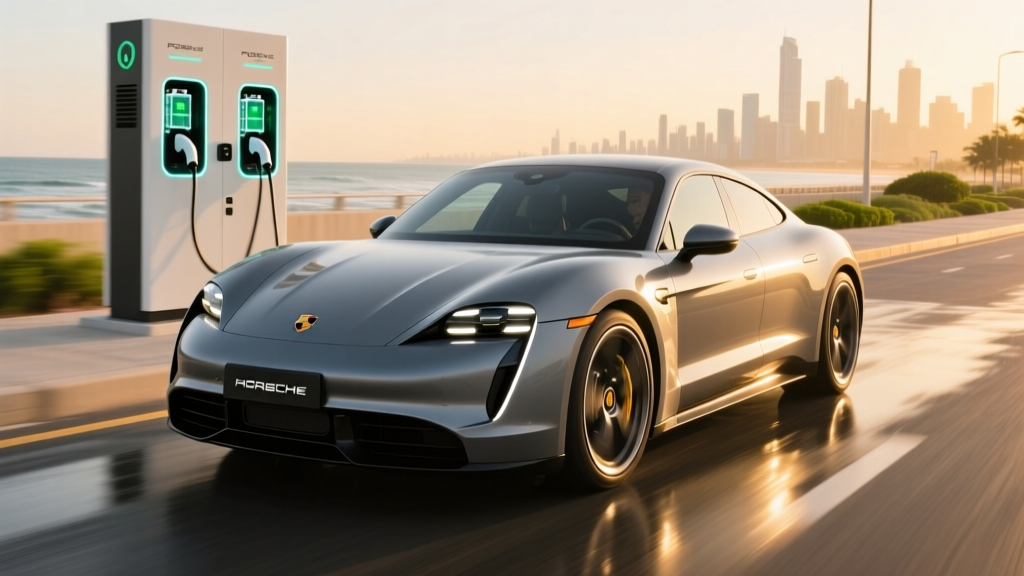
The 2025 Porsche Taycan 4S arrived with a comprehensive mid-cycle refresh that addressed the single biggest criticism of the original: range. With a larger battery, revised power electronics, and dramatically faster DC charging, Porsche has transformed the Taycan 4S from a thrilling but range-limited sports sedan into a genuinely viable daily driver and road-trip companion. But at a starting price north of $107,000, does the math work — and how does real-world range stack up against the EPA sticker?
We spent time analyzing Porsche's published specs, EPA data, and real-world driving behavior to give you the numbers that actually matter for ownership.
Range and Efficiency: The 2025 Taycan 4S's Biggest Upgrade
Real-World Expectation: ~230–250 miles at sustained highway speeds (70–80 mph); ~200–220 miles in cold weather (below 32°F) with cabin heating; ~260–275 miles in mixed city/suburban driving with moderate regen use.
The 2025 Taycan 4S's headline improvement is its new Performance Battery Plus, which now stores 105 kWh gross (97 kWh usable) — up from the previous generation's 93.4 kWh gross. This is an NMC (nickel manganese cobalt) lithium-ion pack, chosen for its higher energy density compared to LFP chemistry, which matters in a performance sedan where packaging space and weight distribution are critical.
On the EPA's fueleconomy.gov listings, the 2025 Taycan 4S with the larger battery achieves an estimated 277 miles of combined range — a massive jump from the pre-refresh 4S's ~227-mile rating. Efficiency is rated at approximately 87 MPGe combined, or roughly 39 kWh per 100 miles.
But here's where real-world ownership diverges from the sticker. The Taycan 4S is a heavy, powerful all-wheel-drive sedan, and physics doesn't take a day off. At 75–80 mph on a flat interstate, expect to consume closer to 42–45 kWh/100mi, which translates to roughly 230–240 miles of range. In winter conditions, battery conditioning and cabin heating can knock another 10–15% off that figure. Porsche's heat pump (standard on the 2025 model) mitigates some of this loss, but cold-weather range reduction is unavoidable in any EV.
The good news? The Taycan 4S's thermal management system is among the best in the industry. Battery preconditioning works reliably when you navigate to a charger, and the car sustains high charge rates even in moderate temperatures — more on that below.
Charging Speed: Best-in-Class DC Fast Charging
| Charging Level | Power / Rate | Speed / Time | Connector |
|---|---|---|---|
| Level 1 (120V) | ~1.4 kW | ~3–4 miles per hour | J1772 / NACS adapter |
| Level 2 (240V, 48A) | 11.5 kW (onboard charger) | ~28–32 miles per hour; full charge in ~9.5 hours | J1772 / NACS |
| DC Fast Charge (peak) | 320 kW (Performance Battery Plus) | 10–80% in ~18 minutes (ideal conditions) | CCS1 / NACS (2025+ models include NACS port) |
This is where the 2025 Taycan 4S separates itself from nearly every competitor. With a peak DC fast-charge rate of 320 kW, the Taycan 4S with the Performance Battery Plus can add 10–80% state of charge in approximately 18 minutes at a compatible 350 kW charger (such as Electrify America's latest stalls).
The secret is Porsche's upgraded 800-volt architecture, which allows higher power delivery at lower amperage — reducing heat buildup and sustaining peak charge rates longer than 400V competitors. In practice, the Taycan 4S holds above 250 kW through roughly 50% SoC before gradually tapering. The charge curve from 80–100% slows considerably (typical for NMC chemistry to protect long-term battery health), so plan your road-trip stops around the 10–80% window for maximum efficiency.
For home charging, the 11.5 kW onboard Level 2 charger is competitive. A full overnight charge from 10% takes roughly 9–10 hours on a hardwired 48-amp Level 2 station. Note: Porsche does not include a Level 2 home charger in the box — you'll need to purchase and install one separately (budget $500–$1,200 for equipment plus $800–$2,000 for electrician installation, depending on your panel capacity).
Performance: Dual-Motor AWD With Porsche DNA
| Specification | Value |
|---|---|
| Drivetrain | Dual-motor all-wheel drive (AWD) |
| Horsepower (Launch Control) | 590 hp |
| Horsepower (Standard) | 482 hp |
| 0–60 mph | 3.5 seconds (with Launch Control) |
| Top Speed | 155 mph (electronically limited) |
| Battery (gross / usable) | 105 kWh / 97 kWh (NMC) |
| EPA Range | 277 miles |
| MPGe (combined) | 87 MPGe |
| Curb Weight | ~5,120 lbs |
The Taycan 4S has always been the sweet spot in the lineup — substantially more powerful than the base rear-wheel-drive Taycan, but not as wallet-draining as the Turbo or Turbo S. For 2025, the 4S produces 590 horsepower with Launch Control engaged (482 hp in standard driving), delivered through a dual-motor AWD system with Porsche's two-speed transmission on the rear axle.
The result is a 3.5-second 0–60 mph time that feels even quicker thanks to instantaneous electric torque delivery. The two-speed rear transmission is a Porsche engineering signature: first gear provides explosive launch acceleration, while second gear optimizes high-speed efficiency. You'll feel the shift around 45–50 mph — it's subtle but noticeable, and it's one reason the Taycan sustains strong acceleration well past 80 mph where single-speed rivals begin to taper.
Adaptive air suspension with Porsche Active Suspension Management (PASM) is standard, and the ride quality balances daily comfort with canyon-carving precision in a way that no other EV sedan currently matches. Rear-axle steering (optional) dramatically tightens the turning radius for city driving while adding high-speed stability on the highway.
Interior, Cargo, and Daily Livability
The Taycan 4S is a driver's car first, but it needs to function as a daily sedan. Here's what the numbers look like:
- Front headroom: ~38.0 inches
- Front legroom: ~41.2 inches
- Rear headroom: ~36.5 inches (tight for passengers over 6'0")
- Rear legroom: ~32.7 inches (compact-sedan territory)
- Trunk (rear cargo): ~14.3 cubic feet
- Frunk (front trunk): ~2.9 cubic feet
The rear seat is the Taycan's most obvious compromise. Legroom is tight for adults on longer trips, and the sloping roofline cuts into headroom. This is a grand-touring sedan, not a family hauler — if rear-seat space is a priority, the Tesla Model S or Mercedes EQS offer measurably more room.
Cargo capacity is adequate for a weekend trip for two, or a week's groceries. The frunk is small but useful for charging cables. The 14.3-cubic-foot trunk is on par with a BMW 3 Series, though the opening is narrower due to the sedan body style. A Cross Turismo (wagon) variant is available if cargo versatility matters to you.
Inside, the 2025 Taycan features Porsche's latest PCM (Porsche Communication Management) software on a 12.6-inch curved digital instrument cluster and a 10.9-inch central touchscreen. A passenger-side 10.9-inch display is optional. Wireless Apple CarPlay and Android Auto are standard. The new infotainment system is faster and more intuitive than the previous generation, with native EV-specific features like charging station routing with battery preconditioning.
Pricing, Trims, and Federal Tax Credit Eligibility
| Item | Amount |
|---|---|
| Base MSRP (Taycan 4S) | $107,400 (sedan) |
| Destination charge | $1,650 |
| As-tested (with common options) | $120,000–$135,000 |
| Federal §30D EV Tax Credit | Not eligible (exceeds MSRP cap) |
Here's the hard truth on incentives: the 2025 Taycan 4S does not qualify for the $7,500 federal EV tax credit under IRS §30D rules. The reason is straightforward — the sedan MSRP cap for §30D eligibility is $55,000, and the Taycan 4S starts at $107,400. No amount of battery sourcing or buyer income qualification can overcome the MSRP ceiling.
This is an important factor if you're cross-shopping against EVs that do qualify (such as the Tesla Model S, which also exceeds the cap, versus more affordable luxury EVs like certain trims of the BMW i5 or Genesis Electrified G80, which also exceed it). At this price point, buyers are generally not credit-dependent, but it's worth noting for total cost of ownership calculations.
Some states offer their own EV incentives that may apply regardless of MSRP — check your local DMV or energy office. Additionally, the federal alternative fuel vehicle refueling property credit (30C) can cover up to $1,000 of home charger installation costs if you're in an eligible census tract.
Common options that push the as-tested price higher include the Performance Battery Plus (standard on most 4S builds for 2025), Premium Package ($3,500+), Adaptive Cruise Control with lane centering, rear-axle steering (~$1,620), and various wheel upgrades. It's easy to spec a Taycan 4S past $130,000.
Warranty and Battery Longevity
Porsche backs the 2025 Taycan 4S with the following coverage:
- New vehicle limited warranty: 4 years / 50,000 miles
- Battery warranty: 8 years / 100,000 miles (guarantees minimum 70% state of health)
- Corrosion warranty: 12 years, unlimited miles
- Roadside assistance: 4 years / 50,000 miles
The 8-year/100,000-mile battery warranty with a 70% capacity retention floor is standard for the luxury EV segment. Porsche's NMC cells have shown strong real-world longevity data in the first-generation Taycan — multiple high-mileage owners and independent tests have shown degradation in the 5–8% range over 100,000+ miles, well within warranty thresholds.
The 800V architecture contributes to battery health by reducing thermal stress during charging (lower amperage for a given power level). Porsche also includes a sophisticated battery management system with active liquid cooling and heating, which keeps cells in their optimal temperature window during both driving and charging.
Taycan 4S vs. the Competition
Pros
- Class-leading 320 kW DC fast charging — 10-80% in ~18 min
- 590 hp and 3.5s 0-60 with genuine sports-car handling dynamics
- 277-mile EPA range eliminates the old Taycan's biggest weakness
- 800V architecture sustains charge rates better than 400V rivals
- Build quality, materials, and fit-and-finish are best-in-segment
- Two-speed rear transmission gives strong acceleration past 80 mph
Cons
- $107,400+ base price; $120K+ as-tested; no federal tax credit
- Rear seat legroom (32.7") is tight for adults on long trips
- Frunk is tiny (2.9 cu ft); total cargo is sedan-limited
- ADAS features (adaptive cruise, lane keep) are optional and less advanced than Tesla FSD or GM Super Cruise
- Infotainment learning curve; no native phone-as-key on base trim
- Insurance costs run 25–40% higher than comparable gas sedans
vs. Tesla Model S Dual Motor: The Model S offers more range (EPA 402 mi), more cargo space (hatchback), and access to the Supercharger network. But the Taycan 4S is a fundamentally better-built car with superior ride quality, steering feel, and interior materials. The Model S is a tech product; the Taycan is a Porsche.
vs. BMW i5 M60: The i5 M60 is slightly less powerful (593 hp comparable) and slower to DC charge (peak ~205 kW), but it offers a more spacious rear seat and a lower starting price (~$85,000). It also qualifies for no federal credit due to MSRP. The i5 is the rational luxury EV sedan; the Taycan 4S is the emotional one.
vs. Audi e-tron GT: The e-tron GT shares the Taycan's J1 platform and 800V architecture but was not refreshed for 2025 with the same battery/charging upgrades. The Taycan 4S now outcharges and outranges its corporate cousin.
Who Should Buy the 2025 Taycan 4S?
Look elsewhere if: You regularly carry rear-seat passengers, need maximum cargo versatility (consider the Cross Turismo or a Model S), want the longest possible range per charge (Tesla Model S or Lucid Air), or need the most advanced hands-free highway driving system (GM Super Cruise or Tesla FSD Supervised — though both remain SAE Level 2 systems requiring full driver attention).
Frequently Asked Questions
What is the real-world highway range of the 2025 Taycan 4S?
Expect approximately 230–250 miles at sustained 70–80 mph highway speeds in moderate temperatures. In cold weather (below freezing), that drops to roughly 200–220 miles with cabin heating active. City and suburban driving with regenerative braking recovers more energy, yielding closer to the 277-mile EPA estimate.
Does the 2025 Taycan 4S qualify for the federal EV tax credit?
No. Under current IRS §30D rules, the federal tax credit has a $55,000 MSRP cap for sedans. The Taycan 4S starts at $107,400, making it ineligible regardless of buyer income or battery sourcing. Some state-level incentives may still apply.
How fast does the Taycan 4S charge at home?
On a 48-amp, 240V Level 2 home charger, the Taycan 4S draws up to 11.5 kW, adding roughly 28–32 miles of range per hour. A full charge from near-empty takes approximately 9.5 hours. You'll need a NEMA 14-50 outlet or hardwired station installed by a licensed electrician — budget $1,500–$3,000 total for equipment and installation, and confirm your electrical panel has capacity (a 200-amp panel is typically required).
Is the Taycan 4S worth it over the base Taycan or the Turbo?
The 4S is the value sweet spot. The base RWD Taycan starts lower (~$99,400) but sacrifices 0-60 performance and AWD capability. The Turbo ($153,500+) adds power but diminishing returns for most drivers. The 4S delivers 95% of the thrill at a meaningfully lower price, especially when you spec the Performance Battery Plus for maximum range and charging speed.
What connector does the 2025 Taycan 4S use?
For the 2025 model year, Porsche has transitioned the Taycan to the NACS (North American Charging Standard) port, joining Tesla's Supercharger network. CCS1 adapters are available if you need to use legacy Electrify America or other CCS-only stations. For home Level 2 charging, a NACS-compatible wall connector or J1772-to-NACS adapter works.
What's the biggest drawback of the Taycan 4S?
Rear-seat space and total cost. The Taycan is a driver's car that compromises passenger comfort and cargo flexibility. Combined with a $120K+ as-tested price, no federal tax credit, and higher-than-average insurance premiums, the total cost of ownership is substantial. If those factors don't concern you, the driving experience is unmatched in the EV sedan segment.