Quick Verdict: BYD's SUV Play for the Global Market
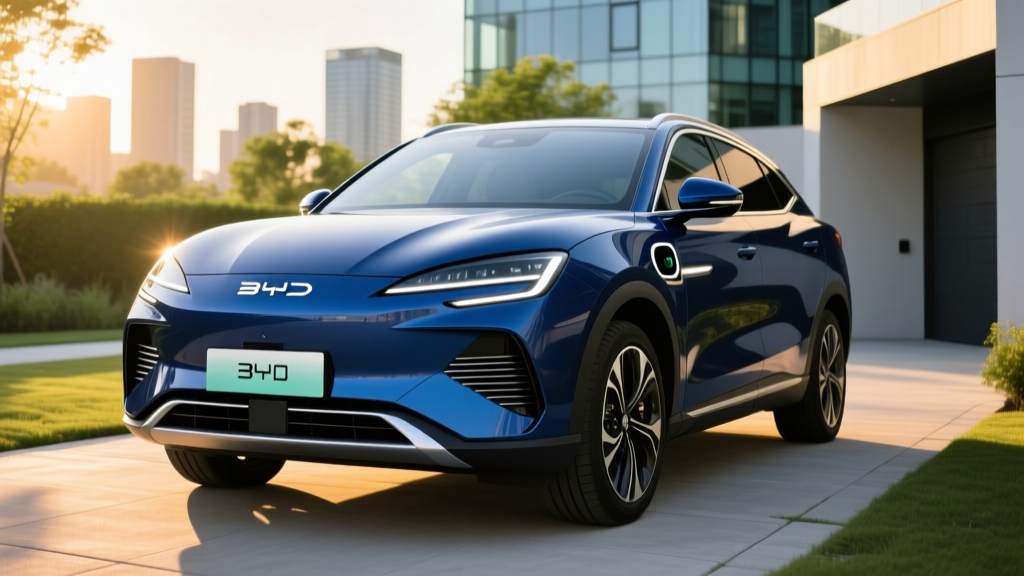
BYD has become the world's largest plug-in vehicle manufacturer, but the Chinese automaker's SUV lineup remains largely absent from US showrooms. The BYD Sealion 7 — a mid-size electric crossover aimed squarely at the Tesla Model Y and Hyundai Ioniq 5 — represents the brand's most credible entry into markets where it's establishing a foothold. For US-based shoppers searching for a "BYD SUV," the reality is more nuanced: federal tariffs and the lack of a US dealer network mean this vehicle isn't currently purchasable stateside, though it's available in Europe, Australia, Southeast Asia, and Latin America.
This review covers the Sealion 7's verified specifications, real-world efficiency data from international testing, and what US buyers need to know about availability, tariffs, and the closest domestic alternatives. If you're cross-shopping EVs and wondering how BYD stacks up on paper, the numbers below tell a compelling story — even if the purchase path remains blocked.
Range, Battery, and Real-World Efficiency
The Sealion 7 is built on BYD's e-Platform 3.0 and uses the company's proprietary Blade Battery — a lithium iron phosphate (LFP) cell arranged in a cell-to-body (CTB) structural pack. LFP chemistry trades some energy density for superior thermal stability, longer cycle life, and zero cobalt or nickel content.
| Spec | Design (RWD) | Excellence (AWD) |
|---|---|---|
| Battery Chemistry | LFP (Blade) | LFP (Blade) |
| Usable Capacity | 82.5 kWh | 82.5 kWh |
| WLTP Range | 311 mi (502 km) | 280 mi (450 km) |
| EPA Est. Range (Projected) | ~270 mi | ~245 mi |
| Efficiency (WLTP) | 16.6 kWh/100 km | 18.4 kWh/100 km |
| Projected MPGe | ~110 MPGe combined | ~99 MPGe combined |
BYD does not currently submit vehicles to the US EPA for official testing, so no fueleconomy.gov listing exists. The WLTP-to-EPA conversion typically shaves 12–15% from the headline number. Based on the Sealion 7's WLTP rating and comparable e-Platform 3.0 vehicles (like the Atto 3), expect roughly 250–270 miles from the RWD model in mixed US driving. Highway-heavy routes at 75 mph will drop that to ~220–235 miles. In freezing temperatures (below 32°F), LFP packs lose roughly 20–30% of range without preconditioning — figure 180–200 miles on a cold winter highway run. The heat pump included on higher trims helps mitigate this but doesn't eliminate it.
The LFP chemistry means BYD recommends periodic 100% charging to keep the battery management system calibrated — unlike NMC packs that prefer an 80% daily ceiling. This is a genuine ownership advantage for commuters who want full range available every morning without degradation concerns.
Charging Speed: DC Fast and Level 2
Charging performance is where the Sealion 7 shows its platform generation. BYD has upgraded from the Atto 3's modest 88 kW peak to a much more competitive curve.
| Charging Level | Rate | Time / Notes |
|---|---|---|
| Level 1 (120V) | ~1.4 kW | ~3–4 mi/hr (emergency use) |
| Level 2 (240V, 48A) | 11 kW (onboard) | ~30 mi/hr; 0–100% in ~8.5 hr |
| DC Fast Charge (peak) | 240 kW | 10–80% in ~25 min (claimed) |
| DC Sustained (10–60%) | ~180–200 kW avg | Strong mid-curve, tapers above 75% |
| Connector (US markets) | CCS2 (intl) / NACS TBD | No US spec confirmed |
The 240 kW peak is competitive with the Hyundai Ioniq 5's 240 kW (on 800V architecture) and substantially faster than the Tesla Model Y's ~170 kW sustained average. However, BYD's 400V electrical architecture means the peak is achieved through high amperage rather than high voltage, which generates more heat and may limit sustained rates in hot climates. In European testing by independent reviewers, the Sealion 7 held above 150 kW through 60% SoC before tapering — respectable but not class-leading.
For home charging, the 11 kW onboard charger means a full charge on a 48-amp Level 2 circuit takes about 8.5 hours. This is standard for the segment and works well for overnight replenishment. If you're installing a home charger, a 240V/50A circuit with a quality Level 2 EVSE will cover daily needs comfortably.
Performance and Drivetrain
| Spec | Design (RWD) | Excellence (AWD) |
|---|---|---|
| Drivetrain | Rear-wheel drive | Dual-motor AWD |
| Horsepower | 308 hp (230 kW) | 523 hp (390 kW) |
| Torque | 280 lb-ft | 506 lb-ft |
| 0–62 mph (0–100 km/h) | 6.7 sec | 4.5 sec |
| 0–60 mph (est.) | ~6.4 sec | ~4.3 sec |
| Top Speed | 134 mph | 134 mph |
| Curb Weight | ~4,850 lbs | ~5,070 lbs |
The AWD Excellence trim's 4.3-second 0–60 puts it in the same ballpark as the Tesla Model Y Performance (3.5 sec) and the Ford Mustang Mach-E GT (3.5 sec), though not quite as quick. The RWD Design's ~6.4 seconds is adequate for merging and passing but won't win drag races against the Ioniq 5 RWD's 5.1-second time.
Ride quality in international reviews leans toward comfort-oriented tuning, with the CTB battery pack contributing to a low center of gravity and minimal body roll. The steering is described as light and isolated — good for city commuting, less engaging on winding roads. Regenerative braking offers two levels plus a mild one-pedal mode, though it doesn't achieve the full one-pedal deceleration of a Nissan Leaf or Tesla.
Interior, Tech, and Cargo Space
The Sealion 7's cabin follows BYD's recent design language: a large rotating center touchscreen (15.6 inches), a 10.25-inch digital instrument cluster, and a head-up display on higher trims. The rotating screen — a BYD signature — toggles between landscape (navigation, media) and portrait (climate controls, app menus) orientations.
| Dimension | Measurement |
|---|---|
| Wheelbase | 110.2 in (2,800 mm) |
| Overall Length | 189.0 in (4,800 mm) |
| Rear Legroom | ~38.5 in (estimated) |
| Cargo (rear seats up) | 20.1 cu ft (570 L) |
| Cargo (rear seats folded) | 60.8 cu ft (1,720 L) |
| Frunk | None (hood houses HVAC components) |
| Towing Capacity | Not rated (expected ~1,650 lbs / 750 kg) |
Cargo volume is competitive with the Model Y's 30/72 cu ft split, though the Sealion 7's measurement methodology (VDA vs SAE) makes direct comparison imprecise. The lack of a frunk is a missed opportunity — the Model Y, Ioniq 5, and Mach-E all offer front trunks for charging cables or small items.
Standard tech includes wireless Apple CarPlay and Android Auto, a 12-speaker Dynaudio sound system (Excellence trim), 360-degree camera, and BYD's DiPilot ADAS suite. The DiPilot system includes adaptive cruise control, lane-keeping assist, automatic emergency braking, and blind-spot monitoring. This is an SAE Level 2 driver-assistance system — it requires active driver supervision at all times and is not a self-driving system.
Pricing, Trims, and US Availability
Here's where the BYD SUV story gets complicated for American buyers. The Sealion 7 launched in international markets in late 2024 and has since expanded across Europe, Australia, Thailand, Brazil, and Mexico. Pricing varies significantly by market due to local incentives, tariffs, and homologation requirements.
| Market | Trim | Local Price | USD Equivalent |
|---|---|---|---|
| Europe (Germany) | Design (RWD) | €44,990 | ~$48,500 |
| Europe (Germany) | Excellence (AWD) | €50,990 | ~$55,000 |
| Australia | Premium (RWD) | A$64,990 | ~$41,500 |
| Australia | Performance (AWD) | A$72,990 | ~$46,500 |
| Thailand | Design | ฿1,399,000 | ~$39,000 |
The BYD Sealion 7 is not available for purchase in the United States as of 2026. BYD has not announced a US launch timeline for any passenger vehicle, citing the current tariff environment (100% tariff on Chinese-made EVs imposed in 2024) and the need to establish a dealer and service network. This means:
- No EPA certification or fueleconomy.gov listing exists
- The vehicle is not eligible for the IRS §30D federal EV tax credit — which requires purchase from a licensed US dealer and North American final assembly for most credit tiers
- No NHTSA crash testing or IIHS safety ratings are available
- Parts, service, and warranty support infrastructure does not exist in the US
Warranty and Battery Longevity
In international markets, BYD provides a competitive warranty package. The Blade Battery's LFP chemistry offers a structural longevity advantage — LFP cells typically sustain 3,000+ full charge cycles before degrading to 80% capacity, compared to ~1,000–2,000 cycles for NMC. For an 82.5 kWh pack with a real-world range of 250 miles, that translates to roughly 750,000 miles of theoretical cycle life before hitting the 80% degradation threshold — far beyond the vehicle's mechanical lifespan.
| Component | Coverage |
|---|---|
| Vehicle (bumper-to-bumper) | 6 years / 150,000 km (~93,000 mi) |
| Battery Pack | 8 years / 160,000 km (~99,000 mi), ≥70% capacity |
| Drive Unit (Motor/Inverter) | 8 years / 160,000 km (~99,000 mi) |
| Roadside Assistance | 6 years |
The battery warranty's 70% capacity retention threshold is slightly less generous than the 70% standard used by Hyundai/Kia (on a 10-year/100,000-mile US warranty) or Tesla's 70% over 8 years/120,000 miles. However, the real-world degradation trajectory of LFP Blade Batteries in BYD's existing fleet (Atto 3, Dolphin) suggests hitting that threshold is unlikely under normal use. Independent fleet data from European ride-hail operators using BYD vehicles shows roughly 5–8% degradation after 100,000 km — well within warranty limits.
How It Compares: Sealion 7 vs. US-Market Alternatives
Since the Sealion 7 isn't purchasable in the US, the practical question is: what should you buy instead? Here's how the closest domestic alternatives stack up against BYD's numbers.
| Spec | BYD Sealion 7 (RWD) | Tesla Model Y (LR RWD) | Hyundai Ioniq 5 (LR RWD) | Ford Mach-E (ER RWD) |
|---|---|---|---|---|
| Battery | 82.5 kWh LFP | 78.1 kWh NMC | 77.4 kWh NMC | 91 kWh NMC |
| EPA Range | ~270 mi (proj.) | 320 mi | 303 mi | 320 mi |
| DC Fast Charge | 240 kW peak | ~250 kW peak | 240 kW (800V) | 150 kW peak |
| 10–80% Time | ~25 min | ~25 min | ~18 min | ~38 min |
| 0–60 mph | ~6.4 sec | 5.8 sec | 5.1 sec | 6.1 sec |
| Base MSRP (US) | N/A | $44,990 | $42,600 | $42,995 |
| Federal Credit (§30D) | N/A | Up to $7,500* | Up to $7,500* | Up to $7,500* |
*Tax credit eligibility depends on MSRP caps, buyer income limits, battery sourcing requirements, and point-of-sale transfer rules under current IRS §30D guidelines. Consult a tax professional.
✓ Pros
- LFP Blade Battery: excellent thermal safety, long cycle life, 100% daily charging OK
- 240 kW DC fast charging is competitive for the segment
- Strong international pricing (undercuts rivals by $5K–$10K in most markets)
- Spacious cabin with generous rear legroom and cargo volume
- Heat pump standard on higher trims for cold-climate efficiency
- Rotating 15.6" screen is genuinely useful for nav vs. controls
✗ Cons
- Not available in the US — no dealer network, no EPA certification, no tax credit
- No frunk — missed utility opportunity for charging cable storage
- Real-world range likely 250–270 mi, trailing Model Y and Ioniq 5 by 30–50 mi
- DiPilot ADAS is competent but unremarkable vs. Tesla Autopilot or GM Super Cruise
- 400V architecture limits sustained DC charging vs. 800V rivals
- US service/parts infrastructure nonexistent
Who Should Consider the BYD Sealion 7?
The honest answer for US-based readers: you can't buy this vehicle today, and BYD has signaled no imminent American launch. If you're reading this from Europe, Australia, or Latin America, the Sealion 7 is a strong value proposition — particularly if you prioritize battery longevity (LFP), competitive fast-charging speeds, and a lower entry price than the Model Y.
- Choose the Sealion 7 if you're in a market where it's sold, want an LFP battery for long-term durability, and value price-per-mile of range above brand cachet or ADAS sophistication.
- Choose the Tesla Model Y if you need Supercharger network access, maximum EPA range (320 mi), strong Autopilot functionality, and proven US resale value.
- Choose the Hyundai Ioniq 5 if you want the fastest 10–80% charging (18 min on 800V), distinctive design, competitive range (303 mi), and full §30D tax credit eligibility.
- Choose the Ford Mach-E if you prefer a more traditional crossover driving feel, need maximum cargo space, and value Ford's US dealer/service network.
For US buyers specifically interested in the LFP battery advantage that BYD offers, the closest domestic option is the Tesla Model Y Standard Range (which uses CATL-supplied LFP cells) or the base Ford Mustang Mach-E Select with its LFP pack option. Both offer LFP's longevity and daily 100% charging convenience within a US-supported ecosystem.
Frequently Asked Questions
What is the real-world range of the BYD Sealion 7?
Based on WLTP testing and real-world conversion, expect approximately 250–270 miles in mixed driving (RWD model). Highway driving at 75 mph reduces this to roughly 220–235 miles. In sub-freezing temperatures without preconditioning, range can drop to 180–200 miles. No official EPA figure exists since the vehicle is not sold in the US.
How fast does the BYD Sealion 7 charge?
DC fast charging peaks at 240 kW, with BYD claiming a 10–80% charge in approximately 25 minutes. Real-world testing shows sustained rates of 180–200 kW through 60% SoC, tapering above 75%. Home Level 2 charging at 11 kW adds roughly 30 miles per hour, fully replenishing the 82.5 kWh pack in about 8.5 hours.
Does the BYD Sealion 7 qualify for the US federal EV tax credit?
No. The Sealion 7 is not sold in the United States and has no EPA certification. Even if imported, it would not qualify for the IRS §30D credit due to Chinese final assembly (the credit increasingly requires North American assembly and compliant battery/critical-mineral sourcing). The 100% tariff on Chinese-made EVs also makes direct import economically unviable.
Is the BYD Blade Battery better than NMC?
It depends on your priorities. LFP (Blade) batteries offer longer cycle life (3,000+ cycles vs. ~1,500 for NMC), superior thermal stability (virtually no fire risk from thermal runaway), and no cobalt or nickel. The trade-off is lower energy density — meaning a heavier pack for the same range — and reduced performance in extreme cold. For daily commuters who can charge at home, LFP is increasingly the preferred chemistry.
Will BYD sell cars in the US?
BYD has not announced any US passenger vehicle launch. The company currently sells electric buses and commercial vehicles in the US but has cited the 100% tariff on Chinese EVs and the complex regulatory/dealer setup as barriers to consumer vehicle entry. BYD is building a factory in Mexico, but USMCA trade rules and potential additional tariffs make using it as a US export hub uncertain. Industry analysts project 2028 at the earliest for a possible US entry, contingent on trade policy shifts.
How does the Sealion 7 compare to the Tesla Model Y?
On paper, the Sealion 7 offers competitive DC charging speed (240 kW vs. ~250 kW), a durable LFP battery, and lower pricing in international markets. The Model Y wins on EPA-certified range (320 vs. ~270 projected miles), Supercharger network access, more advanced Autopilot functionality, established US service infrastructure, and federal tax credit eligibility. For US buyers, the Model Y remains the more practical choice by a significant margin.