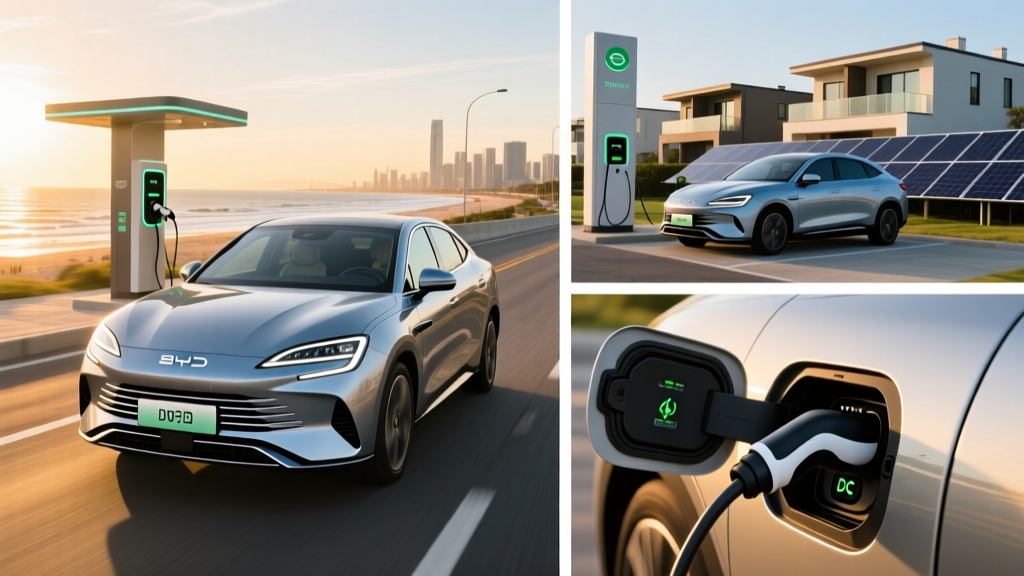
BYD's expansion into global markets has brought vehicles like the Atto 3, Dolphin, and Seal to regions spanning Southeast Asia, Australia, Europe, and Latin America. The BYD Sealion 5 (marketed in some regions as the Song Plus EV or under related nameplates) slots into the compact electric SUV segment — one of the most competitive categories in the EV space. This profile examines what we know about the Sealion 5's specifications, real-world usability, charging behavior, and how it stacks up against established rivals like the Hyundai Ioniq 5, Tesla Model Y, and Volkswagen ID.4.
BYD Sealion 5 Core Specifications at a Glance
| Attribute | Specification |
|---|---|
| Battery Capacity | ~71.8 kWh usable (BYD Blade, LFP chemistry) |
| Claimed Range (WLTP) | ~440 km / ~273 miles (WLTP combined) |
| Estimated EPA-Equivalent Range | ~230–250 miles (estimated, not EPA-certified) |
| Motor Output | 150 kW (201 hp) single-motor FWD |
| 0–100 km/h (0–62 mph) | ~8.5 seconds |
| Max DC Fast Charge | ~90 kW peak |
| 10–80% DC Charge Time | ~30 minutes (claimed) |
| AC Level 2 Charging | 7 kW onboard charger (~25 mi/hr) |
| Drivetrain | Front-wheel drive (single motor) |
| Length / Wheelbase | ~4,705 mm / ~2,765 mm |
| Cargo Volume | ~574 L rear seats up (~20.3 cu ft) |
| International Price Range | AUD $49,990–$56,990 / €38,000–€44,000 (approx.) |
| Battery Warranty (Intl.) | 8 years / 160,000 km (~100,000 mi) |
Range and Efficiency: What to Expect in the Real World
The BYD Sealion 5 carries a 71.8 kWh usable battery pack built on BYD's proprietary Blade cell architecture. The Blade battery uses lithium iron phosphate (LFP) chemistry, which trades some energy density for superior thermal stability, longer cycle life, and reduced reliance on cobalt and nickel. For owners, this translates to a battery that degrades more slowly over thousands of charge cycles compared to typical NMC (nickel-manganese-cobalt) packs — a meaningful advantage for long-term ownership.
WLTP Combined: ~440 km (~273 miles)
Estimated EPA-Equivalent: ~230–250 miles (WLTP figures are typically 10–15% more optimistic than EPA testing)
Real-World Highway (70 mph): Expect ~190–215 miles in moderate temperatures
Cold-Weather (below 32°F / 0°C): Expect ~160–185 miles — LFP chemistry is more susceptible to cold-weather range loss than NMC, often losing 25–35% of rated range in freezing conditions without preconditioning
Efficiency lands in the neighborhood of ~3.8–4.2 miles per kWh (roughly equivalent to ~95–105 MPGe combined) based on international testing reviews. This is competitive but not class-leading — the Hyundai Ioniq 5 Standard Range achieves around 114 MPGe combined, while the Tesla Model Y RWD reaches approximately 123 MPGe. The Sealion 5's slightly heavier curb weight and less aerodynamic profile compared to the Ioniq 5 account for the gap.
For daily commuting under 60 miles round-trip with home charging, the Sealion 5's range is more than sufficient. Road-trippers should plan charging stops every 180–200 miles to stay comfortable, especially in winter or at sustained highway speeds above 70 mph.
Charging Performance: DC Fast Charging and Home Setup
Charging speed is where the Sealion 5 reveals one of its most significant limitations relative to the competition. The vehicle peaks at approximately 90 kW on DC fast charging, which is modest by 2026 standards. Consider the context:
| Metric | BYD Sealion 5 | Hyundai Ioniq 5 | Tesla Model Y |
|---|---|---|---|
| Peak DC Rate | ~90 kW | ~240 kW | ~250 kW |
| 10–80% Time | ~30 min | ~18 min | ~20 min |
| AC Level 2 Rate | 7 kW | 10.9 kW | 11.5 kW |
| Miles Added per Hour (L2) | ~25 mi/hr | ~38 mi/hr | ~44 mi/hr |
The 90 kW peak means you will not fully utilize the 150 kW or 350 kW chargers now common on networks like Electrify America or EVgo. On a 350 kW stall, the Sealion 5 will still draw only its ~90 kW maximum. The 10–80% charge in roughly 30 minutes is adequate for planned stops but noticeably slower than rivals that can add 200+ miles of range in 15–18 minutes.
The LFP battery does offer one charging advantage: BYD recommends periodic charging to 100% State of Charge (SoC) for battery calibration, unlike NMC packs where daily 80% limits are preferred to slow degradation. This means Sealion 5 owners can use the full 71.8 kWh capacity more freely without the long-term health concerns associated with NMC chemistry at high SoC.
At home on a Level 2 charger (240V, 7 kW), a full charge from near-empty takes approximately 10–11 hours. This is sufficient for overnight replenishment but slower than the 7–8 hour full charges possible with vehicles equipped with 10–11 kW onboard chargers. Home charging installation for a 240V/40A circuit typically costs $800–$2,500 depending on panel capacity and run length — consult a licensed electrician for a site-specific quote.
Performance and Driving Dynamics
The Sealion 5 uses a single front-mounted motor producing 150 kW (201 horsepower) and approximately 310 Nm (229 lb-ft) of torque. The 0–100 km/h sprint takes around 8.5 seconds, which translates to a 0–60 mph time in the low-to-mid 8-second range. This is adequate for highway merging and city driving but falls well short of the performance offered by dual-motor competitors (the Ioniq 5 AWD does 0–60 in ~4.5 seconds; the Model Y Long Range AWD in ~4.8 seconds).
Ride quality reviews from international markets describe the Sealion 5 as tuned for comfort rather than sportiness. The suspension absorbs urban bumps competently, and cabin noise levels are well-managed at city speeds. At highway velocities above 110 km/h (~68 mph), some wind noise around the A-pillars has been noted in independent reviews. Regenerative braking offers adjustable levels, though the maximum regen setting does not provide true one-pedal driving to a complete stop — you will still need the friction brake for the final halt, which may disappoint drivers accustomed to strong regen in vehicles like the Nissan Leaf or Chevrolet Bolt.
Interior, Technology, and Cargo Practicality
The Sealion 5's cabin follows BYD's current design language: a large 15.6-inch rotating central touchscreen (landscape for media, portrait for navigation) dominates the dashboard. The infotainment system runs BYD's DiLink software, which supports wireless Apple CarPlay and Android Auto in most markets. A 10.25-inch digital instrument cluster sits behind the steering wheel. Build quality has improved markedly over earlier BYD models, with soft-touch materials on the dashboard and door uppers, though some lower trim pieces use harder plastics.
Passenger and cargo dimensions:
- Front headroom: ~1,000 mm (~39.4 in)
- Rear legroom: ~940 mm (~37.0 in) — generous for the segment
- Cargo behind rear seats: ~574 L (~20.3 cu ft)
- Cargo with rear seats folded: ~1,470 L (~51.9 cu ft)
- No front trunk (frunk) — the space is occupied by power electronics
Compared to the Tesla Model Y (~30.2 cu ft behind rear seats) and Hyundai Ioniq 5 (~27.2 cu ft), the Sealion 5 offers less cargo volume. This is a meaningful trade-off for families who regularly haul strollers, luggage, or bulk groceries.
Driver-assistance technology includes BYD's DiPilot suite: adaptive cruise control, lane-keeping assist, automatic emergency braking, and blind-spot monitoring. These constitute SAE Level 1–2 driver assistance — the driver must remain fully engaged at all times. The system is functional but has received middling reviews from international testers who note that lane-centering can be hesitant on curves and that adaptive cruise following distance calibration feels conservative compared to Tesla Autopilot or Hyundai's Highway Driving Assist.
Pricing, Tax Credits, and Ownership Economics
In international markets, the BYD Sealion 5 is positioned as a value-oriented electric SUV:
- Australia: AUD $49,990–$56,990 (approx. USD $32,000–$36,500 at early-2026 exchange rates)
- Europe: €38,000–€44,000 (approx. USD $41,000–$47,500)
- Southeast Asia: Pricing varies significantly by market and local incentives
Because BYD does not sell the Sealion 5 in the United States, the vehicle is not eligible for the IRS §30D New Clean Vehicle Credit. Even if it were available, several factors would likely disqualify it:
- Battery sourcing: BYD manufactures its own Blade cells in China. Under current §30D rules, battery components and critical minerals must meet escalating domestic-content and free-trade-agreement thresholds that Chinese-sourced batteries cannot satisfy.
- MSRP caps: SUVs must be priced below $80,000 MSRP — the Sealion 5 would likely clear this threshold.
- Buyer income caps: AGI limits of $150,000 (single) / $300,000 (joint) apply.
US buyers interested in BYD's technology should monitor whether the company announces a North American launch, though as of 2026, no such plan has been confirmed.
For buyers in markets where the Sealion 5 is available, total cost of ownership is favorable compared to internal-combustion compact SUVs. Electricity costs at an average of $0.15/kWh translate to roughly $0.04–$0.05 per mile, versus $0.12–$0.15 per mile for a gasoline compact SUV at $3.50/gallon and 28 MPG combined. Over 5 years and 75,000 miles, fuel savings alone could reach $6,000–$7,500 depending on local electricity rates and driving patterns.
BYD's international battery warranty covers 8 years / 160,000 km (~100,000 miles) with a capacity retention threshold typically set at 70% of original capacity. This is comparable to the 8-year/100,000-mile warranties offered by Hyundai, Kia, and Tesla, though some competitors guarantee 70% while others specify 65–70%.
How the Sealion 5 Compares to Key Rivals
For buyers in markets where both the Sealion 5 and its competitors are available, the decision often comes down to priorities:
✅ BYD Sealion 5 Strengths
- LFP Blade battery — superior thermal safety and longer cycle life
- Competitive pricing undercuts many rivals by 10–20%
- Comfortable ride quality for city and suburban driving
- Generous rear-seat legroom
- 100% SoC charging recommended (full usable capacity daily)
❌ BYD Sealion 5 Weaknesses
- 90 kW DC fast charging is slow for the class
- No AWD or dual-motor option available
- Smaller cargo area than Model Y and Ioniq 5
- Driver-assist refinement lags behind Hyundai and Tesla
- No US availability and unlikely to qualify for §30D credit
- LFP cold-weather range loss is significant
Choose the BYD Sealion 5 if: you prioritize long-term battery longevity, want a comfortable commuter SUV at a value price, and primarily drive in moderate climates where LFP cold-weather penalties are minimal.
Choose the Hyundai Ioniq 5 or Tesla Model Y if: you need fast DC charging for road trips, want AWD availability, need maximum cargo space, or require a mature driver-assistance system.
Frequently Asked Questions
What is the real-world range of the BYD Sealion 5?
The WLTP-rated range is approximately 440 km (~273 miles). Real-world highway driving in moderate temperatures yields roughly 190–215 miles. In freezing conditions, expect 160–185 miles due to LFP chemistry's sensitivity to cold. Always plan trips around the lower real-world figure, not the sticker number.
How fast does the BYD Sealion 5 charge?
On DC fast charging, it peaks at ~90 kW, achieving a 10–80% charge in approximately 30 minutes. At home on a Level 2 (240V, 7 kW) charger, expect about 25 miles of range added per hour, with a full charge taking 10–11 hours. These speeds are slower than class leaders like the Ioniq 5 (240 kW peak, 18-min 10–80%) and Model Y (250 kW peak, ~20-min 10–80%).
Does the BYD Sealion 5 qualify for the US federal EV tax credit?
No. The Sealion 5 is not sold in the United States as of 2026. Even if it were, its Chinese-manufactured BYD Blade battery would not meet the §30D battery-sourcing and critical-mineral requirements outlined by the IRS. Buyers in markets where it is sold should check local incentive programs.
Is the BYD Blade LFP battery better than NMC?
It depends on your priorities. LFP offers longer cycle life (3,000+ cycles vs. ~1,500–2,000 for NMC), better thermal stability (lower fire risk), and no cobalt. The trade-offs are lower energy density (heavier pack for the same kWh), more pronounced cold-weather range loss, and a slightly lower voltage that can make state-of-charge estimation less precise. For daily commuters in warm climates, LFP is an excellent choice. For road-trippers in cold regions, NMC may be more practical.
Is the BYD Sealion 5 worth buying over the Tesla Model Y or Hyundai Ioniq 5?
In markets where all three are available, the Sealion 5 wins on price and battery longevity but loses on charging speed, cargo space, AWD availability, and driver-assist sophistication. If your budget is tight and you primarily commute in moderate weather, the Sealion 5 is a strong value pick. If you road-trip frequently, need all-weather capability, or want the fastest charging, the Ioniq 5 or Model Y are better fits.
Sources: International specification data from BYD global and regional distributor publications. EPA-equivalent range estimates are derived from WLTP-to-EPA conversion ratios documented at fueleconomy.gov. US tax credit rules referenced from the IRS §30D guidance page. All specifications reflect the latest available data as of early 2026 and may vary by market and model year.