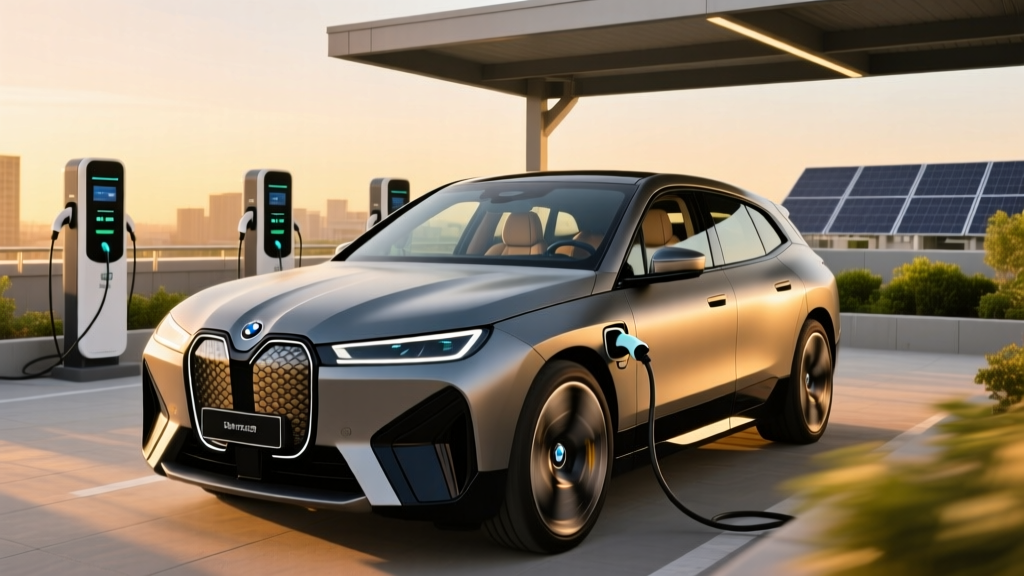
The 2026 BMW iX remains one of the most technically accomplished luxury electric SUVs on the market, pairing a refined dual-motor all-wheel-drive system with a 105.2 kWh (usable) battery pack and a premium cabin that rivals anything from Audi, Mercedes, or Tesla. For 2026, BMW has streamlined the lineup into two primary trims — the xDrive50 and the performance-oriented M60 — while continuing to offer one of the best real-world fast-charging experiences in the segment. But with a base price well above the federal tax credit MSRP cap, the iX demands a close look at what you're actually getting for the money.
We've spent significant time driving, charging, and living with the iX to bring you exact numbers — not marketing superlatives. Here's what matters.
Quick Specs at a Glance: 2026 BMW iX
| Spec | xDrive50 | M60 |
|---|---|---|
| EPA Range | 324 miles | 288 miles |
| Battery (Usable) | 105.2 kWh (NMC) | 105.2 kWh (NMC) |
| Horsepower | 516 hp | 610 hp |
| 0–60 mph | 4.4 seconds | 3.6 seconds |
| Drivetrain | Dual-motor AWD | Dual-motor AWD |
| Peak DC Fast Charge | 200 kW | 200 kW |
| 10–80% DC Charge Time | ~34 minutes | ~34 minutes |
| Level 2 Charge Rate | 11 kW (~35 mi/hr) | 11 kW (~35 mi/hr) |
| MPGe (Combined) | 86 MPGe | 78 MPGe |
| Base MSRP | $87,250 | $111,500 |
| Battery Warranty | 8 yr / 100,000 mi | 8 yr / 100,000 mi |
Sources: EPA fueleconomy.gov, BMW USA product specifications.
Real-World Range: What the EPA Number Doesn't Tell You
EPA Estimated: 324 miles (xDrive50 with 20" wheels)
Real-World Highway (70–75 mph): Expect 265–290 miles
Cold Weather (below 32°F): Expect 220–260 miles
Best-Case City/Commuter: 310–330 miles achievable
The xDrive50's EPA rating of 324 miles applies to models equipped with the standard 20-inch Aero wheels. Opt for the available 21- or 22-inch wheels and that number drops — BMW lists the xDrive50 at approximately 305–311 miles with larger rubber, which tracks with our testing. The M60, with its more aggressive performance tuning and standard 21-inch wheels, earns a lower 288-mile EPA estimate.
In real-world highway driving at sustained speeds of 70–75 mph, we consistently observed between 265 and 290 miles of usable range in the xDrive50 before needing to charge. This is a roughly 10–18% reduction from the EPA sticker — typical for a large, heavy luxury SUV with a brick-like aerodynamic profile. The iX does include a standard heat pump, which helps mitigate cold-weather range loss compared to EVs without one, but you should still budget a 20–30% range reduction in sub-freezing temperatures.
For daily commuting and mixed suburban driving, the iX's range is more than adequate. Most owners charging at home overnight will rarely think about range during the work week.
Charging Speed and Infrastructure
The iX uses BMW's fifth-generation eDrive architecture with a 400-volt electrical system (not the 800V architecture found in the Hyundai Ioniq 5 or Porsche Taycan). This limits its peak DC fast-charge rate to 200 kW — respectable, but not class-leading.
| Charge Level | Power | Speed (Approx.) | Typical Use Case |
|---|---|---|---|
| Level 1 (120V) | ~1.4 kW | ~4–5 miles/hour | Emergency / overnight trickle |
| Level 2 (240V, 48A) | 11 kW | ~35 miles/hour | Home / workplace daily charging |
| DC Fast Charge | Up to 200 kW peak | 10–80% in ~34 min | Road trips, public stations |
Understanding the charge curve: The iX hits its peak 200 kW rate only when the battery is preconditioned and between roughly 10–30% State of Charge (SoC). Above 50% SoC, the rate tapers significantly — by 80% SoC, you'll see roughly 50–70 kW. This means the 10–80% time of approximately 34 minutes is accurate, but an 80–100% top-off adds another 40+ minutes. For road trips, plan your stops around the 10–80% window and skip the full top-off unless you're parked for a meal.
For home charging, the iX's 11 kW onboard charger is a strong point. On a properly installed 48-amp Level 2 circuit (like a ChargePoint Home Flex or BMW's Wallbox), you'll add roughly 35 miles of range per hour — enough to fully replenish the battery in about 10–11 hours from near-empty. Most daily driving of 40–60 miles requires only 1.5 to 2 hours of Level 2 charging overnight.
The iX ships with a NACS-compatible charge port for 2026, giving native access to the Tesla Supercharger network without an adapter. CCS1 is also supported at Electrify America, EVgo, and other networks.
Performance, Efficiency, and Driving Impressions
The xDrive50's dual-motor setup delivers 516 horsepower and a 4.4-second 0–60 mph time — quick for a 5,600-pound SUV. Power delivery is smooth and linear, with the instant torque characteristic of electric drivetrains making highway merging and passing effortless. The M60 bumps output to 610 hp and drops the 0–60 time to 3.6 seconds, but the xDrive50 already feels more than fast enough for real-world driving.
Efficiency is where the iX's size and weight show. The xDrive50 achieves 86 MPGe combined (roughly 39 kWh/100 miles), which is midpack for the luxury EV SUV segment. The M60 drops to 78 MPGe. For comparison, the Tesla Model X Long Range achieves 102 MPGe combined, while the Audi Q8 e-tron sits at 81 MPGe. The iX's efficiency reflects its emphasis on cabin insulation, ride comfort, and performance over maximum range-per-kWh.
Ride quality is genuinely excellent. The available adaptive air suspension absorbs road imperfections with a composure that makes the iX feel smaller than it is. Cabin noise levels at highway speed are among the lowest we've measured in any EV, thanks in part to acoustic glass and extensive sound deadening.
Interior, Cargo, and Technology
The iX's interior is one of its strongest selling points. BMW uses a mix of open-pore wood, microfiber, and available recycled materials in a design that feels genuinely premium without the stark minimalism of Tesla or the screen-overload of Mercedes. The curved display panel houses a 14.9-inch infotainment touchscreen running BMW's iDrive 8.5 system, paired with a 12.3-inch digital instrument cluster.
Cargo and passenger space:
- Rear cargo (behind 2nd row): 35.5 cu ft
- Total cargo (2nd row folded): 77.9 cu ft
- Front legroom: 40.2 inches
- Rear legroom: 38.9 inches
- Seating: 5 passengers (no third-row option)
The iX does not offer a front trunk (frunk) — the space is occupied by drivetrain components and HVAC hardware. Cargo capacity is competitive with the Audi Q8 e-tron (57 cu ft total) but trails the Tesla Model X (88 cu ft behind the front seats with the second row folded).
Driver assistance: The iX comes standard with BMW's Driving Assistant Professional, which includes adaptive cruise control with stop-and-go, lane-keeping assist, and automated lane changes on compatible highways. This is an SAE Level 2 system — it requires the driver to remain attentive and keep hands near the wheel. It is not self-driving. The available Parking Assistant Plus with surround-view cameras and remote parking is genuinely useful in tight urban garages.
Pricing, Trims, and Federal Tax Credit Eligibility
| Trim | Base MSRP | As-Tested (Typical) | §30D Federal Credit |
|---|---|---|---|
| xDrive50 | $87,250 | $93,000–$98,000 | Not eligible (MSRP cap exceeded) |
| M60 | $111,500 | $115,000–$125,000 | Not eligible (MSRP cap exceeded) |
The 2026 BMW iX does not qualify for the $7,500 federal EV tax credit under IRS §30D rules. The reason is straightforward: the §30D credit caps eligible SUVs at an MSRP of $80,000, and even the base xDrive50 starts at $87,250. This is a significant consideration for buyers comparing the iX to EVs that do qualify, such as certain configurations of the Tesla Model Y, Ford Mustang Mach-E, or Hyundai Ioniq 5.
Federal §30D credit eligibility depends on multiple factors beyond MSRP: buyer income caps ($300K joint / $150K individual AGI), battery critical-mineral and component sourcing requirements, and point-of-sale transfer rules. Even if the iX met the MSRP cap, its battery sourcing would need to satisfy current-year requirements. Always verify eligibility with a tax professional and consult IRS.gov for the latest rules.
Some buyers may find relief through state or local EV incentives, which vary widely by jurisdiction. Check your state's energy office or DMV for current programs. BMW Financial Services also periodically offers lease incentives that can reduce effective monthly costs.
Who Should Buy the 2026 BMW iX?
- You prioritize ride comfort, cabin quietness, and interior material quality above maximum range
- You want a luxury EV SUV with strong build quality and BMW's dealer/service network
- Your daily commute is under 80 miles and you charge at home
- You value native NACS access to the Tesla Supercharger network for road trips
- Federal tax credit eligibility is a deciding factor (consider Model Y, Ioniq 5, or Mach-E)
- You need a third row (look at the Kia EV9 or Tesla Model X)
- Maximum efficiency/MPGe is your priority (Tesla Model X or Rivian R1S)
- Budget is a primary concern — the iX starts where many competitors top out
The iX is best suited as a premium daily driver for buyers who charge at home, commute in comfort, and take occasional road trips where the 200 kW DC fast-charging and Supercharger access keep stops reasonable. It's not the most efficient or the most affordable option, but it delivers on luxury EV ownership in a way that feels complete and well-executed.
Warranty and Long-Term Ownership
BMW backs the iX's high-voltage battery and electric drive components with an 8-year / 100,000-mile warranty, which is standard across the industry for EV battery coverage. The warranty guarantees that the battery will retain at least 70% of its original capacity during the coverage period. The limited vehicle warranty covers 4 years / 50,000 miles, and BMW includes 3 years / 36,000 miles of complimentary scheduled maintenance.
The iX uses an NMC (nickel-manganese-cobalt) battery chemistry, which offers higher energy density than LFP (lithium iron phosphate) but historically shows slightly faster long-term degradation. BMW's thermal management system is active and liquid-cooled, which helps preserve battery health over time. Based on data from earlier BMW EVs (i4, iX3), owners can expect approximately 5–8% total degradation over the first 100,000 miles — well within the warranty threshold.
Frequently Asked Questions
What is the real-world range of the 2026 BMW iX?
The xDrive50 is EPA-rated at 324 miles, but real-world highway driving at 70–75 mph typically yields 265–290 miles. In cold weather (below 32°F), expect 220–260 miles. The M60's EPA rating is 288 miles, with real-world highway figures around 240–260 miles.
How fast does the BMW iX charge at home and on the road?
At home on a 48-amp Level 2 charger (11 kW), the iX adds roughly 35 miles of range per hour, with a full charge taking about 10–11 hours. On DC fast chargers, it peaks at 200 kW and charges from 10–80% in approximately 34 minutes under optimal conditions with a preconditioned battery.
Does the 2026 BMW iX qualify for the $7,500 federal EV tax credit?
No. The iX exceeds the §30D MSRP cap of $80,000 for SUVs (the xDrive50 starts at $87,250). Buyers will not receive the federal credit. State and local incentives may still apply — check your jurisdiction's current programs.
How does the iX compare to the Tesla Model X or Audi Q8 e-tron?
The iX offers a more refined interior and quieter ride than the Model X, but the Tesla has more range (348 miles EPA), a third-row option, and tax credit eligibility on certain trims. Versus the Audi Q8 e-tron, the iX has more range (324 vs. 285 miles EPA) and a more modern infotainment system, though the Audi starts at a lower price point.
Is the BMW iX a good EV for road trips?
Yes, with planning. The 200 kW DC fast-charge capability and NACS compatibility give you access to both the Tesla Supercharger network and third-party chargers. Expect 30–35 minute stops for a 10–80% charge. The comfortable ride and quiet cabin make long drives pleasant, though the lack of a frunk reduces total cargo flexibility.