The BYD Atto 3 (sold as the Yuan Plus in China) is one of the best-selling electric vehicles globally, with over a million units delivered across Asia, Europe, and Australia. But for US-based shoppers in 2026, the Atto 3 remains a compelling what-if: a practical compact crossover with BYD's proven Blade LFP battery, competitive range, and aggressive pricing in export markets. This review breaks down every spec that matters — range, charging, battery chemistry, performance, and pricing — while addressing the critical question of US availability and federal tax credit eligibility.
Quick Verdict: A Global Bestseller Locked Out of the US Market
The BYD Atto 3 is a well-executed compact electric crossover that punches above its price class in build quality, battery technology, and interior space. Its 60.48 kWh LFP Blade battery delivers strong longevity with minimal degradation, and the 201-hp front motor provides adequate acceleration for daily driving. However, as of 2026, BYD does not sell the Atto 3 in the United States, and the company has not announced a US launch timeline. American buyers researching this model are most likely considering import options, living abroad, or comparing it against US-market alternatives like the Hyundai Kona Electric, Chevrolet Equinox EV, or Nissan Ariya.
Range, Battery, and Efficiency
Real-World Expectation: In mixed driving, expect approximately 200–220 miles. Highway-only driving at 70+ mph reduces range to roughly 175–190 miles. In cold weather (below 32°F / 0°C), LFP chemistry experiences a more pronounced range dip than NMC — plan for a 25–35% reduction, bringing usable range to 145–165 miles without preconditioning.
BYD equips the Atto 3 Extended Range with a 60.48 kWh (gross) lithium iron phosphate (LFP) Blade battery. The Blade cell format — long, thin prismatic cells arranged in a structural pack — is BYD's signature technology and offers key advantages: superior thermal stability (LFP is far less prone to thermal runaway than NMC), a longer cycle life (BYD claims 3,000+ cycles before 80% capacity retention), and lower material cost since it uses no cobalt or nickel.
The trade-off is lower energy density. LFP packs are heavier and bulkier than equivalent NMC packs, which is why the Atto 3's 60.48 kWh battery yields less range than, say, the Hyundai Kona Electric's 65 kWh NMC pack (EPA 261 miles). The Atto 3 also lacks a heat pump in some export markets — a critical omission for cold-climate buyers — though heat-pump-equipped versions are available in Europe and Australia.
| Spec | Value |
|---|---|
| Battery (gross) | 60.48 kWh, LFP Blade |
| WLTP Range | 261 mi (420 km) |
| Est. EPA-Equivalent Range | 215–235 mi |
| Motor | Single front motor, FWD |
| Power / Torque | 201 hp (150 kW) / 229 lb-ft |
| 0–62 mph (0–100 km/h) | 7.3 seconds |
| Max DC Charge Rate | 88 kW (peak) |
| 10–80% DC Charge Time | ~29 minutes |
| Level 2 AC Charge Rate | 7 kW (single-phase) / 11 kW (three-phase) |
| WLTP Efficiency | ~3.7 mi/kWh (~165 Wh/km) |
| Cargo Volume | 15.6 cu ft (rear seats up) / 46.9 cu ft (folded) |
| Length / Wheelbase | 175.6 in / 106.3 in |
| Curb Weight | ~3,726 lbs (1,690 kg) |
Charging: Adequate but Not Class-Leading
The Atto 3's 88 kW peak DC fast-charge rate is its most significant competitive weakness in 2026. While rivals like the Hyundai Kona Electric (peak 100+ kW on NMC trims) and the Chevrolet Equinox EV (peak ~150 kW) have moved to faster architectures, the Atto 3's LFP pack and 400-volt electrical system limit charge speeds.
| Level | Power | Speed | Notes |
|---|---|---|---|
| Level 1 (120V) | ~1.4 kW | ~4–5 mi/hr | Emergency/trickle only |
| Level 2 (240V, 7 kW) | 7 kW | ~22–25 mi/hr | Full charge in ~9 hours |
| Level 2 (240V, 11 kW) | 11 kW | ~35–38 mi/hr | Requires 3-phase power (rare in US homes) |
| DC Fast Charge | 88 kW peak | 10–80% in ~29 min | CCS2 in export markets; tapers sharply above 80% |
The charge curve is typical of LFP chemistry: the Atto 3 sustains near-peak power (80–88 kW) from roughly 10% to 55% state of charge, then tapers progressively. From 80% to 100%, charge speed drops below 25 kW, meaning that last 20% can take nearly as long as the 10–80% session. For road-trip planning, stick to 10–80% top-ups and plan 30-minute stops at 150+ kW chargers (the car will only draw what it can handle).
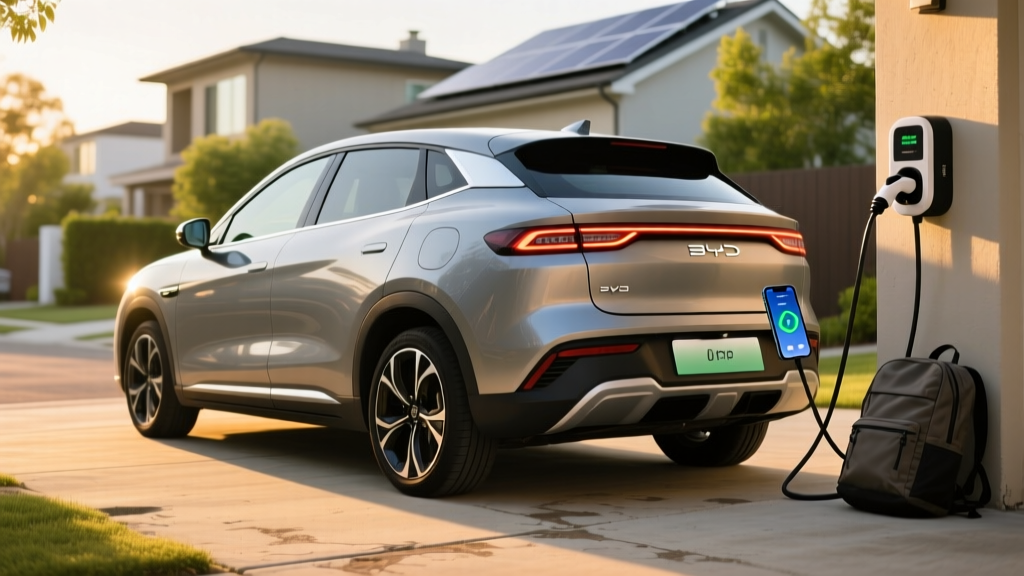
At home on a standard US 240V / 32A Level 2 circuit (7.7 kW available), the Atto 3 will accept its 7 kW single-phase maximum, adding roughly 23 miles of range per hour. An overnight charge from 20% to 100% takes about 10 hours — adequate for daily commuting but slower than the 11 kW onboard chargers found on some competitors.
Performance and Driving Dynamics
The Atto 3's single front-mounted motor produces 201 horsepower (150 kW) and 229 lb-ft of torque, delivering a 0–62 mph (0–100 km/h) time of 7.3 seconds (approximately 7.0 seconds for 0–60 mph). This is brisk enough for confident highway merging and city driving but trails the dual-motor AWD options available in competitors like the Nissan Ariya or Volkswagen ID.4.
Ride quality is tuned for comfort over sportiness. The MacPherson strut front / multi-link rear suspension absorbs bumps competently, and the 3,726-lb curb weight (heavy for a compact crossover, owing to the LFP pack) gives it a planted feel at highway speeds. Steering is light and numb — typical of the segment — and regenerative braking offers two levels plus a standard mode, though it does not enable true one-pedal driving to a full stop as some competitors do.
There is no AWD or dual-motor variant of the Atto 3. If you need all-wheel drive for snow or towing, this model is not the right fit.
Interior, Tech, and Cargo
The Atto 3's cabin is where BYD's value proposition becomes most apparent. The interior design — themed around a "muscle fiber" aesthetic with gym-inspired elements like dumbbell-shaped air vents and guitar-string door trim — is polarizing but undeniably distinctive. Material quality exceeds expectations for the price point, with soft-touch surfaces on the dashboard and door uppers.
The centerpiece is a 12.8-inch rotating touchscreen (it pivots between landscape and portrait orientation) running BYD's DiLink infotainment system. Wireless Apple CarPlay and Android Auto are supported on most export trims. A 5-inch digital instrument cluster sits behind the steering wheel, and a panoramic glass roof is standard on higher trims.
Driver assistance includes adaptive cruise control, lane-keeping assist, automatic emergency braking, blind-spot monitoring, and rear cross-traffic alert — collectively branded as BYD's DiPilot system. This is an SAE Level 2 driver-assist system, meaning the driver must remain fully engaged with hands on the wheel and eyes on the road at all times. It is not autonomous driving.
Cargo space measures 15.6 cubic feet behind the rear seats and 46.9 cubic feet with the 60/40 split rear seats folded. Rear legroom is generous at approximately 37.4 inches, making the Atto 3 viable as a small family hauler. There is no front trunk (frunk).
Pricing, Tax Credits, and US Availability
As of 2026, BYD does not sell vehicles in the United States. The company has cited US tariffs on Chinese-manufactured vehicles (currently 100% on EVs under Section 301) as a barrier, and no US-market launch has been announced. Pricing below reflects export markets where the Atto 3 is available.
| Market | Trim | Price (Local) | Approx. USD |
|---|---|---|---|
| Australia | Standard Range | A$44,990 | ~$29,500 |
| Australia | Extended Range | A$49,990 | ~$32,800 |
| UK | Design | £37,695 | ~$47,500 |
| Germany | Comfort | €38,990 | ~$42,000 |
| China (as Yuan Plus) | 510 km Flagship | ¥149,800 | ~$20,600 |
Warranty and Battery Longevity
BYD provides competitive warranty coverage in its export markets, though terms vary by region:
- Vehicle warranty: 6 years / 93,000 miles (150,000 km) in most markets
- Battery warranty: 8 years / 124,000 miles (200,000 km), with a capacity retention threshold of 70%
- Drive unit warranty: 8 years / 124,000 miles (200,000 km)
The LFP Blade battery is the Atto 3's strongest longevity play. LFP chemistry is inherently more stable than NMC, with published data showing 85–90% capacity retention after 2,000 full charge cycles — equivalent to roughly 400,000+ miles in the Atto 3. BYD's 8-year battery warranty is on par with industry norms (Hyundai, Kia, and most legacy automakers offer 8yr/100,000mi in the US), but the underlying chemistry suggests the pack will outlast the warranty period by a wide margin.
Pros, Cons, and Key Competitors
Pros
- LFP Blade battery offers exceptional cycle life and thermal safety
- Competitive interior quality and tech for the price
- Spacious rear seat and cargo area for a compact crossover
- Low running costs in export markets with affordable electricity
- Distinctive interior design stands out in a homogeneous segment
Cons
- Not available in the United States; no US launch announced
- 88 kW peak DC charging is slow for 2026 standards
- No AWD or dual-motor option
- LFP range drops significantly in cold weather without a heat pump
- US 100% tariff on Chinese EVs makes import economically unviable
- No EPA certification; real-world range is estimated, not verified
US-Market Alternatives to Consider
If you're drawn to the Atto 3's value proposition but need a vehicle you can actually buy and service in the US, these are the closest competitors:
- Hyundai Kona Electric (2026): EPA 261 mi, 65 kWh NMC, 100+ kW DC charging, ~$33,000 base, §30D eligible
- Chevrolet Equinox EV (2026): EPA 319 mi (3LT), 85 kWh NMC, ~150 kW DC charging, ~$33,000 base, §30D eligible
- Nissan Ariya (2026): EPA 289–304 mi, 91 kWh NMC, 130 kW DC charging, ~$40,000 base, §30D eligible on select trims
Who Is the BYD Atto 3 Best Suited For?
The Atto 3 is ideal for urban and suburban commuters in markets where it's sold — particularly those with access to home Level 2 charging and mild climates where LFP's cold-weather penalty is minimized. It works well as a primary family vehicle for households that don't need AWD or frequent 300+ mile road trips. The 88 kW charge speed is manageable for daily use but means road-trip charging stops will be 10–15 minutes longer than in faster-charging competitors.
For US-based buyers, the Atto 3 serves best as a benchmark: it shows what a well-priced, LFP-equipped compact EV looks like globally, and it highlights the competitive pressure that US-market models face. If BYD ever resolves its US market-entry barriers (tariffs, dealership infrastructure, parts supply), the Atto 3 could disrupt the segment — but as of 2026, that remains hypothetical.
Frequently Asked Questions
What is the real-world range of the BYD Atto 3?
The WLTP-rated range is 261 miles for the 60.48 kWh Extended Range variant. In real-world mixed driving, expect 200–220 miles. Highway driving at sustained speeds above 70 mph yields approximately 175–190 miles, and cold weather (below freezing) can reduce range to 145–165 miles due to LFP chemistry characteristics.
How fast does the BYD Atto 3 charge?
On a DC fast charger, the Atto 3 peaks at 88 kW and charges from 10% to 80% in approximately 29 minutes. At home on a 240V Level 2 charger (7 kW), it adds about 23 miles of range per hour, with a full charge taking roughly 9–10 hours.
Does the BYD Atto 3 qualify for the US federal EV tax credit?
No. The Atto 3 is not sold in the US, and even if imported, it would not qualify for the §30D credit due to the 100% Section 301 tariff on Chinese EVs and the battery-sourcing rules that exclude BYD as a foreign entity of concern. See IRS §30D guidelines for current rules.
Is the BYD Atto 3 worth buying vs. competitors?
In markets where it's sold (Australia, Europe, Southeast Asia), the Atto 3 offers strong value — its LFP battery longevity, interior quality, and space compete well against the MG ZS EV, Hyundai Kona Electric, and Kia Niro EV. For US buyers, it's not an option; the Hyundai Kona Electric and Chevrolet Equinox EV are the closest alternatives with similar pricing and US market support.
What is BYD's Blade battery, and is it safe?
The Blade battery uses lithium iron phosphate (LFP) cells in a long, thin prismatic format that BYD claims passes nail-penetration tests without thermal runaway. LFP chemistry is inherently more thermally stable than NMC, and the Blade format adds structural rigidity. Independent testing by Euro NCAP has awarded the Atto 3 a 5-star safety rating in Europe.
Can I import a BYD Atto 3 to the United States?
Technically possible through a Registered Importer (RI) under NHTSA rules, but economically impractical. The 100% Section 301 tariff alone would double the vehicle's cost, and the vehicle would need to be modified to meet US FMVSS standards (lighting, bumper, emissions labeling). Total landed cost would likely exceed $65,000–$75,000, making US-market alternatives far more sensible.