Is the Bobcat Electric Skid Steer the Right EV for Your Worksite?
The short answer: The Bobcat T7X electric compact track loader (the closest Bobcat offers to an "electric skid steer") is a zero-emission, battery-powered machine designed for indoor, noise-sensitive, and urban job sites. It pairs a ~62 kWh lithium-ion battery pack with electric drive motors delivering instantaneous torque comparable to a mid-range diesel skid steer. Base pricing starts around $85,000–$95,000 depending on configuration, with potential savings of $3,000–$6,000 annually in fuel and maintenance versus a diesel equivalent. However, it is not a consumer passenger EV — it's a commercial-grade machine, and buyers should evaluate it on worksite productivity, duty cycle, and charging infrastructure rather than highway range or consumer tax credits.
If you've been searching for a "bobcat electric skid steer," you're likely weighing whether electrifying your compact equipment fleet makes financial and operational sense. This guide breaks down what Bobcat currently offers in the electric skid-steer/compact-loader space, how the economics compare to diesel, and what first-time electric equipment buyers need to know before signing a purchase order.
What Bobcat Actually Offers: The T7X Electric Compact Track Loader
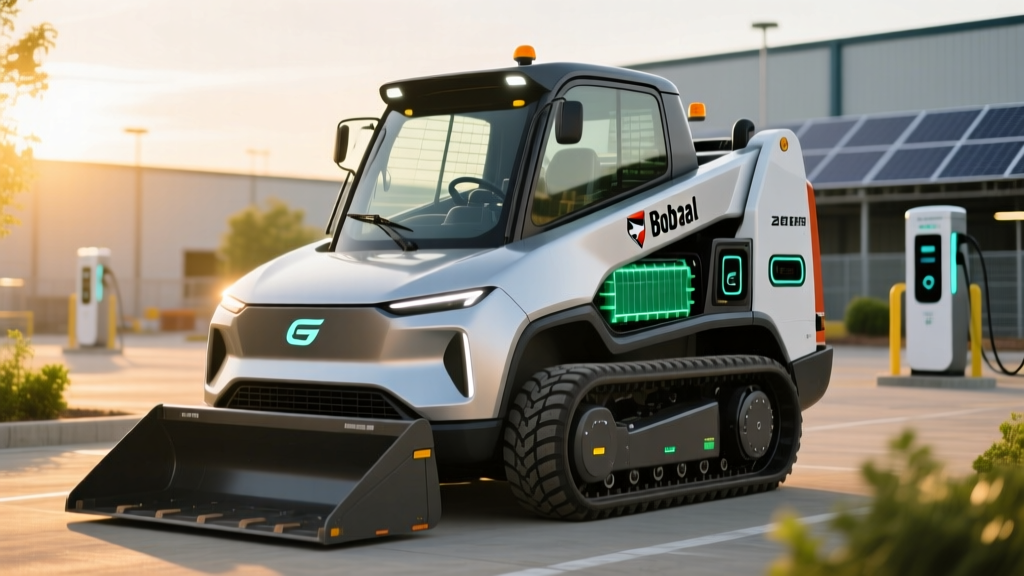
Bobcat does not currently sell a machine branded literally as an "electric skid steer." The product that most buyers are looking for is the Bobcat T7X, an all-electric compact track loader. Announced in concept form and progressing toward broader commercial availability, the T7X represents Bobcat's flagship push into battery-electric construction equipment.
Here's what we know from Bobcat's published specifications and industry reporting:
| Specification | Value |
|---|---|
| Battery Capacity | ~62 kWh lithium-ion (NMC chemistry) |
| Drive System | Electric motors — independent left/right track drive |
| Hydraulic System | Electric-driven hydraulics (no diesel engine) |
| Estimated Runtime | 4–6 hours typical duty cycle (varies heavily by attachment and load) |
| Charge Time (Level 2, ~19 kW) | ~3–4 hours from empty |
| Charge Time (DC Fast, if equipped) | ~1–2 hours (dependent on charger kW rating) |
| Operating Weight | ~9,000–10,000 lbs (with battery) |
| Rated Operating Capacity | Comparable to diesel Bobcat T76 (~2,100–2,400 lbs) |
| Emissions | Zero tailpipe — suitable for indoor/enclosed use |
| Noise Level | Significantly reduced vs. diesel (~75% lower at operator station) |
| Estimated Base Price | $85,000–$95,000 (configuration-dependent) |
Important caveat: Bobcat has been cautious with T7X availability. As of 2026, the machine has been deployed in limited commercial and demonstration programs rather than full open-market availability. Contact your local Bobcat dealer for current ordering status and lead times. Specifications listed above reflect the most recent published data and may shift with production updates.
Electric vs. Diesel Skid Steer: A Cost and Performance Comparison
The core buying decision comes down to whether the T7X's electric powertrain delivers enough productivity to justify its higher upfront cost. Here's a head-to-head comparison against a typical diesel compact track loader in the Bobcat lineup (such as the T76):
| Category | T7X Electric | T76 Diesel |
|---|---|---|
| Base Purchase Price | ~$90,000 | ~$55,000 |
| Fuel/Energy Cost (5 yrs, 1,500 hrs/yr) | ~$5,400 ($0.14/kWh avg, 8 kWh/hr avg) | ~$28,350 ($4.05/gal diesel, 4.7 gal/hr avg) |
| Maintenance (5 yrs) | ~$3,500 (no engine oil, filters, DEF, fewer moving parts) | ~$14,000 (oil changes, filters, DEF, coolant, engine service) |
| Estimated Downtime Cost | Lower (fewer scheduled service intervals) | Higher (engine-related maintenance events) |
| 5-Year Total Cost of Ownership | ~$98,900 | ~$97,350 |
| Indoor/Enclosed Use | Yes — zero emissions | No — requires ventilation |
| Noise-Sensitive Sites | Excellent — dramatically quieter | Poor — diesel noise limits |
The takeaway: At roughly 1,500 operating hours per year, the T7X's fuel and maintenance savings nearly close the $35,000 purchase-price gap within five years. For fleets running higher utilization (2,000+ hours/year) or operating in indoor environments where diesel is prohibited, the payback period shortens to 3–4 years. The break-even point is highly dependent on your local electricity rates, diesel prices, and duty cycle intensity.
Real-World Ownership: Charging, Runtime, and Worksite Considerations
Buying an electric skid steer or compact track loader introduces logistical questions that don't exist with diesel. Here's what first-time electric equipment buyers need to plan for:
Charging Infrastructure at the Job Site
Unlike a passenger EV that charges at home overnight, the T7X needs charging access at or near your worksite. Your options include:
- Depot charging (Level 2): Installing a 240V, ~19 kW Level 2 charger at your equipment yard. Expect $2,000–$6,000 for a commercial-grade EVSE installation, plus potential panel-upgrade costs if your facility's electrical service is already near capacity. A full charge takes approximately 3–4 hours.
- DC fast charging: Some commercial sites are installing DC fast chargers (50–150 kW) that can replenish the T7X battery in 1–2 hours. Installation costs are significantly higher ($15,000–$50,000+) and require 480V three-phase service.
- Portable generators/charging: For remote sites without grid power, you may need a diesel or solar generator to charge — which partially defeats the emissions benefit. Plan site logistics carefully.
Runtime Reality vs. Marketing Claims
Bobcat and industry sources cite 4–6 hours of runtime per charge, but this varies enormously based on:
- Attachment type: Running a hydraulic breaker or auger draws far more energy than light bucket work.
- Load factor: Continuous heavy lifting and travel drain the battery faster than intermittent use.
- Ambient temperature: Lithium-ion batteries lose 15–25% of usable capacity in freezing conditions (below 32°F / 0°C), just like passenger EVs. If you work in Minnesota winters, expect shorter shifts per charge.
- Operator behavior: Aggressive acceleration and high-speed travel consume more energy — the same physics that affect a Tesla on the highway.
Common Misconceptions About Electric Skid Steers
| Myth | Fact |
|---|---|
| "Electric machines don't have enough power for real work." | Electric motors deliver peak torque at zero RPM — the T7X matches or exceeds the breakout force and tractive effort of comparable diesel loaders in Bobcat's testing. |
| "You'll save $7,500 with the federal EV tax credit." | The IRS §30D clean vehicle credit applies to on-road passenger vehicles, not off-road construction equipment. Check with a tax professional about §45W commercial clean vehicle credits, which may apply to certain commercial equipment. |
| "Battery replacement will bankrupt you." | Bobcat designs the T7X battery for the machine's operational life. NMC lithium-ion packs in industrial applications typically retain 80%+ capacity after 3,000–5,000 charge cycles. At one cycle per day, that's 8–14 years of service. |
| "It charges as fast as filling a diesel tank." | Even with DC fast charging, plan for 1–2 hours of downtime to recharge. Diesel refueling takes minutes. Schedule charging during lunch breaks or shift changes. |
Who Should Buy the Bobcat T7X (and Who Shouldn't)
Not every fleet is a good candidate for electric compact equipment right now. Here's a practical decision framework:
Should You Go Electric?
Choose the T7X electric if:
- You work indoors, in warehouses, parking garages, or enclosed demolition sites where diesel exhaust is prohibited or requires costly ventilation.
- Your job sites are noise-restricted (hospitals, schools, residential neighborhoods, overnight urban work).
- You have predictable daily duty cycles under 4–5 hours and can charge at a depot overnight or mid-shift.
- You run 1,500+ hours per year, making fuel and maintenance savings substantial.
- Your company has sustainability/ESG mandates requiring fleet electrification.
Stick with diesel (T76 or equivalent) if:
- You work remote sites with no grid power and no practical charging solution.
- Your daily duty cycle regularly exceeds 6–8 hours of continuous heavy work.
- You need maximum hydraulic flow for high-demand attachments running all day.
- Your budget is strictly constrained and the $30,000–$35,000 price premium is prohibitive without a clear payback timeline.
- You operate in extreme cold climates where battery capacity loss would make the machine unproductive.
What First-Time Electric Equipment Buyers Must Know
If this is your first battery-powered machine, several ownership realities differ from diesel:
- Plan charging before you buy. Have a licensed electrician assess your depot's electrical capacity. A 240V/80A circuit for Level 2 charging may require a panel upgrade costing $3,000–$10,000 depending on your existing service.
- Understand kW vs. kWh. kW (kilowatts) is the rate of power delivery or charging speed. kWh (kilowatt-hours) is the energy stored in the battery — like the size of a fuel tank. The T7X's ~62 kWh battery is the "tank size"; a 19 kW Level 2 charger is the "pump speed."
- Budget for the charger, not just the machine. The EVSE (charging equipment) and installation are additional costs. Factor $2,000–$50,000 depending on Level 2 vs. DC fast charging and your site's electrical readiness.
- Check commercial clean vehicle incentives. While the consumer §30D credit doesn't apply, the IRS §45W commercial clean vehicle credit may offer up to $40,000 for qualifying commercial vehicles and equipment. Eligibility depends on weight, battery sourcing, and other criteria — consult a tax professional before relying on incentive projections.
- Monitor battery State of Health (SoH). Just like a Tesla or Rivian, the T7X battery will degrade over time. Request SoH reporting from Bobcat's telematics system and plan for gradual capacity loss rather than sudden failure.
Frequently Asked Questions
Does Bobcat make an electric skid steer I can buy today?
Bobcat's electric offering is the T7X compact track loader. As of 2026, availability has been limited to demonstration programs and select commercial deployments rather than broad open-market sales. Contact your local Bobcat dealer for the most current ordering information and expected lead times.
How much does the Bobcat T7X electric cost?
Estimated pricing is in the $85,000–$95,000 range depending on configuration and attachments. This is roughly $30,000–$35,000 more than a comparable diesel compact track loader like the Bobcat T76 (~$55,000 base). The price premium is offset by lower fuel and maintenance costs over the machine's life.
How long does the Bobcat T7X battery last on a charge?
Bobcat and industry reports indicate 4–6 hours of runtime per full charge under typical duty cycles. Heavy hydraulic attachment use (breakers, augers) will reduce runtime, while light material handling may extend it. Cold weather (below freezing) can reduce usable capacity by 15–25%.
Can I charge the T7X from a standard outlet?
Technically, Level 1 charging from a 120V outlet is possible but impractical — it would take 24+ hours to fully charge the ~62 kWh battery at ~1.4 kW. You'll need at minimum a 240V Level 2 charger (~19 kW, 3–4 hour charge time) for productive daily use.
Do I qualify for a federal tax credit on the Bobcat T7X?
The consumer §30D clean vehicle credit applies to on-road passenger vehicles and does not cover off-road construction equipment. However, the §45W commercial clean vehicle credit may apply to certain qualifying commercial equipment. Rules are complex and subject to change — always verify eligibility with a qualified tax professional before making purchase decisions based on incentives.
How does the T7X compare to electric skid steers from other brands?
Competitors like the Volvo ECR25 Electric (compact excavator) and machines from startups like Green Machine and Electric Site offer electric compact equipment, but the market is still early. Bobcat's advantage is its extensive dealer network, parts availability, and attachment ecosystem. Compare runtime, hydraulic flow rates, and dealer support — not just sticker price — when evaluating alternatives.