Quick Verdict: A Tech-Forward Cabin Backed by Serious EV Hardware
The BMW iX has always been an inside-out proposition. While the polarizing exterior grille draws debate, the BMW iX interior is where the brand's electric flagship earns its premium. For 2026, BMW has refined the cabin materials, expanded the curved display software, and maintained the spacious, lounge-like atmosphere that sets this midsize electric SUV apart from the Tesla Model X, Audi Q8 e-tron, and Mercedes EQE SUV.
But luxury is only half the equation. Buyers researching the iX also need hard data on range, charging speed, battery longevity, and tax-credit eligibility. This review covers the full ownership picture — cabin quality, real-world efficiency, DC fast-charging curves, and total cost — so you can decide whether the iX deserves a spot in your garage.
| Spec | xDrive45 | xDrive50 | M60 |
|---|---|---|---|
| EPA Range | ~312 mi | ~340 mi | ~300 mi |
| Battery (usable) | ~100 kWh (NMC) | ~105 kWh (NMC) | ~105 kWh (NMC) |
| Horsepower | 402 hp | 516 hp | 610 hp |
| 0-60 mph | 4.9 sec | 4.4 sec | 3.6 sec |
| Drivetrain | Dual-motor AWD | Dual-motor AWD | Dual-motor AWD |
| Peak DC Charge | ~175 kW | ~195 kW | ~195 kW |
| 10-80% DCFC Time | ~34 min | ~31 min | ~31 min |
| Level 2 (11 kW) | ~28 mi/hr | ~30 mi/hr | ~30 mi/hr |
| MPGe (combined) | ~86 MPGe | ~87 MPGe | ~78 MPGe |
| Base MSRP | $87,250 | $92,250 | $111,500 |
Inside the BMW iX Interior: Materials, Layout, and First Impressions
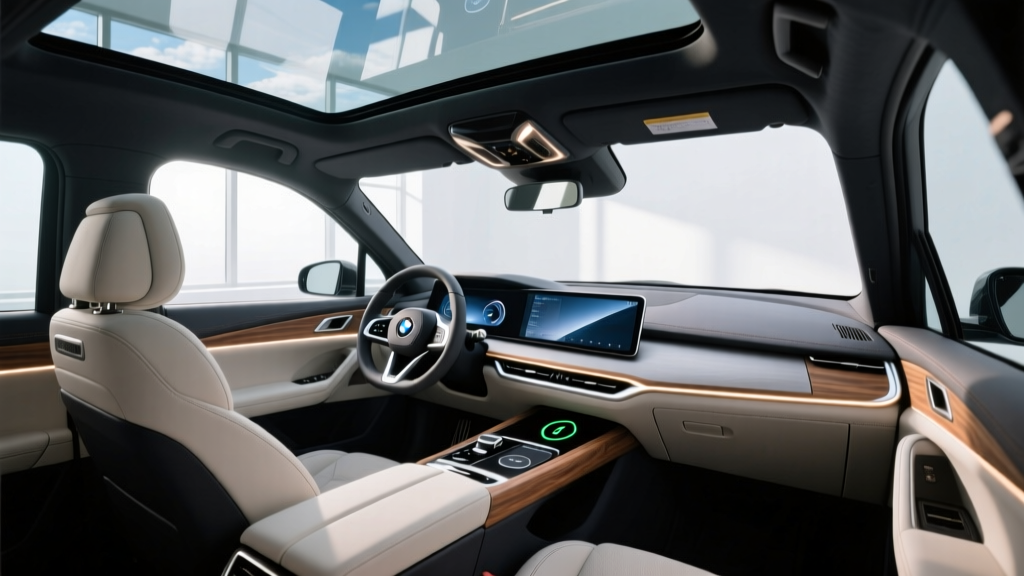
Slide into the driver's seat and the iX immediately communicates "lounge, not cockpit." BMW eliminated the traditional center tunnel — a packaging freedom unique to dedicated EV platforms — creating an open, airy footwell and a floating center console that stores a surprising amount of gear. The hexagonal steering wheel (standard on most trims) takes a day to get used to but frames the 14.9-inch curved infotainment display cleanly.
Material quality is a clear step above the Tesla Model X and competitive with the Mercedes EQE SUV. Standard Sensafin synthetic upholstery feels supple and avoids the weight and ethical concerns of animal leather; optional Merino leather is available for buyers who prefer the real thing. Open-pore wood trim, knurled aluminum controls, and available microfiber headliner trim reinforce the premium positioning.
The BMW Curved Display runs iDrive 8.5 (updated for 2026), combining a 12.3-inch instrument cluster and 14.9-inch central touchscreen under a single glass panel. Wireless Apple CarPlay and Android Auto are standard, as is the BMW Digital Key Plus, which lets your phone or smartwatch act as the key fob via ultra-wideband.
Passenger and Cargo Space
Despite its sloping roofline, the iX offers generous room for five adults:
- Front legroom: 40.2 inches
- Rear legroom: 38.9 inches
- Rear headroom: 37.8 inches (adequate for 6-foot passengers)
- Cargo behind rear seats: 35.5 cu ft
- Cargo with seats folded: 77.9 cu ft
Notably, the iX has no front trunk (frunk) — BMW uses that space for power electronics and HVAC components. If maximum cargo flexibility is a priority, the Rivian R1S and Tesla Model X offer more total volume, though neither matches the iX on cabin refinement.
Real-World Range vs. EPA Estimates
EPA Estimate (xDrive50): ~340 miles
Real-World Expectation: 270–310 miles highway (70-80 mph); 230–260 miles in sub-freezing temperatures with cabin heat.
The xDrive50's ~105 kWh usable NMC (nickel-manganese-cobalt) battery delivers an EPA-estimated 340 miles on the combined cycle — one of the strongest figures in the luxury electric SUV segment. According to fueleconomy.gov, the xDrive50 achieves approximately 87 MPGe combined, translating to roughly 35 kWh per 100 miles.
On a real-world highway loop at 75 mph in moderate temperatures (60–75°F), expect to see approximately 290–310 miles before the battery buffer engages. Push speeds to 80+ mph or drive into sustained headwinds, and 270 miles is more realistic. In winter conditions below 30°F, range drops to approximately 230–260 miles — a 20–30% reduction typical of NMC chemistry without aggressive cabin preconditioning.
The iX includes a heat pump as standard equipment, which recovers waste heat from the powertrain to warm the cabin more efficiently than resistive heating. Always precondition the battery and cabin while plugged in before a cold-weather departure to minimize range loss.
Charging Speed: DC Fast Charge and Home Level 2
The iX uses the CCS1 connector standard across most non-Tesla EVs in North America. BMW quotes a peak DC fast-charge rate of up to 195 kW on the xDrive50 and M60, though sustained rates vary based on state of charge, ambient temperature, and battery preconditioning.
| Charging Level | Power / Rate | Miles Added per Hour | Notes |
|---|---|---|---|
| Level 1 (120V) | ~1.4 kW | ~3–4 mi/hr | Emergency/top-off only |
| Level 2 (240V, 48A) | 11 kW | ~28–30 mi/hr | Full charge in ~10–11 hours |
| DC Fast Charge | Up to 195 kW | ~600+ mi/hr (peak) | 10–80% in ~31 min |
Understanding the charge curve: The iX peaks near 195 kW only between roughly 10–35% state of charge. From 35–60%, expect sustained rates around 140–160 kW; above 80%, the rate tapers sharply to protect battery longevity (dropping below 50 kW). This is why manufacturers quote 10–80% times rather than full charges — charging from 80–100% can add another 25–30 minutes.
For home charging, the iX's onboard 11 kW AC charger is a strong point. A full overnight charge from near-empty takes roughly 10–11 hours on a 48-amp Level 2 wallbox (such as a ChargePoint Home Flex or BMW Wallbox). Most daily driving requires far less — a 100-mile commute replenishes in under 4 hours.
Home installation note: A 48-amp charger requires a dedicated 60-amp circuit. Professional installation typically runs $800–$2,500 depending on panel proximity and local permitting. Homes with older 100-amp electrical panels may need a $2,000–$4,000 panel upgrade. Always consult a licensed electrician for a site assessment.
Performance, Ride Quality, and Driver Assistance
Even the base xDrive45 delivers 402 horsepower and a 4.9-second 0-60 time — brisk for a 5,600-pound SUV. The xDrive50's 516 hp drops that to 4.4 seconds, while the M60's 610 hp and sport-tuned suspension cut it to 3.6 seconds, firmly in sports-sedan territory.
All trims feature dual-motor all-wheel drive with rear-biased torque distribution. Air suspension is standard on the xDrive50 and M60 (optional on xDrive45), providing up to 1.2 inches of adjustable ride height — useful for steep driveways or light off-pavement use. The iX is rated to tow up to 3,500 pounds with the factory hitch, adequate for a small boat or utility trailer but less than the Rivian R1S (7,700 lbs).
Driver Assistance: Level 2, Not Self-Driving
SAE Automation Level: 2 — The BMW Driving Assistant Professional provides hands-on-lane centering, adaptive cruise, and automatic lane changes on highways, but the driver must remain fully engaged and supervising at all times. This is not autonomous driving.
The available Highway Assistant (on equipped models) allows hands-off driving at speeds up to 85 mph on divided highways, provided the driver's eyes remain on the road (monitored via infrared camera). This is competitive with GM's Super Cruise and Ford's BlueCruise. However, the system disengages in construction zones, on undivided roads, and in heavy precipitation — typical Level 2 limitations.
Pricing, Trims, and Federal Tax Credit Eligibility
The 2026 BMW iX lineup starts at $87,250 for the xDrive45 (including destination) and climbs to $111,500 for the performance-oriented M60. A well-equipped xDrive50 — the volume seller and best range/performance balance — typically lands between $95,000 and $105,000 after options like the Premium Package, 22-inch wheels, and Bowers & Wilkins audio.
| Trim | Base MSRP | §30D Federal Credit | Effective Price |
|---|---|---|---|
| xDrive45 | $87,250 | Up to $7,500* | ~$79,750* |
| xDrive50 | $92,250 | Up to $7,500* | ~$84,750* |
| M60 | $111,500 | Up to $7,500* | ~$104,000* |
*Eligibility depends on buyer income, battery-sourcing compliance, and MSRP caps. See IRS rules below.
Does the BMW iX Qualify for the §30D Federal Tax Credit?
The iX is a candidate for the full $7,500 federal EV tax credit under IRS §30D, but eligibility is not automatic. Key requirements for 2026:
- MSRP Cap: SUVs must have an MSRP at or below $80,000. The base xDrive45 at $87,250 exceeds this cap, meaning no trim of the 2026 iX currently qualifies for the new-vehicle §30D credit based on MSRP alone.
- Buyer Income Cap: Modified adjusted gross income must not exceed $150,000 (single), $225,000 (head of household), or $300,000 (joint).
- Battery Sourcing: Critical minerals and battery components must meet escalating domestic-content thresholds. BMW sources cells from multiple suppliers; compliance varies by build date.
- Point-of-Sale Transfer: If eligible, the credit can be transferred to the dealer at purchase, reducing the out-of-pocket price immediately rather than waiting for a tax refund.
Because the iX's MSRP exceeds the $80,000 SUV cap, buyers should not count on the $7,500 credit. Always verify current eligibility on IRS.gov and consult a tax professional before purchasing. Some state and utility incentives may still apply — check your local program.
Battery Longevity, Warranty, and Ownership Costs
BMW equips the iX with an NMC (nickel-manganese-cobalt) lithium-ion battery pack. NMC offers higher energy density than LFP (lithium iron phosphate), enabling the iX's strong range in a relatively compact package, but it is more sensitive to sustained high-state-of-charge storage and extreme heat.
Battery best practices: Set your daily charge limit to 80–90% and reserve 100% charges for road trips. BMW's iDrive system allows you to schedule charging windows and departure preconditioning, which reduces calendar degradation by minimizing time spent at full charge.
Warranty coverage:
- High-voltage battery: 8 years / 100,000 miles (capacity retention threshold: 70% of original)
- Powertrain/electric drive: 8 years / 100,000 miles
- Basic vehicle: 4 years / 50,000 miles
- Corrosion: 12 years / unlimited miles
If the battery degrades below 70% capacity within the warranty period, BMW will repair or replace modules to restore it above that threshold. Out-of-warranty replacement for a ~105 kWh NMC pack currently ranges from $18,000 to $28,000 depending on labor and module availability — a figure worth factoring into long-term ownership plans.
Insurance premiums for the iX run 15–25% higher than comparable gas-powered BMW X5 models, reflecting the vehicle's repair complexity and parts cost. Expect annual premiums in the $2,800–$4,200 range depending on your profile and location.
How the iX Compares to Key Rivals
The luxury electric SUV segment is crowded. Here's how the iX stacks up on the metrics that matter:
- vs. Tesla Model X: The Model X offers more cargo space, a frunk, Falcon Wing doors, and access to the Supercharger network. The iX counters with a far quieter cabin, superior material quality, and a more composed ride. Range is comparable (~340 vs. ~335 mi).
- vs. Audi Q8 e-tron: The Q8 e-tron charges faster (up to 170 kW sustained, CCS) and offers a more conservative design. The iX wins on range (340 vs. ~285 mi EPA) and interior technology.
- vs. Mercedes EQE SUV: Closest competitor in price and size. The EQE offers slightly less rear legroom and range (~305 mi) but a more traditional luxury sedan feel. The iX's cabin feels more modern and spacious.
- vs. Rivian R1S: The R1S dominates on towing (7,700 lbs), off-road capability, and three-row seating. The iX is the better choice for on-road refinement and daily luxury commuting.
Pros
- Class-leading cabin quietness and material quality
- Strong EPA range (340 mi on xDrive50)
- Competitive 195 kW DC fast-charging peak
- Spacious rear seat and flat floor
- Standard heat pump for cold-weather efficiency
- Highway Assistant hands-off Level 2 system
Cons
- No frunk — cargo space trails some rivals
- MSRP exceeds §30D tax-credit SUV cap ($80,000)
- CCS-only — no native NACS/Supercharger access (adapter required)
- Polarizing exterior styling
- Insurance premiums 15–25% above gas equivalents
- M60 price pushes past $110,000 quickly with options
Who Should Buy the 2026 BMW iX?
Choose the BMW iX if:
- You prioritize cabin refinement, quietness, and material quality above all else
- Your daily commute is under 100 miles and you can charge at home
- You want 300+ miles of EPA range without stepping up to a full-size SUV
- You value BMW's driving dynamics and iDrive technology ecosystem
Look elsewhere if:
- You need maximum cargo volume, a frunk, or three-row seating (Rivian R1S, Tesla Model X)
- You tow more than 3,500 lbs regularly
- Federal tax credit eligibility is a dealbreaker (iX exceeds the MSRP cap)
- You want native Tesla Supercharger access without an adapter
Frequently Asked Questions
What is the real-world range of the 2026 BMW iX?
The xDrive50 achieves an EPA-estimated ~340 miles combined. In real-world highway driving at 75 mph, expect 290–310 miles. In freezing weather with cabin heat, plan for 230–260 miles. Always precondition while plugged in to maximize cold-weather range.
How fast does the BMW iX charge at home and on the road?
On a DC fast charger, the iX xDrive50 peaks at ~195 kW and charges from 10–80% in approximately 31 minutes. At home on a 48-amp Level 2 wallbox (11 kW), a full charge takes about 10–11 hours, adding roughly 30 miles of range per hour.
Does the BMW iX qualify for the $7,500 federal EV tax credit?
As of 2026, the iX's base MSRP ($87,250+) exceeds the $80,000 SUV cap set by IRS §30D, meaning it does not qualify for the new-vehicle federal tax credit. State, local, and utility incentives may still apply. Always verify on IRS.gov before purchasing.
Is the BMW iX worth buying over the Tesla Model X or Audi Q8 e-tron?
The iX wins on interior luxury, cabin quietness, and range (vs. the Q8 e-tron). The Model X offers more cargo space, Supercharger access, and a lower starting price. If interior quality and daily comfort are your top priorities, the iX is the strongest choice. If cargo flexibility or charging network access matters more, consider the Model X.
What battery chemistry does the BMW iX use?
The iX uses NMC (nickel-manganese-cobalt) lithium-ion cells, which offer high energy density for strong range. NMC performs best when daily charging is limited to 80–90% and the battery is not routinely stored at 100% or near-zero state of charge.
Does the iX have a front trunk (frunk)?
No. BMW uses the front compartment for power electronics and thermal management hardware. All cargo goes in the rear hatch area (35.5 cu ft behind the second row, 77.9 cu ft with seats folded).
What is the battery warranty on the BMW iX?
BMW covers the high-voltage battery for 8 years or 100,000 miles against degradation below 70% of original capacity. The electric powertrain carries the same 8-year/100,000-mile coverage.