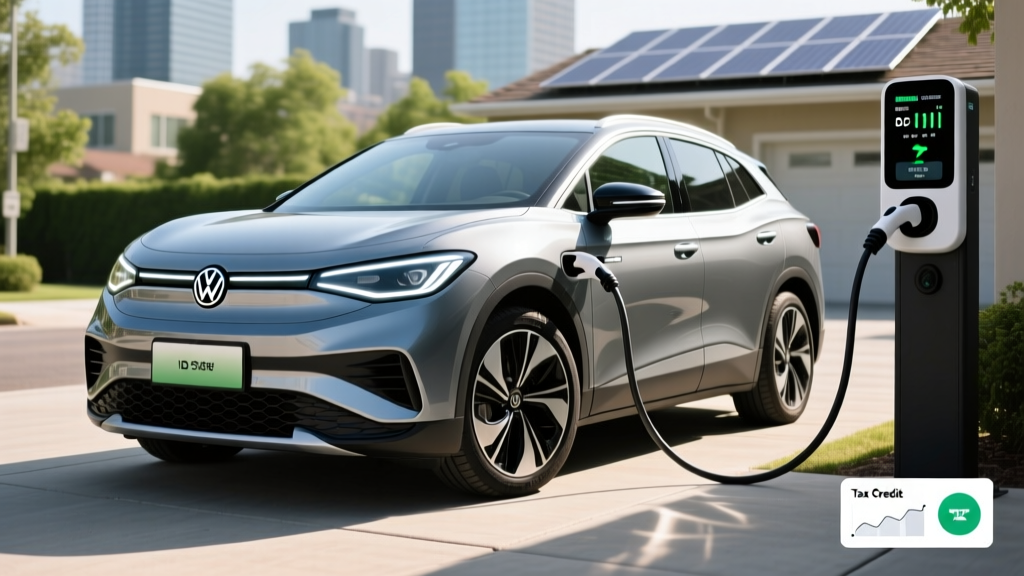
If you've been searching for Volkswagen ID.4 specials, you're likely weighing whether this compact electric SUV's current incentives and price cuts make it the smartest buy in a segment packed with rivals like the Hyundai Ioniq 5, Tesla Model Y, and Ford Mustang Mach-E. For 2026, Volkswagen has restructured ID.4 pricing and is layering factory-to-dealer cash on top of the federal §30D tax credit — potentially pushing the effective price of a base ID.4 well below $30,000 for qualified buyers.
But a deal is only as good as the car behind it. Below, we break down the 2026 ID.4's real-world range, charging behavior, battery chemistry, ownership costs, and which trim actually delivers the best value. Every figure here is grounded in EPA data and manufacturer specs — no marketing fluff.
2026 ID.4 at a Glance: Specs That Matter
| Spec | Standard Range (63 kWh) | Pro / Pro S (82 kWh RWD) | Pro S Plus (AWD) |
|---|---|---|---|
| EPA Range | 206 mi | 291 mi | 263 mi |
| Battery (usable / gross) | 63 kWh / 67 kWh | 82 kWh / 86 kWh | 82 kWh / 86 kWh |
| Chemistry | NMC (Nickel Manganese Cobalt) | NMC | NMC |
| Peak DC Fast Charge | 140 kW | 175 kW | 175 kW |
| 10–80% DCFC Time | ~30 min | ~28 min | ~28 min |
| Level 2 Home Charge | 10.9 kW (~36 mi/hr) | 10.9 kW (~36 mi/hr) | 10.9 kW (~36 mi/hr) |
| Horsepower | 170 hp | 282 hp | 335 hp (dual-motor) |
| 0–60 mph | ~9.0 sec | ~7.2 sec | ~5.4 sec |
| Drivetrain | RWD | RWD | AWD (dual-motor) |
| EPA Efficiency (combined) | 104 MPGe | 107 MPGe | 98 MPGe |
| kWh / 100 mi | 32 | 31 | 34 |
| Base MSRP (2026) | $39,735 | $43,735 | $51,235 |
| Battery / Powertrain Warranty | 8 years / 100,000 miles (70% capacity retention) | ||
Real-World Range: What the EPA Sticker Doesn't Tell You
The 82 kWh RWD ID.4 Pro carries an EPA-estimated 291 miles of range. In real-world mixed driving, plan for ~250–270 miles on the highway at 70+ mph, and ~200–230 miles in sustained cold weather (below 32°F) due to battery internal resistance and cabin heating draw. The AWD Pro S Plus drops to an EPA 263 miles, with real-world highway figures closer to 220–240.
The 63 kWh Standard Range trim's 206-mile EPA figure is best understood as a 170–185 mile practical highway range — adequate for commuting but tight for road trips. VW does not offer an LFP (lithium iron phosphate) battery option on the ID.4; all trims use NMC chemistry, which delivers higher energy density but requires more careful state-of-charge management for longevity (avoid sitting at 100% for extended periods).
One nuance buyers often miss: the ID.4's regenerative braking is relatively mild compared to one-pedal-driving rivals like the Tesla Model Y or Nissan Ariya. You'll use the brake pedal more, which slightly reduces efficiency in stop-and-go traffic where heavy regen could recapture more energy.
Charging Speed: The Curve Behind the Peak kW
| Charging Level | Power | Miles Added per Hour | Notes |
|---|---|---|---|
| Level 1 (120V household) | ~1.2 kW | ~3–4 mi/hr | Emergency/top-up only |
| Level 2 (240V home) | 10.9 kW | ~36 mi/hr | Full charge in ~8–9 hours (82 kWh) |
| DC Fast Charge (peak) | 175 kW (82 kWh) / 140 kW (63 kWh) | ~200+ mi in 30 min | Peak rate only below ~30% SoC |
The ID.4's 175 kW peak DC fast-charge rate applies to the 82 kWh battery — but that peak only sustains roughly from 5% to 30% state of charge. By 50% SoC, the rate tapers to around 120 kW, and above 80% it drops sharply to protect the NMC cells. Expect a realistic 10–80% session to take approximately 28 minutes at a functioning 175+ kW station (Electrify America, Tesla Supercharger with Magic Dock, or comparable networks).
On Level 2 at home, the 10.9 kW onboard charger is competitive. A nightly plug-in from 20% to 80% takes roughly 4.5 hours — easily handled by a standard NEMA 14-50 outlet or hardwired wallbox. Home installation for a Level 2 circuit typically runs $500–$2,000 depending on panel proximity and local permit requirements; budget $1,200 on average for a clean install.
Volkswagen has partnered with Electrify America to provide ID.4 buyers with a set amount of complimentary DC fast charging (historically 3 years of 30-minute sessions, though promotional terms shift — confirm with your dealer at purchase).
Pricing, ID.4 Specials, and Federal Tax Credit Math
For 2026, Volkswagen has aggressively repositioned the ID.4 against competitors. The entry Standard Range starts at $39,735 (including destination), while the volume-selling Pro with 291 miles of range sits at $43,735. The fully loaded AWD Pro S Plus climbs to $51,235.
| Trim | Base MSRP | Est. Dealer Specials / Incentives | Federal §30D Credit | Effective Price (Qualified Buyer) |
|---|---|---|---|---|
| Standard Range | $39,735 | –$2,000 to –$4,000 | Up to $7,500 | ~$28,235 – $30,235 |
| Pro (82 kWh RWD) | $43,735 | –$2,000 to –$4,000 | Up to $7,500 | ~$32,235 – $34,235 |
| Pro S (82 kWh RWD) | $48,235 | –$2,000 to –$3,000 | Up to $7,500 | ~$37,735 – $38,735 |
| Pro S Plus (AWD) | $51,235 | –$1,500 to –$3,000 | Up to $7,500 | ~$40,735 – $42,235 |
§30D Federal Tax Credit Rules (2026): The IRS §30D credit offers up to $7,500 for new EVs, but eligibility depends on three moving targets:
- MSRP Cap: SUVs must be ≤$80,000 — all ID.4 trims qualify.
- Buyer Income Cap: AGI ≤$150,000 (single), ≤$225,000 (head of household), ≤$300,000 (joint).
- Battery Sourcing: Critical minerals and battery components must meet escalating domestic-content thresholds. The ID.4 is assembled in Chattanooga, TN, but battery-cell sourcing determines the exact credit amount ($3,750 or $7,500). Confirm the current-year VIN eligibility on the IRS qualified vehicles list before purchase.
- Point-of-Sale Transfer: As of 2024+, you can transfer the credit to the dealer at purchase, reducing your out-of-pocket cost immediately rather than waiting for a tax refund.
The "specials" you see advertised typically combine VW's factory-to-dealer cash (which varies by region and month) with the §30D credit. A $4,000 dealer discount plus $7,500 federal credit on a Standard Range ID.4 can bring the effective price under $30,000 — a compelling entry point for a new EV.
Interior, Cargo, and Daily Livability
The ID.4's cabin prioritizes space over flash. Rear legroom measures 37.6 inches — genuinely comfortable for adults — and cargo volume behind the second row is 30.3 cubic feet, expanding to 64.2 cu ft with the rear seats folded. That beats the Ioniq 5 on cargo but trails the Model Y slightly (30.2 / 76.2 cu ft).
Notable interior details:
- Infotainment: 12.9-inch touchscreen (on Pro S and above) running VW's latest ID. Software 4.x, which has addressed most of the lag and menu-logic complaints from the 2021–2023 launch models. Wireless Apple CarPlay and Android Auto are standard.
- Driver Assists: Travel Assist (SAE Level 2) bundles adaptive cruise with lane centering — competent for highway commuting but requires hands-on-wheel engagement. It is not autonomous driving.
- Panoramic fixed glass roof (Pro S and above) adds openness but no shade — a known heat issue in southern climates.
- No frunk: Unlike the Ioniq 5 or Mach-E, the ID.4 has no front trunk, limiting under-hood storage to a small cubby for the charging cable.
Pros, Cons, and the Honest Verdict
Pros
- Strong value after specials + §30D credit — potentially under $30K for base
- Comfortable ride quality and quiet cabin at highway speed
- Spacious rear seat and competitive cargo volume
- Competent 175 kW DC fast-charge speed for road trips
- Chattanooga-built; strong dealer network for service
- 8-year / 100,000-mile battery warranty with 70% retention threshold
Cons
- Infotainment still lags behind Hyundai/Kia and Tesla in responsiveness
- Weak regenerative braking — no true one-pedal driving
- No front trunk (frunk)
- Standard Range model's 206 EPA miles limits road-trip utility
- Capacitive touch sliders for climate and volume draw consistent criticism
- AWD availability restricted to top trim, raising cost for snow-belt buyers
ID.4 vs. Key Competitors: Is It the Best Buy?
The ID.4's strongest argument is price after incentives. When VW specials stack with the full $7,500 §30D credit, a Pro trim ID.4 can undercut a comparably equipped Ioniq 5 SEL or Model Y Long Range by $5,000–$8,000. But if you prioritize:
- Fastest charging: Hyundai Ioniq 5 (800V architecture, 10–80% in ~18 min) wins.
- Software and Supercharger network: Tesla Model Y remains the benchmark, though the ID.4 now has NACS-adapter access to Superchargers.
- Driving engagement: Ford Mustang Mach-E delivers sharper handling.
- Comfort and value for families: The ID.4's ride quality, rear space, and post-credit pricing make it a top pick.
The ID.4 is not the most exciting EV in the segment, but it may be the most rational — especially when specials are active.
Who Should Buy the 2026 Volkswagen ID.4?
- You qualify for the full §30D credit and can stack dealer specials
- You need a family-friendly compact SUV with real rear-seat space
- Your daily commute is under 80 miles round-trip (even the Standard Range covers this easily)
- You value a compliant, quiet ride over sporty handling
- You want a domestic-built EV with a widespread dealer service network
- You regularly drive 300+ mile highway trips and need minimal charging stops
- You want cutting-edge infotainment or one-pedal regenerative driving
- You need AWD without paying top-trim prices
Frequently Asked Questions
What is the real-world range of the 2026 Volkswagen ID.4?
The 82 kWh RWD Pro achieves an EPA-estimated 291 miles, but expect roughly 250–270 miles on the highway and 200–230 miles in freezing temperatures. The Standard Range (63 kWh) delivers about 170–185 real-world highway miles.
How fast does the ID.4 charge at home and on the road?
On a Level 2 home charger (10.9 kW), the ID.4 adds about 36 miles of range per hour, fully charging overnight. On DC fast chargers, the 82 kWh models peak at 175 kW and reach 10–80% in approximately 28 minutes, though the charge curve tapers significantly above 50% SoC.
Does the 2026 ID.4 qualify for the $7,500 federal EV tax credit?
All ID.4 trims fall under the $80,000 MSRP cap for SUVs. Buyer income must not exceed $150K (single) / $300K (joint). Battery sourcing requirements determine whether you receive the full $7,500 or a partial $3,750. The credit can be transferred to the dealer at point of sale. Always verify current VIN eligibility on the IRS qualified vehicles list before signing.
Is the Volkswagen ID.4 worth buying over the Tesla Model Y or Ioniq 5?
If your priority is lowest effective price after incentives, the ID.4 with active specials is hard to beat. The Ioniq 5 charges faster, the Model Y has better software and Supercharger access, but the ID.4 offers the best ride comfort and value combination for family-oriented buyers.
What is the ID.4's battery warranty?
Volkswagen covers the ID.4's high-voltage battery for 8 years or 100,000 miles against defects and capacity loss below 70% of original capacity. The general vehicle warranty is 4 years / 50,000 miles.
Can the ID.4 use Tesla Superchargers?
VW has adopted the NACS (North American Charging Standard) port for newer models, and existing CCS-equipped ID.4 owners can access the Supercharger network via a VW-approved NACS adapter. Confirm adapter availability and compatibility with your model year at purchase.