Quick Verdict: The Black-on-White Model Y Still Sets the Benchmark
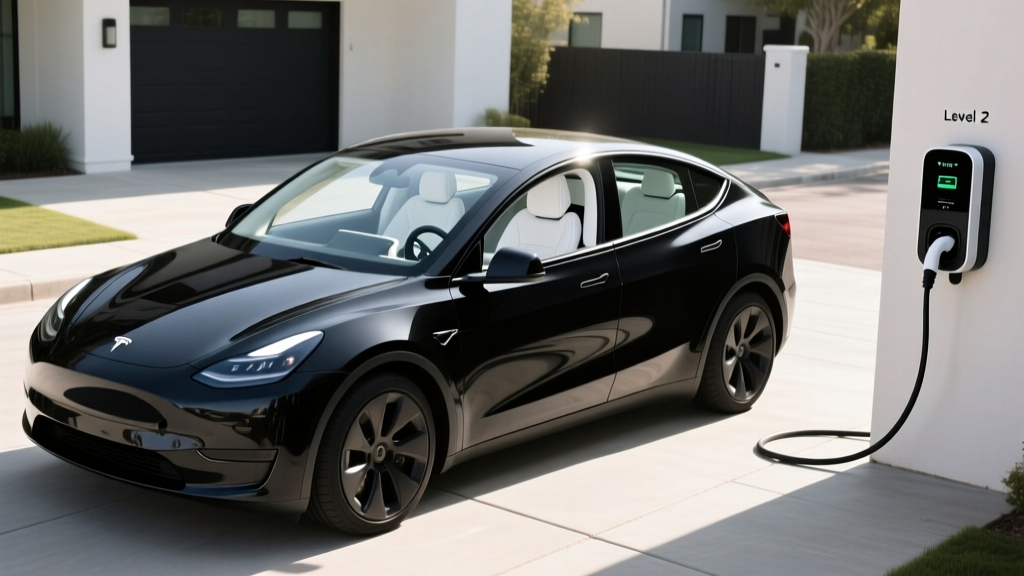
The 2026 Tesla Model Y Long Range AWD remains the default midsize electric SUV for buyers who want a proven platform, expansive Supercharger access, and strong efficiency. Dressed in Solid Black with the premium White interior, it delivers a commanding 320 miles of EPA-estimated range, peppy dual-motor acceleration, and a cabin that feels airier than its dark exterior suggests. But real-world range, charging-curve realities, and evolving competition from the Hyundai Ioniq 5, Kia EV6, and Ford Mustang Mach-E mean buyers need to look past the sticker.
Real-World Expectation: ~265–285 miles on highway-heavy trips (70–75 mph); ~240–260 miles in sub-30°F cold weather without preconditioning. City driving with regen can push past 300 miles.
Range, Battery, and Efficiency
The 2026 Model Y Long Range AWD uses a ~78 kWh usable NMC (nickel-manganese-cobalt) battery pack. Tesla does not publish exact cell chemistry by market, but teardown data and EPA filings on fueleconomy.gov confirm an NMC-type chemistry optimized for energy density and cold-weather performance over the LFP packs found in the RWD Standard Range trim.
| Spec | 2026 Model Y Long Range AWD |
|---|---|
| EPA Range | 320 miles |
| Battery (usable) | ~78 kWh, NMC |
| MPGe (city/hwy/combined) | 127 / 110 / 119 MPGe |
| Efficiency | 28 kWh / 100 mi |
| Drivetrain | Dual-motor AWD |
| 0–60 mph | 4.8 seconds |
| Horsepower | ~384 hp (combined) |
| Cargo (rear seats up / folded) | 30.2 / 72.1 cu ft |
| Rear Legroom | 36.5 in |
| Base MSRP | $44,990 |
Efficiency is a Tesla strong suit. At 28 kWh per 100 miles, the Model Y sips electrons compared to the Mach-E Extended Range AWD (~34 kWh/100 mi) and edges out the Ioniq 5 AWD (~30 kWh/100 mi). That efficiency translates directly to lower charging costs and more miles per minute at a DC fast charger.
Charging Speed: DC Fast, Level 2, and the Curve Reality
The 2026 Model Y Long Range supports up to 250 kW peak DC fast charging on V3 Superchargers (CCS/NACS depending on build date). In controlled testing, a 10–80% session takes approximately 25–28 minutes when the battery is preconditioned via the car's navigation-routed warm-up.
| Charging Level | Power | Speed / Time |
|---|---|---|
| DC Fast Charge (V3 Supercharger) | Up to 250 kW peak | 10–80% in ~25–28 min; ~170 mi in 15 min |
| Level 2 (Home Wall Connector, 48A) | 11.5 kW | ~44 miles per hour of charging |
| Level 2 (Public / 32A) | 7.7 kW | ~30 miles per hour |
| Level 1 (120V outlet) | ~1.4 kW | ~4 miles per hour |
Charging-curve reality check: The 250 kW peak is only sustained between roughly 10–30% state of charge. Above 50%, the rate tapers significantly — by 80%, you are typically pulling under 60 kW. This is why Tesla (and every other automaker) quotes 10–80% times rather than 0–100%. For road-trip planning, budget 25–30 minutes per stop, not 15.
At home, the Tesla Wall Connector on a 60A circuit delivers 11.5 kW, adding roughly 44 miles of range per hour — enough to fully replenish the pack overnight. Installation costs typically run $800–$2,000 depending on panel proximity and local permitting, though a panel upgrade to 200A service can push that above $3,500.
Performance and Driving Dynamics
The dual-motor AWD powertrain produces approximately 384 combined horsepower, launching the Model Y to 60 mph in 4.8 seconds. That is brisk for a family crossover and sufficient for confident highway merging. The Performance trim drops that to 3.5 seconds but sacrifices roughly 20 miles of range and costs an additional $4,000.
Ride quality on the refreshed Model Y (post-2025 update) is noticeably improved over earlier builds, with revised damper tuning that absorbs sharp pavement impacts without the crashiness that plagued 2020–2023 models. Steering remains quick and precise, though feedback is minimal — a characteristic Tesla trait. Regenerative braking is strong enough for one-pedal driving in most conditions, though Tesla now offers a low-regen mode for drivers transitioning from ICE vehicles.
Interior: The Case for Black Exterior, White Cabin
The Solid Black ($1,500 premium over Pearl White Multi-Coat) exterior paired with the White interior ($1,000 option) creates a high-contrast aesthetic that photographs well and, more importantly, keeps the cabin feeling open. The vegan leather seats are durable and resist staining better than early Tesla white seats — owners report minimal discoloration after 12+ months with routine wiping. The panoramic glass roof floods the cabin with light, though summer solar gain is real; Tesla includes a tinted panel, but many owners add an aftermarket shade for southern climates.
The 15.4-inch center touchscreen handles all infotainment, climate, and vehicle settings. The interface is responsive, but the lack of physical buttons for wipers, glovebox, and mirror adjustment remains a friction point for new EV adopters. Wireless phone charging, HEPA air filtration (Bioweapon Defense Mode), and a 14-speaker audio system are standard. Rear-seat passengers get a dedicated 8-inch screen for climate and entertainment controls.
Cargo space is generous: 30.2 cubic feet behind the second row, expanding to 72.1 cu ft with the 60/40 split folded. The front trunk (frunk) adds 4.1 cu ft — useful for charging cables or a small bag. Rear legroom of 36.5 inches is adequate for adults but trails the Ioniq 5's 39.4 inches.
Pricing, Tax Credits, and Total Cost
| Item | Amount |
|---|---|
| Base MSRP (Long Range AWD) | $44,990 |
| Solid Black Paint | +$1,500 |
| White Interior | +$1,000 |
| Destination Fee | +$1,390 |
| As-Tested MSRP | $48,880 |
| Federal §30D Tax Credit (if eligible) | Up to $7,500 |
| Effective Price After Credit | ~$41,380 |
Federal tax credit eligibility (§30D): The Model Y Long Range AWD qualifies for up to $7,500 under current IRS rules, provided the buyer meets all requirements:
- MSRP cap: Vehicle MSRP must not exceed $80,000 (Model Y clears this easily).
- Buyer income cap: AGI must be ≤ $300,000 (joint), ≤ $225,000 (head of household), ≤ $150,000 (single).
- Battery sourcing: A percentage of critical minerals and battery components must be sourced from the US or FTA partners. Tesla's Fremont and Austin-built Model Y currently meets these thresholds, but rules tighten annually — verify at irs.gov or via the point-of-sale dealer attestation at purchase.
- Point-of-sale transfer: The credit can be applied at purchase as a down-payment reduction, not just as a tax return credit.
State incentives vary widely — California's CVRP, Colorado's $5,000 credit, and New York's Charge NY program may stack additional savings. Check your state energy office for current amounts.
Autopilot, FSD, and Driver Assistance
Basic Autopilot (Traffic-Aware Cruise Control + Autosteer) is standard and competent for highway use. The $8,000 FSD (Supervised) package adds automatic lane changes, traffic-light and stop-sign recognition, and city-street navigation — but its performance remains inconsistent in construction zones, heavy rain, and unprotected left turns. For most buyers, the standard Autopilot plus a $99/month FSD subscription (to trial the feature) is the prudent path.
Safety ratings are strong: the Model Y earned a 5-star overall rating from NHTSA and a Top Safety Pick+ designation from IIHS (when equipped with acceptable headlights).
Who Should Buy the Black-on-White Model Y?
- You prioritize Supercharger network reliability for road trips.
- You want class-leading efficiency and low cost-per-mile.
- You need AWD for snow/rain but don't require serious off-road capability.
- You value OTA updates that add features post-purchase.
- You need maximum rear-seat legroom (Ioniq 5 wins).
- You want physical buttons and a more conventional cockpit (Mach-E, EV6).
- You tow more than 3,500 lbs (Rivian R1S or F-150 Lightning territory).
- You want 800V ultra-fast charging (Ioniq 5/EV6 charge 10–80% in ~18 min).
Pros and Cons
- 320-mile EPA range; 28 kWh/100 mi efficiency
- 250 kW Supercharger access with reliable network uptime
- Spacious cargo area (72.1 cu ft max) with frunk
- Strong safety ratings (NHTSA 5-star, IIHS TSP+)
- Over-the-air updates continuously improve the vehicle
- Qualifies for up to $7,500 federal tax credit
- Rear legroom (36.5 in) trails Hyundai Ioniq 5 (39.4 in)
- No physical buttons — all controls via touchscreen
- 250 kW peak charge rate trails 800V competitors' ~350 kW capability
- FSD (Supervised) remains a Level 2 system with inconsistent city performance
- Glass roof causes noticeable cabin heat in summer
- Insurance premiums run 15–25% higher than comparable ICE crossovers
Warranty and Long-Term Ownership
Tesla covers the Model Y with a 4-year/50,000-mile limited vehicle warranty and an 8-year/120,000-mile battery and drive unit warranty. The battery warranty guarantees retention of at least 70% capacity over the coverage period — a standard threshold in the industry. Real-world degradation data from Tesla fleet telemetry suggests ~10% capacity loss at 150,000 miles for NMC packs, though individual results vary with charging habits (frequent 100% charges and DC fast charging accelerate wear).
Maintenance costs are low: no oil changes, no spark plugs, and regenerative braking extends pad life to 100,000+ miles. Cabin air filter replacement ($60–$100 every 2 years) and tire rotation are the primary service items. Tire wear is higher than ICE vehicles due to instant torque and vehicle weight — budget $1,200–$1,600 for a set of EV-optimized tires every 30,000–40,000 miles.
Frequently Asked Questions
What is the real-world range of the black Tesla with white interior (Model Y Long Range)?
The EPA estimates 320 miles, but expect 265–285 miles on highway-heavy trips at 70–75 mph, and 240–260 miles in cold weather below 30°F without preconditioning. City driving with regenerative braking can approach or exceed 300 miles.
How fast does the Model Y charge at home and on the road?
On a V3 Supercharger, it peaks at 250 kW and charges 10–80% in about 25–28 minutes. At home on a 48A Wall Connector (11.5 kW), it adds roughly 44 miles of range per hour — a full charge takes about 7 hours.
Does the 2026 Model Y qualify for the $7,500 federal EV tax credit?
Yes, if you meet IRS §30D requirements: AGI under $300K (joint) / $150K (single), and the vehicle's battery meets critical-mineral and component sourcing thresholds. The credit can be applied at point of sale. Verify current eligibility at irs.gov before purchasing.
Is the white interior hard to keep clean?
Tesla's current-generation vegan leather resists stains significantly better than earlier iterations. Most owners report that a quick wipe with a damp microfiber cloth weekly keeps seats looking new. Dark denim transfer is minimal. It is not the maintenance burden many fear.
How does the Model Y compare to the Hyundai Ioniq 5 and Ford Mach-E?
The Ioniq 5 offers more rear legroom and faster 800V charging (10–80% in ~18 min), but its charging network (via Electrify America) is less reliable than Tesla's Superchargers. The Mach-E provides a more traditional cockpit with physical controls but trails in efficiency. The Model Y wins on network access, cargo volume, and energy efficiency.
What does the black-on-white Model Y cost after incentives?
As tested (Solid Black paint, White interior, destination), the MSRP is $48,880. With the full $7,500 federal credit, the effective price drops to approximately $41,380. State incentives may reduce this further.