Quick Verdict: Still the Benchmark for Electric Performance Sedans
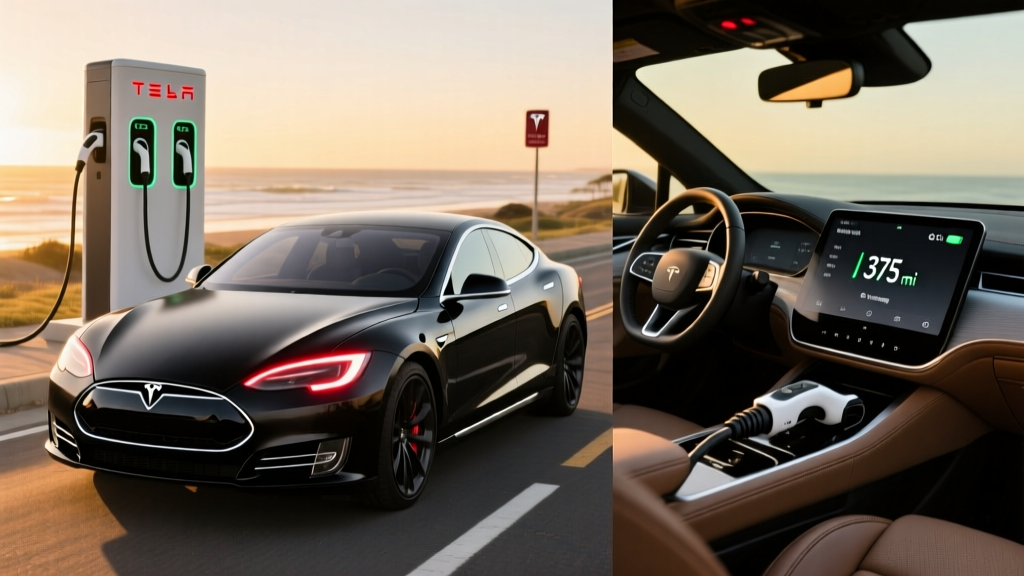
The Tesla Model S Plaid remains one of the fastest production cars ever built, and the black exterior paired with the tri-motor powertrain delivers a presence that few EVs can match. For 2026, the Plaid retains its 1,020-horsepower punch and ~396-mile EPA range, but real buyers need to look past the 1.99-second 0-60 claim and examine what daily ownership actually looks like — from charging curves to cold-weather range loss to federal tax credit eligibility. This review breaks down every number that matters.
| Spec | Value |
|---|---|
| EPA Range | 396 miles |
| Battery (usable) | ~100 kWh, NMC chemistry |
| Drivetrain | Tri-Motor AWD |
| Horsepower | 1,020 hp |
| 0–60 mph | 1.99 seconds (with rollout) |
| Top Speed | 200 mph (with track package) |
| Peak DC Fast Charge | 250 kW |
| 10–80% DC Charge Time | ~30 minutes |
| Level 2 Home Charge | 11.5 kW (~34 mi/hr) |
| MPGe (combined) | 120 MPGe |
| Efficiency | 28 kWh/100 mi |
| Cargo Volume | 28 cu ft (rear seats up), 79 cu ft (folded) |
| Frunk | ~5.3 cu ft |
| Base MSRP | $89,990 |
| Battery Warranty | 8 years / 150,000 miles |
Range and Efficiency: EPA Sticker vs. Real-World Miles
The EPA rates the 2026 Model S Plaid at 396 miles on the Long Range equivalent cycle, though the Plaid's tri-motor setup and performance tuning typically yield slightly lower results than the dual-motor Long Range variant. Tesla officially lists the Plaid at 396 miles with the standard 19-inch Tempest wheels; stepping up to the 21-inch Arachnid wheels drops that figure to approximately 359 miles.
Real-World Range Expectation: In mixed highway driving at 70–75 mph, expect 310–340 miles from the Plaid on 19-inch wheels. In freezing temperatures (below 32°F), range can drop 20–30%, yielding as little as 240–270 miles on a full charge. City driving with heavy regenerative braking can approach or slightly exceed the EPA figure.
Efficiency lands at roughly 120 MPGe combined, or 28 kWh per 100 miles, per fueleconomy.gov. That is competitive for a 4,766-pound performance sedan but noticeably higher than the dual-motor Model S Long Range, which achieves around 124 MPGe. The tri-motor setup's added weight and power draw trade efficiency for the kind of acceleration that rewrites physics.
Charging Speed: DC Fast, Level 2, and the Charge Curve Reality
The Model S Plaid supports a peak DC fast-charge rate of 250 kW via the NACS (North American Charging Standard) connector — Tesla's proprietary plug now adopted industry-wide. On a V3 Supercharger or compatible 250 kW station, the Plaid can add up to 183 miles in 15 minutes under ideal conditions.
| Charging Level | Power | Speed (miles added) | Notes |
|---|---|---|---|
| Level 1 (120V) | ~1.4 kW | ~3–4 mi/hr | Emergency/trickle only |
| Level 2 (240V, 48A) | 11.5 kW | ~34 mi/hr | Home Wall Connector; full charge in ~10 hrs |
| DC Fast (V3 Supercharger) | 250 kW peak | ~183 mi in 15 min | Peak rate held to ~50% SoC, then tapers |
| DC Fast (V4 Supercharger) | Up to 350 kW capable | Vehicle-limited to 250 kW | Model S architecture caps at 250 kW |
The critical detail most spec sheets omit is the charge curve. The Plaid's battery management system holds near-peak 250 kW draw only up to roughly 50% State of Charge. From 50–80%, the rate tapers progressively — averaging closer to 150–170 kW over the full 10–80% session. That translates to roughly 30 minutes for a 10–80% charge. Above 80%, the rate drops sharply to protect cell longevity, making 80–100% top-ups impractical on road trips.
At home, the Tesla Wall Connector on a 60-amp circuit delivers 11.5 kW (48 amps continuous), adding about 34 miles of range per hour. A full 0–100% charge takes approximately 10 hours — easily accomplished overnight. Preconditioning the battery before arrival at a Supercharger (automatic when navigating to one) is essential for achieving peak charge speeds, especially in cold climates.
Performance: 1,020 Horsepower and the 1.99-Second Claim
The Plaid's three-motor architecture — one front, two rear — produces 1,020 horsepower and an estimated 1,050 lb-ft of torque. Tesla's published 1.99-second 0–60 mph time includes a one-foot rollout (drag-racing convention) and requires a prepped surface with the car in Drag Mode, which conditions the battery and powertrain for maximum launch.
In independent testing by outlets like Motor Trend and Car and Driver, the Plaid has achieved 0–60 times between 2.1 and 2.3 seconds on standard asphalt — still staggering and quicker than virtually any production car ever sold. The carbon-sleeved rotors in the permanent-magnet and induction motors resist thermal degradation, meaning repeat launches are possible without the power fade that plagues lesser EVs.
The adaptive air suspension, standard on the Plaid, adjusts ride height and damping based on speed and road conditions. Torque vectoring across the rear motors provides cornering agility that belies the sedan's 4,766-pound curb weight. The optional carbon-ceramic brake package ($15,000) is required to unlock the 200-mph top speed and is bundled with the Track Package.
Interior, Tech, and Cargo: Luxury Sedan or Track Tool?
The 2026 Model S Plaid's cabin centers on a 17-inch landscape touchscreen running Tesla's latest software, a 12.3-inch digital instrument cluster, and a secondary 8-inch rear-seat display. The yoke steering wheel remains standard on the Plaid (a conventional round wheel can be requested at no charge). Build quality has improved substantially since the Fremont factory's 2022–2023 production ramp, with tighter panel gaps and higher-grade materials throughout.
Passenger space accommodates five adults, though the rear center position is best suited for shorter trips:
- Front legroom: 42.7 inches
- Rear legroom: 35.4 inches
- Front headroom: 38.8 inches
- Rear headroom: 38.1 inches
Cargo capacity totals 28 cubic feet behind the rear seats and 79 cubic feet with the 60/40 split folding. The front trunk (frunk) adds 5.3 cubic feet — enough for a charging cable kit and a small bag. Combined, the Model S offers more usable volume than most midsize luxury sedans and rivals several crossover SUVs.
The 22-speaker audio system with active noise cancellation, HEPA air filtration with Bioweapon Defense Mode, and Tesla's over-the-air update pipeline remain standout features. The gaming-capable infotainment system (supporting titles like Cyberpunk 2077 via the integrated GPU) is a unique differentiator for charging-stop entertainment.
Autopilot and Driver Assistance: Level 2, Not Self-Driving
SAE Automation Level: 2. Tesla Autopilot and Full Self-Driving (Supervised) are Level 2 driver-assistance systems. The driver must remain fully engaged, hands on the wheel (or providing steering-torque input), and eyes on the road at all times. These systems do NOT make the Model S Plaid a self-driving vehicle.
Standard Autopilot includes Traffic-Aware Cruise Control and Autosteer (lane-centering on marked highways). The optional FSD (Supervised) package ($8,000 one-time or $99/month) adds Navigate on Autopilot (highway interchanges), Auto Lane Change, Autopark, Summon, and traffic-light/stop-sign recognition. For 2026, Tesla continues to refine the neural-network-based vision system, but NHTSA maintains active oversight of Level 2 systems, and driver responsibility remains absolute.
What FSD (Supervised) Does NOT Do: It does not operate without driver supervision. It does not handle all road types, construction zones, or adverse weather reliably. It does not eliminate the need for situational awareness. Treat it as an advanced cruise control, not an autonomous chauffeur.
Pricing, Trims, and Federal Tax Credit Eligibility
The 2026 Tesla Model S Plaid carries a base MSRP of $89,990 (before destination). The only other Model S variant is the Long Range at $74,990. Key options on the Plaid include:
- Carbon-Ceramic Brake / Track Package: +$15,000
- FSD (Supervised): +$8,000
- 21-inch Arachnid Wheels: +$4,500
- Premium Interior Colors (Cream, White): +$2,000
- Signature Paint (Ultra Red, Midnight Silver Metallic): +$2,500–$3,000
| Configuration | MSRP | After Potential Credit |
|---|---|---|
| Plaid (base, Solid Black paint) | $89,990 | $89,990 (see credit note below) |
| Plaid + FSD + 21" wheels | $102,490 | $102,490 |
| Plaid + Track Package + FSD | $112,990 | $112,990 |
Federal Tax Credit (§30D) Reality Check: The Model S Plaid does not qualify for the $7,500 federal EV tax credit under current IRS rules. The §30D credit imposes an MSRP cap of $55,000 for sedans, and at $89,990, the Plaid far exceeds it. Additionally, the credit requires the buyer's adjusted gross income to fall below $150,000 (single) or $300,000 (joint filing), and the battery must meet critical-mineral and component-sourcing thresholds. The Model S Plaid's buyers will pay full MSRP regardless of income or sourcing compliance. For details, consult the IRS Clean Vehicle Credit page.
Warranty and Long-Term Ownership Costs
Tesla covers the Model S Plaid with the following warranty structure:
- Basic Vehicle: 4 years / 50,000 miles
- Battery & Drive Units: 8 years / 150,000 miles (whichever comes first), with a minimum 70% capacity retention guarantee
The 150,000-mile battery warranty is among the most generous in the EV sedan segment. Tesla's NMC cells in the Plaid use a low-cobalt formulation optimized for power delivery. Long-term degradation data from high-mileage Model S owners suggests approximately 8–12% capacity loss over 100,000 miles under normal use, with the majority of loss occurring in the first 20,000–30,000 miles before stabilizing.
Insurance costs for the Plaid are notably high. National averages place annual premiums between $3,800 and $5,500 depending on driver profile, state, and coverage level — reflecting the vehicle's repair costs, performance capability, and parts pricing. Always obtain quotes before purchase.
Who the Model S Plaid Is For (and Who Should Look Elsewhere)
Choose the Model S Plaid if:
- You want the quickest-accelerating sedan available and value tri-motor AWD traction
- You need 350+ miles of real-world range for road trips with access to the Supercharger network
- You prioritize OTA software updates and a tech-forward cabin experience
- You regularly drive in varied weather and need torque-vectoring AWD confidence
Look elsewhere if:
- Budget is a primary concern — the Porsche Taycan Turbo S, Lucid Air Sapphire, and BMW i7 M70 offer different value propositions
- You need three-row seating or SUV cargo flexibility (consider the Model X Plaid or Rivian R1S)
- You want the absolute longest EV range available — the Lucid Air Grand Touring achieves 516 miles EPA
- You require federal tax credit eligibility — no luxury sedan above $55,000 MSRP qualifies
Pros
- 1.99-second 0–60 mph — quickest production sedan
- 396-mile EPA range (19" wheels) is class-leading for performance tier
- 250 kW DC fast charging with extensive Supercharger network
- Generous cargo space (28 cu ft + frunk) for a sedan
- 8-year/150,000-mile battery warranty
- Continuous OTA improvements and feature additions
Cons
- $89,990 base MSRP — no federal tax credit eligibility
- 250 kW peak charge rate trails Hyundai/Kia 800V architecture (350 kW)
- Yoke steering polarizing; round wheel requires special request
- Insurance premiums significantly above segment average
- FSD (Supervised) remains Level 2 — not autonomous
- Rear-seat space tighter than competing luxury sedans (BMW i7, Mercedes EQS)
Frequently Asked Questions
What is the real-world range of the Tesla Model S Plaid?
The EPA rates the Plaid at 396 miles on 19-inch wheels. In real-world highway driving at 70–75 mph, expect 310–340 miles. In sub-freezing temperatures, range drops to approximately 240–270 miles. City driving with regenerative braking can approach the EPA number.
How fast does the Model S Plaid charge at home and on the road?
At home on a Level 2 Tesla Wall Connector (11.5 kW / 48A), the Plaid adds about 34 miles per hour, with a full charge in roughly 10 hours. On a 250 kW V3 Supercharger, 10–80% takes approximately 30 minutes, though the charge curve tapers significantly above 50% SoC. The vehicle's architecture caps at 250 kW and cannot utilize newer 350 kW chargers at full rate.
Does the Model S Plaid qualify for the federal EV tax credit?
No. The IRS §30D Clean Vehicle Credit caps sedan eligibility at $55,000 MSRP. The Plaid's $89,990 base price disqualifies it regardless of buyer income or battery sourcing. State-level incentives may still apply — check your local DMV or energy office.
Is the Model S Plaid worth buying over the Porsche Taycan Turbo S or Lucid Air Sapphire?
The Plaid wins on straight-line acceleration and Supercharger network access. The Taycan Turbo S offers superior handling dynamics and 800V architecture for faster charging (up to 350 kW). The Lucid Air Sapphire delivers 1,234 hp with 427 miles of range but has a sparser service network. The Plaid's advantage remains the Tesla ecosystem — software, Supercharger density, and OTA updates — combined with the lowest cost of entry in the hyper-sedan segment.
How much does it cost to charge a Model S Plaid?
At the national average electricity rate of $0.16/kWh, a full 100 kWh charge costs approximately $16. On Tesla Superchargers (averaging $0.28–$0.36/kWh in 2026), a 10–80% session costs roughly $20–$25. Compared to a gasoline performance sedan averaging 16 mpg on premium fuel at $4.20/gallon, the Plaid saves roughly $1,800–$2,400 annually in fuel costs for a 12,000-mile driver.
What is the battery replacement cost if the warranty expires?
Out-of-warranty battery replacements for the Model S Plaid currently range from $18,000 to $25,000 including labor, based on Tesla service center estimates. However, Tesla's NMC cells have demonstrated strong longevity, with most high-mileage vehicles retaining 85–90% capacity at 100,000 miles. The 8-year/150,000-mile warranty with a 70% retention floor provides substantial coverage.
Sources: fueleconomy.gov, Tesla Model S specifications, IRS §30D Clean Vehicle Credit, NHTSA.