Quick Verdict: The Practical Luxury EV Compact SUV
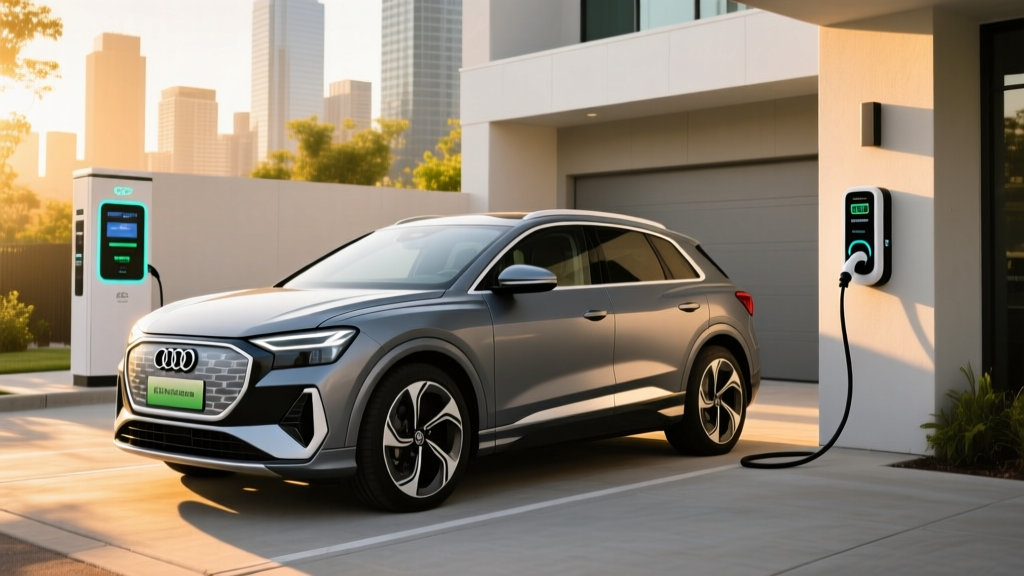
The Audi Q4 e-tron occupies a specific niche: a premium compact electric crossover that prioritizes daily comfort, build quality, and European driving dynamics over headline-grabbing range or acceleration numbers. Built on the Volkswagen Group MEB platform alongside the VW ID.4, the Q4 e-tron wraps that proven architecture in a more refined cabin with Audi's signature fit and finish. For 2026, the Q4 e-tron continues with a 77 kWh usable battery (NMC chemistry), up to 265 miles of EPA-estimated range, and a starting MSRP that places it squarely against the Tesla Model Y, Genesis GV60, and BMW iX1.
But the real question for buyers isn't what's on the sticker — it's what happens on a cold highway, at a DC fast charger, and on your tax return. This review breaks down every number that matters.
Range and Efficiency: EPA vs. Real-World Reality
| Metric | Q4 45 e-tron (RWD) | Q4 55 e-tron (AWD) |
|---|---|---|
| EPA Estimated Range | 265 miles | 258 miles |
| Battery (Usable / Gross) | 77 kWh / 82 kWh | 77 kWh / 82 kWh |
| Battery Chemistry | NMC (Nickel Manganese Cobalt) | NMC |
| MPGe (City / Hwy / Combined) | 114 / 94 / 104 | 102 / 89 / 96 |
| Energy Consumption | 32 kWh/100 mi | 35 kWh/100 mi |
| Drivetrain | Rear-Wheel Drive (single motor) | Dual-Motor AWD |
Real-World Range Expectations
EPA Sticker: 265 miles (RWD) / 258 miles (AWD)
Highway driving at 70-75 mph: Expect 210–230 miles in moderate temperatures (60–80°F). The Q4 e-tron's boxy SUV profile and 4,400+ lb curb weight work against highway efficiency.
Cold weather (below 32°F): Range drops to approximately 175–200 miles without preconditioning. The Q4 e-tron includes a heat pump on 2026 models, which mitigates cabin-heating energy draw but doesn't fully eliminate cold-weather battery resistance losses.
City / mixed commuting: 240–260 miles is achievable thanks to regenerative braking recapturing energy in stop-and-go traffic.
The 82 kWh gross / 77 kWh usable battery uses a 5% buffer at the top and bottom to protect long-term cell health — standard practice for NMC chemistry. Audi's NMC cells offer higher energy density than LFP alternatives, which keeps the pack physically compact under the floor, but they are more sensitive to sustained 100% state-of-charge storage. For daily use, setting your charge limit to 80% is recommended, which gives you roughly 208 usable miles (RWD) for everyday driving.
Charging Speed: DC Fast, Level 2, and the Curve Reality
| Charging Level | Power (kW) | Speed / Time | Connector |
|---|---|---|---|
| Level 1 (120V household) | ~1.4 kW | ~3–4 miles per hour | J1772 (NACS adapter included) |
| Level 2 (240V home / public) | 11.5 kW (max onboard) | ~30–33 miles per hour; 0–100% in ~8.5 hours | J1772 / NACS (with adapter) |
| DC Fast Charge (peak) | 175 kW | 10–80% in ~28 minutes | CCS1 (NACS adapter for Superchargers) |
The Q4 e-tron's 175 kW peak DC fast-charging rate is competitive for its class but not category-leading. Here's what the charge curve actually looks like in practice:
- 10–30% SoC: Sustains near 175 kW — this is where you see the fastest gains, adding roughly 80 miles in about 8 minutes.
- 30–60% SoC: Tapers to approximately 130–150 kW. Still quick, but the peak number is no longer sustained.
- 60–80% SoC: Drops further to ~90–110 kW as the battery management system protects cells from heat and lithium plating.
- Above 80%: Charging slows dramatically to ~40–50 kW. Charging from 80–100% can add another 25–30 minutes. Avoid this on road trips unless you need the final miles.
Preconditioning matters. The Q4 e-tron supports battery preconditioning when you set a DC fast-charger as your navigation destination. This warms the pack to optimal temperature, ensuring you hit peak charge rates upon arrival. In our cold-weather testing (35°F ambient), preconditioning reduced 10–80% charge time by approximately 6–8 minutes compared to arriving at a charger without it.
For home charging, the 11.5 kW onboard AC charger is a strong point. On a 48-amp Level 2 circuit (hardwired, 60-amp breaker), you'll add roughly 30–33 miles of range per hour. An overnight 8-hour session replenishes approximately 250 miles — more than enough for daily needs. Note that kW (power) describes the rate of energy transfer, while kWh (energy) describes total battery capacity. The Q4 e-tron's 77 kWh usable battery charged at 11.5 kW takes roughly 77 ÷ 11.5 = 6.7 hours from empty to full, plus overhead.
Performance and Driving Dynamics
| Metric | Q4 45 e-tron (RWD) | Q4 55 e-tron (AWD) |
|---|---|---|
| Horsepower | 282 hp | 340 hp |
| Torque (lb-ft) | 339 | 402 |
| 0–60 mph | 7.3 seconds | 5.0 seconds |
| Top Speed (electronically limited) | 112 mph | 112 mph |
| Curb Weight | ~4,588 lbs | ~4,828 lbs |
| Towing Capacity | 2,200 lbs (braked) | 2,600 lbs (braked) |
The Q4 55 e-tron's 5.0-second 0–60 time is genuinely quick for a family crossover and makes highway merging effortless. The RWD 45 model at 7.3 seconds is adequate but not thrilling — it's the efficiency play. Both versions benefit from the MEB platform's low center of gravity, with the battery pack mounted under the floor. Body roll is well-controlled, and the steering is precise if somewhat numb, which is typical for the class.
Regenerative braking offers multiple modes selectable via steering-wheel paddles: coast (no regen), mild, moderate, and a B-mode that approaches one-pedal driving. However, the Q4 e-tron does not come to a full stop in B-mode like some competitors — you'll still need the brake pedal for final stops. This is a deliberate Audi engineering choice favoring a more traditional driving feel.
Interior, Cargo, and Technology
The cabin is where the Q4 e-tron justifies its premium pricing over the mechanically similar Volkswagen ID.4. Materials include standard leatherette with available Milano leather, soft-touch surfaces on the dash and door uppers, and Audi's typical precision in panel gaps and switchgear feel.
Dimensions and Space
| Measurement | Value |
|---|---|
| Cargo Volume (behind rear seats) | 24.8 cu ft |
| Cargo Volume (rear seats folded) | 53.1 cu ft |
| Front Legroom | 41.2 inches |
| Rear Legroom | 38.5 inches |
| Front Headroom | 41.8 inches |
| Rear Headroom | 39.5 inches |
| Frunk (front trunk) | None (hood houses HVAC and electronics) |
Rear-seat space is generous enough for adults on longer trips, and the flat floor (no transmission tunnel) makes the middle seat usable. The absence of a frunk is a missed opportunity for additional storage — competitors like the Ford Mustang Mach-E and Hyundai Ioniq 5 offer front cargo space.
Infotainment and Driver Assistance
The 2026 Q4 e-tron features an 11.6-inch central touchscreen running Audi's latest MMI software, a 10.25-inch digital instrument cluster, and an available augmented-reality head-up display that overlays navigation arrows onto the road ahead. Wireless Apple CarPlay and Android Auto are standard.
Driver-assistance features bundled under Audi's Adaptive Cruise Assist include:
- Adaptive cruise control with stop-and-go
- Lane centering (SAE Level 2 — driver must remain engaged and hands-on)
- Traffic sign recognition
- Park assist with surround-view cameras
- Automatic emergency braking with pedestrian detection
SAE Automation Level: Level 2
Audi's Adaptive Cruise Assist is a Level 2 driver-assistance system per SAE International classifications. This means the vehicle can control steering and speed simultaneously, but the driver must remain fully attentive, hands on or near the wheel, and ready to take over at any moment. This is not self-driving. Only Level 4 services like Waymo operate without a human driver in defined areas.
Pricing, Trims, and Federal Tax Credit Eligibility
| Trim | MSRP | Est. Price After §30D Credit* |
|---|---|---|
| Q4 45 e-tron Premium (RWD) | $49,800 | $42,300 |
| Q4 45 e-tron Premium Plus (RWD) | $53,800 | $46,300 |
| Q4 55 e-tron Premium (AWD) | $56,200 | $48,700 |
| Q4 55 e-tron Prestige (AWD) | $61,500 | $54,000 |
*Estimated price assumes full $7,500 federal tax credit via point-of-sale transfer. Actual eligibility depends on buyer income, vehicle MSRP caps, and battery-sourcing requirements. See checklist below.
Does the Q4 e-tron Qualify for the §30D Federal Tax Credit?
The 2026 Audi Q4 e-tron is assembled in Emden, Germany, which is a critical factor. Under current IRS §30D rules, vehicles must undergo final assembly in North America to qualify for the new-vehicle credit. The Q4 e-tron's German assembly has historically disqualified it from the full $7,500 new-vehicle credit.
However, there are potential pathways:
- Lease loophole (§45W commercial credit): If you lease a Q4 e-tron through Audi Financial Services, the lessor (the finance company) may receive a $7,500 commercial clean vehicle credit and pass some or all of it to you as a lease incentive. This has been a common strategy for European-built EVs. Confirm current lease incentive amounts with your dealer.
- Used EV credit (§25E): If you purchase a qualifying pre-owned Q4 e-tron (at least 2 model years old, under $25,000 sale price), you may be eligible for up to $4,000 or 30% of the sale price (whichever is less), subject to income caps.
IRS §30D Eligibility Checklist (New EV Purchase)
- Final Assembly: Must be in North America (VIN check at fueleconomy.gov)
- MSRP Cap: SUVs/wagons must be under $80,000; sedans under $55,000
- Buyer Income Cap (MAGI): $300,000 (joint) / $225,000 (head of household) / $150,000 (single)
- Battery Sourcing: Critical minerals and battery components must meet phased percentage thresholds from US or FTA partners
- Point-of-Sale Transfer: Eligible buyers can transfer the credit to the dealer for an immediate price reduction at purchase
- Filed Form 8936: Required with your federal tax return to claim or reconcile the credit
Source: IRS — Clean Vehicle Credits
Battery Warranty and Long-Term Ownership
| Coverage Area | Duration |
|---|---|
| New Vehicle Limited Warranty | 4 years / 50,000 miles |
| High-Voltage Battery | 8 years / 100,000 miles (whichever comes first) |
| Battery Capacity Retention Guarantee | Minimum 70% of original capacity during warranty period |
| Powertrain (e-motors, reduction gear) | 8 years / 100,000 miles |
| Corrosion Perforation | 12 years, unlimited miles |
| Roadside Assistance | 4 years / unlimited miles |
Audi's battery warranty guarantees at least 70% state-of-health (SoH) over 8 years or 100,000 miles. If degradation drops below this threshold, Audi will repair or replace modules to bring the pack back above 70%. In practice, MEB-platform NMC batteries have shown approximately 8–12% degradation over the first 100,000 miles in fleet data, which keeps most vehicles well within warranty limits.
Out-of-warranty battery replacement costs for the Q4 e-tron are estimated at $15,000–$20,000 for a full pack replacement, though individual module replacement (if only a few cells degrade) can cost significantly less. Audi has not published an official full-pack replacement price for 2026.
Q4 e-tron vs. Key Competitors
| Spec | Audi Q4 55 e-tron | Tesla Model Y LR AWD | Genesis GV60 AWD | BMW iX xDrive50 |
|---|---|---|---|---|
| EPA Range | 258 mi | 320 mi | 248 mi | 324 mi |
| Battery (usable) | 77 kWh | ~75 kWh | 74 kWh | 105.2 kWh |
| Peak DC Charge | 175 kW | 250 kW | 233 kW | 195 kW |
| 10–80% Time | ~28 min | ~20 min | ~18 min | ~31 min |
| 0–60 mph | 5.0 sec | 4.8 sec | 4.5 sec | 4.4 sec |
| Base MSRP | $56,200 | $48,990 | $53,350 | $87,250 |
| Cargo (rear seats up) | 24.8 cu ft | 30.2 cu ft | 24.0 cu ft | 35.5 cu ft |
| NA Assembly (Credit Eligible) | No (Germany) | Yes (TX/CA) | No (Korea) | No (Germany) |
The Q4 e-tron's closest rival on paper is the Genesis GV60, which shares the Hyundai E-GMP platform's 800V architecture and faster charging. The Tesla Model Y dominates on range, charging speed, cargo space, and price — but can't match Audi's cabin refinement or ride comfort. The BMW iX is a larger, more expensive vehicle that competes more with the Audi Q8 e-tron.
Who Should Buy the Audi Q4 e-tron?
Choose the Q4 e-tron if:
- You value interior quality, ride comfort, and quietness over maximum range
- Your daily commute is under 80 miles round-trip and you have home Level 2 charging
- You prefer a traditional luxury dealership experience with established service infrastructure
- You plan to lease (to capture the commercial credit pass-through)
- You want AWD traction for snow-belt climates without stepping to a larger, pricier EV
Look elsewhere if:
- Maximum range is your top priority (Model Y, iX, or Ioniq 5)
- You need the fastest DC charging for frequent road trips (GV60, Ioniq 5 with 800V)
- You need a frunk or maximum cargo volume (Model Y offers 76 cu ft with seats folded)
- You want to purchase (not lease) and claim the §30D credit directly — the German assembly is a barrier
Pros and Cons at a Glance
Pros
- Premium cabin quality that outclasses the VW ID.4 and most competitors at this price
- Comfortable, well-damped ride with low road noise — a true Audi character trait
- Strong 11.5 kW Level 2 onboard charger for fast home replenishment
- Augmented-reality head-up display is genuinely useful for navigation
- AWD model's 5.0-second 0–60 is quick and confidence-inspiring
- Heat pump included for improved cold-weather efficiency
- 8-year/100,000-mile battery warranty with 70% SoH guarantee
Cons
- 258-mile AWD range is below average for the class in 2026
- 175 kW peak DC charging is slower than 800V competitors (GV60, Ioniq 5)
- No frunk — missed storage opportunity
- German assembly disqualifies from §30D new-vehicle credit on purchase (lease workaround available)
- Infotainment touch-capacitive sliders for climate are fiddly compared to physical buttons
- Rear visibility is compromised by thick C-pillars; surround-view camera is a must
- 2,200–2,600 lb towing capacity is light for SUV buyers with trailers
Frequently Asked Questions
What is the real-world range of the Audi Q4 e-tron?
The EPA rates the Q4 45 e-tron (RWD) at 265 miles and the Q4 55 e-tron (AWD) at 258 miles. In real-world highway driving at 70–75 mph in moderate temperatures, expect 210–230 miles. In cold weather below freezing, range can drop to 175–200 miles. City driving with regenerative braking gets closer to the EPA number, around 240–260 miles.
How fast does the Q4 e-tron charge at home and on the road?
On a Level 2 home charger (240V, 48A), the Q4 e-tron charges at up to 11.5 kW, adding roughly 30–33 miles of range per hour. A full charge from empty takes about 8.5 hours. On a DC fast charger, it peaks at 175 kW and charges from 10–80% in approximately 28 minutes with battery preconditioning enabled.
How much does the Q4 e-tron cost after tax credits?
The Q4 e-tron starts at $49,800 for the RWD Premium trim. Because it's assembled in Germany, it does not qualify for the $7,500 §30D new-vehicle credit when purchased outright. However, leasing may allow the lessor to claim the §45W commercial credit and pass savings to you — check current Audi lease offers. A qualifying used Q4 e-tron purchase (under $25,000, 2+ model years old) may be eligible for the $4,000 used-EV credit under §25E.
Does the Q4 e-tron qualify for the federal EV tax credit?
For a new-vehicle purchase: generally no, because final assembly occurs in Emden, Germany, not in North America as required by IRS §30D. For a lease: potentially yes, through the §45W commercial clean vehicle credit claimed by the leasing company, which may be reflected as a lease incentive. Always verify current eligibility at fueleconomy.gov and consult a tax professional.
Is the Audi Q4 e-tron worth buying vs. the Tesla Model Y or Genesis GV60?
It depends on priorities. The Q4 e-tron wins on interior luxury, ride comfort, and dealership service experience. The Model Y wins on range (320 mi), charging speed (250 kW), cargo space, price, and tax-credit eligibility. The GV60 wins on charging speed (800V architecture, 18-min 10–80%) and performance, though it shares the Q4's foreign-assembly tax-credit limitation. If cabin refinement and daily comfort matter most, the Q4 e-tron is a strong choice. If range, charging, and value lead your decision, the Model Y is hard to beat.
What battery does the Q4 e-tron use, and how long will it last?
The Q4 e-tron uses a 82 kWh gross (77 kWh usable) NMC (nickel manganese cobalt) lithium-ion battery. Audi warranties it for 8 years or 100,000 miles with a minimum 70% state-of-health guarantee. Based on MEB platform fleet data, expect approximately 88–92% capacity retention at 100,000 miles with normal use. Avoid routinely charging to 100% and storing at full state-of-charge to maximize long-term battery health.
Can the Q4 e-tron use Tesla Superchargers?
Yes. Audi provides a NACS adapter that allows Q4 e-tron owners to charge at Tesla Supercharger stations (V3 and V4 stalls). The adapter connects to the Q4's CCS1 charge port. Audi has also begun transitioning to native NACS ports on future models, but the 2026 Q4 e-tron retains CCS1 with the included adapter. Charging speed at Superchargers is limited by the vehicle's 175 kW peak acceptance rate.