Is the 2026 Chevrolet Blazer EV the Right Lease for Rochester Drivers?
If you're researching Blazer EV leasing in Rochester, NY, you're likely weighing a midsize electric SUV against the realities of Western New York winters, suburban commuting along I-490 and I-590, and the economics of leasing versus buying. The 2026 Chevrolet Blazer EV arrives with meaningful software and battery-management refinements over its troubled 2024 launch, offering up to 324 miles of EPA range, 190 kW DC fast charging, and a starting MSRP around $44,600 before incentives. But how does it actually perform when lake-effect snow hits and temperatures drop into the teens?
We've analyzed the specs, charging data, and ownership economics to give Rochester-area shoppers a clear, number-driven breakdown — no marketing fluff, just the figures that matter for your lease decision.
Range and Efficiency: EPA Numbers vs. Rochester Winters
| Trim / Drivetrain | Battery (kWh usable) | Chemistry | EPA Range | MPGe (City/Hwy/Comb) | kWh/100 mi |
|---|---|---|---|---|---|
| LT (RWD) | 102 kWh | NMC | 324 mi | 103 / 87 / 95 | 35 |
| LT (AWD) | 102 kWh | NMC | 279 mi | 99 / 84 / 92 | 36 |
| RS (AWD) | 102 kWh | NMC | 279 mi | 99 / 84 / 92 | 36 |
| SS (AWD) | 102 kWh | NMC | 293 mi | 100 / 85 / 93 | 36 |
The EPA sticker says up to 324 miles (LT RWD) or 279 miles (AWD trims). In practice, expect 250–275 miles on the highway at 70 mph in mild weather for AWD models. In a Rochester January with temperatures around 15–25°F, plan for 180–220 miles of usable range due to cabin heating demands and battery cold-soak. Preconditioning while plugged in recovers roughly 15–20% of that loss. For the typical Monroe County commuter doing 30–40 miles round-trip, even winter range comfortably covers daily driving with margin.
The Blazer EV uses an NMC (nickel manganese cobalt) lithium-ion pack with approximately 102 kWh of usable capacity. NMC offers higher energy density than LFP, which is why GM fits it here for maximum range — but it does mean you'll want to follow the 80% daily charge recommendation to limit long-term degradation, unlike LFP packs that tolerate regular 100% charges.
Efficiency of 35–36 kWh per 100 miles is competitive with the Ford Mustang Mach-E extended range (34 kWh/100 mi) but trails the Hyundai Ioniq 5 (30 kWh/100 mi) due to the Blazer's larger frontal area and greater curb weight (~5,800 lbs for AWD). (Source: EPA fueleconomy.gov)
Charging Speed: DC Fast Charge and Home Level 2
| Charging Level | Power / Rate | Time / Miles Added | Notes |
|---|---|---|---|
| Level 1 (120V, 12A) | ~1.4 kW | ~3 mi/hr | Emergency/trickle only |
| Level 2 (240V, 48A) | 11.5 kW | ~26 mi/hr; full charge ~10 hr | Home wall connector; requires 60A circuit |
| Level 2 (240V, 32A) | 7.7 kW | ~18 mi/hr; full charge ~14 hr | Common portable/mobile connector |
| DC Fast Charge (peak) | 190 kW | 10–80% in ~31 min | CCS or NACS (2026 adapter); tapers above 80% |
| DC Fast Charge (avg 10–80%) | ~130 kW sustained | ~200 mi in 20 min | Real-world average on 350 kW station |
The Blazer EV peaks at 190 kW on a DC fast charger — respectable, though not class-leading. The Hyundai Ioniq 5 hits 240 kW, and the Tesla Model Y peaks around 250 kW on V3 Superchargers. The Blazer's charge curve holds above 150 kW up to roughly 55% state of charge, then tapers progressively. Expect a realistic 10–80% session to take about 31 minutes on a properly functioning 350 kW Electrify America or EVgo stall.
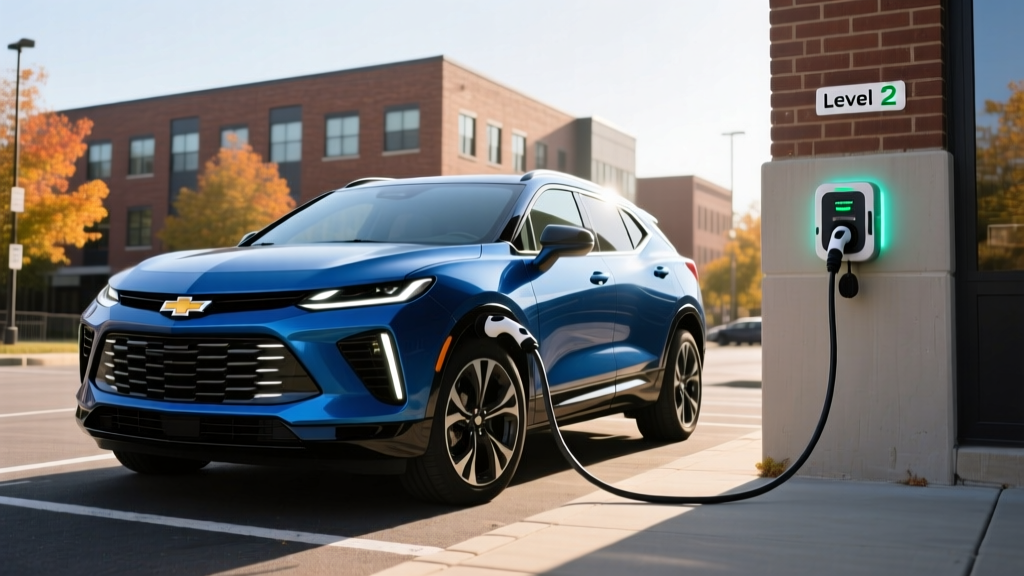
For Rochester-area home charging, a Level 2 wall connector on a 60-amp dedicated circuit (48A continuous) will add roughly 26 miles per hour of charging. An overnight 8-hour session replenishes about 200 miles — more than enough for daily needs. Installation in the Rochester market typically runs $800–$1,800 if your panel has capacity, or $2,500–$4,500 if a 200A panel upgrade is needed. Always consult a licensed electrician for a site-specific quote.
Public charging infrastructure in Monroe County has expanded significantly. Electrify America, EVgo, and ChargePoint all operate DC fast stations in the greater Rochester area, including locations near Eastview Mall, The Mall at Greece Ridge, and along I-90 corridor stops for longer trips toward Syracuse or Buffalo.
Performance, Drivetrain, and the SS Trim
| Trim | Drivetrain | Horsepower | Torque (lb-ft) | 0–60 mph |
|---|---|---|---|---|
| LT RWD | Rear-Wheel Drive | 340 hp | 325 | ~6.9 sec |
| LT AWD | Dual-Motor AWD | 288 hp | 343 | ~7.3 sec |
| RS AWD | Dual-Motor AWD | 288 hp | 343 | ~7.3 sec |
| SS AWD | Dual-Motor AWD | 557 hp | 648 | ~3.9 sec |
The volume trims (LT and RS with AWD) deliver adequate acceleration for merging onto 490 and passing on the Thruway, but they're not quick by EV standards — the dual-motor AWD setup prioritizes range over outright power. The SS trim, with its 557 hp and Wide Open Watts mode, is genuinely rapid but commands a significant price premium and reduces range to 293 miles.
For Rochester winters, AWD is the sensible choice. The Blazer EV's dual-motor system provides independent front/rear torque distribution, and regenerative braking on all four wheels aids stability on snow-packed roads. The RWD LT offers the longest range but is harder to recommend for Western New York's December–March conditions.
Pricing, Lease Economics, and Federal Tax Credit Eligibility
| Trim | Base MSRP | As-Tested (Typical Options) | §30D Credit Eligibility | Effective Price After Credit |
|---|---|---|---|---|
| LT RWD | $44,600 | $46,500 | Up to $7,500 (see rules) | ~$37,100 |
| LT AWD | $47,600 | $49,800 | Up to $7,500 (see rules) | ~$40,100 |
| RS AWD | $51,400 | $54,500 | Up to $7,500 (see rules) | ~$43,900 |
| SS AWD | $61,400 | $64,000 | Up to $7,500 (see rules) | ~$53,900 |
For Rochester shoppers considering a lease, there's an important distinction: the §30D federal tax credit applies to purchases, while leases may qualify for the commercial clean vehicle credit (§45W), which the leasing company receives and may (or may not) pass through as a lower monthly payment. This is known as the "lease loophole." When shopping Blazer EV leases at Rochester-area Chevrolet dealers, ask explicitly whether the lessor is passing through the $7,500 credit equivalent as a capitalized-cost reduction.
- MSRP Cap: SUVs must have an MSRP at or below $80,000 (all Blazer EV trims qualify)
- Buyer Income Cap (purchase/§30D): MAGI ≤ $150,000 single / $225,000 head of household / $300,000 joint
- Battery Sourcing: Critical minerals and battery component requirements phase up annually — confirm current-year compliance on the specific VIN with the dealer (IRS §30D rules)
- Point-of-Sale Transfer: Eligible buyers can transfer the credit to the dealer at purchase, reducing the drive-off price immediately
- Lease (§45W): No buyer income cap; credit goes to the lessor — negotiate pass-through
New York State also offers the Drive Clean Rebate (up to $2,000 at point of sale for eligible EVs under $60,000 MSRP), which can stack with federal incentives. Check current NYSERDA program availability, as funding is allocated on a first-come basis.
Interior, Cargo, and Technology
The Blazer EV's cabin is spacious for the midsize SUV segment, with dimensions that accommodate families and cargo comfortably:
- Front legroom: 43.1 inches
- Rear legroom: 38.4 inches
- Cargo behind rear seats: 27.7 cu ft (AWD) / 30.5 cu ft (RWD, no front motor)
- Cargo with rear seats folded: 54.2 cu ft (AWD) / 57.0 cu ft (RWD)
- Front trunk (frunk): Not available — the Blazer EV does not offer a front trunk
The infotainment system centers on a 17.7-inch diagonal touchscreen running GM's Ultifi-based software, paired with an 11-inch digital instrument cluster. Wireless Apple CarPlay and Android Auto are standard. The system supports Google Built-In for navigation and voice assistant, which is useful for hands-free destination entry while driving.
On the driver-assistance front, the Blazer EV includes Chevy Safety Assist (automatic emergency braking, lane keep assist, following distance indicator, IntelliBeam) as standard. Super Cruise — GM's hands-free highway driving system on mapped divided highways — is available on RS and SS trims. Important: Super Cruise is an SAE Level 2 system. You must remain attentive, and the driver-monitoring camera will alert you if your eyes leave the road. This is not autonomous driving.
Warranty Coverage
| Coverage | Term |
|---|---|
| Limited Bumper-to-Bumper | 3 years / 36,000 miles |
| Powertrain | 5 years / 60,000 miles |
| Battery & EV Components | 8 years / 100,000 miles (capacity retention ≥ 70%) |
| Corrosion (Rust-Through) | 6 years / 100,000 miles |
| Roadside Assistance | 5 years / 60,000 miles |
The 8-year/100,000-mile battery warranty with a 70% capacity retention threshold is standard for the segment. For a 36-month lease, you'll be well within the battery warranty period, making long-term degradation a non-issue for lessees. If you're buying and plan to keep the Blazer EV past the warranty, NMC batteries typically retain 85–90% capacity at 100,000 miles under normal use.
Pros, Cons, and Who the Blazer EV Suits Best
- Strong EPA range (324 mi RWD, 279 mi AWD) covers most commutes even in winter
- Spacious cabin with 38+ inches of rear legroom
- Super Cruise hands-free driving available on mapped highways
- Qualifies for full $7,500 §30D credit (verify VIN sourcing annually)
- AWD dual-motor system well-suited to Rochester snow and ice
- Comfortable ride quality over rough upstate roads
- 190 kW peak DC charging trails Ioniq 5 (240 kW) and Model Y (~250 kW)
- No front trunk (frunk) — lost cargo utility
- Infotainment software still maturing after rocky 2024 launch
- AWD performance trims are modest in acceleration (7.3 sec 0–60)
- Curb weight near 5,800 lbs impacts efficiency vs lighter competitors
- No NACS native port (adapter required for Tesla Superchargers; 2026 models may include native NACS — confirm with dealer)
- You want a roomy midsize EV SUV with Super Cruise for Thruway commuting
- You value domestic-brand dealer support in the Rochester area
- You need AWD for winter and can accept ~250 miles of real-world range
- Faster DC charging is a priority for road trips
- You want a frunk and more flexible cargo solutions
- Acceleration and efficiency matter more than interior volume
Blazer EV vs. Key Competitors in Rochester
| Spec | Blazer EV RS AWD | Ford Mustang Mach-E ER AWD | Hyundai Ioniq 5 Long Range AWD | Tesla Model Y LR AWD |
|---|---|---|---|---|
| EPA Range | 279 mi | 290 mi | 266 mi | 308 mi |
| Battery (kWh) | 102 | 91 | 84 | 78.1 |
| DC Fast Charge (kW) | 190 | 150 | 240 | ~250 |
| 10–80% Time | ~31 min | ~38 min | ~18 min | ~22 min |
| 0–60 mph | 7.3 sec | 5.1 sec | 5.1 sec | 4.8 sec |
| Cargo (rear seats up) | 27.7 cu ft | 29.7 cu ft | 27.2 cu ft | 30.2 cu ft |
| Base MSRP (AWD) | $51,400 | $48,995 | $50,100 | $48,990 |
The Blazer EV's advantage is interior volume and ride comfort. Its disadvantage is charging speed and efficiency. For Rochester buyers who rarely road-trip more than 200 miles in winter and primarily charge at home, the Blazer's slower DC rate is less consequential. For frequent I-90 corridor drivers heading to Albany or NYC, the Ioniq 5's faster charging is a meaningful time saver.
Frequently Asked Questions
What is the real-world range of the Blazer EV in Rochester winters?
AWD trims rated at 279 miles EPA typically deliver 250–275 miles in mild weather highway driving. In Rochester's January cold (15–25°F), expect 180–220 miles due to battery heating and cabin climate demands. Preconditioning while plugged in helps recover 15–20% of that loss. For a 30–40 mile daily commute, even winter range is ample with nightly Level 2 charging.
How fast does the Blazer EV charge at home and on DC fast chargers?
On a 240V/48A Level 2 home charger, the Blazer EV adds about 26 miles per hour and fully charges in roughly 10 hours. On a DC fast charger, it peaks at 190 kW and charges from 10–80% in approximately 31 minutes. Average sustained rate is around 130 kW, adding roughly 200 miles in 20 minutes.
How much does the Blazer EV cost after tax credits?
The LT RWD starts at $44,600 MSRP. With the full $7,500 federal §30D credit (subject to income, sourcing, and MSRP caps) and up to $2,000 NYS Drive Clean Rebate, effective cost can drop to approximately $35,100. For leases, the lessor claims the commercial credit (§45W) — negotiate to ensure the $7,500 equivalent reduces your capitalized cost.
Does the Blazer EV qualify for the federal EV tax credit?
Yes, the Blazer EV qualifies for up to $7,500 under §30D for eligible buyers (income caps: $150K single / $300K joint; SUV MSRP cap: $80K). However, the exact credit amount depends on battery component and critical-mineral sourcing requirements, which tighten annually. Verify the specific VIN's eligibility at fueleconomy.gov before signing.
Is the Blazer EV worth leasing vs. buying in Rochester?
Leasing makes sense if you want to avoid long-term battery-degradation risk, prefer lower monthly payments, and plan to upgrade in 36 months. The lease loophole may allow the $7,500 credit equivalent without income restrictions. Buying makes sense if you want full §30D point-of-sale transfer, plan to drive past 100,000 miles, or want equity in the vehicle. For Rochester drivers with home charging access and moderate annual mileage, leasing the Blazer EV is a low-risk entry into EV ownership.
Can I use Tesla Superchargers with the Blazer EV?
The 2026 Blazer EV is expected to offer NACS (Tesla) charging-port compatibility either natively or via a GM-approved adapter. Confirm with your dealer whether the specific model year and trim includes native NACS or requires the adapter. GM has been transitioning its EV lineup to NACS, but availability varies by build date.