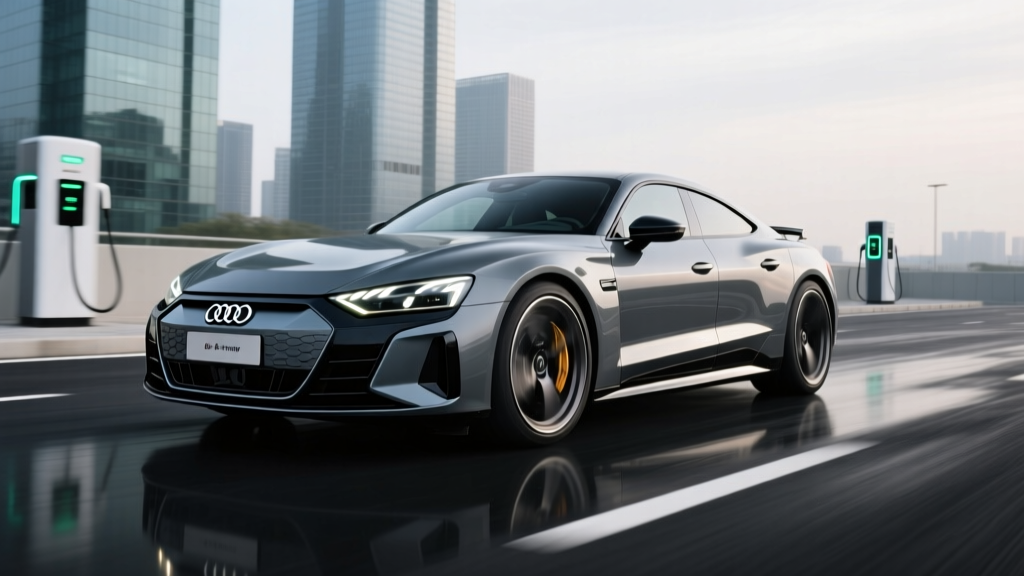
The Audi e-tron GT has always occupied a narrow lane: a luxury grand tourer that trades some practicality for head-turning design and ferocious straight-line speed. For 2026, Audi has refreshed the lineup with updated battery management, slightly improved efficiency, and the continued availability of the range-topping RS variant. But when buyers search for e-tron GT 0-60 times, they want the raw numbers — and the context around them. This review delivers both, covering real-world range, charging curves, pricing after incentives, and whether this electric GT earns its six-figure asking price against rivals like the Porsche Taycan, Tesla Model S, and Lucid Air.
Quick Specs at a Glance
| Spec | e-tron GT quattro | RS e-tron GT | RS e-tron GT Performance |
|---|---|---|---|
| EPA Range | 270 miles | 260 miles | 248 miles |
| Battery (usable) | 97.0 kWh (NMC) | 97.0 kWh (NMC) | 97.0 kWh (NMC) |
| Horsepower | 523 hp | 646 hp | 912 hp |
| 0-60 mph | 3.9 sec | 3.1 sec | 2.5 sec |
| Drivetrain | Dual-motor AWD | Dual-motor AWD | Dual-motor AWD |
| Peak DC Charge Rate | 270 kW | 270 kW | 270 kW |
| 10-80% DC Charge | ~21 min | ~21 min | ~21 min |
| Level 2 (240V) Rate | 11 kW (~30 mi/hr) | 11 kW (~30 mi/hr) | 11 kW (~30 mi/hr) |
| MPGe (combined) | 85 MPGe | 81 MPGe | 78 MPGe |
| Base MSRP | $108,200 | $150,200 | $190,200 |
| Battery Warranty | 8 yr / 100,000 mi | 8 yr / 100,000 mi | 8 yr / 100,000 mi |
Sources: EPA fueleconomy.gov, Audi USA
0-60 Performance: What the Numbers Mean in the Real World
The headline figure buyers search for — the e-tron GT 0-60 time — varies dramatically by trim. The base e-tron GT quattro hits 60 mph in 3.9 seconds with 523 hp on tap, which is genuinely quick for daily driving and highway merging. The RS e-tron GT drops that to 3.1 seconds with 646 hp, entering supercar territory. But the 2026 range-topper, the RS e-tron GT Performance, is the one that rewrites expectations: 912 hp and a 2.5-second 0-60 run, putting it in the same bracket as the Lucid Air Sapphire and well ahead of most combustion supercars.
All three trims use a dual-motor all-wheel-drive layout with a two-speed transmission on the rear axle — a design choice Audi shares with the mechanically related Porsche Taycan. That second gear allows stronger acceleration from a standstill while preserving highway efficiency. In our experience, launch control delivers consistent, repeatable times without the battery thermal throttling that plagues some competitors after two or three hard launches.
The trade-off for this performance is efficiency: the Performance trim's aggressive power delivery and stickier tires reduce EPA range by roughly 22 miles compared to the base model. If straight-line speed is your priority, the numbers don't disappoint. If range matters more, the base quattro offers the best balance.
Real-World Range vs. EPA Sticker
Real-world expectation: Plan for 220-245 miles in mixed highway driving for the base model, and 200-220 miles for the Performance trim. In cold weather (below 32°F), expect a further 15-25% reduction, dropping the base model to roughly 180-200 miles on a full charge. City driving with regenerative braking recovers closer to EPA estimates. The e-tron GT's low, aerodynamic sedan profile helps highway efficiency compared to taller SUVs, but its wide performance tires work against it.
The 97.0 kWh usable battery pack (NMC chemistry — nickel manganese cobalt) is shared across all trims. Audi quotes a gross capacity slightly higher, but the usable buffer protects long-term battery health. This is a fairly large pack by luxury-sedan standards, though the vehicle's 5,100+ lb curb weight and performance-oriented tuning keep efficiency in the 78-85 MPGe range — roughly 39-42 kWh per 100 miles driven.
For context, the Porsche Taycan 4S (the e-tron GT's closest platform sibling) achieves a similar 246-288 mile EPA range depending on configuration, while the Lucid Air Pure exceeds 400 miles thanks to a larger battery and obsessive efficiency engineering. If maximum range is your top criterion, the e-tron GT is not the segment leader — it prioritizes driving dynamics and design over distance.
Charging Speed: 270 kW Peak, but Watch the Curve
The 2026 e-tron GT supports a peak DC fast-charge rate of 270 kW via its 800-volt architecture — the same voltage platform used by the Porsche Taycan and Hyundai Ioniq 5. On a compatible 350 kW charger (such as Electrify America's newest stalls), Audi claims a 10-80% charge in approximately 21 minutes.
| Charging Level | Power | Speed / Time | Connector |
|---|---|---|---|
| Level 1 (120V household) | ~1.4 kW | ~4 miles per hour | J1772 (NACS adapter available) |
| Level 2 (240V home/work) | 11 kW (48A) | ~30 miles per hour; 0-100% in ~10 hrs | J1772 / NACS adapter |
| DC Fast Charge | Peak 270 kW | 10-80% in ~21 min; ~150 mi in 10 min | CCS1 (NACS adapter for Superchargers) |
However, real-world charging requires understanding the charge curve. The 270 kW figure is a peak, not a sustained rate. In practice, the e-tron GT holds above 200 kW through roughly 40% state of charge, then tapers progressively. From 60-80%, you'll see rates closer to 100-130 kW. This taper protects battery longevity but means the last 20% takes nearly as long as the first 40%. For road trips, plan stops around the 10-70% window where charging is fastest.
The e-tron GT includes a battery preconditioning feature: when you set a DC fast charger as your navigation destination, the car warms or cools the battery to optimal temperature before arrival. In cold weather, preconditioning can be the difference between a 120 kW and a 250 kW peak. Always use it.
For home charging, the onboard 11 kW AC charger adds roughly 30 miles of range per hour, meaning a full overnight charge from near-empty is achievable in about 10 hours on a 48-amp Level 2 circuit. Most owners charging from 20-80% overnight will wake to a full battery every morning. Note: a 48-amp charger requires a 60-amp dedicated circuit — budget $800-$2,500 for professional installation depending on your electrical panel (consult a licensed electrician for your specific setup).
Pricing, Trims, and Federal Tax Credit Eligibility
The 2026 Audi e-tron GT lineup starts at $108,200 for the base GT quattro (including destination), climbs to $150,200 for the RS e-tron GT, and peaks at $190,200 for the RS e-tron GT Performance. Well-optioned examples with the Prestige package, carbon-fiber trim, and Audi exclusive paint can add $15,000-$25,000, pushing as-tested prices well above $200,000 for the top trim.
| Trim | Base MSRP | §30D Credit Eligible? | Effective Price (if eligible) |
|---|---|---|---|
| e-tron GT quattro | $108,200 | No — exceeds $55,000 sedan MSRP cap | $108,200 |
| RS e-tron GT | $150,200 | No — exceeds $55,000 sedan MSRP cap | $150,200 |
| RS e-tron GT Performance | $190,200 | No — exceeds $55,000 sedan MSRP cap | $190,200 |
Key point on the federal tax credit: Under current IRS §30D rules, new electric sedans must have an MSRP at or below $55,000 to qualify for the up-to-$7,500 federal tax credit. The e-tron GT, at any trim level, far exceeds this cap and is not eligible for the new-vehicle §30D credit. Additionally, buyer income caps apply ($150,000 single / $300,000 joint filers), and battery component and critical-mineral sourcing requirements must be met. Always verify current rules at IRS.gov and consult a tax professional.
One workaround: the used EV credit (§25E) offers up to $4,000 (30% of sale price, capped at $25,000 MSRP) for eligible pre-owned EVs purchased from a dealer. A 2-3 year old e-tron GT that has depreciated below the $25,000 used-vehicle MSRP cap could theoretically qualify, though given the e-tron GT's original pricing, this is unlikely for several years. Check state-level incentives as well — some states offer rebates with no MSRP cap.
Interior, Tech, and Daily Livability
The e-tron GT's cabin is unmistakably Audi: minimalist, material-rich, and technology-forward. The 10.1-inch touchscreen runs Audi's latest MMI infotainment with wireless Apple CarPlay and Android Auto, a 12.3-inch digital cluster, and an available head-up display. The flat floor (no transmission tunnel) creates generous front-seat space, though the low roofline means rear headroom is tighter than a sedan like the Lucid Air.
Cargo space: 9.2 cubic feet in the rear trunk plus a 3.5 cubic-foot frunk (front trunk) — enough for a laptop bag and charging cables. This is a significant weakness versus the Model S (28 cu ft rear) or Lucid Air (32 cu ft). The e-tron GT is a grand tourer, not a hauler.
Passenger dimensions: Front legroom is 41.3 inches; rear legroom is 33.1 inches. The rear seat is best for children or shorter adults on longer trips. The low seating position and panoramic glass roof (standard on RS trims) create an airy feel despite the snug dimensions.
Driver assistance: Audi equips the e-tron GT with Audi adaptive cruise, lane centering, intersection assist, and park assist. This is an SAE Level 2 system — the driver must remain fully engaged with hands on the wheel and eyes on the road. It is not autonomous driving. The system is competent for highway cruising but less aggressive and feature-rich than Tesla's Autopilot or GM's Super Cruise in hands-free zones.
Who Should Buy the e-tron GT?
Choose the e-tron GT if:
- You want a design-first luxury EV that stands out in a sea of crossovers
- Straight-line performance (especially in RS/Performance trims) is a top priority
- You primarily commute solo or with one passenger and don't need cargo space
- You have access to home Level 2 charging and 350 kW DC fast chargers for road trips
Look elsewhere if:
- Maximum range is your #1 criterion (see Lucid Air or Tesla Model S)
- You regularly carry rear-seat adults or need trunk space (see BMW i5 or Mercedes EQS)
- You want federal tax credit eligibility (consider the BMW i4, Hyundai Ioniq 6, or Tesla Model 3)
- You want hands-free highway driving (GM Super Cruise on the Cadillac Celestiq or Tesla FSD Supervised)
Pros and Cons
- Blistering 0-60 times, especially RS Performance at 2.5 sec
- 800V architecture enables 270 kW peak charging
- Stunning low-slung design that ages well
- Refined, quiet cabin with premium materials
- 8-year / 100,000-mile battery warranty
- EPA range trails Lucid Air and Model S by 100+ miles
- Tiny 9.2 cu ft trunk and 3.5 cu ft frunk
- No federal tax credit eligibility (MSRP exceeds $55K cap)
- Rear headroom and legroom tight for adults
- Infotainment is functional but less polished than Tesla or Lucid
Frequently Asked Questions
What is the real-world range of the 2026 Audi e-tron GT?
The EPA rates the base e-tron GT quattro at 270 miles and the Performance at 248 miles. In real-world mixed highway driving, expect 220-245 miles (base) and 200-220 miles (Performance). Cold weather can reduce this by an additional 15-25%.
How fast does the e-tron GT charge at home and on the road?
On a 350 kW DC fast charger, the e-tron GT peaks at 270 kW and charges from 10-80% in approximately 21 minutes. On a home Level 2 charger (11 kW / 48A), it adds about 30 miles of range per hour, with a full charge taking roughly 10 hours.
Does the Audi e-tron GT qualify for the federal EV tax credit?
No. Under current IRS §30D rules, new electric sedans must have an MSRP at or below $55,000 to qualify. The e-tron GT starts at $108,200, making it ineligible at all trim levels. Always verify at IRS.gov.
Is the e-tron GT worth buying vs. the Porsche Taycan?
They share the same 800V J1 platform, but the e-tron GT offers slightly more standard range, a more luxurious interior, and a lower entry price. The Taycan offers a wider trim range, a Sport Turismo wagon body style, and marginally sharper handling. Choose the e-tron GT for grand-touring comfort; choose the Taycan for track-focused variants and body-style options.
What is the e-tron GT's battery warranty?
Audi covers the battery pack for 8 years or 100,000 miles, whichever comes first, with a minimum 70% capacity retention guarantee. The limited vehicle warranty is 4 years / 50,000 miles.
What's the fastest e-tron GT 0-60 time?
The 2026 RS e-tron GT Performance achieves a 2.5-second 0-60 mph time with 912 hp, making it the quickest Audi ever produced and competitive with the fastest production sedans in the world.