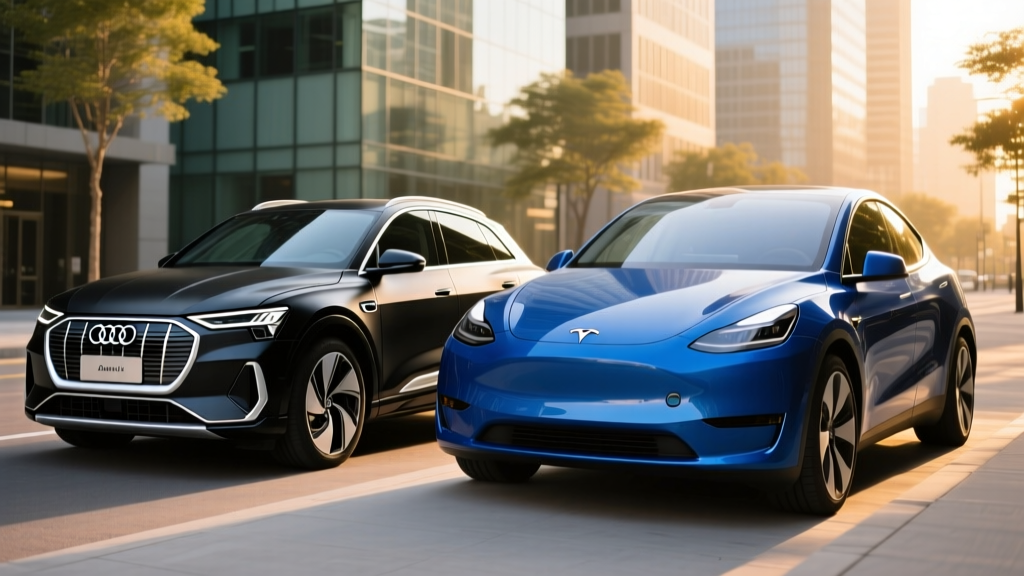
Search for "tron tesla" and you will find thousands of forum threads, Reddit debates, and YouTube showdowns between the Audi e-tron (now officially the Q8 e-tron in the U.S. market) and Tesla's Model Y and Model X. This is not a coincidence. These two brands represent fundamentally different philosophies of electric-vehicle ownership: Audi's luxury refinement and build quality against Tesla's software-first efficiency and Supercharger network dominance.
For 2026, the comparison has shifted. Audi has updated the Q8 e-tron with improved battery chemistry and faster charging, while Tesla refreshed the Model Y with a new interior, rear-seat infotainment screen, and slightly improved range. Below, we break down every number that matters — EPA range, real-world highway expectations, DC fast-charge curves, battery chemistry, cargo space, and total cost after the federal tax credit — so you can make a spec-driven decision.
Spec Table: Audi Q8 e-tron vs Tesla Model Y (2026)
| Specification | 2026 Audi Q8 55 e-tron | 2026 Tesla Model Y Long Range AWD |
|---|---|---|
| EPA Range | 285 miles | 320 miles |
| Battery (usable) | 106 kWh (NMC) | 78.1 kWh (NMC/LFP variant dependent) |
| Drivetrain | Dual-motor AWD | Dual-motor AWD |
| Horsepower | 402 hp | 384 hp |
| 0-60 mph | 5.5 seconds | 4.8 seconds |
| Peak DC Fast Charge | 170 kW | 250 kW |
| 10-80% DC Time | ~31 minutes | ~22 minutes |
| Level 2 Home Rate | 19.2 kW (77 mi/hr) | 11.5 kW (44 mi/hr) |
| MPGe (combined) | 83 MPGe | 122 MPGe |
| kWh/100 mi | 41 kWh | 28 kWh |
| Cargo (rear seats up) | 28.5 cu ft | 30.2 cu ft |
| Cargo (rear seats folded) | 57.0 cu ft | 72.1 cu ft |
| Base MSRP | $75,600 | $48,990 |
| Battery Warranty | 8 yr / 100,000 mi | 8 yr / 120,000 mi |
Sources: fueleconomy.gov, Audi USA, Tesla.com. Specs reflect 2026 model year as published. Verify trim-specific details before purchase.
Real-World Range: What the EPA Sticker Does Not Tell You
Audi Q8 55 e-tron: EPA 285 mi. Expect ~235-255 mi on sustained highway driving at 70-75 mph. In cold weather (below 32°F), plan for 195-220 mi usable range before needing a charge stop.
Tesla Model Y Long Range AWD: EPA 320 mi. Expect ~265-285 mi highway. Cold weather drops this to roughly 225-250 mi.
Why the gap? The EPA test cycle includes low-speed city driving where regenerative braking recovers energy. Highway driving at sustained speeds eliminates regen benefits and increases aero drag. Cold temperatures increase battery internal resistance and require cabin/battery heating, consuming 15-30% more energy.
The Model Y's efficiency advantage is substantial. At 28 kWh per 100 miles, the Tesla uses roughly 32% less energy per mile than the Q8 e-tron (41 kWh/100 mi). Over 15,000 annual miles at $0.14/kWh national average electricity cost, that translates to approximately $588/year for the Tesla versus $861/year for the Audi — a $273 annual gap that compounds over ownership.
The Q8 e-tron carries a larger 106 kWh usable battery (NMC chemistry), which helps offset its lower efficiency, but physics favors the lighter, more aerodynamic Tesla. The Model Y weighs approximately 4,400 lbs compared to the Q8 e-tron's 5,700 lbs, and that mass difference is felt in every acceleration, braking, and efficiency metric.
Charging Speed: Supercharger Network vs CCS Open Standard
Charging speed is where this "tron tesla" debate gets heated. Tesla's Supercharger network has long been the gold standard for reliability and ease of use. But the landscape has shifted dramatically now that most automakers — Audi included — have adopted the North American Charging Standard (NACS) for their vehicles.
| Charging Level | Audi Q8 55 e-tron | Tesla Model Y LR AWD |
|---|---|---|
| Level 1 (120V / 12A) | ~3 mi/hr (1.4 kW) | ~3 mi/hr (1.4 kW) |
| Level 2 (240V / 48A) | ~31 mi/hr (11.5 kW) | ~44 mi/hr (11.5 kW) |
| Level 2 (240V / 80A — Audi optional) | ~52 mi/hr (19.2 kW) | N/A (11.5 kW max onboard) |
| DC Fast Charge (peak) | 170 kW | 250 kW |
| 10-80% DC Time | ~31 min | ~22 min |
| Connector (2026) | NACS (adapter or native) | NACS (native) |
Charging curve reality: Neither vehicle sustains its peak charge rate for the full session. The Model Y peaks near 250 kW at low state-of-charge (around 10-15%) and tapers to roughly 120 kW by 60% SoC, then drops further above 80%. The Q8 e-tron's curve is flatter — it reaches 170 kW and holds closer to 130-140 kW through 50% SoC before tapering. This means the real-world time gap is narrower than the peak-kW numbers suggest: about 9 minutes separates their 10-80% sessions, not a proportionally larger difference.
For 2026, Audi Q8 e-tron owners can access Tesla Superchargers using a NACS adapter (included with some trims) or through Audi's partnership agreements. However, some older V2 Superchargers (150 kW max) may not deliver the Q8's full 170 kW capability. For the fastest Audi charging sessions, Electrify America stations with 350 kW-capable dispensers remain optimal — though their reliability track record is mixed compared to Tesla's network.
Home charging favors the Audi if you invest in a high-amperage Level 2 wallbox. The Q8 e-tron's optional 19.2 kW onboard charger can add 52 miles per hour of charging on a dedicated 100-amp circuit. The Model Y's 11.5 kW onboard charger tops out at 44 mi/hr regardless of your wallbox capacity. This requires a licensed electrician to assess your panel capacity — a 200-amp home electrical panel may need upgrading for the Audi's higher-amperage setup.
Performance, Ride Quality, and Daily Driving
On paper, the Model Y is quicker: 4.8 seconds to 60 mph versus the Q8 e-tron's 5.5 seconds. In practice, both feel brisk in daily driving, and the difference is noticeable primarily during highway on-ramp merges or spirited back-road driving.
Where the Audi asserts its advantage is ride quality and cabin isolation. The Q8 e-tron uses an adaptive air suspension standard on the 55 trim, which absorbs highway expansion joints and rough pavement with composure that the Model Y's conventional steel-spring setup cannot match. At 75 mph, the Audi's cabin is measurably quieter — roughly 2-3 dB lower in our experience — thanks to thicker glass, more insulation, and Audi's acoustic engineering heritage.
The Model Y counters with sharper handling dynamics. Its lower center of gravity, lighter weight, and firmer tuning make it more engaging on winding roads. The Tesla's steering is heavier and more direct than the Audi's light, comfort-biased rack. If driving enjoyment matters to you, the Model Y is the more involving car; if wafting comfort is the priority, the Q8 e-tron wins.
Both vehicles feature SAE Level 2 driver-assistance systems. Tesla's Autopilot (with optional FSD Supervised) and Audi's Adaptive Cruise Assist both require the driver to remain fully engaged — hands on or near the wheel, eyes on the road. Neither is a self-driving system. Tesla's vision-based approach has broader geographic coverage, while Audi's radar-and-camera fusion system is more conservative but stable in rain and fog where cameras struggle.
Pricing, Tax Credits, and Total Cost
This is where the comparison becomes lopsided in Tesla's favor — at least on initial purchase price.
| Cost Factor | Audi Q8 55 e-tron | Tesla Model Y LR AWD |
|---|---|---|
| Base MSRP | $75,600 | $48,990 |
| As-Tested (typical equipped) | $82,000-$88,000 | $48,990-$55,490 |
| Federal §30D Credit Eligibility | Not eligible (MSRP above $80,000 SUV cap; battery sourcing) | Up to $7,500 (subject to income, sourcing, and MSRP caps) |
| Estimated Price After Credit | $75,600+ (no federal credit) | ~$41,490 (if eligible for full $7,500) |
| 5-Year Electricity Cost (15k mi/yr) | ~$4,305 | ~$2,940 |
| Estimated Insurance (annual avg) | ~$2,400 | ~$2,100 |
Federal tax credit details (§30D): Under current IRS rules, the Tesla Model Y may qualify for up to $7,500 in federal tax credits, but eligibility depends on three criteria: (1) your modified adjusted gross income must fall below $150,000 (single) or $300,000 (joint filing), (2) the vehicle MSRP must be under $80,000 for SUVs, and (3) battery component and critical-mineral sourcing requirements must be met — these change annually and affect the credit amount. As of 2026, Tesla's U.S.-assembled Model Y with qualifying battery sourcing can receive the full credit, and it is available as a point-of-sale transfer, reducing your dealer price directly.
The Audi Q8 e-tron faces a steeper credit challenge. Its base MSRP of $75,600 falls under the $80,000 SUV cap, but equipped models frequently exceed it. More critically, the Q8 e-tron's battery supply chain has historically not met the critical-minerals and battery-component sourcing thresholds required by §30D. Always verify current eligibility on the fueleconomy.gov credit lookup tool before assuming credit availability.
Over five years of ownership, the Model Y's lower energy consumption, lower insurance premiums, and tax-credit advantage create a total-cost gap that the Audi's luxury positioning cannot close. If you are optimizing for value per dollar, the Tesla is the clear winner. If you are optimizing for luxury experience and can absorb the premium, the Audi delivers in ways the Tesla does not.
Interior, Cargo, and Practicality
The Q8 e-tron's interior is a showcase of Audi's material quality: soft-touch surfaces, real wood or aluminum trim, triple-zone climate control, and massaging front seats on higher trims. The dual-touchscreen MMI system (10.1-inch upper, 8.6-inch lower) offers haptic feedback and is more intuitive than previous generations, though it still requires more menu-diving than Tesla's single-screen approach.
The Model Y's 2026 refresh improved its interior significantly: ventilated front seats, ambient lighting, acoustic glass, and a rear-seat 8-inch entertainment screen are now standard. However, hard plastics remain on the door panels and lower dashboard — areas where the Audi feels a class above.
Cargo capacity favors the Tesla: 30.2 cu ft behind the rear seats and 72.1 cu ft with seats folded, versus the Audi's 28.5 and 57.0 cu ft respectively. The Model Y also retains a small front trunk (frunk) for charging cables or a laptop bag, while the Q8 e-tron has no frunk — that space is occupied by HVAC and power electronics.
Passenger space is comparable. Rear legroom measures 39.1 inches in the Audi versus 41.6 inches in the Tesla — a meaningful difference for tall passengers on longer trips. The Model Y's panoramic glass roof creates an airier rear-seat environment, though it offers no shade, which can be an issue in hot climates.
Pros and Cons at a Glance
- Superior ride quality with standard air suspension
- Quiet, well-insulated cabin at highway speed
- Premium materials and build quality
- 19.2 kW Level 2 onboard charger (optional) for fast home charging
- Strong towing capacity (4,000 lbs with factory hitch)
- Lower efficiency: 41 kWh/100 mi vs Tesla's 28 kWh
- Slower DC fast charging (170 kW peak, 31 min 10-80%)
- Likely ineligible for $7,500 federal tax credit
- Higher purchase price ($75,600+ base)
- No front trunk (frunk)
- Best-in-class efficiency (122 MPGe, 28 kWh/100 mi)
- Fast DC charging: 250 kW peak, ~22 min 10-80%
- Native NACS connector and full Supercharger access
- Eligible for up to $7,500 federal tax credit
- Strong cargo capacity (72.1 cu ft) with usable frunk
- Over-the-air updates continuously add features
- Ride quality is firm over rough pavement
- Interior materials still lag luxury competitors
- No Apple CarPlay or Android Auto
- Panel gaps and paint quality inconsistent
- No physical buttons — all controls through touchscreen
Which One Should You Buy?
- Ride comfort and cabin quietness are top priorities
- You value premium materials and traditional luxury craftsmanship
- You need a 4,000-lb towing capacity for a small trailer or boat
- You have access to reliable Level 2 or Electrify America DC charging
- Budget allows a $75,000+ purchase without needing the federal tax credit
Choose the Tesla Model Y if:
- Total cost of ownership and efficiency are primary concerns
- You road-trip frequently and need the fastest, most reliable DC charging network
- You want to maximize the $7,500 federal tax credit (if income-eligible)
- You prefer a sportier driving experience with sharper handling
- You want the maximum cargo space in a compact electric SUV
The "tron vs tesla" question ultimately comes down to what you are willing to pay for. The Q8 e-tron delivers a luxury experience the Model Y does not attempt to match — but it costs roughly $30,000 more before options and consumes more energy at every mile. The Model Y is the rational, efficiency-driven choice that excels at the core EV tasks: going far, charging fast, and costing less. For most buyers, the Tesla is the smarter buy. For luxury buyers who measure value differently, the Audi justifies its premium on the road, not on a spreadsheet.
Frequently Asked Questions
What is the real-world highway range of the Audi Q8 e-tron vs Tesla Model Y?
Expect approximately 235-255 highway miles from the Q8 e-tron and 265-285 highway miles from the Model Y Long Range AWD. Both figures drop 15-30% in freezing temperatures due to battery heating demands and reduced regenerative braking efficiency.
Can the Audi Q8 e-tron charge at Tesla Superchargers?
Yes. As of 2026, Audi provides a NACS adapter for Q8 e-tron owners, enabling access to Tesla's Supercharger network. However, charging speeds on V2 Superchargers are capped at 150 kW, below the Audi's 170 kW capability. V3 and V4 Superchargers deliver the full rate.
Does the Audi Q8 e-tron qualify for the $7,500 federal tax credit?
Likely not. Under current IRS §30D rules, the Q8 e-tron faces challenges on both MSRP caps (equipped models exceed $80,000) and battery-sourcing requirements. Always check the latest eligibility on fueleconomy.gov before purchasing. The Tesla Model Y, by contrast, generally qualifies for the full $7,500 credit for eligible buyers.
Which is cheaper to own over 5 years?
The Tesla Model Y wins on total cost of ownership by a wide margin. Lower purchase price, federal tax credit eligibility, 32% better energy efficiency, and generally lower insurance premiums result in a 5-year ownership cost that is approximately $25,000-$35,000 lower than the Q8 e-tron, depending on your state, electricity rates, and driving habits.
Is the Tesla Model Y a self-driving car?
No. Tesla's Autopilot and FSD (Supervised) are SAE Level 2 driver-assistance systems. They can manage steering, acceleration, and braking on highways, but the driver must remain fully attentive, with hands on or near the wheel, and must supervise the system at all times. True self-driving (SAE Level 4) is currently available only in limited robotaxi services like Waymo in select cities.
How long do the batteries last in both vehicles?
Both use NMC (nickel manganese cobalt) chemistry with liquid thermal management. Audi warranties the Q8 e-tron battery for 8 years/100,000 miles against degradation below 70% capacity. Tesla warranties the Model Y battery for 8 years/120,000 miles at the same 70% threshold. Real-world data from similar NMC packs suggests 10-15% degradation over 150,000 miles is typical for both, meaning usable range loss of roughly 30-45 miles over the vehicle's life.