The Tesla Cybertruck's polarizing angular design and cold-rolled stainless steel exoskeleton have drawn both admiration and skepticism since its late-2023 delivery. But as early adopters accumulate real-world miles, one question surfaces repeatedly in forums and service centers: Cybertruck rust issues — are they a widespread defect, a cosmetic nuisance, or a misunderstood characteristic of stainless steel? This review dissects the metallurgy, owner reports, and Tesla's response, while delivering the full spec-sheet analysis buyers need in 2026.
The Stainless Steel Reality: Surface Corrosion vs. Structural Rust
The Cybertruck uses a 300-series austenitic stainless steel alloy — similar to what you'd find in commercial kitchen equipment or marine applications. Unlike the galvanized mild steel used in conventional truck bodies, this alloy contains chromium (at least 10.5%) that forms a passive oxide layer, preventing the kind of deep, structural rust that eats through fenders and frames on older vehicles.
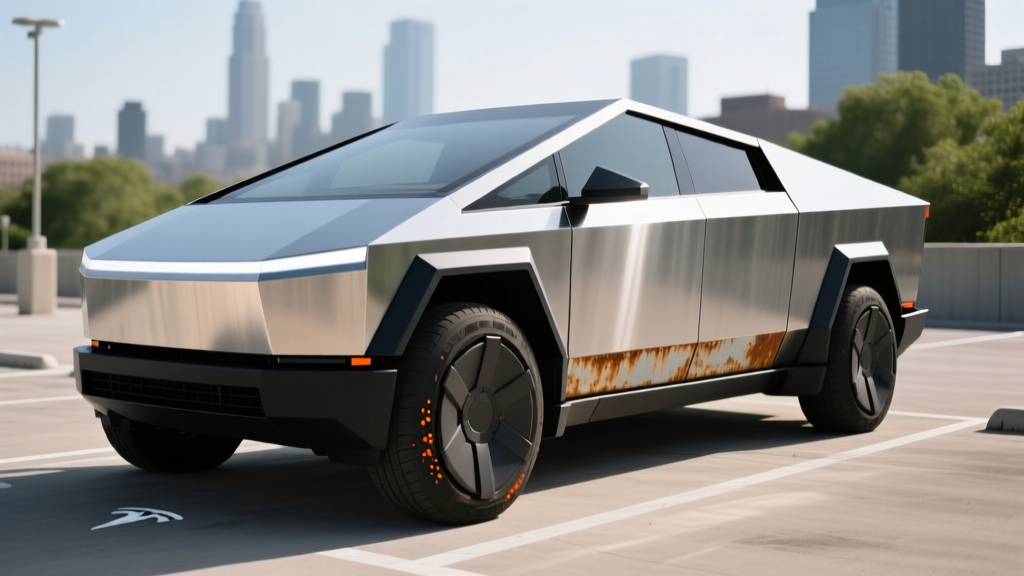
However, surface-level corrosion is a different story. Multiple owners have reported orange-brown spotting on body panels, particularly:
- Along weld seams and laser-cut edges where the protective oxide layer is disrupted
- Near fastener points where dissimilar metals contact the stainless
- On lower panels exposed to road salt, brake dust, and industrial fallout
- In coastal environments with salt-laden air
This is not "rust" in the traditional sense of iron oxide consuming the base metal. It's typically free iron contamination — microscopic iron particles (from manufacturing tooling, brake dust, or rail transport) embedding in the stainless surface and oxidizing. The fix is often a passivation treatment or specialized stainless cleaner (e.g., Bar Keepers Friend or CitriSurf), not body panel replacement.
Tesla has acknowledged the issue in service bulletins, recommending specific cleaning protocols. As of the 2026 model year, Tesla states it has improved post-production passivation processes at Giga Texas, though long-term field data is still accumulating.
2026 Cybertruck Specifications: Range, Battery, and Efficiency
| Specification | AWD (Dual-Motor) | Cyberbeast (Tri-Motor) |
|---|---|---|
| EPA Estimated Range | 340 miles | 320 miles |
| Battery Capacity (usable) | ~123 kWh (NMC) | ~123 kWh (NMC) |
| Battery Chemistry | NMC (Nickel Manganese Cobalt) | NMC |
| MPGe (Combined) | 72 MPGe | 68 MPGe |
| Energy Consumption | 47 kWh/100 mi | 50 kWh/100 mi |
| 0-60 mph | 3.9 seconds | 2.6 seconds |
| Horsepower | 600 hp | 845 hp |
| Drivetrain | Dual-Motor AWD | Tri-Motor AWD |
| Towing Capacity | 11,000 lbs | 11,000 lbs |
| Payload Capacity | 2,500 lbs | 2,500 lbs |
Charging Performance: DC Fast Charging and Home Setup
The Cybertruck's 800-volt architecture enables impressive peak charging rates, but the charge curve tells the full story:
| Charging Method | Max Power / Rate | Time or Miles Added |
|---|---|---|
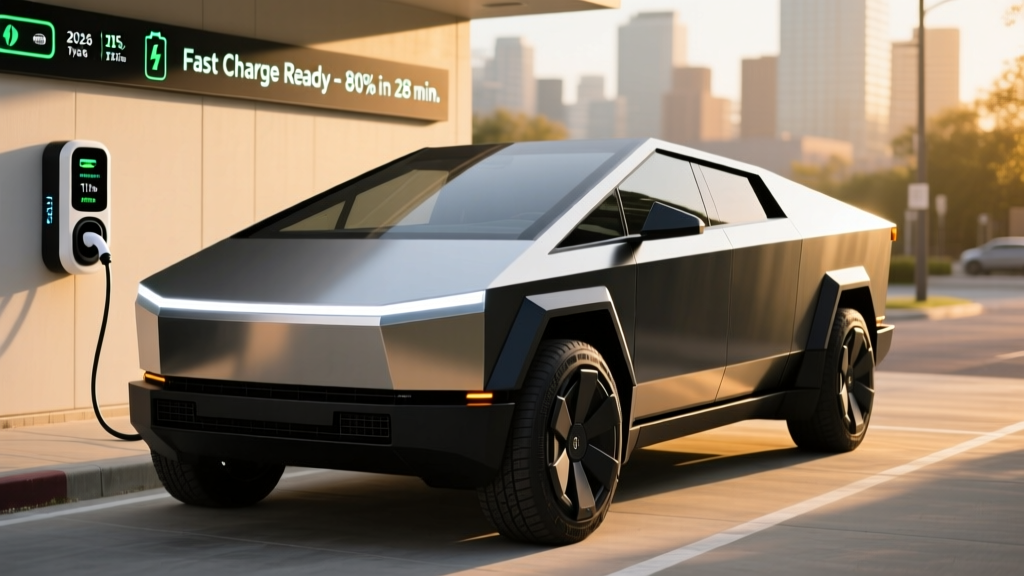
| DC Fast Charge (V4 Supercharger) | Peak 350 kW | 10-80% in ~18 minutes |
| DC Fast Charge (250 kW V3 Supercharger) | Peak 250 kW | 10-80% in ~24 minutes |
| Home Level 2 (Tesla Wall Connector, 48A) | 11.5 kW | ~34 miles per hour of charging |
| Home Level 2 (32A mobile connector) | 7.7 kW | ~23 miles per hour |
| Level 1 (120V household) | ~1.4 kW | ~4 miles per hour |
Charging curve reality: The 350 kW peak is sustained only between roughly 10-35% State of Charge (SoC). Above 50%, the rate tapers progressively — by 80%, you're pulling under 100 kW. This is normal for NMC chemistry at high SoC to protect battery longevity. For road trips, the practical strategy is 10-80% charges (~18 min at V4 stations), which adds roughly 240 miles of real-world range.
Home charging note: Fully replenishing a depleted 123 kWh battery on a 48A Level 2 circuit takes approximately 11-12 hours. Most owners charging overnight from 30-80% daily will see full replenishment in 5-6 hours. Ensure your electrician installs a NEMA 14-60 outlet or hardwires the Wall Connector on a 60A circuit.
Pricing, Tax Credits, and Ownership Cost
Tesla's Cybertruck pricing has shifted multiple times since launch. As of early 2026, the MSRP structure is:
| Trim | Base MSRP | Est. Price After §30D Credit* |
|---|---|---|
| AWD (Dual-Motor) | $79,990 | $72,490 |
| Cyberbeast (Tri-Motor) | $99,990 | $92,490 |
*Federal tax credit estimates assume buyer eligibility under IRS §30D rules. Actual credit depends on MSRP caps, buyer income limits, battery component sourcing, and critical mineral requirements. The Cybertruck, as a truck, falls under the $80,000 MSRP cap for vans/SUVs/trucks — meaning the AWD trim at $79,990 qualifies for the full $7,500 credit if other criteria are met, while the Cyberbeast at $99,990 exceeds the cap and is ineligible. Always consult IRS.gov or a tax professional before purchase.
Income caps (2026 tax year): Modified AGI limits are $300,000 (married filing jointly), $225,000 (head of household), $150,000 (single). Point-of-sale transfer is available, allowing the credit to reduce the purchase price at delivery rather than waiting for tax filing.
Ownership cost reality: Beyond the purchase price, Cybertruck owners report insurance premiums 30-50% higher than comparable trucks (F-150 Lightning, Rivian R1T) due to the stainless body's repair complexity and limited collision-center familiarity. Tesla's own insurance product may offer competitive rates in eligible states.
Interior, Cargo, and Technology
The Cybertruck's cabin is minimalist even by Tesla standards — an 18.5-inch front touchscreen handles nearly all vehicle functions, with a secondary 9.4-inch rear screen for passengers. There are no traditional stalks; turn signals are steering-wheel buttons (a divisive choice).
Cargo dimensions:
- Bed length: 6 feet (with tailgate up); 7+ feet with tailgate down
- Bed volume: ~67 cubic feet (bed) + ~17 cu ft front trunk (frunk)
- Rear legroom: ~38 inches (adequate for adults on short trips, tight for tall passengers on long hauls)
- Seating: 5-passenger, 3-across rear bench
Notable tech features:
- Steer-by-wire system (no mechanical linkage between steering wheel and wheels) — provides variable ratio but requires acclimation
- 48-volt electrical architecture (first in a production Tesla) — enables smaller wiring harnesses and more efficient accessory power
- Armor glass (laminated) — improved over the 2019 demo shattering, though not impervious
- Air suspension with ~12 inches of travel, up to 17 inches of ground clearance in Extract mode
- Tesla Autopilot (Level 2 driver assist) standard; FSD (Supervised) available as a $8,000 option or $99/month subscription
Notable drawbacks: The steer-by-wire system's lack of road feedback frustrates some drivers. Rear visibility is poor due to the sloping bed cover and small rear window — the camera-based digital rearview mirror is essential. The tonneau bed cover, while power-retractable, has drawn reports of alignment issues and water ingress in heavy rain.
Warranty Coverage and Long-Term Durability
Tesla's warranty for the 2026 Cybertruck:
- Basic Vehicle Limited Warranty: 4 years / 50,000 miles
- Battery & Drive Unit Warranty: 8 years / 120,000 miles (whichever comes first), with minimum 70% battery capacity retention guaranteed
- Restraint System: 5 years / 60,000 miles
- Corrosion (perforation): 12 years / unlimited miles — but this covers holes from corrosion, not surface staining or cosmetic discoloration
The corrosion warranty distinction matters for buyers concerned about Cybertruck rust issues: surface spotting and free-iron staining are not covered, as Tesla (correctly, from a metallurgical standpoint) considers these maintenance items rather than defects. However, any structural perforation — an extremely unlikely scenario with 300-series stainless — would be covered for 12 years.
Cybertruck vs. Competitors: Is It Worth Buying?
The electric truck segment in 2026 offers credible alternatives:
- Ford F-150 Lightning: EPA range up to 320 mi (Extended Range), starting ~$55,000, conventional steering, widely serviceable. Less polarizing design, lower performance, but more practical for traditional truck buyers.
- Rivian R1T (Dual-Motor): EPA range up to 352 mi (Max Pack), starting ~$73,000, superior interior quality and off-road capability, but no federal tax credit (exceeds MSRP cap on most trims).
- Chevrolet Silverado EV: EPA range up to 450 mi (4WT), starting ~$55,000, massive range, but larger footprint and fleet-oriented initial trims.
The Cybertruck's unique value proposition is its combination of tri-motor performance (2.6s 0-60 in Cyberbeast), 11,000-lb towing, and the stainless body's theoretical longevity. But buyers prioritizing serviceability, insurance cost, and traditional truck ergonomics may find the F-150 Lightning or Silverado EV more pragmatic choices.
Pros and Cons: The Honest Assessment
- Class-leading performance (Cyberbeast: 2.6s 0-60)
- 11,000-lb towing with integrated trailer features
- Stainless body won't structurally rust like mild steel
- 800V charging architecture enables fast DC fills
- 48V electrical system is a genuine engineering advance
- AWD trim eligible for $7,500 federal tax credit
- Surface staining/cosmetic corrosion requires maintenance
- Insurance premiums 30-50% higher than competitors
- Steer-by-wire lacks road feel; acclimation required
- Rear visibility is poor; reliance on cameras
- Cyberbeast exceeds $80K MSRP cap — no federal credit
- Limited collision repair network for stainless body
- Highway efficiency poor (~260-290 real-world miles at 75 mph)
Who Should Buy the Cybertruck (And Who Shouldn't)
Best for: Tech-enthusiast truck buyers who prioritize performance, want the stainless body's longevity, have home charging access, and are willing to accept the learning curve of steer-by-wire and camera-based visibility. The AWD trim, with its $7,500 tax credit eligibility, is the value sweet spot.
Not ideal for: Fleet operators or commercial users who need easy, cheap body repairs; buyers in heavy road-salt regions who don't want to perform regular stainless passivation; those who prefer traditional truck ergonomics and steering feedback; budget-conscious buyers (the F-150 Lightning starts $25K lower).
Frequently Asked Questions
Does the Cybertruck actually rust?
The 300-series stainless steel body does not structurally rust like conventional steel. However, surface-level orange staining from free iron contamination, brake dust, or salt exposure is common. This is cosmetic and treatable with stainless cleaners or passivation — not a sign of metal degradation.
What is the real-world range of the Cybertruck?
The AWD's EPA estimate is 340 miles, but real-world highway driving at 70-75 mph yields 260-290 miles. In cold weather (below freezing), expect 220-270 miles. The Cyberbeast's 320-mile EPA figure translates to roughly 240-270 miles highway.
How fast does the Cybertruck charge?
On a V4 Supercharger (350 kW capable), 10-80% takes approximately 18 minutes. On a V3 Supercharger (250 kW), it's ~24 minutes. Home Level 2 charging at 48A adds about 34 miles of range per hour.
Does the Cybertruck qualify for the $7,500 federal tax credit?
The AWD trim at $79,990 MSRP is under the $80,000 truck cap and may qualify for the full $7,500 credit, subject to buyer income limits ($150K single / $300K joint), battery sourcing requirements, and point-of-sale transfer rules. The Cyberbeast at $99,990 exceeds the MSRP cap and is ineligible. Always verify current rules at IRS.gov.
Is the Cybertruck worth buying over the F-150 Lightning or Rivian R1T?
If you prioritize raw performance, stainless body durability, and Tesla's Supercharger network, yes. If you value lower insurance costs, easier body repairs, traditional steering feel, or a lower entry price, the F-150 Lightning or Rivian R1T may be more practical choices.
How do I prevent surface staining on the Cybertruck?
Tesla recommends regular washing (especially after salt or brake dust exposure), using pH-neutral cleaners, and applying a stainless steel passivation treatment (e.g., CitriSurf) every 6-12 months. Avoid steel wool or carbon-steel brushes, which embed iron particles and worsen staining.