2026 Audi e-tron: Quick Verdict
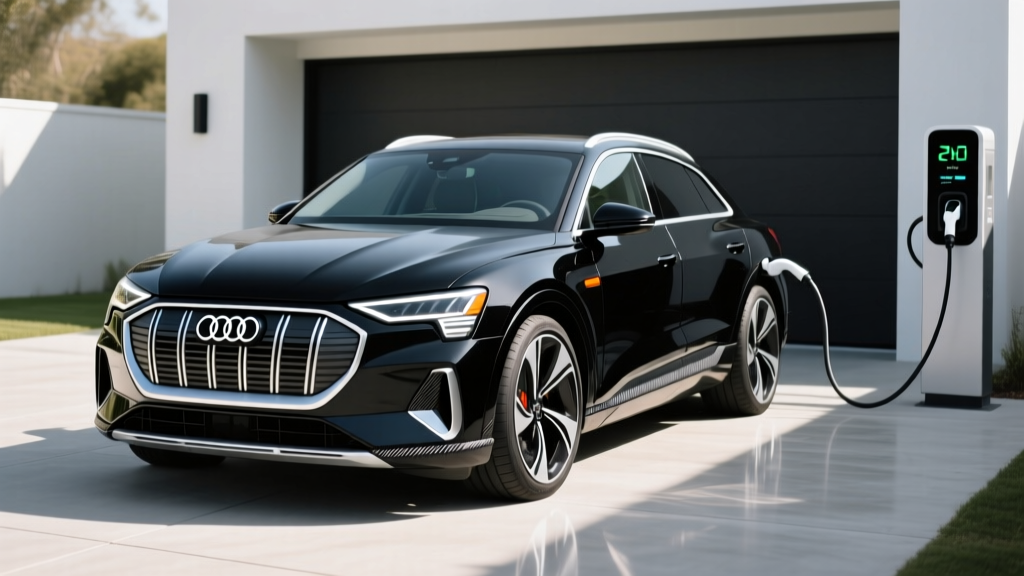
The Audi e-tron (now officially badged as the Q8 e-tron in the U.S. market) remains one of the most refined luxury electric SUVs available, trading headline-grabbing range for exceptional ride quality, cabin isolation, and DC fast-charging performance. For buyers researching the Audi e-tron cost of ownership, the calculus involves a premium entry price offset by strong charging infrastructure access, competitive efficiency for its class, and Audi's build quality. This profile covers every number you need to make an informed purchase decision.
Real-World Range vs. EPA Estimate
EPA Estimated Range: 285 miles (Q8 55 e-tron, 114 kWh battery)
Real-World Expectation: Expect 240–260 miles on highway-heavy trips at 70+ mph. In cold weather (below 32°F), plan for 190–220 miles due to battery heating demands and cabin climate load. City driving with regenerative braking can push closer to the EPA sticker or slightly above.
Audi e-tron Pricing and Trim Levels
The 2026 Audi Q8 e-tron lineup starts at a premium price point consistent with its luxury midsize SUV positioning. Here's the current MSRP structure before destination charges, incentives, or dealer adjustments:
| Trim | MSRP | Drivetrain | EPA Range |
|---|---|---|---|
| Premium | $74,400 | quattro AWD | 285 mi |
| Premium Plus | $79,800 | quattro AWD | 285 mi |
| Prestige | $85,400 | quattro AWD | 285 mi |
| Sportback (Premium Plus) | $82,300 | quattro AWD | 273 mi |
Destination charge: $1,195 (adds to all trims).
As-tested pricing: A well-equipped Premium Plus with optional 21-inch wheels, towing package, and Bang & Olusen audio typically lands between $86,000–$89,000 before incentives.
Federal Tax Credit Eligibility (IRS §30D)
The Audi Q8 e-tron is assembled in Brussels, Belgium, which disqualifies it from the full $7,500 federal tax credit under current IRS §30D rules requiring North American final assembly. However, the vehicle may qualify for partial credit depending on critical mineral and battery component sourcing thresholds that shift annually. Key eligibility constraints:
- MSRP cap: SUVs must be below $80,000 — the Premium trim qualifies; Premium Plus and Prestige exceed the cap unless optioned down.
- Income limits: Modified AGI cannot exceed $300,000 (joint), $225,000 (head of household), or $150,000 (single).
- Assembly requirement: Final assembly must occur in North America — the Q8 e-tron does NOT meet this requirement as of 2026.
- Point-of-sale transfer: If eligible, the credit can be applied at purchase to reduce upfront cost.
Bottom line: Most Audi e-tron buyers will not qualify for the federal credit due to the Belgium assembly. Check fueleconomy.gov for the latest eligible vehicle list before purchasing. State incentives (California, Colorado, New York, and others) may partially offset cost — consult your state's energy office.
Battery, Range, and Efficiency
| Specification | Q8 55 e-tron |
|---|---|
| Battery Capacity (gross) | 114 kWh |
| Battery Capacity (usable) | 106 kWh |
| Chemistry | NMC (Nickel Manganese Cobalt) |
| EPA Range | 285 miles |
| EPA Efficiency | 81 MPGe combined (2.4 kWh/mi) |
| kWh per 100 miles | 42 kWh/100mi |
The 114 kWh NMC pack is one of the largest in the luxury SUV segment, but the Q8 e-tron's 5,600+ lb curb weight and emphasis on cabin comfort over aerodynamic efficiency keep MPGe figures moderate. For comparison, the BMW iX xDrive50 achieves 87 MPGe combined with a smaller 111.5 kWh battery, while the Mercedes EQE SUV rates at 79 MPGe.
Efficiency insight: The Q8 e-tron's thermal management system is excellent — battery preconditioning for DC fast charging is effective, and the heat pump (standard on all trims) minimizes cold-weather range loss relative to competitors without heat pumps.
Charging Speed: DC Fast and Home Level 2
| Charging Method | Power | Time / Rate |
|---|---|---|
| DC Fast Charge (peak) | 170 kW | 10–80% in ~31 minutes |
| DC Fast Charge (sustained avg) | ~130 kW | Curve tapers above 80% |
| Level 2 (240V, 48A) | 11.5 kW | ~22 miles per hour |
| Level 2 (full 0–100%) | 11.5 kW | ~9.5 hours |
| Level 1 (120V) | 1.4 kW | ~3 miles per hour |
Charging curve reality: The Q8 e-tron peaks at 170 kW only between 10–30% state of charge. From 30–60%, it sustains roughly 140–150 kW, then tapers to 100 kW by 70%, and drops sharply above 85%. This is a respectable curve, but not class-leading — the Hyundai Ioniq 5 and Kia EV6 (800V architecture) sustain higher rates longer.
Home charging: The onboard 11.5 kW charger is adequate for overnight replenishment. A typical daily commute of 40 miles requires roughly 2 hours of Level 2 charging. Installation of a 48A Level 2 home charger (requiring a 60A circuit) typically costs $800–$2,500 depending on panel capacity and run length.
Performance and Drivetrain
| Metric | Q8 55 e-tron |
|---|---|
| Horsepower | 402 hp (boost mode) |
| Torque | 490 lb-ft |
| 0–60 mph | 5.5 seconds |
| Drivetrain | Dual-motor quattro AWD |
| Towing Capacity | 4,000 lbs (with towing package) |
| Top Speed | 124 mph (electronically limited) |
The Q8 e-tron prioritizes linear, refined acceleration over sports-SUV aggression. The 5.5-second 0–60 time is respectable but trails the BMW iX xDrive50 (4.4 seconds) and Tesla Model X (3.8 seconds). Where the Audi excels is ride quality — the standard adaptive air suspension delivers exceptional isolation from road imperfections, and cabin noise levels at highway speed are among the lowest in the segment.
Regenerative braking: The Q8 e-tron offers three regen levels selectable via steering-wheel paddles, but does not offer true one-pedal driving to a complete stop. Maximum regen deceleration is approximately 0.3g, which recovers energy effectively but requires brake-pedal use for full stops.
Interior, Cargo, and Technology
Passenger and Cargo Dimensions
| Measurement | Q8 e-tron SUV |
|---|---|
| Front Headroom | 39.6 inches |
| Rear Headroom | 38.4 inches |
| Front Legroom | 41.6 inches |
| Rear Legroom | 39.1 inches |
| Cargo Volume (behind 2nd row) | 28.5 cu ft |
| Cargo Volume (2nd row folded) | 57.0 cu ft |
| Frunk (front trunk) | Not available (charging components) |
The Q8 e-tron's cabin materials and assembly quality are exemplary — soft-touch surfaces, real wood or aluminum trim, and precise panel gaps throughout. Rear legroom accommodates adults comfortably on long trips, a weakness in some competitors (Mercedes EQE SUV).
Cargo note: The 28.5 cu ft behind the second row is competitive but not segment-leading (BMW iX: 35.5 cu ft). The absence of a frunk is a missed opportunity for secure, weatherproof storage of charging cables and small items.
Infotainment and Driver Assistance
The Q8 e-tron runs Audi's latest MMI touch response system with dual screens (10.1-inch upper, 8.6-inch lower) and a 12.3-inch Virtual Cockit digital instrument cluster. Wireless Apple CarPlay and Android Auto are standard.
Driver assistance (SAE Level 2): Audi's Adaptive Cruise Assist with lane guidance is standard on Premium Plus and Prestige trims. This is a Level 2 system — the driver must maintain hands-on-wheel supervision at all times. It is not autonomous driving. Features include:
- Adaptive cruise control with stop-and-go
- Lane centering assist
- Traffic sign recognition
- Predictive efficiency assist (adjusts regen based on navigation data)
Notable tech drawback: The dual-screen MMI interface requires precise finger placement and can distract from driving. Physical climate controls would improve usability.
Ownership Costs and Warranty
| Category | Coverage |
|---|---|
| Basic Warranty | 4 years / 50,000 miles |
| Powertrain Warranty | 4 years / 50,000 miles |
| Battery Warranty | 8 years / 100,000 miles (70% capacity retention) |
| Roadside Assistance | 4 years / unlimited miles |
| Complimentary Maintenance | 1 year / 10,000 miles |
Battery warranty detail: Audi guarantees the high-voltage battery will retain at least 70% of its original capacity over 8 years or 100,000 miles. This is industry-standard but not exceptional — Hyundai/Kia offer 10-year/100,000-mile battery coverage. Real-world degradation data for the 114 kWh NMC pack is limited (the Q8 e-tron launched in 2024), but NMC chemistry with active thermal management typically loses 8–12% capacity over 8 years under normal use.
Charging cost estimate: At the U.S. average electricity rate of $0.16/kWh, fully charging the 106 kWh usable battery costs approximately $17. For a driver covering 12,000 miles annually at 2.4 kWh/mile, annual home-charging cost is roughly $460. DC fast-charging at Electrify America or similar networks ($0.40–$0.50/kWh) increases cost to $1,150–$1,440 annually if used exclusively.
Pros, Cons, and Who Should Buy
Pros
- Exceptional ride quality and cabin isolation
- Strong DC fast-charging curve (170 kW peak)
- Standard heat pump minimizes cold-weather range loss
- Premium materials and build quality
- Competitive 4,000-lb towing capacity
- Air suspension standard on all trims
Cons
- No federal tax credit (Belgium assembly)
- Range lags BMW iX and Tesla Model X
- No frunk for charging-cable storage
- Dual-screen MMI can distract while driving
- 5.5-sec 0–60 trails sportier competitors
- High entry price with limited credit offset
Who This EV Suits Best
Buy the Q8 e-tron if: You prioritize ride comfort and cabin quietness over maximum range, have reliable home Level 2 charging, value Audi's design language and build quality, and don't rely on federal tax credits to justify the purchase.
Consider alternatives if: You need maximum range for frequent 300+ mile road trips (BMW iX xDrive50: 324 mi EPA), want the fastest acceleration (Tesla Model X), or require federal tax credit eligibility to meet budget constraints (BMW iX, Tesla Model X, and Rivian R1S qualify).
Audi e-tron Cost: FAQ
What is the real-world range of the Audi Q8 e-tron?
EPA estimates 285 miles for the SUV body style. Real-world highway driving at 70+ mph yields 240–260 miles. Cold weather (below freezing) reduces range to 190–220 miles. City driving with regen can approach or exceed the EPA figure.
How fast does the Audi e-tron charge?
DC fast charging peaks at 170 kW, achieving 10–80% in approximately 31 minutes. Sustained average rate is ~130 kW. Home Level 2 charging at 11.5 kW adds ~22 miles per hour, fully replenishing the battery in ~9.5 hours.
Does the Audi Q8 e-tron qualify for the federal EV tax credit?
No. The Q8 e-tron is assembled in Brussels, Belgium, and does not meet the North American final assembly requirement of IRS §30D. Some state incentives may apply. Check irs.gov for current rules.
How much does the Audi e-tron cost after incentives?
The base Premium trim starts at $74,400 + $1,195 destination = $75,595. Without federal credit eligibility, the out-of-pocket cost remains near MSRP. State incentives (where available) may reduce cost by $2,000–$7,500 depending on jurisdiction.
Is the Audi Q8 e-tron worth buying vs. competitors?
It depends on priorities. For ride quality and cabin refinement, the Q8 e-tron leads its class. For range and efficiency, the BMW iX xDrive50 (324 mi, 87 MPGe) is superior. For performance and tech, the Tesla Model X offers more. For value with federal credit eligibility, the BMW iX and Rivian R1S are stronger choices.
What is the battery warranty on the Audi e-tron?
Audi covers the high-voltage battery for 8 years or 100,000 miles, guaranteeing at least 70% capacity retention over that period. This is standard for the luxury EV segment.