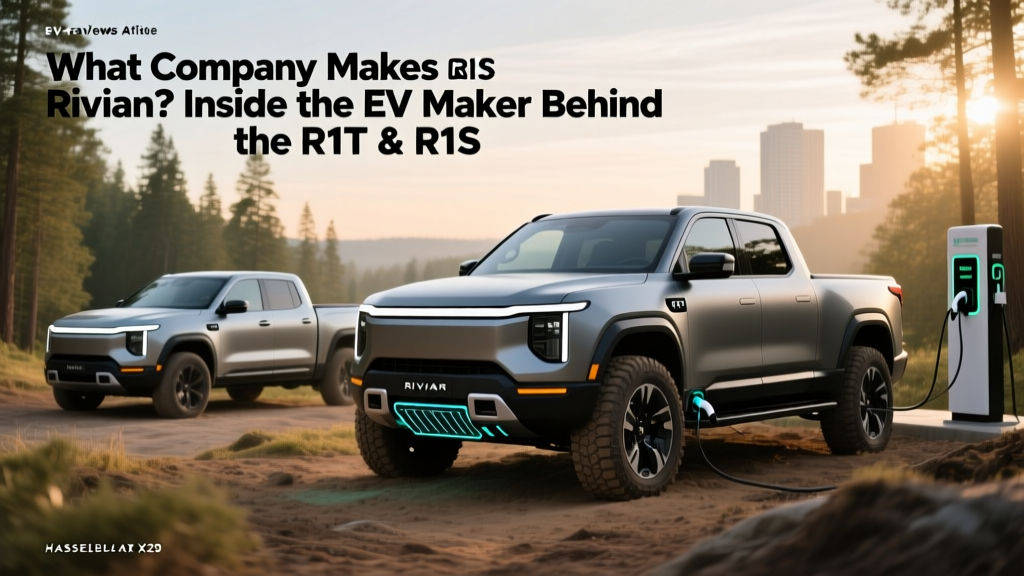
If you've searched "what company makes Rivian" you're not alone — the name still feels newer than legacy automakers, even though Rivian has been delivering electric vehicles since 2021. The short answer: Rivian Automotive, Inc. is its own independent, publicly traded American EV manufacturer (NASDAQ: RIVN), headquartered in Irvine, California, with manufacturing in Normal, Illinois. It is not a subsidiary of Ford, Volkswagen, Amazon, or any other legacy brand — though it has taken significant investment from Amazon and previously from Ford.
Founded in 2009 by MIT engineer RJ Scaringe, Rivian launched into the consumer market with the R1T pickup and R1S SUV, both built on a shared skateboard platform with dual- and quad-motor powertrains. Below we break down the 2026 model-year lineup, real-world specs, and what it takes to own one.
Rivian at a Glance: 2026 R1T and R1S Core Specs
For 2026, Rivian has streamlined battery offerings around its second-generation (Gen 2) drive units and battery packs. Here's the core data buyers need:
| Attribute | Specification |
|---|---|
| EPA-estimated range | ~330 miles (Standard Pack); ~420 miles (Max Pack) |
| Battery capacity | ~95 kWh usable (Standard); ~141 kWh usable (Max) |
| Battery chemistry | NMC (nickel manganese cobalt) — Samsung SDI cells |
| Peak DC fast-charge rate | ~220 kW (Standard); ~200 kW sustained avg (Max) |
| 10–80% DC fast-charge time | ~21 minutes (Standard); ~36 minutes (Max) |
| Level 2 home charging | 11.5 kW onboard (~25–30 miles/hr added) |
| 0–60 mph | 4.5 sec (Dual-Motor); 3.0 sec (Quad-Motor) |
| Horsepower | 533 hp (Dual-Motor); 835 hp (Tri-Motor); 1,025 hp (Quad-Motor) |
| Drivetrain | AWD (Dual/Tri/Quad-Motor) |
| Efficiency | ~73 MPGe combined; ~46 kWh/100 mi |
| Towing capacity | 11,000 lbs (R1T Dual-Motor) |
| Base MSRP (R1T Dual-Motor) | $69,900 (before destination/credits) |
| Battery & drivetrain warranty | 8 years / 175,000 miles (70% capacity retention) |
Charging Speed: DC Fast Charging and Home Level 2 Reality
Charging speed is where Rivian's Gen 2 platform shows meaningful improvement over its 2022–2023 predecessors. The Standard Pack's smaller battery accepts peak rates around 220 kW on a capable 350 kW DC fast charger, holding strong through the 20–60% state-of-charge (SoC) window before tapering. The Max Pack, with more cells in parallel, sustains a lower peak but pulls consistent wattage longer — meaning the 10–80% time stretches to roughly 36 minutes.
| Charge Level | Power | Miles Added per Hour | Notes |
|---|---|---|---|
| Level 1 (120V outlet) | ~1.4 kW | ~3–4 miles/hr | Emergency/trickle only |
| Level 2 (240V, 48A) | 11.5 kW | ~25–30 miles/hr | Full overnight charge in 10–14 hrs |
| DC Fast Charge (Standard) | Peak 220 kW | ~600+ miles/hr (peak) | 10–80% in ~21 min |
| DC Fast Charge (Max) | Peak ~200 kW | ~500+ miles/hr (peak) | 10–80% in ~36 min |
On the road, Rivian owners have access to the Rivian Adventure Network (proprietary DC chargers at outdoor destinations) plus the broader Electrify America, EVgo, and ChargePoint networks. With Rivian's 2024 adoption of the NACS charge port, 2026 models can also access Tesla Supercharger stalls using the native NACS connector — no adapter required on new vehicles.
At home, plan on installing a 60-amp circuit to support the 11.5 kW onboard charger (48 amps continuous draw). Most Rivian owners report 25–30 miles of range added per hour of Level 2 charging, which is plenty to replenish a daily commute overnight. If your home electrical panel is older or near capacity, a panel upgrade to 200A service could add $1,500–$3,000 to your installation cost — a factor many buyers overlook.
Pricing, Trims, and Federal Tax Credit Eligibility
Rivian's pricing has shifted as battery costs have fallen and competition has intensified. For 2026, the R1T Dual-Motor Standard Pack starts at $69,900 (plus ~$1,800 destination). The R1S SUV commands roughly $5,000 more at equivalent trim. Upgrading to the Max Pack adds approximately $10,000; the Tri-Motor and Quad-Motor performance variants push pricing well above $90,000–$100,000.
| Model / Trim | Base MSRP | Federal §30D Credit Eligible? |
|---|---|---|
| R1T Dual-Motor Standard | $69,900 | Potentially — subject to MSRP cap, income limits, sourcing |
| R1T Dual-Motor Max | ~$79,900 | Over $80K truck cap — ineligible |
| R1S Dual-Motor Standard | $74,900 | Potentially — subject to MSRP cap, income limits, sourcing |
| R1S Quad-Motor | ~$99,000+ | Over $80K truck cap — ineligible |
Tax credit reality check: Under IRS §30D rules, the Rivian R1T and R1S are classified as trucks/SUVs, meaning the MSRP cap is $80,000. Only the Standard Pack Dual-Motor configurations clear that threshold. Additionally, buyers must meet income caps ($150K single / $300K joint AGI), and the vehicle's battery must satisfy critical-mineral and battery-component sourcing requirements that shift annually. The credit can now be transferred at the point of sale, reducing your purchase price directly. Always verify current-year eligibility on fueleconomy.gov and consult a tax professional — rules are subject to change.
Performance, Drivetrain, and What It's Like to Drive
Rivian offers a spectrum of powertrains that few competitors match. The Dual-Motor setup (one motor per axle) delivers 533 hp and a 4.5-second 0–60 time — quick for a body-on-frame truck or large SUV. The Tri-Motor (one front, two rear) bumps output to 835 hp, while the Quad-Motor (one motor per wheel) reaches a staggering 1,025 hp and a sub-3.0-second sprint.
But the numbers only tell part of the story. Rivian's torque-vectoring capability — especially on Tri- and Quad-Motor variants — provides precise power distribution that shines in off-road and low-traction scenarios. The hydraulic roll control system (replacing traditional sway bars) keeps body roll minimal on pavement while allowing maximum articulation off-road. Ground clearance reaches up to 14.9 inches on the Max Pack with air suspension fully raised, and the vehicles can ford up to 3+ feet of water.
On-road, the ride quality is firm but controlled — this is a heavy vehicle (6,000–7,000+ lbs depending on configuration) and you feel it during aggressive cornering. The regenerative braking offers multiple levels, including a strong one-pedal driving mode that most owners quickly adopt as their default.
Interior Space, Cargo, and Everyday Practicality
The R1T is a midsize pickup with a 4.5-foot bed — shorter than a Tacoma or Ranger, but augmented by the innovative Gear Tunnel, a lockable, pass-through storage compartment running laterally behind the rear seats. This adds roughly 11 cubic feet of secure, weather-sealed cargo space that's perfect for skis, camping gear, or groceries.
- R1T bed volume: ~27 cu ft (bed) + 11 cu ft (Gear Tunnel) + 11 cu ft (frunk)
- R1S cargo (behind 3rd row): ~10.5 cu ft; folded flat: ~104 cu ft
- Frunk (front trunk): ~11 cu ft on both R1T and R1S
- Rear legroom (R1T crew cab): ~38.5 inches
- Seating: R1T seats 5; R1S seats up to 7 with optional third row
The cabin materials are premium but utilitarian — vegan leather and real wood accents with a minimalist aesthetic. The 15.6-inch center touchscreen runs Rivian's proprietary OS, which is responsive and well-organized, though it lacks Apple CarPlay and Android Auto. Instead, Rivian offers native integrations for navigation, media, and phone connectivity. This omission remains a dealbreaker for some buyers accustomed to phone-mirroring.
Driver-Assistance Tech and Safety
Rivian's driver-assistance suite is branded Rivian Driver+. It includes adaptive cruise control, lane-centering assist, automatic emergency braking, blind-spot monitoring, and a hands-on-wheel highway assist feature. This is a SAE Level 2 system — it assists with steering and speed but requires the driver to remain fully engaged at all times. It is not autonomous or "self-driving."
Both the R1T and R1S have earned strong safety marks, with the R1T receiving a NHTSA 5-star overall safety rating. The vehicle's substantial weight and rigid skateboard platform contribute to impressive crash-test performance, though the mass also means longer braking distances compared to lighter EVs.
Pros, Cons, and Who Should Buy a Rivian
Pros
- Class-leading EPA range (up to 420 mi with Max Pack)
- Exceptional off-road capability with 14.9" ground clearance
- Gear Tunnel and massive frunk add unmatched utility
- 11,000-lb towing capacity (R1T) with integrated trailer features
- NACS native port for Tesla Supercharger access
- 8-yr / 175,000-mi battery warranty exceeds industry standard
- Over-the-air updates continuously add features
Cons
- Starting near $70K — premium pricing limits accessibility
- No Apple CarPlay or Android Auto
- Heavy vehicle weight impacts tire wear and braking distance
- Max Pack 10–80% charge time (~36 min) trails some competitors
- Rear bed (R1T) is shorter than traditional midsize trucks
- Service center network still expanding in rural areas
- Only base Standard Dual-Motor qualifies for potential tax credit
Best for: Outdoor enthusiasts, adventure-oriented families, and truck/SUV buyers who need genuine off-road capability and towing without burning fossil fuels. If you regularly tow a camper, haul gear to trailheads, or want a three-row electric SUV with real range, the Rivian lineup is one of the most capable options available.
Not ideal for: Budget-conscious buyers, daily commuters who don't need truck/SUV utility, or those who consider Apple CarPlay non-negotiable. If your primary use case is urban commuting, a smaller, less expensive EV will serve you better at a fraction of the cost.
Rivian vs. the Competition: How Does It Stack Up?
The R1T's closest competitor is the Tesla Cybertruck, which undercuts on price (starting around $60K for the Dual-Motor AWD) and offers a stainless-steel exoskeleton and slightly faster peak charging on the Max Range variant. However, the Rivian delivers more refined interior quality, a more traditional (and some say more practical) truck form factor, and superior off-road suspension articulation.
For the R1S, the competitive set includes the Kia EV9 (starting ~$55K, three rows, but unibody and less off-road capable) and the Mercedes EQS SUV (far more expensive, more luxurious, but less adventurous). The R1S occupies a unique niche as the only body-on-frame, off-road-capable three-row electric SUV.
Choose Rivian If:
- You need genuine truck utility (bed, towing, Gear Tunnel)
- Off-road capability is a priority, not a novelty
- You want 330+ miles of EPA range in a truck/SUV platform
- You value independent American manufacturing
Look Elsewhere If:
- Your budget is under $55K
- You primarily commute and never tow or go off-road
- CarPlay/Android Auto is essential to you
- You need a full-size 6+ foot truck bed
Frequently Asked Questions
What company makes Rivian?
Rivian Automotive, Inc. is an independent American EV company founded in 2009, headquartered in Irvine, CA, with its production facility in Normal, IL. It is publicly traded (NASDAQ: RIVN) and not owned by any legacy automaker, though Amazon holds a significant stake and has ordered thousands of Rivian EDV delivery vans.
What is the real-world range of a Rivian?
The EPA estimates 330 miles for the Standard Pack and up to 420 miles for the Max Pack. In real-world highway driving at 70+ mph, expect roughly 260–310 miles (Standard) or 340–380 miles (Max). Cold weather (below 30°F) can reduce range by 20–30%. Preconditioning the battery before fast charging helps recover some of this loss.
How fast does a Rivian charge at home and on the road?
On a Level 2 home charger (240V, 48A), the Rivian charges at 11.5 kW, adding roughly 25–30 miles of range per hour — enough to fully recharge overnight. On DC fast chargers, the Standard Pack peaks at ~220 kW (10–80% in ~21 minutes), while the Max Pack takes ~36 minutes for the same range due to its larger battery capacity.
Does the Rivian qualify for the $7,500 federal EV tax credit?
Potentially — but only the Dual-Motor Standard Pack variants fall under the $80,000 MSRP cap for trucks/SUVs under IRS §30D. Buyers must also meet income limits ($150K single / $300K joint) and the vehicle must satisfy critical-mineral and battery-component sourcing requirements. The credit can be transferred at the point of sale. Always verify current eligibility at fueleconomy.gov and consult a tax professional.
Is a Rivian worth buying over a Tesla Cybertruck or Ford F-150 Lightning?
It depends on your priorities. The Rivian R1T offers more refined ride quality and off-road suspension than the Cybertruck, plus greater utility (Gear Tunnel, frunk). Compared to the F-150 Lightning, the Rivian has more EPA range and a more premium interior, but the Lightning offers a full-size truck bed and lower starting price. Test-drive all three before deciding.
What is Rivian's battery warranty?
Rivian provides an 8-year / 175,000-mile warranty on the battery pack and drive units, guaranteeing at least 70% capacity retention over that period. This is more generous in mileage than the industry-standard 8-yr/100,000-mi coverage and reflects confidence in the NMC cell durability and thermal management system.