The Short Answer on the Kia Electric Truck
As of early 2026, Kia does not yet sell an electric truck in the United States. The Kia Tasman, a midsize body-on-frame pickup, was unveiled for global markets (Australia, South Africa, Middle East) in late 2024, but it launched exclusively with turbo-diesel and gasoline powertrains — no battery-electric variant has been confirmed for production. Kia's EV roadmap through 2027 focuses on SUVs, crossovers, and a purpose-built pickup truck concept (the "Kia Pickup EV" shown at various auto shows), but no U.S.-market electric pickup has been officially announced with a release date, EPA range, or MSRP.
If you want a Kia electric vehicle today, the EV9 three-row SUV and EV6 crossover are your options. If you specifically need an electric pickup truck, the Ford F-150 Lightning, Rivian R1T, Chevrolet Silverado EV, and Tesla Cybertruck are the vehicles currently on sale. This guide breaks down what Kia has confirmed, what's rumored, and how to evaluate your options right now.
What Kia Has Actually Announced (and What's Just Rumor)
Kia's electric truck ambitions have generated significant buzz, but separating confirmed facts from speculation is essential before you plan a purchase or wait for a model that may not arrive for years.
The Kia Tasman: Real Truck, No Electric Version Yet
The Kia Tasman is a legitimate midsize pickup built on a body-on-frame ladder chassis. It targets markets where midsize trucks dominate — think Toyota Hilux and Ford Ranger territory. Key specs for the global Tasman include:
- 2.2-liter turbo-diesel engine (approximately 207 hp, 325 lb-ft torque)
- Available 4WD with locking rear differential
- Towing capacity up to 3,500 kg (~7,700 lbs) in diesel configuration
- Not sold in the U.S. — the midsize truck segment here is dominated by the Tacoma, Ranger, Colorado, and Frontier
Kia has not announced an electric variant of the Tasman for any market. The platform was designed with electrification in mind (Kia executives have hinted at hybrid and plug-in hybrid possibilities), but a battery-electric Tasman remains unconfirmed.
The Kia EV Pickup Concept and Plan S Strategy
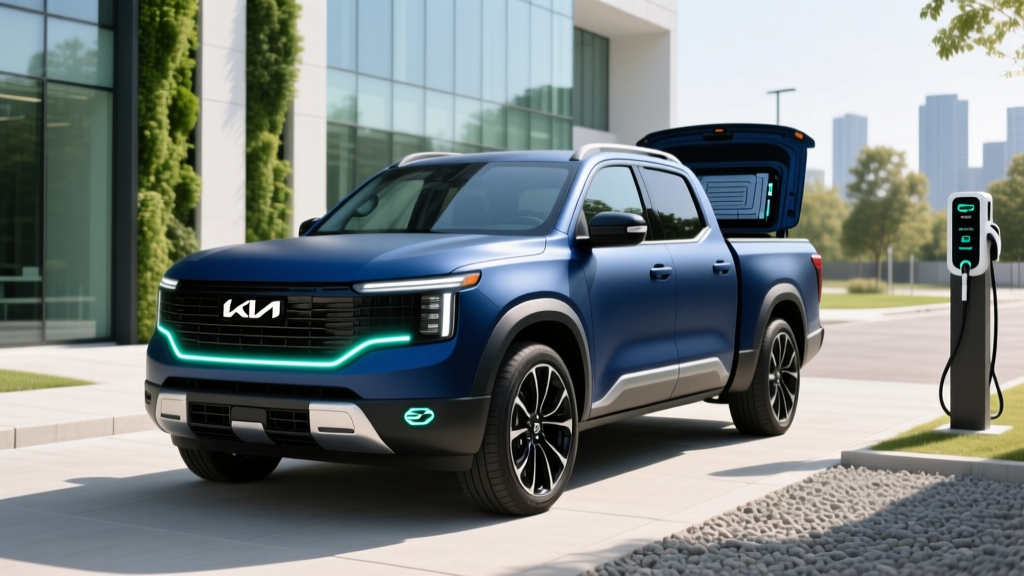
Under Kia's "Plan S" electrification strategy, the company has committed to launching 15 battery-electric models globally by 2027. A purpose-built electric pickup has appeared in Kia's concept presentations — most notably a rugged, angular pickup design shown alongside the EV9 and EV5. However, concept vehicles are not production commitments, and Kia has not published:
- A production nameplate for an electric pickup
- Target EPA range or battery capacity (kWh)
- U.S. MSRP or on-sale date
- Manufacturing location (critical for §30D tax credit eligibility)
Myth vs. Fact: Kia Electric Truck Claims
| Claim | Reality |
|---|---|
| "The Kia Tasman is an electric truck" | The Tasman launched with diesel/gas engines only. No EV variant confirmed. |
| "Kia's electric truck is coming to the U.S. in 2026" | No U.S. launch date, pricing, or EPA certification has been announced. |
| "The Kia EV9 is basically a truck" | The EV9 is a unibody three-row SUV with up to 300 miles EPA range. It cannot match a body-on-frame pickup's payload or towing. |
| "Kia's electric truck will qualify for the $7,500 tax credit" | Impossible to determine — credit eligibility depends on final MSRP caps, battery sourcing, buyer income, and North American assembly, none of which are confirmed. |
What You Can Actually Buy: Electric Trucks on Sale in 2026
If you need an electric pickup now, here are the vehicles with confirmed EPA data, real-world pricing, and verifiable charging performance. Use this comparison to set realistic expectations for what a future Kia electric truck would need to compete against.
| Spec | Ford F-150 Lightning (Std Range) | Rivian R1T (Dual-Motor, Standard) | Chevy Silverado EV (4WT) | Tesla Cybertruck (AWD) |
|---|---|---|---|---|
| EPA Range | 240 mi | 270 mi | 380 mi | 340 mi |
| Battery (usable kWh) | ~98 kWh (NMC) | ~95 kWh (NMC) | ~200 kWh (NMC) | ~123 kWh (NMC) |
| Peak DC Fast Charge | 150 kW | 200+ kW | 350 kW | 250 kW |
| 10–80% Charge Time | ~44 min | ~30 min | ~20 min | ~25 min |
| 0–60 mph | ~4.0 sec | ~4.5 sec | ~4.5 sec | ~4.1 sec |
| Horsepower | 580 hp | 533 hp | 510 hp | 600 hp |
| Max Towing | 7,700 lbs | 11,000 lbs | 10,000 lbs | 11,000 lbs |
| Starting MSRP | ~$55,000 | ~$69,900 | ~$55,000 (fleet) | ~$79,990 |
| Federal §30D Credit | Up to $7,500 (verify sourcing) | Up to $7,500 (verify sourcing) | Limited eligibility | Up to $7,500 (verify sourcing) |
Real-world range caveat: EPA estimates assume moderate temperatures, mixed driving, and no heavy towing. Expect 20–30% range reduction when towing at capacity, and 15–25% loss in sub-freezing temperatures. The F-150 Lightning's 240-mile EPA range can drop to ~170–180 miles when towing 5,000+ lbs on the highway. Always plan charging stops around worst-case range, not best-case.
Cost Breakdown: Electric Truck vs. Gas Truck Ownership
A common question from first-time EV truck buyers is whether the higher upfront cost is offset by fuel and maintenance savings. Here's a five-year total cost of ownership (TCO) comparison using the Ford F-150 Lightning vs. the gas F-150 SuperCrew 4WD as a benchmark. A future Kia electric truck would need to deliver similar economics to be competitive.
5-Year TCO: F-150 Lightning vs. Gas F-150 (15,000 mi/year)
| Cost Category | F-150 Lightning (Std Range) | Gas F-150 4WD (3.5L EcoBoost) |
|---|---|---|
| Purchase Price (base MSRP) | $55,000 | $50,000 |
| Federal §30D Tax Credit | –$7,500 (if eligible) | $0 |
| Net Purchase Price | $47,500 | $50,000 |
| Fuel / Electricity (5 yrs) | $4,800 (home L2 at $0.14/kWh avg) | $14,250 (gas at $3.50/gal, 19 MPG combined) |
| Maintenance (5 yrs) | $1,500 (no oil changes, fewer moving parts) | $4,500 (oil, filters, transmission service) |
| Insurance (5 yrs, avg) | $9,500 | $7,500 |
| Estimated Depreciation (5 yrs) | $22,000 | $20,000 |
| Total 5-Year Cost | $85,300 | $96,250 |
| Net Savings (EV) | ~$10,950 over 5 years | |
Key assumptions and caveats:
- Electricity cost assumes 80% home Level 2 charging at $0.14/kWh national average and 20% public DC fast charging at $0.40/kWh. If you rely exclusively on public fast charging, your 5-year fuel cost jumps to ~$7,200, cutting savings significantly.
- The §30D tax credit requires the vehicle to meet IRS critical mineral and battery component sourcing rules, buyer income caps ($150K single / $300K joint), and MSRP caps ($80K for trucks/vans/SUVs). Verify eligibility at the point of sale — rules change annually.
- EV insurance premiums run 15–25% higher than equivalent gas vehicles due to repair costs and battery replacement risk. Get quotes before purchasing.
- Depreciation estimates are volatile for EVs — the market is still maturing, and battery health perception affects resale value.
Real-World Ownership Considerations Before You Wait (or Switch)
Whether you're waiting for a Kia electric truck or buying a Lightning today, these practical factors determine whether an electric pickup actually works for your life.
Home Charging Access Is Non-Negotiable for Truck Owners
Electric trucks have large batteries (95–200 kWh). On a standard 120V Level 1 outlet, you'd add roughly 2–4 miles of range per hour — meaning a full charge of a depleted 100 kWh battery would take 30–50 hours. This is impractical for daily use.
A Level 2 home charger (240V, 40–80 amps) is essential. Here's what to budget:
- Level 2 charger hardware: $400–$700 (ChargePoint Home Flex, Wallbox Pulsar Plus, or Tesla Wall Connector)
- Electrician installation (50-amp circuit, 240V outlet): $800–$2,000
- Electrical panel upgrade (if your home has a 100-amp panel): $1,500–$3,500
- Permit fees: $50–$200 depending on jurisdiction
Total home charging setup: $1,250–$6,400, depending on your electrical infrastructure. If you live in an apartment or condo without dedicated parking and charging access, an electric truck is significantly harder to own — plan for daily public charging, which costs 2–3× more than home electricity.
Towing and Payload: The EV Truck Trade-Off
Electric trucks deliver instant torque and impressive acceleration, but towing at capacity devastates range. Physics is the reason: moving 7,000+ lbs of trailer at 65 mph requires enormous energy, and unlike regenerative braking in stop-and-go driving, highway towing provides minimal energy recovery.
Real-world towing range for current electric trucks:
- F-150 Lightning (240 mi EPA): ~140–170 miles towing 5,000 lbs at highway speed
- Rivian R1T (270 mi EPA): ~160–190 miles towing 5,000 lbs
- Cybertruck (340 mi EPA): ~200–230 miles towing 5,000 lbs
If you tow frequently over distances greater than 150 miles one-way, plan your route around DC fast chargers capable of 150+ kW. Electrify America and Tesla Supercharger networks have expanded truck-capable stalls (pull-through designs), but coverage remains sparse in rural areas. Check fueleconomy.gov for EPA-rated efficiency data on specific trims.
Cold Weather: The Range Tax Nobody Talks About
Lithium-ion batteries lose efficiency in cold temperatures, and cabin heating in an EV draws directly from the traction battery (unlike a gas truck, which uses waste engine heat). Expect:
- 20–30% range loss at 20°F compared to EPA estimates
- Slower DC fast charging in cold weather unless the vehicle has battery preconditioning (the Lightning, Rivian, and Cybertruck all offer this — verify Kia's future system does too)
- A heat pump (standard on most modern EVs) mitigates cabin-heating energy draw by 30–40% compared to resistive heaters
Decision Framework: Should You Wait for Kia or Buy Now?
Choose Based on Your Actual Situation
Buy a Ford F-150 Lightning NOW if:
- You need a full-size electric truck for work or towing within 6 months
- You have home Level 2 charging access (or can install it)
- Your typical daily driving is under 200 miles and you tow under 5,000 lbs on most trips
- You want to take advantage of the current §30D tax credit before sourcing rules tighten further
Buy a Rivian R1T NOW if:
- You want best-in-class towing capacity (11,000 lbs) with competitive range (270+ mi with Max Pack)
- You value over-the-air updates, adventure-oriented features, and a growing service network
- Your budget allows $75,000–$95,000+ depending on battery pack and trim
Wait for a Kia electric truck ONLY if:
- You are not in a hurry — no production timeline exists, and 2028+ is a realistic earliest U.S. arrival
- You specifically want Kia's design language, warranty coverage (10-year/100,000-mile powertrain), and dealer network
- You're flexible on size — Kia's eventual EV truck may be a compact/midsize unibody design (similar to the Hyundai Santa Cruz) rather than a full-size body-on-frame pickup
- You're willing to risk that the vehicle may never arrive, or arrive with specs different from concept projections
Consider a PHEV truck alternative if:
- You want electric commuting but gas-powered range for long towing trips
- You lack reliable home charging or live in a charging desert
- The Ford F-150 PowerBoost hybrid or upcoming F-150 PHEV variants offer a practical bridge
Common Misconceptions About Electric Trucks — Addressed with Data
| Misconception | What the Data Shows |
|---|---|
| "Electric trucks can't tow anything" | The F-150 Lightning tows 7,700 lbs; the Rivian R1T tows 11,000 lbs. The issue isn't capability — it's range while towing. Plan charging stops accordingly. |
| "Batteries need replacing every 5 years" | Modern NMC and LFP batteries are warrantied for 8 years/100,000 miles at 70%+ capacity retention. Real-world degradation data from Tesla and Nissan shows ~10–15% capacity loss at 150,000 miles with proper care (avoid frequent 100% charges, minimize DC fast charging to >80%). |
| "EV trucks cost more to own than gas trucks" | Over 5 years at 15,000 mi/yr, the Lightning saves ~$10,950 vs. a gas F-150 when factoring in the tax credit, fuel savings, and lower maintenance — even with higher insurance and depreciation. |
| "I can charge from any regular outlet" | Level 1 (120V) adds ~3 miles/hour. A depleted 100 kWh truck battery would take 40+ hours to charge. A Level 2 (240V) home charger is mandatory for practical daily ownership. |
| "The Kia Tasman EV is already available" | The Tasman launched with diesel/gas only. No electric variant has been announced for any market as of early 2026. |
First-Time EV Truck Buyer Checklist
If you're transitioning from a gas truck to an electric pickup — whether it's a Lightning today or a hypothetical Kia EV truck tomorrow — work through this list before signing:
- Confirm home charging feasibility. Get an electrician quote for a 240V/50-amp circuit. If your panel needs upgrading, factor in $1,500–$3,500 and 2–6 weeks of lead time.
- Calculate your real electricity cost. Check your utility's rate schedule. Time-of-use plans can cut charging costs by 40% if you charge overnight. National average: $0.14–$0.17/kWh; California: $0.25–$0.35/kWh.
- Verify §30D tax credit eligibility. Check IRS.gov for current-year rules on income caps, MSRP limits ($80K for trucks), battery sourcing requirements, and point-of-sale transfer options. Do not assume eligibility — rules change annually.
- Map your longest regular drive. If your most common long trip exceeds 70% of the truck's EPA range (accounting for weather and terrain), verify DC fast charger availability along that route.
- Get insurance quotes before purchase. EV truck insurance averages 15–25% more than gas equivalents. Some insurers offer EV-specific discounts — shop around.
- Understand the warranty. Federal law mandates 8-year/100,000-mile battery warranties for EVs. Kia's existing 10-year/100,000-mile powertrain warranty would likely extend to a future EV truck's battery and motors — a significant competitive advantage if it carries over.
Frequently Asked Questions
Is Kia making an electric pickup truck?
Kia has shown an electric pickup concept as part of its Plan S electrification strategy, but no production model has been officially announced for the U.S. market. The Kia Tasman, their current global midsize truck, launched with diesel and gasoline engines only — no EV variant is confirmed. The earliest realistic timeline for a Kia electric truck in the U.S. would be 2028 or later, and even that is speculative.
How much would a Kia electric truck cost?
There is no official pricing because the vehicle does not exist yet. For reference, competitive electric trucks start at $55,000 (F-150 Lightning) to $80,000+ (Cybertruck, Rivian R1T). If Kia positions an EV truck as a value-oriented option, a starting MSRP in the $45,000–$55,000 range would be competitive — but this is entirely speculative until Kia publishes official specs.
Would a Kia electric truck qualify for the $7,500 federal tax credit?
It depends on factors Kia has not yet determined: final MSRP (must be under $80,000 for trucks under §30D rules), buyer income (capped at $150K single / $300K joint), battery component and critical mineral sourcing (must meet escalating domestic-content thresholds), and North American final assembly. If Kia builds the truck in Korea or another non-NAFTA country, it would not qualify for the new-vehicle credit regardless of other factors. The used-EV credit (§25E) could apply if you buy one secondhand at under $25,000.
What's the best electric truck available right now?
It depends on your priorities. The Ford F-150 Lightning offers the best value at ~$55K with strong towing and a familiar truck form factor. The Rivian R1T leads in towing capacity (11,000 lbs) and adventure features but starts near $70K. The Chevrolet Silverado EV offers the longest range (380 mi with the large battery) but is currently fleet-oriented. The Tesla Cybertruck delivers strong range and performance but starts at ~$80K and has limited service infrastructure outside major metros.
Can I charge an electric truck at home?
Yes, but you need a Level 2 (240V) home charger for practical daily use. A 50-amp circuit delivers ~11.5 kW, adding roughly 25–35 miles of range per hour — enough to fully recharge an electric truck overnight. Budget $1,250–$6,400 total for the charger, installation, and any electrical panel upgrades. Without home charging, daily ownership becomes significantly more expensive and time-consuming.
How does towing affect electric truck range?
Expect a 30–40% range reduction when towing 5,000+ lbs at highway speeds. A truck rated at 300 miles EPA might deliver only 180–210 miles while towing. This is the single biggest practical limitation of current electric trucks. Plan charging stops accordingly, and prioritize routes with 150+ kW DC fast chargers that accommodate truck-trailer combinations (pull-through stalls).