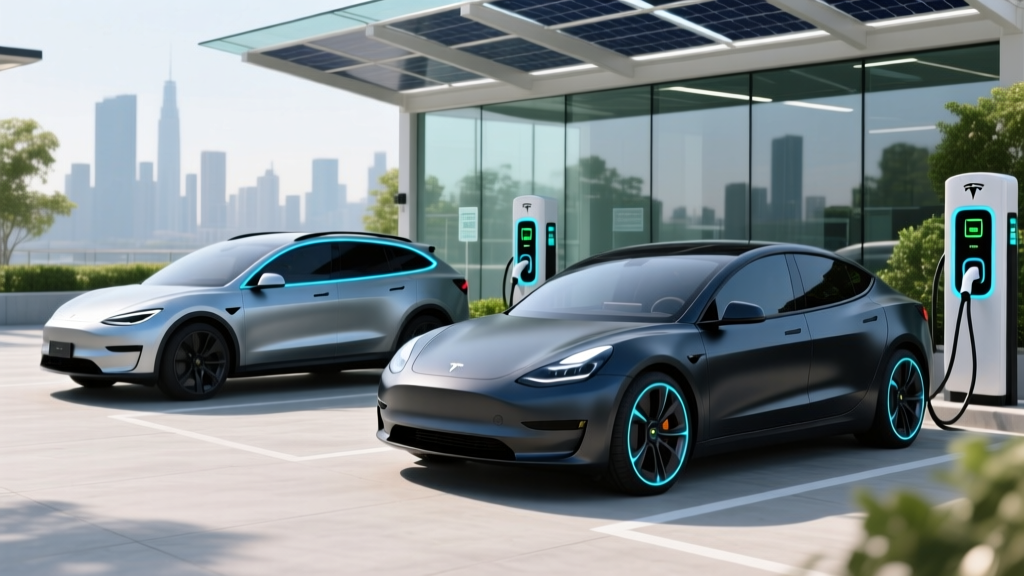
If you've ever searched "are Tesla's all electric?" the short answer is yes. Tesla has never produced a gasoline, diesel, or hybrid vehicle. Every model in Tesla's lineup — from the entry-level Model 3 to the Cybertruck — is a battery-electric vehicle (BEV) with no internal combustion engine of any kind. There is no gas cap, no oil to change, and no tailpipe.
But knowing the entire lineup is electric only answers the surface question. What matters to buyers in 2026 is how each Tesla model performs in the real world: actual highway range versus EPA stickers, sustained DC fast-charging speeds (not just peak kW), battery chemistry trade-offs, and whether you'll actually qualify for the federal tax credit under current IRS §30D rules. This guide walks through every current Tesla model with the data you need.
The 2026 Tesla Lineup at a Glance
Tesla currently sells four vehicle lines in the United States. All are fully electric. Here is the spec snapshot before we dig into real-world nuance:
| Spec | Model 3 | Model Y | Model S | Model X | Cybertruck |
|---|---|---|---|---|---|
| EPA Range (max) | 363 mi (LR RWD) | 320 mi (LR AWD) | 402 mi (LR) | 335 mi (LR) | 340 mi (AWD) |
| Battery (usable kWh) | ~60 (RWD) / ~79 (LR) | ~79 (LR) | ~95 (LR) | ~95 (LR) | ~123 (AWD) |
| Chemistry | LFP (RWD) / NMC (LR) | NMC (LR) | NMC | NMC | NMC (4680 cells) |
| Max DC Fast Charge | 250 kW | 250 kW | 250 kW | 250 kW | 350 kW (est.) |
| 10–80% DC Time | ~25 min | ~27 min | ~30 min | ~32 min | ~20 min (est.) |
| Level 2 Home Rate | 11.5 kW (~44 mi/hr) | 11.5 kW (~44 mi/hr) | 11.5 kW (~34 mi/hr) | 11.5 kW (~34 mi/hr) | 11.5 kW (~35 mi/hr) |
| 0–60 mph | 5.8 s (RWD) / 3.1 s (Perf) | 4.8 s (LR) / 3.5 s (Perf) | 3.1 s (LR) / 1.99 s (Plaid) | 3.8 s (LR) / 2.5 s (Plaid) | 3.9 s (AWD) / 2.6 s (Cybeast) |
| Horsepower | 271–510 hp | 384–510 hp | 670–1,020 hp | 670–1,020 hp | 600–845 hp |
| MPGe (combined) | 132 MPGe (LR RWD) | 122 MPGe (LR AWD) | 120 MPGe (LR) | 102 MPGe (LR) | 72 MPGe (AWD) |
| Base MSRP | ~$38,990 | ~$44,990 | ~$79,990 | ~$84,990 | ~$79,990 |
| Battery Warranty | 8 yr / 100k–120k mi | 8 yr / 120k mi | 8 yr / 150k mi | 8 yr / 150k mi | 8 yr / 150k mi |
Sources: EPA / fueleconomy.gov, Tesla.com official specs. Pricing reflects approximate 2026 MSRP before destination fees and is subject to change.
Real-World Range: What the EPA Sticker Doesn't Tell You
Tesla's efficiency remains among the best in the industry. The Model 3 Long Range RWD, for example, achieves an EPA-estimated 363 miles — but on a 75-mph highway road trip in winter, plan for roughly 260–290 miles of usable range before you're hunting for a Supercharger. That's still class-leading for a sedan under $50,000.
The Cybertruck's boxy aerodynamics hurt it most at highway speeds. While the EPA rates the dual-motor AWD at 340 miles, real-world highway testing consistently shows 250–280 miles at 70+ mph. The stainless-steel exoskeleton creates significant drag compared to the teardrop-shaped Model S, which can still squeeze 350+ highway miles from its 402-mile EPA rating thanks to a low 0.208 drag coefficient.
For the LFP-equipped Model 3 RWD (the ~60 kWh pack), Tesla recommends charging to 100% regularly — unlike NMC packs where 80–90% daily limits prolong longevity. This means LFP owners get to use all 272 EPA-rated miles daily, while NMC owners effectively operate on 80–90% of their sticker range for routine commuting.
Charging Speed and Infrastructure
Tesla's Supercharger network remains the gold standard for public DC fast charging — over 6,000 stations and 65,000+ stalls in North America as of early 2026. All current Teslas use the NACS (North American Charging Standard) connector natively, which is now the industry standard adopted by Ford, GM, Rivian, Hyundai, and most major automakers.
| Charging Level | Power (kW) | Approx. Miles Added per Hour | Notes |
|---|---|---|---|
| Level 1 (120V outlet) | ~1.4 kW | 3–5 mi/hr | Emergency/trickle only |
| Level 2 (240V home) | 11.5 kW | 34–44 mi/hr | Full overnight charge in 6–10 hrs |
| DC Fast (V3 Supercharger) | Up to 250 kW | ~170 mi in 15 min (Model 3) | Peak rate; tapers above 60% SoC |
| DC Fast (V4 Supercharger) | Up to 350 kW | Varies by model | Limited rollout; Cybertruck benefits most |
A critical point on charge curves: the advertised peak kW is not sustained across the full session. A Model 3 Long Range might peak at 250 kW around 10–15% state of charge, but by 60% SoC it tapers to roughly 100–120 kW, and above 80% it drops sharply to protect the battery. That 10–80% time of ~25 minutes reflects this taper. Charging from 80–100% can add another 20–30 minutes — plan accordingly on road trips and aim to leave chargers at 80% unless you truly need the last 20%.
For home charging, a Tesla Wall Connector on a 60-amp circuit delivers the full 11.5 kW (48 amps continuous). Expect a professional installation to cost $800–$2,000 depending on your panel capacity and run distance. Homes with older 100-amp electrical panels may need a $1,500–$3,000 panel upgrade — confirm with a licensed electrician before purchasing equipment.
Federal Tax Credit Eligibility (2026 IRS §30D Rules)
This is where Tesla buyers need to pay close attention. Under current IRS §30D rules, the federal clean vehicle credit offers up to $7,500, but eligibility depends on a matrix of requirements:
- MSRP caps: Sedans (Model 3, Model S) must be under $55,000. SUVs and trucks (Model Y, Model X, Cybertruck) must be under $80,000.
- Buyer income limits: Modified AGI must not exceed $300,000 (joint), $225,000 (head of household), or $150,000 (single).
- Battery sourcing: Critical minerals and battery components must meet phased-in domestic/free-trade-partner sourcing thresholds that tighten annually.
- Point-of-sale transfer: Eligible buyers can transfer the credit to the dealer at purchase, reducing the purchase price directly rather than waiting for tax filing.
| Model | MSRP vs. Cap | Qualifies for Full $7,500? | Key Caveat |
|---|---|---|---|
| Model 3 RWD (~$38,990) | Under $55k cap ✓ | Likely — verify sourcing | LFP cells may affect critical-mineral threshold |
| Model 3 LR (~$42,490) | Under $55k cap ✓ | Likely — verify sourcing | US-built with improving domestic sourcing |
| Model Y LR (~$44,990) | Under $80k cap ✓ | Likely — verify sourcing | Most popular Tesla; high credit-claim volume |
| Model S (~$79,990) | Over $55k sedan cap ✗ | No | Classified as sedan — exceeds MSRP limit |
| Model X (~$84,990) | Over $80k SUV cap ✗ | No | Base MSRP exceeds SUV cap |
| Cybertruck AWD (~$79,990) | At $80k cap edge | Possible — trim dependent | Higher trims exceed cap; confirm exact MSRP |
Critical note: Battery-sourcing rules tighten each year. A model that qualified in 2025 may not qualify in 2026. Always verify current eligibility on the fueleconomy.gov credit lookup tool and consult a tax professional before relying on the credit in your purchase decision. Rules are subject to legislative change.
Performance, Efficiency, and Daily Usability
Every Tesla benefits from instant electric torque and a low center of gravity (battery pack mounted in the floor). Even the "slow" Model 3 RWD hits 60 mph in 5.8 seconds — quicker than most gas-powered sport sedans. The Model S Plaid's 1.99-second 0–60 time remains one of the fastest production car times ever recorded.
Efficiency is where Tesla's engineering advantage shows most clearly. The Model 3 Long Range RWD achieves 132 MPGe combined (25 kWh/100 mi), making it one of the most efficient EVs on the market. Compare that to the Cybertruck at 72 MPGe (87 kWh/100 mi) — the truck's weight and aerodynamics demand nearly 3.5× the energy per mile.
Cargo and Passenger Space
- Model 3: 23 cu ft trunk + frunk; rear legroom 35.3 in. Adequate for two adults; tight for three across.
- Model Y: 30 cu ft behind second row (76 cu ft folded) + frunk; rear legroom 41.6 in. The family hauler sweet spot.
- Model S: 28 cu ft rear cargo (hatchback) + frunk; rear legroom 40.9 in. Premium sedan with surprising utility.
- Model X: Up to 88 cu ft (5-seat config, rows folded) + frunk; optional third row. Falcon-wing doors need lateral clearance.
- Cybertruck: 6.5-ft bed with powered tonneau; frunk + sail-pillar storage. Tows up to 11,000 lbs (range drops ~50% while towing).
Tech, Driver Assistance, and Drawbacks
All Teslas ship with Basic Autopilot — a Level 2 driver-assistance system providing adaptive cruise control and lane centering. The optional FSD (Supervised) package adds automatic lane changes, traffic-light recognition, and navigate-on-autopilot, but it remains a Level 2 system requiring continuous driver supervision. Tesla has not achieved Level 4 autonomy in any consumer vehicle.
The minimalist interior — dominated by a 15.4-inch center touchscreen (17-inch in Model S/X) with no physical buttons — draws polarized reactions. HVAC, mirrors, and glovebox are all screen-controlled. Build quality has improved markedly since 2023, but panel gaps and interior material quality still lag behind Mercedes EQS and BMW iX competitors at the premium end.
Pros
- Best-in-class Supercharger network (65k+ stalls)
- Industry-leading efficiency (kWh/100 mi)
- OTA updates add features post-purchase
- NACS connector is now the North American standard
- Strong resale value relative to other EVs
- Extensive Sentry Mode / security features
Cons
- No physical controls — everything through the screen
- FSD (Supervised) costs extra, remains Level 2
- Model S/X exceed tax-credit MSRP caps
- Repair costs and insurance premiums run high
- Cybertruck efficiency and range disappoint vs. EPA
- Service center wait times in high-demand metros
Which Tesla Fits Your Use Case?
Commuter (under 40 mi/day, home charging): Model 3 RWD. Lowest cost, LFP battery tolerates daily 100% charges, 272 EPA miles is more than enough. After potential $7,500 credit: ~$31,490 effective.
Family of 3–4 (road trips, cargo): Model Y Long Range AWD. 320-mile range, 30 cu ft cargo, available tax credit. The volume best-seller for good reason.
Premium sedan buyer: Model S Long Range. 402-mile EPA range is the longest in the lineup, but no federal credit and $80k+ price limits its value proposition versus the Lucid Air or BMW i5.
Towing / work truck: Cybertruck AWD. 11,000-lb tow rating, stainless bed, but expect ~250 miles real-world highway and ~170 miles while towing heavy.
Three-row family hauler: Model X. Falcon-wing doors are a conversation-starter, but the $85k+ price and no tax credit push many to the Rivian R1S or Kia EV9 instead.
Frequently Asked Questions
Has Tesla ever made a gas or hybrid car?
No. Since its founding, Tesla has exclusively produced battery-electric vehicles. The original Roadster (2008), Model S (2012), Model X (2015), Model 3 (2017), Model Y (2020), and Cybertruck (2023) are all fully electric BEVs with no gasoline engine, fuel tank, or hybrid system.
What is the real-world range of Tesla's most popular model?
The Model Y Long Range AWD carries a 320-mile EPA rating. In real-world mixed driving at moderate temperatures, expect 280–310 miles. At sustained 75-mph highway speeds, plan for 260–280 miles. In freezing winter conditions, 220–250 miles is realistic. Preconditioning the battery while navigating to a Supercharger recovers some of this loss.
How fast do Teslas charge at home versus on the road?
At home on a 240V Level 2 Wall Connector (11.5 kW), Teslas add 34–44 miles of range per hour — a full overnight charge takes 6–10 hours depending on the model. On a V3 Supercharger (250 kW DC), a Model 3 can add roughly 170 miles in 15 minutes. The 10–80% session takes approximately 25–32 minutes depending on the model and battery temperature.
Do all Teslas qualify for the $7,500 federal tax credit?
No. Under current IRS §30D rules, the Model 3 and Model Y are the strongest candidates — they fall under MSRP caps and are built in US facilities. The Model S exceeds the $55,000 sedan cap, and the Model X exceeds the $80,000 SUV cap. Cybertruck eligibility depends on exact trim pricing and battery-sourcing compliance. Income limits ($150k single / $300k joint) and critical-mineral sourcing rules apply to all models.
Is Tesla's battery warranty competitive?
Tesla covers batteries at 8 years with mileage limits varying by model: 100,000 miles (Model 3 RWD), 120,000 miles (Model 3 LR, Model Y), and 150,000 miles (Model S, Model X, Cybertruck). The warranty guarantees at least 70% capacity retention during the coverage period. This is broadly competitive with Hyundai's 10-year/100,000-mile warranty and the industry standard of 8 years/100,000 miles from most automakers.
Is a Tesla worth buying over competitors in 2026?
For buyers who prioritize charging infrastructure, efficiency, and over-the-air updates, Tesla's ecosystem remains unmatched — the Supercharger network alone is a decisive advantage for frequent road-trippers. However, competitors like the Hyundai Ioniq 5, BMW i4, and Chevrolet Equinox EV now rival Tesla on range and charging speed while offering physical controls, more interior material variety, and in some cases stronger tax-credit positioning. Test-drive both before committing.