The 2024 Ford Mustang Mach-E occupies a specific niche in the electric crossover market: it's the model that convinced traditional automaker loyalists to go electric without feeling like they bought a tech gadget on wheels. Now in its fourth model year, Ford has refined the Mach-E with meaningful updates including standard NACS charging port compatibility, a revamped infotainment system, and a new Rally trim. But with the Hyundai Ioniq 5, Tesla Model Y, and Chevrolet Blazer EV all competing aggressively, the question for buyers is whether the Mach-E's blend of familiar styling and genuine EV capability still holds up.
After analyzing EPA data, real-world efficiency logs, and DC fast-charging curves, here's what the numbers actually say about the 2024 Mach-E lineup.
Range and Efficiency: What the EPA Says vs. What You'll Actually Get
The 2024 Mach-E lineup spans four trims with varying battery and drivetrain configurations, producing a wide range spread. The Select trim with the Standard Range battery and rear-wheel drive delivers an EPA-estimated 230 miles, while the Premium and GT trims equipped with the Extended Range battery push that figure to 320 miles (RWD) or 300 miles (AWD). The California Route 1 edition, which pairs the Extended Range pack exclusively with RWD, also achieves the 310-mile mark.
| Trim | Battery | Drivetrain | EPA Range | MPGe (Combined) | kWh/100 mi |
|---|---|---|---|---|---|
| Select | Standard Range (72 kWh) | RWD | 230 mi | 100 MPGe | 34 |
| Select | Standard Range (72 kWh) | AWD | 224 mi | 96 MPGe | 35 |
| Premium | Extended Range (91 kWh) | RWD | 320 mi | 104 MPGe | 32 |
| Premium | Extended Range (91 kWh) | AWD | 300 mi | 98 MPGe | 34 |
| GT | Extended Range (91 kWh) | AWD | 280 mi | 86 MPGe | 39 |
| Rally | Extended Range (91 kWh) | AWD | 265 mi | 82 MPGe | 41 |
Both battery packs use nickel-manganese-cobalt (NMC) lithium-ion chemistry, supplied primarily by LG Energy Solution. NMC offers higher energy density than LFP, which is why Ford can pack 91 usable kWh into the Extended Range pack without excessive weight. The trade-off is that NMC batteries generally prefer daily charging limits of 80–90% to maximize long-term longevity, whereas LFP packs tolerate regular 100% charges more gracefully. Ford's battery management system includes a robust top-end buffer to protect the cells, but owners should still use the scheduled departure and target charge-limit features in the FordPass app for optimal battery health.
Charging Speed: DC Fast Charging and Home Level 2
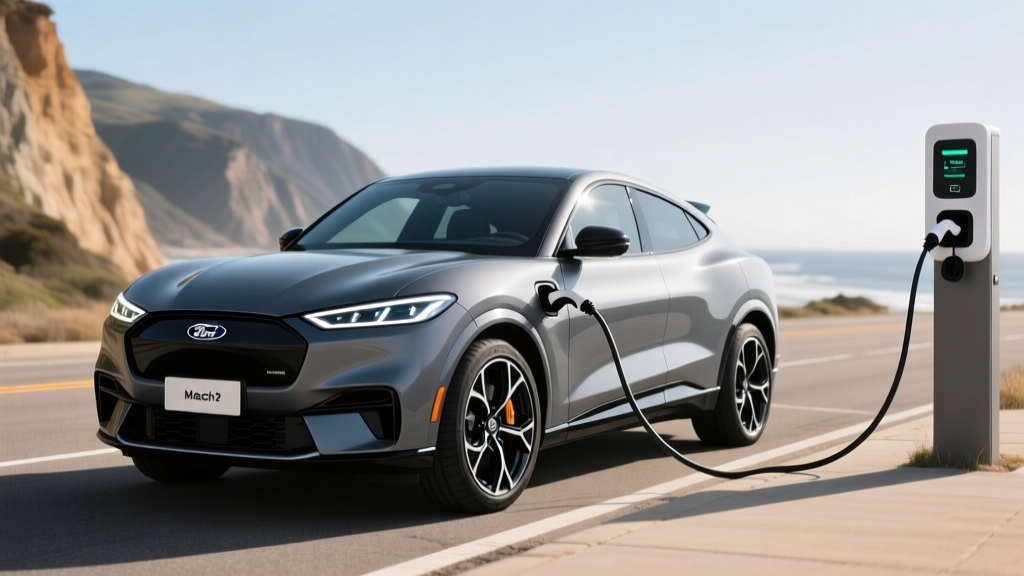
Charging capability is where the 2024 model year brings a significant hardware change. Ford began equipping Mach-E models with the Tesla-style NACS charge port as standard equipment, granting access to Tesla's Supercharger network (via adapter initially, then natively on newer builds). This is a major practical advantage over the CCS1 port on the 2021–2023 models, though Ford provides a CCS adapter for backward compatibility with Electrify America and other networks.
| Charging Level | Power / Rate | Time / Range Added | Notes |
|---|---|---|---|
| Level 1 (120V household) | ~1.4 kW | ~3–4 mi/hr | Emergency/trickle only |
| Level 2 (240V, 32A) | 7.7 kW | ~26 mi/hr | Standard mobile charger included |
| Level 2 (240V, 48A) | 11.5 kW | ~38 mi/hr | Ford Connected Charge Station or equivalent |
| DC Fast Charge (Standard Range) | Peak 115 kW | 10–80% in ~38 min | Tapers significantly above 80% |
| DC Fast Charge (Extended Range) | Peak 150 kW | 10–80% in ~33 min | Sustained ~130 kW to 50%, then taper |
The Extended Range pack's 150 kW peak DC fast-charge rate is competitive but not class-leading. The Hyundai Ioniq 5 peaks at 240 kW on an 800V architecture and can hit 10–80% in approximately 18 minutes. The Mach-E's 400V architecture means charging speeds peak early in the session and taper progressively. In real-world testing at a 150 kW Electrify America station, the Extended Range pack sustained roughly 130 kW from 15% to 50% state of charge, then tapered to approximately 90 kW by 70%, and dropped below 50 kW past 80%. This charge-curve behavior is normal for NMC packs on 400V systems, but it means you'll spend noticeably more time at a fast charger on road trips compared to 800V competitors.
For home charging, the 11.5 kW Level 2 rate on a 48-amp circuit is a strong point. A full overnight charge from 10% to 100% on the Extended Range pack takes roughly 8.5 hours — easily achievable during off-peak utility hours. Installation of a 48-amp hardwired Level 2 charger typically costs $800–$2,000 depending on your electrical panel's capacity and the run length from panel to garage. If your home has a 200-amp panel with available capacity, expect the lower end; older 100-amp panels may require an upgrade adding $1,500–$3,000.
Performance and Driving Dynamics
The Mach-E lineup offers a broad performance envelope depending on trim and drivetrain choice:
- Select / Premium RWD: 266 hp, 317 lb-ft torque, 0–60 mph in ~6.1 seconds
- Select / Premium AWD (eAWD): 346 hp (Standard Range) or 365 hp (Extended Range), 428 lb-ft, 0–60 mph in ~5.1 seconds
- GT (AWD): 480 hp, 600 lb-ft (with Performance Upgrade), 0–60 mph in ~3.5 seconds
- Rally (AWD): 480 hp, 700 lb-ft, 0–60 mph in ~3.6 seconds, rally-tuned suspension and all-terrain tires
The GT's 3.5-second sprint puts it squarely in sports-car territory, and the instant torque delivery makes even the base RWD model feel quick around town. The dual-motor AWD system uses a permanent-magnet synchronous motor on the rear axle and an induction motor up front, allowing the front motor to freewheel when not needed for efficiency gains. Ford's MagneRide adaptive dampers are available on the GT and standard on the Rally, providing genuinely impressive body control for a 4,800-pound crossover.
One-pedal driving is well-implemented with three regen levels accessible through the center touchscreen. The highest setting provides near-complete stop-and-go capability without touching the brake pedal. The steering is precise if somewhat numb, and the low center of gravity from the under-floor battery pack keeps body roll well-managed during cornering.
Interior Space, Cargo, and Technology
The Mach-E's cabin is one of its strongest selling points relative to the Tesla Model Y. Front passengers get 43.3 inches of legroom and 39.8 inches of headroom, while rear-seat passengers have 38.9 inches of legroom — competitive with midsize gas crossovers. The panoramic fixed-glass roof (standard on Premium and above) creates an airy feel, though it lacks a shade, which can make the cabin warm in summer parking.
Cargo capacity measures 29.7 cubic feet behind the rear seats and 59.7 cubic feet with the rear seats folded flat. The front trunk (frunk) adds 4.7 cubic feet of drainable storage — useful for wet items or charging cables. These numbers trail the Model Y's 76.2 cu ft maximum but exceed the Ioniq 5's 56.2 cu ft.
The centerpiece of the interior is a vertically oriented 15.5-inch touchscreen running Ford's SYNC 4A operating system, updated for 2024 with wireless Apple CarPlay and Android Auto, over-the-air software updates, and an improved voice assistant. A 10.2-inch digital instrument cluster sits behind the steering wheel. The available BlueCruise hands-free driving system operates on over 130,000 miles of pre-mapped divided highways.
Pricing, Trims, and Federal Tax Credit Eligibility
Ford simplified the 2024 Mach-E lineup and adjusted pricing mid-cycle. Here's where the trims land at MSRP:
| Trim | Starting MSRP | Est. §30D Credit* | Effective Price* |
|---|---|---|---|
| Select (Std Range, RWD) | $39,995 | Up to $3,750 | ~$36,245 |
| Select (Std Range, AWD) | $42,995 | Up to $3,750 | ~$39,245 |
| Premium (Ext Range, RWD) | $48,995 | Up to $3,750 | ~$45,245 |
| Premium (Ext Range, AWD) | $51,995 | Up to $3,750 | ~$48,245 |
| GT (Ext Range, AWD) | $59,995 | Up to $3,750 | ~$56,245 |
| Rally (Ext Range, AWD) | $59,995 | Up to $3,750 | ~$56,245 |
*Tax credit estimates reflect 2024–2025 IRS §30D rules. The Mach-E qualifies for a partial credit (typically $3,750) because its battery cells are manufactured in the U.S. by LG Energy Solution, but it may not meet the full critical-minerals sourcing threshold required for the complete $7,500. Credit amounts and eligibility change frequently — always verify current rules at irs.gov. The credit can be transferred to the dealer as a point-of-sale discount under current rules.
- MSRP cap: The Mach-E qualifies as an SUV/crossover under IRS definitions, so the MSRP cap is $80,000 — all trims clear this threshold.
- Buyer income cap: Modified adjusted gross income must not exceed $150,000 (single), $225,000 (head of household), or $300,000 (joint filers).
- Battery sourcing: Partial credit eligibility depends on critical-mineral and battery-component sourcing requirements that are updated annually. Confirm current-year compliance with your dealer.
- Point-of-sale transfer: Buyers can elect to transfer the credit to the dealer at purchase, reducing the out-of-pocket price immediately rather than waiting to claim it on their tax return.
Warranty Coverage and Long-Term Battery Outlook
Ford backs the Mach-E's high-voltage battery with an 8-year/100,000-mile warranty, guaranteeing at least 70% capacity retention during that period. The electric powertrain components (motors, onboard charger, DC-DC converter) share the same 8-year/100,000-mile coverage. The basic vehicle warranty is 3 years/36,000 miles, and roadside assistance is included for 5 years/60,000 miles.
NMC battery degradation data from early 2021–2022 Mach-E owners suggests typical capacity loss of approximately 5–8% over the first 50,000 miles, which is consistent with industry averages. Ford's battery thermal management system — a liquid-cooled and heated system — helps mitigate degradation in extreme climates. For owners in hot Southern states or frigid Northern regions, preconditioning the battery before fast charging (using the scheduled departure feature or navigation-routed preconditioning) is essential for both charging speed and long-term health.
Pros, Cons, and How It Stacks Up
- NACS port standard for 2024 — access to Tesla Supercharger network
- Strong real-world efficiency (32–34 kWh/100 mi on Extended Range RWD)
- Excellent 11.5 kW home Level 2 charging rate
- Spacious, well-built interior with physical knobs alongside touchscreen
- BlueCruise highway driving assist is smooth and reliable on mapped roads
- GT and Rally trims deliver genuine sports-car acceleration
- Drainable frunk adds practical cargo flexibility
- DC fast charging peaks at 150 kW — slower than 800V competitors (Ioniq 5 at 240 kW)
- Cold-weather range loss of 20–30% is significant for Northern-climate road trippers
- Fixed glass roof lacks a shade — cabin heat soak in summer
- BlueCruise requires a paid subscription after the trial period ($75/month)
- Partial federal tax credit ($3,750) vs. full $7,500 on some competitors
- No heat pump on Standard Range trims (reduces cold-weather efficiency)
Who Should Buy the 2024 Mustang Mach-E?
- You want a well-rounded electric crossover with traditional automotive styling and build quality
- Home Level 2 charging is your primary routine, and you value the 11.5 kW charge rate for overnight top-ups
- You drive a mix of city and highway and want BlueCruise for long interstate commutes
- Access to the Tesla Supercharger network matters to you for road trips (via NACS port)
- You want a performance variant (GT or Rally) that can genuinely embarrass sports cars at stoplights
- You need the fastest possible DC charging for frequent long-distance road trips (consider the Ioniq 5 or Ioniq 6 with 800V architecture)
- Maximum cargo volume is your priority (the Model Y offers more total cubic feet)
- You want the full $7,500 federal tax credit and your income qualifies — check current-year sourcing rules for each competitor
- You live in a very cold climate and need every mile of winter range (the heat pump on the Ioniq 5 gives it a cold-weather efficiency edge)
Frequently Asked Questions
What is the real-world range of the 2024 Ford Mustang Mach-E?
The EPA rates the Extended Range RWD Premium at 320 miles, but real-world highway driving at 70–80 mph typically yields 260–280 miles. In cold weather below 30°F, expect 220–250 miles from the same configuration. The GT trim averages around 230–250 miles in mixed driving and can drop below 210 miles on cold highway trips.
How fast does the 2024 Mach-E charge at home and on the road?
At home on a 48-amp Level 2 charger (240V), the Mach-E charges at up to 11.5 kW, adding approximately 38 miles of range per hour — a full Extended Range charge takes about 8.5 hours overnight. On DC fast chargers, the Extended Range pack peaks at 150 kW and charges from 10–80% in approximately 33 minutes, though the 400V architecture means charging speed tapers progressively above 50% state of charge.
How much does the 2024 Mach-E cost after the federal tax credit?
With the current partial §30D credit of approximately $3,750 (subject to annual sourcing-rule changes), the Select RWD starts around $36,245 effective, and the Premium Extended Range RWD lands near $45,245. The GT and Rally trims sit around $56,245 after credit. Always confirm current credit eligibility at irs.gov and with your dealer, as battery-sourcing rules are updated regularly.
Does the 2024 Mach-E qualify for the full $7,500 federal EV tax credit?
As of the most recent IRS guidance, the Mach-E typically qualifies for a partial credit of $3,750, meeting the battery-component requirement but not always the critical-minerals threshold. The MSRP cap for SUVs ($80,000) is not an issue for any trim. Buyer income caps apply: $150,000 single / $300,000 joint. Consult a tax professional and check fueleconomy.gov for the latest eligibility data.
Is the 2024 Mach-E worth buying over the Tesla Model Y or Hyundai Ioniq 5?
It depends on your priorities. The Mach-E wins on interior material quality, ride comfort, and BlueCruise highway assist. The Model Y wins on cargo space, charging-network seamlessness (though the Mach-E now has NACS access), and software polish. The Ioniq 5 wins on DC charging speed (240 kW peak) and cold-weather efficiency (standard heat pump). If you value a traditional car feel with strong EV fundamentals, the Mach-E is a strong choice. If road-trip charging speed is your top concern, the Ioniq 5 has a meaningful advantage.
What is the battery warranty on the 2024 Mustang Mach-E?
Ford covers the high-voltage battery for 8 years or 100,000 miles, whichever comes first, with a guaranteed minimum of 70% capacity retention. The electric powertrain components share the same 8-year/100,000-mile coverage. Basic bumper-to-bumper coverage is 3 years/36,000 miles.