Quick Answer: What Are Amazon's Electric Vehicles?
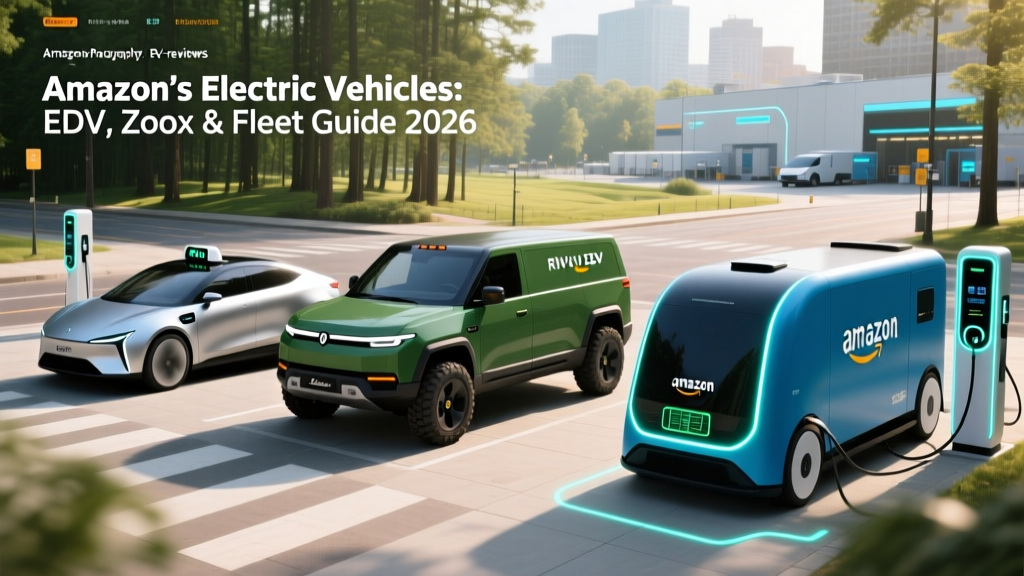
Amazon's electric vehicle strategy rests on three pillars: 10,000+ Rivian EDV delivery vans deployed across US last-mile routes, a 100,000-van order (the largest commercial EV commitment in history), and majority ownership of Zoox, a Level 4 autonomous robotaxi company operating in select cities. For consumers, the Rivian EDV is not available for purchase — it's a purpose-built commercial fleet vehicle. However, Amazon's investment directly funds Rivian's consumer models (R1T, R1S) and Zoox's ride-hail expansion, making Amazon one of the most consequential players in the EV ecosystem even though it doesn't sell cars to the public.
Amazon's EV Fleet: The Rivian EDV Delivery Van
Amazon's most visible electric vehicle is the Rivian Electric Delivery Van (EDV), a purpose-built last-mile delivery vehicle co-developed with Rivian. As of early 2026, Amazon has deployed over 10,000 EDVs across more than 100 US cities, with the fleet expected to reach its full 100,000-unit order by 2030. These vans are exclusive to Amazon — you cannot buy one.
Rivian EDV Specifications
| Spec | EDV-700 (Small) | EDV-900 (Medium) | EDV-500 (Large/Announced) |
|---|---|---|---|
| Battery Capacity | ~89 kWh usable (NMC) | ~135 kWh usable (NMC) | TBD |
| EPA-Est. Range | ~120 miles | ~150 miles | TBD |
| Real-World Range (Loaded, Urban) | ~90–110 miles | ~110–140 miles | TBD |
| Peak DC Fast Charge | ~115 kW | ~150 kW | TBD |
| 10–80% Charge Time | ~45 minutes | ~50 minutes | TBD |
| Level 2 Charging | ~11.5 kW | ~11.5 kW | TBD |
| Cargo Volume | ~500 cu ft | ~660 cu ft | ~800+ cu ft (est.) |
| Payload Capacity | ~2,500 lbs | ~3,300 lbs | TBD |
| Power | ~245 hp | ~335 hp | TBD |
Sources: Rivian fleet specifications, Rivian Fleet. EDV-500 specs are preliminary/announced.
Why the EDV Range Is Shorter Than Consumer EVs
The EDV's 120–150 mile EPA range may look modest compared to consumer EVs like the Tesla Model Y (310+ miles), but it's engineered for a specific duty cycle: urban delivery routes averaging 60–90 miles per day with 150+ stops. The van returns to a depot nightly for Level 2 charging. This eliminates range anxiety entirely because the route is predictable and the charging infrastructure is owned by Amazon.
Real-World Range Reality: In cold-weather testing (below 32°F), the EDV-900 loses approximately 25–35% of its range due to battery chemistry limitations and cabin heating demands. Amazon mitigates this by deploying more vans per route in northern markets during winter and using depot preconditioning.
Zoox: Amazon's Level 4 Autonomous Robotaxi Bet
Amazon acquired Zoox in 2020 for approximately $1.3 billion. Zoox is developing a fully autonomous, Level 4 robotaxi — a vehicle with no steering wheel or pedals designed exclusively for ride-hailing. As of 2026, Zoox operates limited commercial services in Las Vegas and Foster City, California, with planned expansion to additional cities.
SAE Automation Level: Level 4. Zoox's robotaxi is a true driverless vehicle that operates without a human safety driver in its designated operational design domain (specific geofenced areas under specific conditions). This is fundamentally different from Tesla FSD (Supervised), GM Super Cruise, or Ford BlueCruise, which are all Level 2 systems requiring active driver engagement.
Zoox Vehicle Specifications (Announced)
| Attribute | Detail |
|---|---|
| Seating | 4 passengers (face-to-face) |
| Top Speed | 75 mph |
| Steering | None (fully autonomous) |
| Sensor Suite | LiDAR, cameras, radar (360° coverage) |
| Availability | Limited commercial service (Las Vegas, Foster City) |
| Consumer Purchase | Not available — ride-hail only |
Zoox Safety Record and Regulation
Zoox holds a permit from the California DMV and NHTSA exemptions for its steering-wheel-free design. As of late 2025, Zoox has logged millions of autonomous miles. According to NHTSA standing general orders, Zoox has reported minor incidents consistent with urban low-speed operations, though its safety record remains narrower than Waymo's multi-million-mile dataset in Phoenix and San Francisco.
How Amazon's EV Strategy Compares to Competitors
| Metric | Amazon (Rivian EDV) | UPS (Conventional + EV Mix) | FedEx (Conventional Fleet) |
|---|---|---|---|
| EV Fleet Size (2026 est.) | 10,000+ | ~1,000 EVs + 125,000 gas/diesel | Limited EV pilots |
| Fuel Cost per Mile (est.) | $0.08–0.12 (electric, depot) | $0.25–0.35 (gas/diesel avg) | $0.25–0.35 |
| Maintenance Cost per Mile | $0.06–0.09 | $0.12–0.18 | $0.12–0.18 |
| Annual CO₂ per Van (est.) | ~2–4 metric tons (grid-dependent) | ~10–14 metric tons | ~10–14 metric tons |
| Upfront Vehicle Cost (est.) | ~$75,000–$90,000 | ~$35,000–$50,000 (ICE van) | ~$35,000–$50,000 |
Fuel and maintenance estimates based on fleet operator data and fueleconomy.gov commercial averages. Actual costs vary by electricity rate, route density, and climate.
The Economics: Why Amazon Is All-In on Electric Vans
Despite a 2–2.5× higher upfront purchase price, the EDV's per-mile operating cost is roughly 55–65% lower than a comparable gas delivery van. Over a 10-year fleet lifecycle at 15,000 miles/year:
- Gas van fuel cost: ~$37,500–$52,500
- EDV electricity cost: ~$12,000–$18,000 (at depot commercial rates of $0.10–0.15/kWh)
- Maintenance savings: ~$9,000–$13,500 (no oil changes, fewer brake replacements due to regenerative braking, no transmission service)
That translates to roughly $30,000–$47,000 in lifetime savings per van, easily offsetting the higher purchase price.
What Amazon's EV Investment Means for Consumer Buyers
While you can't buy an EDV, Amazon's relationship with Rivian has ripple effects for consumer EV shoppers:
1. Rivian's Financial Stability
Amazon's 100,000-van order provides Rivian with a revenue floor that most EV startups lack. This helps fund R&D for the consumer R1T pickup and R1S SUV, as well as the upcoming, more affordable R2 and R3 platforms expected in 2026–2027.
2. Charging Infrastructure Spillover
Amazon's depot charging installations (often 50–200+ Level 2 chargers per facility) put pressure on utilities to upgrade grid capacity in delivery-dense neighborhoods — infrastructure that can eventually support residential EV adoption in those same areas.
3. Zoox and the Future of Robotaxis
If Zoox scales successfully, Amazon could integrate it with its logistics network for autonomous package delivery during off-peak hours, or expand into consumer ride-hailing. This would compete directly with Waymo (Alphabet) and Cruise (GM).
Common Misconceptions About Amazon's Electric Vehicles
| Myth | Fact |
|---|---|
| "I can buy an Amazon delivery van" | The Rivian EDV is exclusive to Amazon's fleet and is not available for consumer purchase. Rivian's consumer vehicles (R1T, R1S, upcoming R2) are separate platforms. |
| "Amazon's vans are self-driving" | EDV delivery vans are driven by human Amazon DSP drivers. Only Zoox (a separate Amazon subsidiary) operates Level 4 autonomous vehicles, and only in limited geofenced areas. |
| "Amazon EVs have unlimited range" | EDVs have 120–150 miles of EPA range, which is sufficient for urban delivery routes but would not work for long-haul or rural routes without mid-day charging. |
| "Amazon's fleet is 100% electric" | As of 2026, Amazon's 10,000+ EDVs represent roughly 10–15% of its US delivery fleet. The majority of Amazon packages still arrive in gas or diesel vehicles. |
| "Amazon EVs produce zero emissions" | Tailpipe emissions are zero, but upstream electricity generation matters. In coal-heavy grid regions, the well-to-wheel emissions advantage shrinks, though it rarely eliminates the EV benefit entirely. |
Amazon's EV Fleet vs. Buying Your Own EV: A Decision Framework
Amazon's fleet strategy raises a question many readers have: if EVs make sense for a 100,000-van fleet, do they make sense for me?
Should You Buy an EV in 2026? (Inspired by Amazon's Fleet Logic)
- IF you can install a Level 2 charger at home (240V, ~$500–$2,000 install) AND your daily driving is under 80 miles → EV is likely a strong fit. Like Amazon's depot-charged vans, you'll start every day with a full "tank" at ~$0.04–0.08/mile fuel cost.
- IF you lack home charging access AND rely on public DC fast charging → Consider a PHEV or HEV instead. Public charging costs $0.30–$0.50/kWh (sometimes more than gas per mile), and reliability remains inconsistent.
- IF you regularly drive 300+ miles in a single day OR live in a region with sparse DC fast chargers → A PHEV (like the Toyota RAV4 Prime) or HEV may be more practical until charging infrastructure catches up.
- IF you live in a cold climate (sub-20°F winters) AND your commute exceeds 60 miles → Look for EVs with heat pumps and large batteries (e.g., Hyundai Ioniq 5, Tesla Model Y). Expect 25–40% range loss in extreme cold.
- IF you qualify for the §30D federal tax credit (up to $7,500, income and MSRP caps apply, battery sourcing rules in effect) → The economics tilt strongly toward EV. A $45,000 EV effectively costs ~$37,500 after the credit.
Cost Breakdown: What Amazon Saves vs. What You'd Save
| Cost Category | Amazon EDV (per van/year) | Consumer EV (e.g., Tesla Model Y, per year) | Consumer Gas Car (e.g., Toyota RAV4, per year) |
|---|---|---|---|
| Fuel/Energy | ~$1,500–$2,250 | ~$540–$900 | ~$1,800–$2,400 |
| Maintenance | ~$900–$1,350 | ~$400–$700 | ~$900–$1,400 |
| Insurance | Commercial fleet rates | ~$1,800–$2,800 | ~$1,400–$2,200 |
| Depreciation (Year 1–5 avg) | Fleet accounting | ~$5,000–$7,000/yr | ~$3,500–$5,000/yr |
| Annual Mileage | ~15,000–20,000 | ~12,000–15,000 | ~12,000–15,000 |
Consumer estimates based on 12,000 miles/year, $0.14/kWh home charging, $3.50/gallon gas. Insurance varies significantly by state, driver profile, and vehicle. Source: fueleconomy.gov, AAA Your Driving Costs 2025.
First-Time EV Buyer Takeaways from Amazon's Fleet Strategy
Amazon's approach to electrification reveals several principles that apply to individual buyers:
- Depot charging (home charging) is the economic foundation. Amazon never relies on public charging for its fleet. Neither should you. A Level 2 home charger transforms EV ownership from a logistical challenge into a convenience — plug in at night, wake up full.
- Route predictability eliminates range anxiety. Amazon knows its vans drive 60–90 miles daily. If your daily driving is similarly predictable, a 200–250 mile EPA-range EV is more than adequate.
- Total cost of ownership matters more than sticker price. Amazon pays 2× more upfront for an EDV but recoups it in 4–6 years through fuel and maintenance savings. The same math applies to consumer EVs — especially with the §30D tax credit.
- Cold weather is a real constraint. Amazon deploys fewer routes per van in northern winters. You should similarly budget for 25–40% range loss in freezing temperatures and choose an EV with a heat pump.
Frequently Asked Questions
Can I buy Amazon's Rivian delivery van?
No. The Rivian EDV is built exclusively for Amazon under a 100,000-unit contract and is not available to consumers or other fleet operators. Rivian does sell consumer vehicles — the R1T pickup, R1S SUV, and the upcoming R2 compact SUV (expected late 2026) — but these are entirely different platforms from the EDV.
Are Amazon's delivery vans self-driving?
No. Amazon's Rivian EDV delivery vans are driven by human drivers employed by Amazon's Delivery Service Partners (DSPs). The vans include driver-assistance features like automatic emergency braking and lane-keeping assist (SAE Level 1), but they are not autonomous. Zoox, Amazon's separate robotaxi subsidiary, operates Level 4 self-driving vehicles in Las Vegas and Foster City, CA, but these are not delivery vans.
How much does it cost Amazon to charge an EDV?
Amazon charges its EDVs at depot Level 2 stations overnight, typically at commercial electricity rates of $0.08–$0.15/kWh. Fully recharging an EDV-900's ~135 kWh battery costs roughly $11–$20 per day, compared to $40–$55 to fill an equivalent gas van at $3.50/gallon and 12 MPG.
What battery chemistry does the Rivian EDV use?
The Rivian EDV uses NMC (nickel manganese cobalt) lithium-ion battery cells, similar to those in Rivian's consumer R1T and R1S. NMC offers higher energy density than LFP (lithium iron phosphate), which is important for a cargo van that needs to maximize payload capacity within a limited battery volume. Trade-off: NMC degrades slightly faster than LFP over many charge cycles, but fleet data suggests the EDV batteries retain over 85% capacity after 100,000+ miles.
Will Amazon's Zoox robotaxi compete with Uber and Lyft?
Potentially, yes. Zoox is designed as a ride-hail-first vehicle, and Amazon has the logistics and app infrastructure to scale a robotaxi service. However, as of 2026, Zoox operates only in limited geofenced areas with small fleets. Widespread competition with Uber/Lyft — or Waymo — would require expansion to dozens of cities and tens of thousands of vehicles, which is likely years away.
Does Amazon's EV fleet qualify for the federal tax credit?
Commercial fleet EVs like the EDV are eligible for the §45W Commercial Clean Vehicle Credit (up to $40,000 for vehicles over 14,000 lbs GVWR), not the §30D consumer credit. Amazon has not publicly disclosed how many credits it claims, but the savings are substantial at fleet scale. For individual consumers, the §30D credit (up to $7,500) has separate income, MSRP, and battery-sourcing requirements — consult a tax professional for eligibility.
Final Assessment: Amazon as an EV Catalyst
Amazon doesn't sell electric vehicles to consumers, but its influence on the EV market is enormous. The 100,000-van Rivian order has stabilized a key American EV manufacturer. Zoox represents one of only a handful of Level 4 robotaxi programs operating in the US. And Amazon's depot-charging model demonstrates — at massive scale — that predictable-route EVs with home/depot charging are economically superior to gas vehicles even without consumer subsidies.
For individual buyers, the lesson is clear: if Amazon can make EVs work for 100,000 vans driving in freezing Minneapolis winters and scorching Phoenix summers, the technology is proven. The question isn't whether EVs are viable — it's whether your specific situation (home charging access, daily mileage, budget, climate) makes an EV the right choice today. Use the decision framework above to find out.