The Short Answer
As of 2026, a true all electric travel trailer with a self-propelled drivetrain does not exist in production for consumers. What does exist are electric campers and travel trailers designed to be towed by EVs, plus a handful of concept-stage trailers with onboard battery packs that extend tow-vehicle range (such as the announced Lightship L1 and Airstream e-trailer concepts). If you're searching for an all-electric travel trailer you can buy and tow today, you're really looking at conventional travel trailers paired with an electric tow vehicle — and understanding how towing crushes EV range is the single most important thing to get right before spending $50,000+ on this setup.
The dream of fully electric camping — silent boondocking, zero generator fumes, and off-grid power from a massive onboard battery — is closer than ever. But the marketing around "electric trailers" often blurs what's real versus what's still in prototype. This guide breaks down exactly what's available in 2026, what towing does to your EV's range, the real costs, and how to decide if an electric-towed camper setup works for your travel patterns.
What "All Electric Travel Trailer" Actually Means in 2026
The phrase "all electric travel trailer" gets used loosely across forums and YouTube reviews. Let's separate the three categories you'll encounter:
- Electric-towable travel trailers (available now): Conventional travel trailers (Airstream, Jayco, Grand Design, etc.) with all-electric appliances — induction cooktops, heat pumps, electric water heaters — designed to run off shore power or a battery bank. No propulsion system. You tow them with an EV like a Ford F-150 Lightning, Rivian R1T, or Tesla Cybertruck.
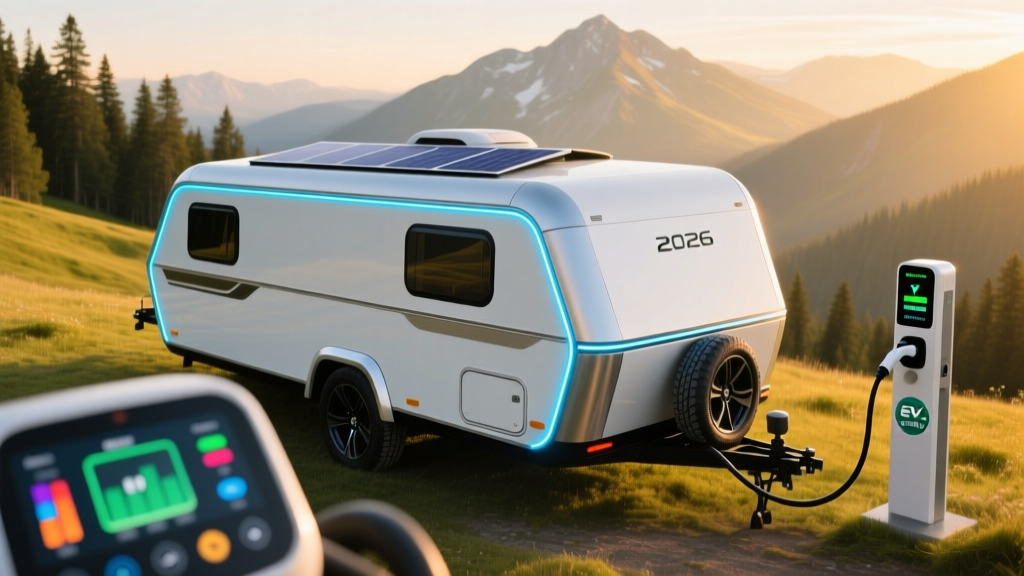
- Range-extending electric trailers (announced/preliminary): Trailers with their own high-voltage battery pack and electric axle that actively reduces the load on the tow vehicle, preserving EV range. The Lightship L1 (announced for late 2026/2027 delivery) and the Airstream e-trailer concept fall here. These are not yet in customer hands at scale.
- Electric motorhomes (Class B/C, limited availability): Self-propelled electric RVs like the Winnebago e-RV (concept/limited production) or the upcoming Grounded G1. These are motorhomes, not towable trailers.
If you need something you can order, hitch up, and camp in this season, you're working with category one: a conventional trailer optimized for electric towing and all-electric living systems.
How Towing a Travel Trailer Destroys EV Range
This is the make-or-break data point that most first-time EV-towing buyers underestimate. When you hitch a 5,000–7,500 lb travel trailer to an electric truck or SUV, expect to lose 40–60% of your EPA-rated range. This isn't a defect — it's physics. Aerodynamic drag increases with the square of velocity, and a boxy travel trailer at 65 mph is an aerodynamic disaster compared to a sleek sedan.
| Tow Vehicle | Battery (kWh) | EPA Range (mi) | Est. Towing Range (mi) | Max Tow Rating (lb) |
|---|---|---|---|---|
| Ford F-150 Lightning (Extended Range) | 131 usable | 320 | 130–170 | 10,000 |
| Rivian R1T (Dual-Motor Max Pack) | 141 usable | 410 | 170–220 | 11,000 |
| Tesla Cybertruck (AWD) | 123 usable | 340 | 140–180 | 11,000 |
| Chevrolet Silverado EV (4WT) | 200 usable | 492 | 210–270 | 12,500 |
| GMC Hummer EV Pickup | 212 usable | 381 | 160–200 | 12,000 |
Real-world caveat: The towing range figures above assume a ~6,000 lb loaded trailer, 60–65 mph highway speeds, flat terrain, and moderate temperatures (60–75°F). Add mountain passes, headwinds, cold weather (below 40°F), or speeds above 70 mph, and cut those numbers by another 15–25%. According to fueleconomy.gov, towing and high-speed driving are the single largest efficiency penalties for any electric vehicle.
What this means practically: With a Ford F-150 Lightning Extended Range and a mid-size travel trailer, your realistic highway towing range is roughly 150 miles before you need to charge. That means you're stopping at a DC fast charger roughly every 2–2.5 hours of driving. If your typical camping trip is within 200 miles of home, this is manageable. If you're planning 600-mile hauls across the Mountain West, you need a meticulous charging strategy — or a different rig.
Charging Logistics: The Real Bottleneck of EV Towing
Range is only half the equation. The other half is whether you can actually charge a truck-sized EV while it's hitched to a 25-foot trailer. Here's the reality of 2026's charging infrastructure for EV towers:
DC Fast Charging While Hitched
Most Tesla Supercharger stalls and many Electrify America and EVgo stations are designed for passenger cars to pull in and out. A truck-plus-trailer combination is 45–55 feet long. At many plazas, you cannot reach the charge cable without unhitching or blocking multiple stalls. Some networks have begun adding pull-through "truck-friendly" stalls (Tesla has expanded these at select Supercharger locations along interstate corridors), but they remain a minority.
| Vehicle | Peak DC Rate (kW) | 10–80% Time (min) | Connector (2026) |
|---|---|---|---|
| Ford F-150 Lightning | 150 kW (peak) | ~41 | NACS (native) |
| Rivian R1T (Max Pack) | 200 kW (peak) | ~34 | NACS (native) |
| Tesla Cybertruck | 250 kW (peak) | ~28 | NACS (native) |
| Chevy Silverado EV | 350 kW (peak) | ~22 | NACS (adapter) |
Important nuance: Peak kW is not sustained kW. A truck that peaks at 250 kW may only hold that rate from 10–30% State of Charge before tapering to 100 kW or less above 60%. Real-world 10–80% sessions average closer to the sustained rate. Expect a typical highway charging stop while towing to take 35–50 minutes at a functional, compatible station.
Campground Charging
Most campgrounds offer 30-amp or 50-amp NEMA 14-50 outlets for trailer shore power — not for charging your tow vehicle. Level 2 charging at a campground (240V, 40–48 amps) adds roughly 25–35 miles of range per hour to a large electric truck. Overnight (10 hours), that's 250–350 miles of replenished range — enough for many trips, but only if your campsite has the infrastructure and you brought a portable Level 2 EVSE.
Cost Breakdown: EV Towing vs. Gas Truck Towing
The economics of towing with an EV versus a gas truck depend heavily on your electricity source, driving volume, and fuel prices in your area. Here's a five-year comparison for a realistic scenario: 6,000 miles of towing per year (roughly 12 weekend trips at 250 miles each round-trip, plus a couple of longer hauls).
| Cost Category | EV (F-150 Lightning, home charging) | Gas (F-150 3.5L EcoBoost) |
|---|---|---|
| Towing efficiency | ~2.5 kWh/mile | ~10 MPG towing |
| Annual energy/fuel cost | $1,950 (at $0.13/kWh home rate) | $4,500 (at $3.75/gal, 600 gal) |
| 5-year energy/fuel total | $9,750 | $22,500 |
| 5-year maintenance (towing-related) | ~$600 (cabin filter, wipers, tire rotation) | ~$3,200 (oil changes, trans fluid, plugs) |
| Vehicle base MSRP (2026) | ~$65,000 (XLT Extended Range) | ~$52,000 (XLT 3.5L EcoBoost 4x4) |
| Federal tax credit (§30D) | Up to $7,500 (if eligible) | $0 |
| 5-year total (vehicle + energy + maint.) | ~$74,150 | ~$77,700 |
Key takeaway: Over five years, the EV towing setup can save roughly $3,000–$5,000 in operating costs, but the higher upfront purchase price narrows the gap substantially. The savings widen if you charge primarily on solar or off-peak utility rates, and shrink if you rely heavily on public DC fast charging (which can cost $0.35–$0.55/kWh — nearly matching gas on a per-mile basis).
Federal tax credit caveat: Under current IRS §30D rules, the $7,500 Clean Vehicle Credit requires meeting battery critical-mineral sourcing and component manufacturing requirements, plus buyer income caps ($300K joint / $150K single AGI) and an MSRP cap of $80,000 for trucks/SUVs. Eligibility changes as sourcing rules tighten — verify current-year rules with a tax professional before counting on the credit.
EV vs. Gas Towing: Head-to-Head
| Factor | Electric (EV) | Gas/Diesel (ICE) |
|---|---|---|
| Towing range per fill/charge | 130–270 mi (real-world) | 350–500 mi |
| Refuel/recharge time | 30–50 min (DC fast charge) | 8–12 min (gas pump) |
| Energy cost per towing mile | $0.25–$0.55 (home vs. DCFC) | $0.38–$0.50 |
| Instant torque (hill performance) | Excellent — no gear hunting | Good with turbo, but shifts under load |
| Regenerative braking on downhills | Recovers energy, reduces brake wear | None — relies on engine braking |
| Quiet campsite operation | Silent; can power trailer via V2L | Engine noise; idling for power |
| Remote/cold-weather reliability | Range drops 20–40% below 30°F | Minimal range impact; refuel anywhere |
| Charging infrastructure (rural) | Limited — requires planning | Gas stations everywhere |
The EV wins on torque delivery, downhill regen, campsite silence, and home-base energy cost. The gas truck wins on range, refueling speed, cold-weather predictability, and rural infrastructure. Neither is universally superior — the right choice depends entirely on your trip profile.
Real-World Ownership Considerations
Home Charging Access Is Non-Negotiable
If you cannot install a Level 2 charger (240V, 48–80 amp) at home, EV towing becomes significantly harder. Relying on public DC fast chargers for daily topping-up is expensive and time-consuming. Budget $800–$2,500 for a professional Level 2 home installation, including a NEMA 14-50 outlet or hardwired wall connector. Homes with older 100-amp electrical panels may need a $2,000–$4,000 panel upgrade to support simultaneous EV charging and household loads.
Climate Matters More Than You Think
Lithium-ion battery efficiency drops noticeably in cold weather. If you're towing a travel trailer to a ski area in January at 15°F, expect your already-reduced towing range to drop another 20–30%. Conversely, extreme heat (above 95°F) with air conditioning running also erodes range. Owners in temperate coastal climates (Pacific Northwest, Southeast) will see the smallest gap between EPA estimates and real-world towing range.
Driving Pattern Fit
EV towing works best when:
- Your typical one-way trip to a campsite is under 150 miles
- You can charge overnight at your destination (Level 2 at campground or at a nearby town charger)
- You tow 10 or fewer times per year
- You primarily travel on well-serviced interstate corridors (I-5, I-95, I-70 east of Denver)
EV towing is painful when:
- You regularly tow 300+ miles in a single day through rural areas
- You boondock in remote BLM land far from any charging infrastructure
- You tow in extreme cold frequently
- You need to cover 600+ miles in a single day (possible, but requires 4–5 charging stops of 40+ minutes each)
Common Misconceptions About All Electric Travel Trailers
| Myth | Fact |
|---|---|
| "Electric trailers drive themselves and add range to my truck." | Range-extending trailers (Lightship L1, Airstream e-trailer) are still in pre-production as of 2026. They're not yet available at dealerships. |
| "I can tow 300 miles on a charge." | No current consumer EV achieves 300 miles while towing a full-size travel trailer at highway speeds. The Chevy Silverado EV 4WT comes closest at ~210–270 miles under ideal conditions. |
| "Any travel trailer works fine with an EV." | Aerodynamics matter enormously. A low-profile, rounded teardrop or A-frame trailer reduces range loss by 15–25% compared to a tall, flat-front conventional trailer. |
| "I'll save a fortune on fuel." | If you charge exclusively at home ($0.10–$0.15/kWh), yes — roughly 50% less per mile than gas. If you rely on DC fast charging ($0.40+/kWh), savings shrink to near zero. |
| "The federal tax credit covers $7,500 of any EV truck." | The §30D credit has MSRP caps ($80K for trucks), income caps, and battery sourcing requirements. Many EV trucks above $80K MSRP (Rivian R1T tri-motor, Hummer EV) do not qualify. |
Decision Framework: Should You Tow a Travel Trailer With an EV?
Choose an EV tow setup if:
- Your typical camping trip is within 150 miles one-way
- You have (or can install) Level 2 home charging
- You value silent, emission-free campsite operation and can use V2L (vehicle-to-load) to power your trailer's appliances
- You tow fewer than 12 times per year and your daily driver benefits from being electric the other 350 days
- You live in a temperate climate or primarily camp in spring/summer/fall
Choose a gas/diesel tow setup if:
- You regularly drive 300+ miles one-way to remote campsites
- You boondock off-grid far from charging infrastructure
- You tow in sub-freezing temperatures frequently
- You cannot install home charging (apartment, street parking)
- You need maximum flexibility with zero route planning
Consider waiting (12–24 months) if:
- You're specifically waiting for a range-extending electric trailer (Lightship L1, Airstream e-trailer) to reach production
- You want a larger battery pack option (200+ kWh) in a mid-size truck to push towing range past 300 miles
- You need pull-through DC fast charging to be more widely available on your specific routes
What a First-Time EV Towing Buyer Should Know
- Test-tow before you commit. Rent an electric truck (via services like Turo or specialized EV rental companies) and tow a friend's trailer or a U-Haul loaded to approximate weight. See how range and charging logistics feel on your actual route.
- Invest in a good trailer with low drag. Aerodynamic trailers (Airstream's rounded profile, Oliver Travel Trailers, Escapod teardrops) will give you back 20–40 miles of range versus a boxy conventional trailer at highway speeds.
- Plan every charge stop before departure. Use apps like A Better Routeplanner (ABRP) with your specific truck, trailer weight, and route to simulate range and identify compatible chargers. Verify that pull-through or unhitch-friendly charging exists at each stop.
- Carry a portable Level 2 EVSE. A $400–$600 portable charger (like the Lectron V-Box Pro or ChargePoint Home Flex portable) lets you plug into campground 14-50 outlets and add 25–35 miles of range per hour overnight.
- Factor in tire wear. EVs are heavy, and towing adds even more load. Expect tire replacement every 25,000–35,000 miles when towing regularly — a $1,200–$2,000 expense that gas-truck owners also face, but that catches some EV owners off guard.
- Check your insurance. EV insurance premiums run 15–30% higher than comparable gas trucks due to repair cost data. Get quotes before purchasing. Per the IIHS, collision repair costs for EVs remain elevated due to battery-pack proximity concerns.
Frequently Asked Questions
Can I tow a travel trailer with a Tesla Model Y or other electric SUV?
The Tesla Model Y has a 3,500-lb tow rating — adequate only for very small teardrop or pop-up campers (under 3,000 lbs loaded). For a full travel trailer (4,500–7,500 lbs), you need an electric truck: F-150 Lightning, Rivian R1T, Cybertruck, Silverado EV, or Hummer EV. Smaller EV SUVs simply don't have the tow rating or battery capacity.
Will towing void my EV's battery warranty?
No. Towing within the manufacturer's rated capacity does not void the battery warranty. Federal law and manufacturer warranty terms (typically 8 years / 100,000 miles for the battery pack) cover defects and capacity degradation regardless of towing use, as long as you stay within the published tow rating. However, excessive towing loads that damage the drivetrain may not be covered.
What's the best electric truck for towing a 5,000-lb travel trailer?
For a 5,000-lb trailer, the Rivian R1T Max Pack (141 kWh, ~220 mi towing range) and the Chevrolet Silverado EV 4WT (200 kWh, ~250 mi towing range) offer the best range buffers. The F-150 Lightning Extended Range is the value pick at a lower MSRP, with ~150 mi towing range — adequate for shorter trips.
Do all-electric travel trailers with their own batteries exist yet?
Not at consumer scale. The Lightship L1 (a solar-equipped, aerodynamic travel trailer with a ~80 kWh battery pack and electric axle designed to preserve tow-vehicle range) is expected to begin deliveries in late 2026 or 2027, with pricing announced around $75,000+. The Airstream e-trailer concept has been demonstrated but has no firm production date. Until these ship, "all electric travel trailer" means a conventional trailer with all-electric appliances towed by an EV.
How much does it cost to charge an electric truck while towing on a road trip?
At a public DC fast charger averaging $0.40/kWh, and assuming 2.5 kWh/mile while towing, you'll spend roughly $1.00 per mile — comparable to or slightly more than a gas truck at 10 MPG and $3.75/gallon ($0.375/mile). The economics only favor the EV if you charge predominantly at home at utility rates ($0.10–$0.18/kWh = $0.25–$0.45/mile towing).
Can I use my EV's battery to power my travel trailer at the campsite?
Yes, if your truck supports V2L (vehicle-to-load). The Ford F-150 Lightning's Pro Power Onboard offers up to 9.6 kW of continuous output — enough to run a travel trailer's air conditioner, induction cooktop, lights, and electronics simultaneously for days without shore power. The Rivian R1T and Hyundai Ioniq 5 also offer V2L, though at lower wattages (1.5–3.6 kW). This is one of the biggest practical advantages of EV towing.