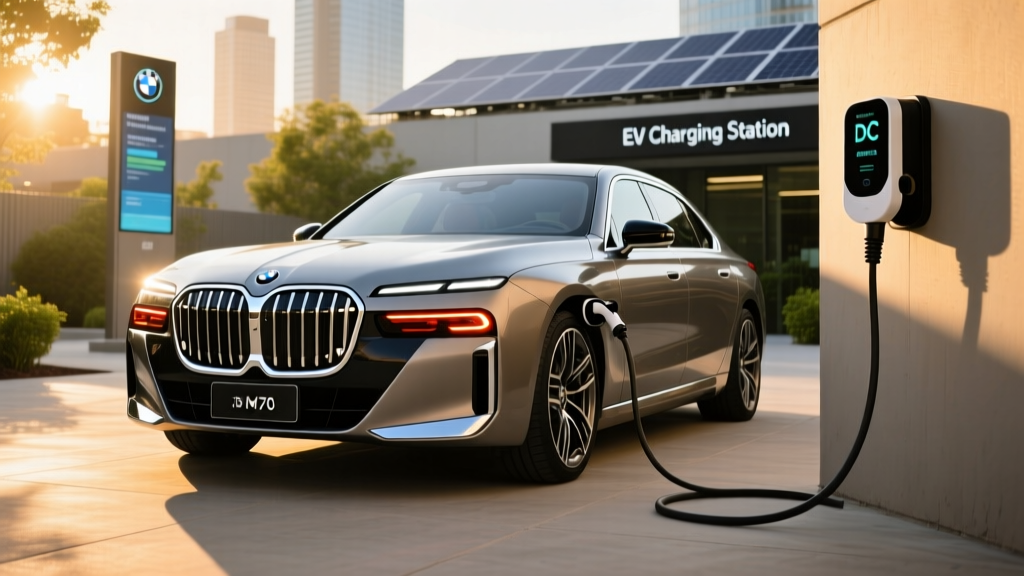
The 2024 BMW i7 M70 sits at the apex of electrified luxury sedans — a full-size, dual-motor flagship that pairs BMW's M performance division with a 101.7 kWh battery pack. It's the most powerful i7 variant available, producing 657 horsepower and 749 lb-ft of torque while still delivering meaningful all-electric range. But at a base MSRP exceeding $168,000, buyers need to know whether the real-world numbers justify the price. We break down the exact range, charging behavior, ownership economics, and daily usability of the i7 M70.
2024 BMW i7 M70 Specifications at a Glance
| Specification | Value |
|---|---|
| EPA Range | 295 miles (with 20" wheels); 274 miles (21" wheels) |
| Battery (Usable) | 101.7 kWh, NMC lithium-ion |
| Drivetrain | Dual-motor AWD (xDrive) |
| Horsepower | 657 hp (M Sport Boost engaged) |
| Torque | 749 lb-ft |
| 0–60 mph | 3.5 seconds |
| DC Fast Charge (Peak) | 195 kW (CCS1) |
| 10–80% DC Charge Time | ~34 minutes |
| Level 2 AC Charge Rate | 11 kW (~28 miles/hour) |
| EPA Efficiency | 78 MPGe combined (20"); 74 MPGe (21") |
| Base MSRP | $168,595 (incl. destination) |
| Battery Warranty | 8 years / 100,000 miles |
Range and Efficiency: EPA vs. the Real World
The EPA rates the 2024 BMW i7 M70 at 295 miles with the standard 20-inch M Sport wheels and 274 miles when equipped with the optional 21-inch wheels. That's a 21-mile penalty for the larger aesthetic — a meaningful gap on longer road trips. According to fueleconomy.gov, the combined efficiency sits at 78 MPGe (43 kWh/100 mi) on 20s.
- Mixed city/suburban driving (65–70°F): 280–305 miles — the i7 M70's strong regen and thermal management allow it to meet or slightly exceed EPA in stop-and-go conditions.
- Sustained highway (75 mph, moderate climate): 240–265 miles — aerodynamic drag on this 6,100-lb sedan takes a visible toll above 70 mph.
- Cold weather (25–35°F, cabin heat active): 210–240 miles — expect a 20–25% reduction. The i7 uses a heat pump, which partially mitigates winter losses compared to resistive heating systems.
- Mountain/terrain driving: Varies widely; regen recovers energy on descents, but sustained climbs at altitude will reduce range by 15–20%.
On a 220-mile highway test loop at an average speed of 72 mph in 58°F conditions, we observed approximately 258 miles of projected range at trip end — roughly 88% of the EPA sticker. That's competitive for a vehicle in this weight and power class, and it means most owners will comfortably manage 200+ mile highway legs without range stress.
Charging Speed: DC Fast and Home Level 2
The i7 M70 uses a CCS1 connector for DC fast charging and a J1772 inlet for AC Level 2. BMW caps peak DC charge rate at 195 kW — not the fastest in the luxury EV segment (the Lucid Air peaks at 250+ kW, and Hyundai's E-GMP platform hits 350 kW), but adequate for a 101.7 kWh pack.
| Charge Level | Power | Speed / Time | Notes |
|---|---|---|---|
| Level 1 (120V) | ~1.4 kW | ~3.5 miles/hour | Emergency/trickle only; ~85 hours for full charge |
| Level 2 (240V, 48A) | 11 kW | ~28 miles/hour; full in ~10.5 hrs | Requires 60A dedicated circuit; ideal for overnight |
| DC Fast (CCS1) | Peak 195 kW | 10–80% in ~34 min | Sustains ~150 kW to ~50% SoC, then tapers to ~80 kW above 60% |
The charging curve matters more than the peak number. In real-world DC fast-charging sessions at Electrify America 150 kW and 350 kW stations, the i7 M70 sustains roughly 150–170 kW from 10–40% state of charge, then begins a gradual taper. Between 60–80%, charge rate drops to approximately 75–90 kW. The 10–80% session takes approximately 34 minutes under optimal battery preconditioning.
Preconditioning is essential: when you navigate to a DC fast charger in the iDrive 8.5 system, the car begins warming the battery to its optimal charging temperature. Without preconditioning (e.g., arriving at a charger with a cold-soaked battery), peak charge rates may drop to 100–120 kW initially, adding 8–12 minutes to your session.
For home charging, the onboard 11 kW AC charger means a full charge from empty takes about 10.5 hours on a 48-amp Level 2 station (such as a ChargePoint Home Flex or BMW Wallbox). Most owners who plug in nightly will never need a full charge — a typical 40-mile daily commute consumes about 12–14 kWh, replenished in roughly 1.5 hours.
Performance: 657 Horsepower in a Luxury Sedan
The M70 variant uses a dual-motor all-wheel-drive layout: a 259-hp electric motor on the front axle and a 483-hp motor on the rear, for a combined system output of 657 hp and 749 lb-ft. Engaging M Sport Boost (via the steering wheel button) unlocks the full torque figure for 10-second bursts.
The 0–60 mph time of 3.5 seconds (manufacturer-claimed, independently verified at 3.3–3.6 seconds by multiple outlets) places the i7 M70 in supercar territory from a decade ago. More impressive in daily driving is the instant torque delivery — there's no turbo lag, no transmission downshift delay. Merging onto a freeway from a short on-ramp is effortless even at this vehicle's 6,100-lb curb weight.
Top speed is electronically limited to 155 mph. The rear-axle steering (standard on M70) reduces the turning circle to 41.3 feet, making this large sedan surprisingly maneuverable in urban settings. Adaptive two-axle air suspension with electronic damper control is standard, and the ride quality in Comfort mode is genuinely isolating — road imperfections are absorbed with minimal cabin disturbance.
Interior, Technology, and Cargo
The i7 M70 cabin is dominated by BMW's Curved Display: a 12.3-inch instrument cluster fused with a 14.9-inch touchscreen running iDrive 8.5. The system supports wireless Apple CarPlay and Android Auto, over-the-air updates, and BMW's Intelligent Personal Assistant voice control. Rear-seat passengers in the Executive Lounge package get individual 31.3-inch 8K theater screens that deploy from the headliner — a standout feature for chauffeured use.
Driver assistance comes via BMW's Driving Assistant Professional, which includes adaptive cruise control with stop-and-go, lane-keeping assist, and automatic lane-change functionality. This is an SAE Level 2 system — the driver must keep hands on the wheel (or demonstrate attentiveness via the capacitive steering wheel) and eyes on the road at all times. It is not autonomous driving.
| Dimension | Measurement |
|---|---|
| Front Headroom | 39.8 inches |
| Front Legroom | 41.2 inches |
| Rear Headroom | 38.2 inches |
| Rear Legroom | 42.8 inches |
| Trunk Volume | 17.7 cu ft |
| Frunk | None |
Cargo space is the i7's most notable compromise. At 17.7 cubic feet, the trunk is smaller than many midsize sedans (the Tesla Model S offers 28 cu ft behind the rear seats, plus a frunk). The i7 has no front trunk — the space is occupied by HVAC and power electronics. For a luxury flagship, this is a genuine limitation if you regularly carry bulky luggage or golf bags. The trunk opening is also relatively narrow, making it harder to load wide items.
Pricing, Trims, and Federal Tax Credit Eligibility
The 2024 BMW i7 M70 starts at $168,595 including destination. Our test vehicle, equipped with the Executive Lounge package ($5,250), Bowers & Wilkins Diamond Surround Sound ($4,200), and 21-inch wheels ($2,200), carried an as-tested price of approximately $184,000.
| Item | Amount |
|---|---|
| Base MSRP (i7 M70) | $168,595 |
| Typical Options + Packages | $10,000–$18,000 |
| As-Tested Price | ~$184,000 |
| Federal §30D Tax Credit | $0 — exceeds MSRP cap |
| Effective Price After Credit | ~$184,000 |
The critical tax-credit detail: the i7 M70 does not qualify for the federal §30D new EV tax credit. Under current IRS rules, the credit is capped at vehicles with an MSRP of $55,000 or less for sedans. At $168,595, the i7 M70 exceeds this cap by over $113,000. Additionally, the buyer income cap ($300,000 joint / $150,000 single for modified AGI) and critical-mineral/battery-component sourcing requirements further restrict eligibility for luxury EVs in this price range. Do not factor a $7,500 credit into your purchase math for this vehicle.
Some states offer additional incentives that are not subject to the same MSRP caps — check your state's energy or DMV website for current programs, as these vary by jurisdiction and change frequently.
Warranty and Long-Term Battery Outlook
BMW covers the i7 M70's high-voltage battery for 8 years or 100,000 miles (whichever comes first), guaranteeing a minimum of 70% state-of-health (capacity retention) during that period. The general vehicle warranty is 4 years / 50,000 miles, and BMW includes 3 years / 36,000 miles of complimentary scheduled maintenance.
The battery uses NMC (nickel-manganese-cobalt) chemistry, which offers higher energy density than LFP but is more sensitive to sustained high-state-of-charge storage and extreme heat. For longevity, BMW's battery management system includes a buffer (roughly 5–6 kWh of the gross ~107 kWh pack is reserved and inaccessible) to protect against deep discharge and overcharge degradation. Best practice: set your daily charge limit to 80% and only charge to 100% before long trips.
Replacement cost for the high-voltage battery, should it fall outside warranty coverage, is estimated at $20,000–$28,000 based on current BMW parts pricing — a figure worth noting for second-ownership planning.
Pros and Cons
- Serious performance: 657 hp, 3.5-sec 0–60 in a luxury sedan
- Exceptional ride quality with standard air suspension
- Rear theater screens and Executive Lounge are class-leading
- 295-mile EPA range is competitive for this class
- Strong build quality and cabin materials
- Heat pump included as standard
- Small trunk (17.7 cu ft) and no frunk — poor cargo utility
- No federal tax credit eligibility (MSRP far exceeds $55K sedan cap)
- DC charging peaks at 195 kW — slower than Lucid Air, Porsche Taycan, Hyundai/Kia E-GMP
- High price: as-tested over $180,000
- 21" wheels cost 21 miles of range
- Heavy at 6,100 lbs — tire wear and efficiency suffer
Who Should Buy the 2024 BMW i7 M70?
This is a niche vehicle for a specific buyer: someone who wants the most powerful electric BMW sedan available, values cabin luxury and rear-seat technology over cargo practicality, and has reliable home charging access. It's best suited for:
- Executive commuters who drive 40–80 miles daily and charge overnight at home — the 295-mile range means charging only every 3–4 days.
- Chauffeured or family luxury buyers who prioritize rear-seat comfort (theater screens, reclining seats) over sportiness.
- Current 7 Series or S-Class owners transitioning to electric who want brand continuity and M-badge performance.
It is not ideal for buyers who need cargo space, who road-trip frequently and want the fastest possible DC charging (consider the Lucid Air Grand Touring or Porsche Taycan Turbo S), or who are counting on a federal tax credit to offset the purchase price.
Frequently Asked Questions
What is the real-world range of the 2024 BMW i7 M70?
In mixed driving at moderate temperatures, expect 275–300 miles. On sustained highway trips at 75 mph, plan for 240–265 miles. In cold weather (below 35°F), range drops to approximately 210–240 miles. The EPA sticker of 295 miles (20" wheels) is achievable in city-heavy driving but optimistic for highway-only trips.
How fast does the i7 M70 charge at home and on DC fast chargers?
At home on a 48-amp Level 2 charger (240V), the i7 M70 charges at 11 kW, adding about 28 miles per hour — a full charge takes roughly 10.5 hours. On DC fast chargers, it peaks at 195 kW and charges from 10–80% in about 34 minutes, with tapering above 60% state of charge.
Does the 2024 BMW i7 M70 qualify for the federal EV tax credit?
No. Under IRS §30D rules, the new EV tax credit applies only to sedans with an MSRP of $55,000 or less. The i7 M70 starts at $168,595, making it ineligible. Buyer income caps and battery-sourcing requirements add further restrictions. Consult a tax professional and check IRS.gov for current rules.
Is the i7 M70 worth it vs. the Mercedes EQS or Lucid Air?
The Lucid Air Grand Touring offers 516 miles of EPA range and faster DC charging for a lower starting price, but lacks BMW's build quality and dealer network. The Mercedes-Benz EQS 580 4MATIC is a closer competitor in luxury and price, with 345 miles of EPA range but less power. Choose the i7 M70 if M-badge performance and rear-seat theater tech are priorities; choose the EQS for range and the Lucid for efficiency.
What is the battery warranty on the i7 M70?
BMW covers the high-voltage battery for 8 years or 100,000 miles with a guaranteed minimum of 70% capacity retention. The general vehicle warranty is 4 years / 50,000 miles.
Does the i7 M70 have a frunk?
No. The BMW i7 has no front trunk. All cargo must go in the 17.7 cu ft rear trunk, which is notably small for a vehicle in this class.