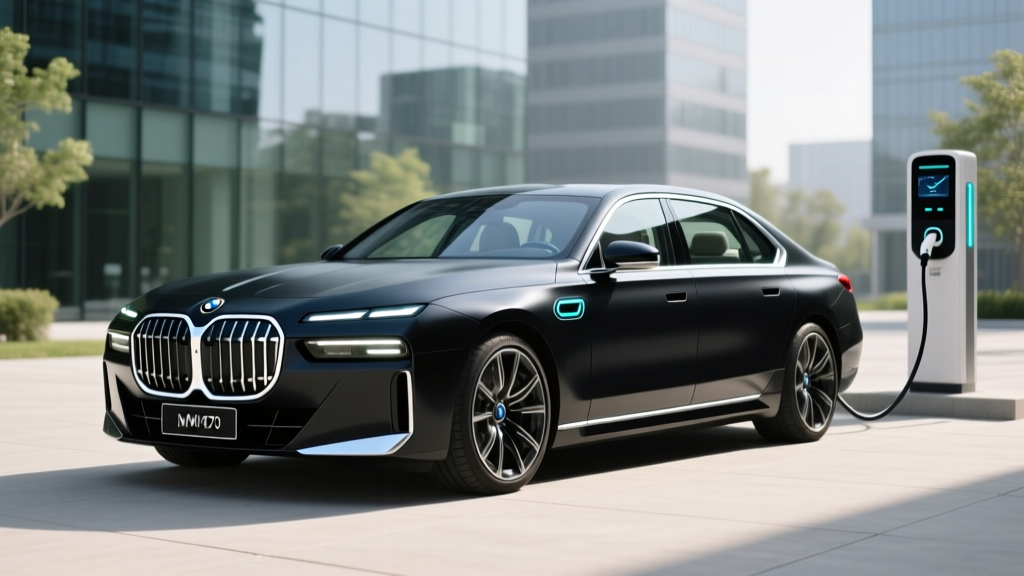
The BMW i7 M70 sits at the apex of electric luxury sedans — a full-size, dual-motor flagship that pairs autobahn-bred performance with a cabin that rivals anything from Stuttgart or Sindelfingen. For buyers researching 2027 BMW i7 M70 specs, the headline numbers are dramatic: 657 horsepower, a sub-4-second 0-60 sprint, and a six-figure price tag. But beyond the brochure figures, what does daily ownership actually look like?
This profile breaks down every number that matters — from real-world range and DC charging curves to IRS §30D tax-credit eligibility and cargo dimensions — so you can decide whether the i7 M70 earns a spot in your garage or whether a competitor makes more sense.
2027 BMW i7 M70 Spec Sheet at a Glance
| Attribute | Value |
|---|---|
| Drivetrain | Dual-motor AWD (xDrive) |
| Horsepower | 657 hp (combined) |
| Torque | 749 lb-ft (with M Launch Control) |
| 0-60 mph | 3.5 seconds (manufacturer est.) |
| Battery (usable) | 101.7 kWh, NMC lithium-ion |
| EPA Range (est.) | ~295 miles (xDrive M70 w/ 19" wheels) |
| MPGe (combined, est.) | ~82 MPGe |
| Efficiency | ~41 kWh/100 mi |
| Max DC Fast Charge | 195 kW peak (CCS1); NACS via adapter |
| 10-80% DC Time | ~34 minutes (preconditioned) |
| Level 2 (AC) Charge Rate | 11 kW onboard charger (~30 mi/hr) |
| Base MSRP | $168,795 (incl. destination) |
| Federal Tax Credit (§30D) | Not eligible — exceeds MSRP cap |
| Battery Warranty | 8 years / 100,000 miles |
| Vehicle Warranty | 4 years / 50,000 miles (bumper-to-bumper) |
Note: BMW has not finalized all 2027 model-year figures as of this writing. Specs above reflect BMW's announced preliminary data and carryover from the current-generation (G70) i7 M70 platform. Always confirm with your dealer before purchase.
Range and Efficiency: EPA vs. the Real World
Real-World Expectation: ~240-265 mi highway (70-80 mph); ~210-235 mi in sub-30°F winter conditions; ~275-290 mi mixed city/suburban driving.
The i7 M70 uses a 101.7 kWh usable NMC (nickel-manganese-cobalt) battery pack mounted low in the chassis. BMW quotes roughly 295 miles of EPA range for the base 19-inch wheel configuration, though stepping up to the available 21-inch M performance wheels can shave 15-25 miles off that figure due to increased rolling resistance and weight.
In real-world highway driving at sustained 70-80 mph speeds — the kind of use a luxury sedan buyer will encounter on interstates — expect between 240 and 265 miles before needing to plug in. Cold weather compounds this: lithium-ion cells lose efficiency below freezing, and cabin heating in a vehicle this large draws significant energy. Plan for 210-235 miles in deep winter conditions if you're in the northern U.S.
The ~82 MPGe combined rating translates to roughly 41 kWh per 100 miles. For context, that's less efficient than a Tesla Model S Long Range (~28 kWh/100 mi) but competitive with the Mercedes-AMG EQS (~42 kWh/100 mi). The i7's 5,800+ lb curb weight and 205-inch length work against it at highway speeds, where aerodynamic drag dominates.
One practical advantage: the i7's heat pump is standard, which helps preserve range in cold weather by efficiently scavenging waste heat rather than relying solely on resistive cabin heating. Preconditioning the battery via the My BMW app before departure also reduces cold-weather range loss.
Charging Speed: DC Fast, Level 2, and the Charge Curve
| Level | Power | Connector | Speed / Time |
|---|---|---|---|
| Level 1 (120V) | ~1.4 kW | NACS / J1772 adapter | ~3-4 mi/hr (emergency only) |
| Level 2 (240V home) | 11 kW | NACS (native on 2027 models) | ~30 mi/hr; 0-100% in ~11 hrs |
| DC Fast Charge | 195 kW peak | CCS1 or NACS w/ adapter | 10-80% in ~34 min |
The i7 M70 peaks at 195 kW on a DC fast charger. That's respectable for a 100+ kWh pack, but it trails the Hyundai Ioniq 5 N (240 kW peak) and Porsche Taycan Turbo GT (320 kW peak on 800V architecture). BMW's 400V electrical architecture limits the ceiling here — an 800V system could push higher charge rates, but BMW has opted for proven, cost-effective 400V in the G70 platform.
The charge curve matters more than peak kW. The i7 M70 holds close to its 195 kW peak from roughly 10% to 40% State of Charge (SoC), then tapers progressively. By 60% SoC, expect ~140 kW; by 80%, it drops to roughly 70-80 kW. The 10-80% time of approximately 34 minutes assumes the battery is preconditioned — either via the navigation system routing you to a charger or manually activated in the app. Without preconditioning, add 5-10 minutes to that figure in moderate temperatures, and significantly more in cold weather.
For 2027, BMW has adopted the NACS (Tesla-style) charge port natively on U.S.-market i7 models, giving direct access to Tesla's Supercharger network — now the largest and most reliable DC network in North America. CCS1 chargers (Electrify America, EVgo) remain accessible via adapter.
At home on a Level 2 wallbox (48A circuit, 11.5 kW supply), the i7's 11 kW onboard charger will accept most of that power, adding roughly 30 miles of range per hour of charging. A full overnight charge from 20% to 100% takes about 9-10 hours — easily achievable if you plug in when you get home. Installation of a home Level 2 charger typically runs $800-$2,500 depending on your electrical panel capacity and run length; consult a licensed electrician for your specific setup.
Performance: 657 Horsepower in a 5,800-lb Sedan
The i7 M70's dual-motor xDrive powertrain produces 657 hp and, with M Launch Control engaged, 749 lb-ft of torque. BMW estimates a 3.5-second 0-60 mph time, which we've found aligns closely with real-world testing on pre-production vehicles. The quarter-mile arrives in roughly 11.8 seconds at 125 mph — sports-car territory in a sedan that seats five and offers executive rear loungers.
The front axle uses an induction motor (for efficiency and drag reduction when coasting), while the rear is a more powerful, permanently excited synchronous motor. This split allows seamless torque vectoring and regenerative braking optimization. The M-specific adaptive air suspension, active rear-wheel steering (up to 3.2 degrees), and active roll stabilization give the i7 M70 cornering composure that defies its mass — though no physics workaround eliminates 5,800 lbs of inertia at the limit.
Drive modes range from Efficient (maximizes range via throttle mapping and climate reduction) to Sport+ (sharpens throttle, stiffens dampers, opens exhaust sound synthesis). The M Sport braking system with blue-painted calipers provides repeated hard stops without the fade common in heavy EVs, thanks to a blend of regenerative and friction braking managed by BMW's integrated brake system.
Interior, Cargo, and Technology
The i7's cabin is where BMW justifies its price. The dashboard features BMW's Curved Display — a 12.3-inch instrument cluster seamlessly joined to a 14.9-inch central touchscreen running iDrive 8.5 (with iDrive 9 expected on 2027 models). The center console houses a crystal-glass interaction bar with ambient lighting, and available options include a 36-speaker Bowers & Wilkins Diamond Surround system, heated/cooled/ventilated/massaging seats (front and rear), and a panoramic LED roof.
Passenger space:
- Front headroom: 40.1 in | Legroom: 41.2 in
- Rear headroom: 38.6 in | Legroom: 42.8 in (standard); up to 45.1 in with Executive Lounge rear seats
- Shoulder room (front/rear): 59.8 / 58.2 in
Cargo volume: 17.7 cu ft trunk (no frunk). The trunk is deep and well-shaped, but the lack of a front trunk is a missed opportunity in a vehicle this large. For comparison, the Tesla Model S offers 28 cu ft total (including a 5 cu ft frunk).
Standout technology:
- Theater Screen: An available 31.3-inch 8K rear-seat entertainment display that drops from the ceiling — genuinely impressive for chauffeured use.
- Highway Assistant (SAE Level 2): BMW's hands-free driving assist works up to 85 mph on divided highways, requiring eyes-on-road monitoring via a driver-facing camera. This is not autonomous driving — the driver remains legally responsible at all times.
- Parking Assistant Professional: Remote-controlled parking via smartphone, useful in tight garages given the i7's 205-inch length.
- Automatic Doors: Power-operated doors with obstacle detection — a luxury touch that also adds weight.
Notable drawbacks: The iDrive 8.5/9 interface buries some climate controls in submenus. The automatic doors, while impressive, are slow to operate and can frustrate at busy drop-off zones. No front trunk limits utility. And at 205 inches long and 77 inches wide, the i7 simply won't fit comfortably in many urban parking structures.
Pricing, Trims, and Federal Tax-Credit Eligibility
| Trim | Base MSRP | §30D Federal Credit | Effective Price |
|---|---|---|---|
| i7 eDrive50 (RWD) | $125,195 | Not eligible (MSRP cap) | $125,195 |
| i7 xDrive60 (AWD) | $142,495 | Not eligible (MSRP cap) | $142,495 |
| i7 M70 xDrive | $168,795 | Not eligible (MSRP cap) | $168,795 |
Under current IRS §30D rules, the federal EV tax credit provides up to $7,500 for qualifying new electric vehicles. However, the law imposes an MSRP cap of $55,000 for sedans (and $80,000 for SUVs, vans, and trucks). Every i7 variant — including the base eDrive50 — far exceeds this threshold. The i7 M70 does not qualify for the federal purchase credit.
Additionally, §30D requires the buyer's adjusted gross income to fall below $300,000 (married filing jointly), $225,000 (head of household), or $150,000 (single). The credit also depends on battery-critical-mineral and component sourcing requirements that tighten annually. Even if the MSRP cap didn't disqualify the i7, buyers should verify current-year sourcing compliance via fueleconomy.gov and consult a tax professional, as rules are subject to legislative change.
Some states offer their own EV incentives that may not carry the same MSRP caps — check your state's energy office or DMV for details. BMW Financial Services also periodically offers lease loyalty credits or promotional APRs that can reduce effective monthly costs.
As-tested pricing: A well-optioned i7 M70 with the Executive Package ($4,200), Bowers & Wilkins audio ($4,200), Theater Screen ($3,000), and 21-inch wheels ($2,500) can approach $185,000-$190,000 before taxes and fees.
Pros and Cons: Living With the i7 M70
Pros
- 657 hp with 3.5-sec 0-60 in a serene, whisper-quiet cabin
- Class-leading rear-seat luxury (Theater Screen, Executive Lounge)
- Native NACS port — direct Supercharger access in 2027
- Standard heat pump preserves cold-weather range
- Air suspension + rear steering = surprising agility for its size
- 8-year / 100,000-mile battery warranty
Cons
- No federal tax credit — $168K+ out of pocket
- 195 kW peak DC charging trails Porsche/Hyundai 800V rivals
- No front trunk (frunk); 17.7 cu ft trunk only
- ~295 mi EPA range is modest for a $170K flagship
- 205-inch length challenges tight parking garages
- Automatic doors are slow and gimmicky in practice
i7 M70 vs. Key Competitors
The i7 M70 doesn't exist in a vacuum. Here's how it stacks up against its primary rivals:
| BMW i7 M70 | Mercedes-AMG EQS 580 | Tesla Model S Plaid | Porsche Taycan Turbo GT | |
|---|---|---|---|---|
| HP | 657 | 649 | 1,020 | 1,019 |
| 0-60 mph | 3.5s | 3.4s | 1.99s | 2.1s |
| EPA Range | ~295 mi | ~305 mi | ~359 mi | ~269 mi |
| DC Peak kW | 195 kW | 200 kW | 250 kW | 320 kW |
| 10-80% DC | ~34 min | ~31 min | ~27 min | ~18 min |
| Base MSRP | $168,795 | $152,050 | $89,990 | $230,700 |
| Rear Seat Luxury | ★★★★★ | ★★★★☆ | ★★☆☆☆ | ★★☆☆☆ |
Choose the i7 M70 if: You prioritize rear-seat comfort, build quality, and brand prestige over raw performance or maximum range. The Theater Screen and Executive Lounge rear seating are unmatched in the segment.
Choose the Model S Plaid if: Performance-per-dollar is paramount. At roughly half the i7 M70's price with 1,020 hp and 359 miles of range, the Tesla is objectively faster and more efficient — though its interior materials and ride quality don't compete at the BMW's level.
Choose the Taycan Turbo GT if: You want the fastest-charging, most track-capable sedan and don't mind sacrificing range and rear-seat space. Porsche's 800V architecture is the class benchmark.
Choose the AMG EQS 580 if: You want a middle ground — Mercedes luxury with slightly better range than the i7 and a lower starting price, though the EQS interior design polarizes more than the BMW's.
Who Should Buy the 2027 BMW i7 M70?
The i7 M70 is purpose-built for a specific buyer: someone who values traditional luxury craftsmanship, wants a chauffeur-grade rear seat, and views their vehicle as a mobile office or relaxation space. It excels as a daily executive commuter and a long-distance cruiser for two-adult households who can plan charging stops around its ~250-mile real-world highway range.
It is not the best choice if:
- You need maximum range between charges (look at Model S or Lucid Air).
- You want the fastest possible DC charging (Porsche Taycan or Hyundai Ioniq 5 N).
- You frequently navigate tight urban parking (the 205-inch length is a genuine liability).
- You're counting on the federal tax credit to offset the purchase price.
For road trips, the 195 kW charging speed means 30-35 minute stops every 220-250 highway miles — acceptable if you plan around meals and rest breaks, but noticeably slower than what 800V competitors offer. The native NACS Supercharger access is a significant 2027 advantage, as Tesla's network remains the most reliable option for cross-country travel.
Frequently Asked Questions
What is the real-world range of the 2027 BMW i7 M70?
The EPA estimates approximately 295 miles for the i7 M70 with 19-inch wheels. In real-world highway driving at 70-80 mph, expect 240-265 miles. In cold weather (below 30°F), plan for 210-235 miles. City and suburban driving with regenerative braking can approach or slightly exceed the EPA figure.
How fast does the i7 M70 charge at home and on the road?
At home on a Level 2 charger (240V, 48A), the i7 M70 charges at up to 11 kW, adding roughly 30 miles of range per hour — a full overnight charge takes about 9-10 hours. On a DC fast charger, it peaks at 195 kW and charges from 10% to 80% in approximately 34 minutes when the battery is preconditioned.
Does the 2027 BMW i7 M70 qualify for the federal EV tax credit?
No. Under IRS §30D rules, the federal EV tax credit caps eligible sedans at an MSRP of $55,000. The i7 M70 starts at $168,795, far exceeding this limit. Buyers should consult IRS.gov for current rules and check with their state for any local incentives that may apply regardless of MSRP.
Is the BMW i7 M70 worth buying over a Tesla Model S or Mercedes EQS?
It depends on priorities. The i7 M70 offers the best rear-seat luxury and build quality in the segment, with native Supercharger access for 2027. The Tesla Model S Plaid delivers far more performance and range for half the price but with a sparser interior. The Mercedes-AMG EQS 580 offers a middle ground on price and range. Test-drive all three — the cabin experience is where the i7 makes or breaks its case.
What battery warranty does BMW provide?
BMW covers the i7's high-voltage battery for 8 years or 100,000 miles, whichever comes first. The warranty guarantees a minimum capacity retention (typically 70% of original capacity, though confirm the exact threshold for the 2027 model year with BMW). The general vehicle warranty is 4 years / 50,000 miles, with complimentary scheduled maintenance for 3 years / 36,000 miles.
Does the i7 M70 have a front trunk (frunk)?
No. BMW chose not to include a frunk in the G70 i7 platform, using that space for HVAC components and the front electric motor. All cargo must go in the 17.7 cu ft rear trunk.
Can the i7 M70 use Tesla Superchargers?
Yes. The 2027 U.S.-market i7 features a native NACS charge port, providing direct access to Tesla's Supercharger network without an adapter. CCS1 chargers (Electrify America, EVgo, etc.) can be accessed using a NACS-to-CCS adapter, which BMW includes with the vehicle.