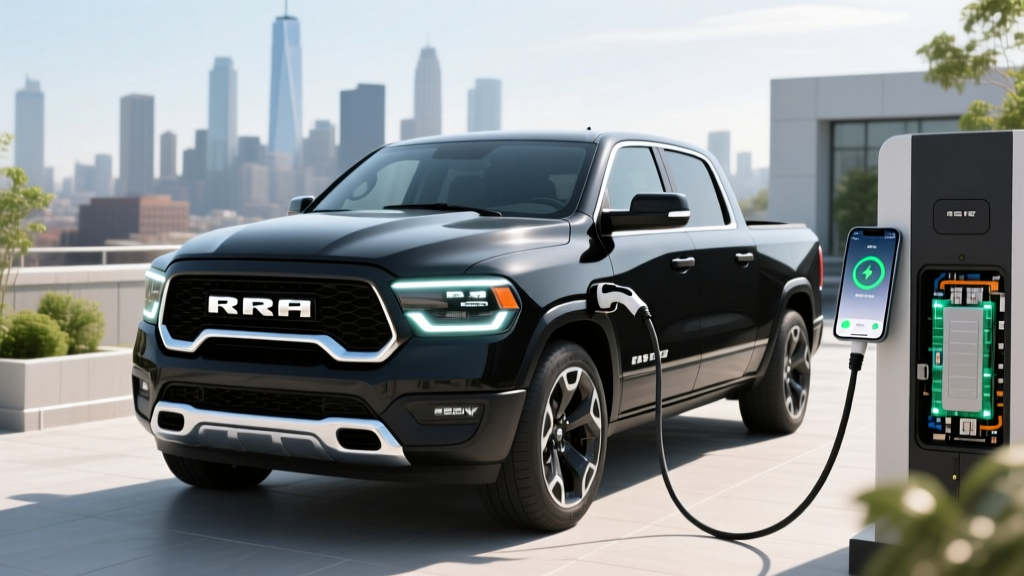
The Ram 1500 REV is Stellantis' long-awaited answer to the Ford F-150 Lightning, Chevrolet Silverado EV, and Tesla Cybertruck. Originally unveiled in 2023 and delayed multiple times, the 2026 Ram 1500 REV has entered production with a dual-motor all-wheel-drive platform, two battery configurations, and a promised class-leading 500-mile range variant. For fleet managers, commercial operators, and truck enthusiasts researching this model, locating free use images of the 2026 Ram 1500 REV for presentations, comparison articles, or internal planning has become a priority — and we'll point you to official media sources below. But first, let's break down what this truck actually delivers in range, charging speed, towing capability, and real-world ownership economics.
Quick Verdict: A Heavy-Duty EV With Real Range Potential
The 2026 Ram 1500 REV enters a crowded electric truck market with two key differentiators: an optional 229 kWh battery pack (one of the largest ever fitted to a production pickup) and a body-on-frame architecture that preserves conventional truck proportions rather than adopting a skateboard-only design. The standard 92 kWh pack targets buyers who need a daily-driver truck with moderate range, while the extended-range 229 kWh pack aims squarely at fleet and long-haul users. Neither version is light — expect curb weights north of 7,000 lbs — but the dual-motor powertrain compensates with serious output.
Range, Battery, and Real-World Expectations
- Standard Range (92 kWh): EPA est. ~270 miles — expect ~220-240 miles highway at 70 mph, ~180-200 miles in sub-freezing temperatures
- Extended Range (229 kWh): EPA est. ~500 miles (target) — expect ~400-440 miles highway, ~340-380 miles in cold weather with cabin heating
Note: Ram's 500-mile claim applies to the extended-range variant under optimal conditions. Heavy towing (8,000+ lbs) can cut range by 40-50% regardless of pack size. Always plan charging stops based on loaded, highway-speed expectations.
The Ram 1500 REV uses NMC (nickel manganese cobalt) lithium-ion cells in both battery configurations. NMC offers higher energy density than LFP chemistry — critical for fitting 229 kWh into a truck frame — but requires more careful state-of-charge management for long-term health. Ram recommends daily charging to 80-90% for routine use and reserving 100% charges for long trips.
| Spec | Standard Range | Extended Range |
|---|---|---|
| EPA Range | ~270 mi (est.) | ~500 mi (target) |
| Battery Capacity | 92 kWh (NMC) | 229 kWh (NMC) |
| Drivetrain | Dual-motor AWD | Dual-motor AWD |
| Horsepower | ~654 hp | ~654 hp |
| 0-60 mph | ~4.4 sec | ~4.4 sec (heavier curb weight may add 0.2-0.3s) |
| Max DC Fast Charge | 350 kW (peak) | 350 kW (peak) |
| 10-80% DC Charge Time | ~20 min | ~45 min (larger pack) |
| Level 2 Home Charge | 19.2 kW (~30 mi/hr) | 19.2 kW (~30 mi/hr) |
| Max Towing | ~10,000 lbs (est.) | ~10,000 lbs (est.) |
| Max Payload | ~1,800 lbs (est.) | ~1,500 lbs (est., reduced by battery weight) |
Charging Speed: DC Fast, Level 2, and the 229 kWh Challenge
The Ram 1500 REV supports up to 350 kW peak DC fast charging on 800-volt-capable infrastructure (Electrify America, EVgo, and select Tesla Supercharger stations with the Magic Dock adapter). However, peak kW is not sustained kW — here's what the charging curve actually looks like:
| Charge Level | Power (kW) | Standard Range (92 kWh) | Extended Range (229 kWh) |
|---|---|---|---|
| Level 1 (120V household) | ~1.4 kW | ~3 mi/hr | ~3 mi/hr |
| Level 2 (240V, 48A) | 11.5 kW | ~18 mi/hr / full overnight | ~18 mi/hr / 12+ hr full charge |
| Level 2 (240V, 80A) | 19.2 kW | ~30 mi/hr / ~5 hr full | ~30 mi/hr / ~10 hr full |
| DC Fast (peak 350 kW) | Up to 350 kW | 10-80% in ~20 min | 10-80% in ~45 min |
Critical ownership note: The 229 kWh pack takes significantly longer to fill from a DC fast charger simply because there's more energy to push in. Even at a sustained 250 kW average (optimistic for most of the curve), you're looking at nearly an hour for 10-80%. Plan road trips around this reality. For the 92 kWh pack, the 20-minute 10-80% time is competitive with the F-150 Lightning's extended-range pack.
At home, the 19.2 kW Level 2 onboard charger is a strong point — it's among the fastest AC chargers in any production EV, meaning a full overnight replenishment is realistic even for the larger pack if you start at ~20% SoC.
Performance and Drivetrain
Both Ram 1500 REV variants use a dual-motor all-wheel-drive configuration producing approximately 654 horsepower and 620 lb-ft of torque. Ram quotes a 0-60 mph time in the 4.4-second range for the standard-range truck; the heavier extended-range model may add a few tenths. Either way, this is sports-sedan acceleration in a body-on-frame pickup.
The truck uses Ram's STLA Frame platform — a body-on-frame architecture shared with upcoming Stellantis EVs. Air suspension is standard across trims, providing adjustable ride height for highway efficiency, off-road clearance, or bed-loading convenience. Regenerative braking is adjustable via steering-wheel paddles, with a true one-pedal driving mode available.
Interior, Cargo, and Technology
The Ram 1500 REV interior borrows heavily from the current-generation Ram 1500, which is a compliment — it's widely regarded as the most refined full-size truck cabin. Key interior and cargo specifications:
- Infotainment: 14.5-inch center touchscreen (Uconnect 5), 12.3-inch digital instrument cluster, available 10.25-inch passenger display
- Front legroom: ~40.9 inches (crew cab)
- Rear legroom: ~45.2 inches (crew cab) — class-leading
- Bed length: 5'7" standard box
- Front trunk (frunk): ~15 cu ft — lockable, weatherproof, with available power open/close
- V2L (Vehicle-to-Load): Up to 7.2 kW onboard power export — can run power tools, a campsite, or a home circuit during an outage
The 15-cubic-foot frunk is a practical standout. Unlike the F-150 Lightning's 14.1 cu ft Mega Power Frunk, the Ram's version sits slightly higher but offers more usable depth. The 7.2 kW V2L system can power most household essentials during a blackout, though it falls short of Ford's 9.6 kW Pro Power Onboard with home integration.
Driver Assistance: The REV comes equipped with Ram's Active Driving Assist — a Level 2 (SAE) hands-on system offering adaptive cruise, lane centering, and traffic sign recognition. This is not a self-driving system. The driver must remain engaged at all times. An optional Hands-Free Active Driving Assist allows hands-off highway driving on pre-mapped roads, similar to GM's Super Cruise or Ford's BlueCruise — but eyes-on supervision remains mandatory.
All Ram Active Driving Assist features are SAE Level 2 — the vehicle controls steering and acceleration under specific conditions, but the driver must continuously supervise and be ready to take over immediately. This is not autonomous driving.
Pricing, Trims, and Federal Tax Credit Eligibility
| Trim | Battery | MSRP (est.) | Potential Credit | After Credit |
|---|---|---|---|---|
| Tradesman | 92 kWh | ~$58,000 | Up to $7,500* | ~$50,500 |
| Big Horn / Laramie | 92 kWh | ~$65,000-$72,000 | Up to $7,500* | ~$57,500-$64,500 |
| Limited / Tungsten | 229 kWh | ~$85,000-$95,000 | Varies* | ~$77,500-$87,500 |
*Federal Tax Credit (§30D) Caveats — 2026 Rules:
- MSRP Cap: Vans, SUVs, and pickups must have an MSRP ≤ $80,000 to qualify. Higher-trim REV models with the 229 kWh pack may exceed this threshold.
- Buyer Income Cap: AGI must not exceed $150,000 (single), $225,000 (head of household), or $300,000 (married filing jointly).
- Battery Sourcing: Critical minerals and battery components must meet phased-in domestic/free-trade sourcing thresholds. Stellantis has not confirmed full compliance for all REV configurations — verify at fueleconomy.gov before purchasing.
- Point-of-Sale Transfer: Qualified buyers can transfer the credit to the dealer at purchase, reducing the purchase price directly rather than waiting for a tax refund.
- Assembly: Vehicle must undergo final assembly in North America. The REV is assembled at the Sterling Heights, Michigan plant — this requirement is met.
Always verify current eligibility at irs.gov and consult a tax professional. Rules are subject to legislative change.
Pros, Cons, and How It Compares
- Up to ~500 miles EPA range (extended pack) — highest of any production pickup
- 350 kW peak DC fast charging capability
- 19.2 kW Level 2 onboard charger — fastest in class
- 15 cu ft frunk with power open/close
- 7.2 kW V2L power export
- Class-leading rear-seat legroom
- Air suspension standard across all trims
- Proven Uconnect 5 infotainment
- Extended-range 229 kWh pack adds ~$20,000+ and significant weight
- 45-minute 10-80% DC charge on the large pack limits road-trip convenience
- Payload reduced on extended-range variant due to battery mass
- Only 5'7" bed — no long-box option
- High-trim pricing likely exceeds $80K MSRP cap for tax credit
- Repeated production delays raise delivery uncertainty
- No LFP option for buyers prioritizing cycle life over energy density
Where to Find Free Use Images of the 2026 Ram 1500 REV
For fleet presentations, editorial articles, dealership materials, or comparison graphics, official high-resolution imagery is available through several legitimate channels:
- Stellantis Media Site (media.stellantisnorthamerica.com): The primary source for official press images, 360-degree views, and lifestyle shots. Registration is free for media and industry professionals. Images are typically available for editorial use under Stellantis' media terms.
- Ram Brand Press Pages: The Ram section of the Stellantis media portal includes model-year launch galleries, trim-specific imagery, and technical diagrams.
- Manufacturer Configurator Screenshots: The ramtrucks.com build-and-price tool renders the truck in all available colors and trims. Screenshots are commonly used for personal and editorial comparison purposes.
- Creative Commons / Wikimedia: As the REV enters customer deliveries, expect independently photographed images to appear on Wikimedia Commons under Creative Commons licenses — always verify the specific license (CC-BY, CC-BY-SA) and attribution requirements.
Usage note: "Free use" does not mean unrestricted. Press images from Stellantis are typically cleared for editorial, educational, and internal business use — not for commercial advertising or resale. Always review the specific license or terms of use before publishing.
Who Should Buy the Ram 1500 REV?
- Choose the REV Standard Range (92 kWh) if: You need a daily-driver truck with ~270 miles of range, primarily commute or work within a metro area, have home Level 2 charging, and want a premium interior with strong towing capacity.
- Choose the REV Extended Range (229 kWh) if: You operate a fleet requiring 400+ real-world miles between charges, frequently drive long rural routes without reliable DC fast-charging access, or need maximum range for towing scenarios where charging stops are costly downtime.
- Look at the F-150 Lightning instead if: You need a proven platform with established service networks, prefer Ford's 9.6 kW Pro Power Onboard, or want a truck that's been in customer hands since 2022 with real-world reliability data.
- Look at the Silverado EV instead if: You need a longer 6'6" bed (available on select Silverado EV trims) or prefer GM's Ultium platform with Super Cruise hands-free driving on mapped highways.
Frequently Asked Questions
What is the real-world range of the 2026 Ram 1500 REV?
For the 92 kWh standard pack, expect ~220-240 miles at highway speeds in moderate weather, dropping to ~180-200 miles in cold conditions. The 229 kWh extended pack targets ~500 miles EPA, but real-world highway driving will likely yield 400-440 miles, and cold-weather towing could cut that to 250-300 miles.
How fast does the Ram 1500 REV charge?
At a 350 kW DC fast charger, the 92 kWh pack charges 10-80% in approximately 20 minutes. The 229 kWh pack takes roughly 45 minutes for the same range due to its larger capacity. At home on a 19.2 kW Level 2 charger, expect about 30 miles of range added per hour of charging.
Does the 2026 Ram 1500 REV qualify for the federal EV tax credit?
It depends on the trim and your income. The Tradesman and mid-level trims with the 92 kWh pack are expected to fall under the $80,000 MSRP cap for pickups, potentially qualifying for up to $7,500 — provided you meet income limits and battery-sourcing requirements are satisfied. High-trim models with the 229 kWh pack may exceed the MSRP cap. Verify at fueleconomy.gov and consult a tax professional.
How does the REV compare to the Ford F-150 Lightning?
The REV offers more maximum range (500 vs. 320 miles EPA), a larger frunk, and a faster onboard Level 2 charger. The Lightning has a longer track record, a larger dealer/service network, higher payload capacity, and Ford's superior 9.6 kW home power integration. For buyers who prioritize proven reliability, the Lightning currently has the edge. For maximum range and newer tech, the REV is compelling — once it's in customer hands at scale.
Can the Ram 1500 REV power my home?
The REV's V2L (Vehicle-to-Load) system provides up to 7.2 kW of power export through bed-mounted and frunk outlets — enough to run essential home circuits (refrigerator, lights, furnace fan) for several days. However, it does not currently support full V2H (Vehicle-to-Home) bidirectional integration like Ford's Intelligent Backup Power, which requires a dedicated home transfer switch and compatible inverter.
What is the battery warranty?
Ram covers the REV's battery pack for 8 years or 100,000 miles (whichever comes first) with a minimum 70% capacity retention threshold — consistent with the industry standard and federal requirements for EV battery warranties. The powertrain is covered for 5 years / 60,000 miles.
Sources: Stellantis North America Media, fueleconomy.gov (EPA), IRS Clean Vehicle Credit. Pricing and specifications are based on manufacturer announcements and may change. Verify all figures with your dealer before purchase.