Quick Verdict: The Benchmark Compact EV Gets Better With Age
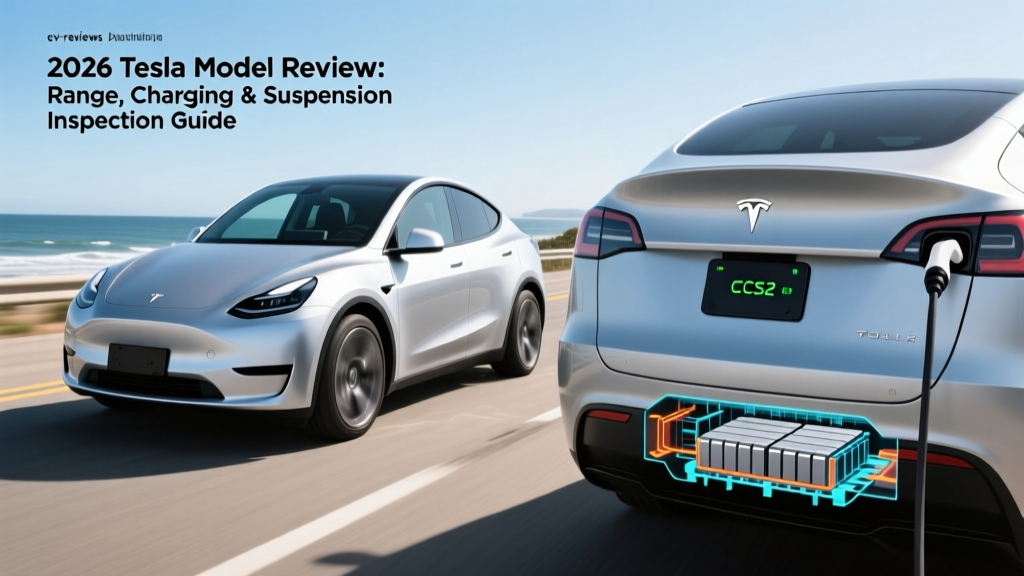
The 2026 Tesla Model Y remains the compact electric SUV to beat. With a refreshed Juniper design language introduced for 2025, improved cabin materials, and a revised suspension tuning that finally addresses the ride-harshness complaints of earlier model years, the Model Y Long Range AWD delivers 320 miles of EPA-estimated range, 250 kW peak DC fast charging, and a starting price that — after the federal tax credit — undercuts nearly every premium competitor in its class. But as these vehicles age and pile on miles, one maintenance concern keeps surfacing in owner forums and service centers: the Tesla suspension inspection. This review covers the full ownership picture, including what to watch for when evaluating suspension health on new and used examples.
| Spec | Long Range AWD | Performance AWD | Standard Range RWD |
|---|---|---|---|
| EPA Range | 320 mi | 285 mi | 268 mi |
| Battery (usable) | 75 kWh (NMC) | 75 kWh (NMC) | 60 kWh (LFP) |
| Peak DC Charge Rate | 250 kW | 250 kW | 170 kW |
| 10–80% DCFC Time | ~27 min | ~27 min | ~30 min |
| Level 2 (11.5 kW) | ~44 mi/hr | ~44 mi/hr | ~35 mi/hr |
| 0–60 mph | 4.8 sec | 3.5 sec | 6.6 sec |
| Horsepower | 384 hp | 456 hp | 295 hp |
| Drivetrain | Dual-Motor AWD | Dual-Motor AWD | RWD |
| Efficiency | 27 kWh/100mi (122 MPGe) | 30 kWh/100mi (111 MPGe) | 25 kWh/100mi (134 MPGe) |
| Base MSRP | $47,990 | $54,990 | $39,990 |
| Battery Warranty | 8 yr / 120,000 mi | 8 yr / 120,000 mi | 8 yr / 100,000 mi |
Range & Efficiency: EPA Sticker vs. Real-World Miles
EPA Estimated: 320 miles (Long Range AWD) / 268 miles (Standard Range RWD)
Real-World Expectation: Plan for roughly 270–290 miles on mixed highway driving in moderate temperatures. In sustained 70+ mph highway use, expect 250–270 miles. In sub-freezing winter conditions (20°F and below), range drops 20–30%, putting realistic cold-weather range at approximately 220–250 miles for the Long Range. Tesla's heat pump, standard on all 2026 trims, mitigates cabin-heating energy draw but cannot fully offset battery chemistry limitations in extreme cold.
The Model Y Long Range's 75 kWh usable NMC battery pack delivers strong efficiency at 27 kWh per 100 miles — a figure that consistently ranks among the best in the compact SUV segment, according to fueleconomy.gov. The Standard Range RWD model uses a 60 kWh LFP (lithium iron phosphate) pack, which sacrifices some range for lower cost and superior cycle longevity. LFP chemistry tolerates regular 100% charging without the degradation concerns of NMC, making the Standard Range an excellent choice for owners with predictable daily commutes under 150 miles.
For road trippers, the 320-mile EPA figure translates to roughly 3.5 to 4 hours of driving between Supercharger stops when you factor in the recommended 10–80% charging window and a buffer for terrain and HVAC load.
Charging Speed: Supercharger Network Advantage
Charging remains where Tesla's ecosystem delivers its clearest advantage. The 2026 Model Y Long Range and Performance trims peak at 250 kW on V3 and V4 Superchargers, reaching 80% state of charge in approximately 27 minutes under optimal battery preconditioning. The Standard Range RWD, limited to 170 kW due to its LFP cell configuration, takes roughly 30 minutes for the same 10–80% window.
| Charge Level | Power / Voltage | Miles Added per Hour | Best Use Case |
|---|---|---|---|
| Level 1 (120V) | ~1.4 kW | ~5 mi/hr | Overnight trickle, emergencies |
| Level 2 (240V, 48A) | 11.5 kW | ~44 mi/hr | Daily home charging, full overnight fill |
| DC Fast Charge (Long Range) | Peak 250 kW | ~1,000+ mi/hr (peak) | Road trips, Supercharger network |
| DC Fast Charge (Std Range) | Peak 170 kW | ~700+ mi/hr (peak) | Road trips, Supercharger network |
A critical note on the charge curve: the 250 kW peak is not sustained across the entire session. Charging speed tapers significantly above 60% state of charge, dropping to roughly 80–100 kW by the time you reach 70%, and further to under 40 kW above 85%. This is normal lithium-ion behavior, not a defect — but it means the final 20% takes nearly as long as the first 50%. Preconditioning the battery by navigating to a Supercharger in the Tesla nav system warms the pack to optimal temperature and enables the fastest possible charge rate upon arrival.
At home, a Level 2 Wall Connector on a 60-amp circuit (48A continuous) replenishes roughly 44 miles of range per hour. A full overnight charge from 20% to 90% takes about 8–9 hours. Expect home charging installation to run $800–$2,500 depending on panel capacity and conduit run length — budget for a potential $1,500–$3,000 panel upgrade if your home still has a 100-amp service.
Performance & Driving Dynamics
The 2026 Model Y Long Range AWD pairs dual permanent-magnet motors for 384 combined horsepower and a 4.8-second 0–60 mph time. The Performance trim bumps output to 456 hp with a 3.5-second sprint. Both deliver the instant torque delivery and low center of gravity that make every Tesla feel quicker than its numbers suggest.
The Juniper refresh brought meaningful suspension revisions: retuned dampers, revised bushings, and updated geometry that improve ride compliance over broken pavement without sacrificing the flat cornering attitude. Steering remains quick and direct, though some enthusiasts note the heavily assisted feel lacks feedback compared to, say, a BMW iX3 or Porsche Macan Electric.
This brings us to a topic that surfaces regularly in ownership discussions and pre-purchase evaluations: the Tesla suspension inspection.
What to Check During a Tesla Suspension Inspection
Tesla's suspension components — control arms, ball joints, tie rods, and dampers — are not fundamentally different from those on any modern unibody crossover. However, the Model Y's significant curb weight (approximately 4,400 lbs for the Long Range AWD) and instant torque delivery place above-average stress on front lower control arm bushings and rear trailing arm links. Here is what to evaluate during a suspension inspection, whether on a used Model Y you are considering or your own vehicle approaching 50,000+ miles:
- Front lower control arm bushings: Inspect for cracking, tearing, or separation of the rubber isolator. Symptoms include clunking over bumps, vague steering feel, and uneven inner tire wear. These are among the most commonly replaced wear items on Model Ys past 40,000 miles.
- Ball joints: Check for play by lifting the front wheel and checking vertical movement at the 12-and-6 o'clock positions. Excessive play indicates wear and requires replacement of the control arm assembly.
- Rear trailing arm links: These locate the rear suspension and absorb longitudinal forces under acceleration and braking. Worn bushings here cause rear-end vagueness and can trigger alignment drift.
- Dampers (shock absorbers):strong> The Juniper refresh uses updated damper tuning. On pre-2025 models, check for fluid weeping on the damper body and perform a bounce test — the vehicle should settle in one rebound, not oscillate.
- Tire wear pattern: The Model Y's weight and torque can accelerate inner-edge tire wear if alignment is out of spec. Request a printout of the four-wheel alignment during inspection. Tesla recommends checking alignment annually or every 10,000 miles.
- Air suspension (if equipped):strong> Some 2026 Performance models offer optional adaptive dampers. Listen for compressor cycling noises and check for ride-height inconsistency between corners.
A thorough Tesla suspension inspection typically takes 45–60 minutes at a qualified independent EV shop or Tesla Service Center. Expect to pay $150–$250 for a pre-purchase inspection that includes suspension, battery health readout, and a full diagnostic scan. Given that control arm replacement runs $400–$700 per side at a Tesla Service Center, catching wear early saves real money.
Interior, Tech & Cargo Space
The 2026 Juniper interior represents a genuine step up from the spartan pre-refresh cabin. Ambient lighting, ventilated front seats, a rear-seat entertainment screen, and improved sound deadening make the Model Y feel closer to its premium-SUV pricing. The 15.4-inch center touchscreen runs Tesla's latest software with responsive performance and access to the Supercharger network's real-time stall availability.
Cargo volume: 30.2 cubic feet behind the second row, expanding to 72.1 cubic feet with the 60/40 rear seats folded. The front trunk (frunk) adds 4.1 cubic feet — enough for a charging cable kit and a small soft bag. Rear legroom measures 40.5 inches, adequate for adults on longer trips, though the sloping roofline limits headroom for passengers over 6 feet.
Driver assistance: Basic Autopilot (Traffic-Aware Cruise Control and Autosteer) is standard. Full Self-Driving (Supervised) remains a $8,000 option or $99/month subscription. It is critical to understand that FSD is an SAE Level 2 system — the driver must remain fully engaged, hands on or near the wheel, and eyes on the road at all times. This is not autonomous driving. Tesla's FSD continues to improve in urban environments, but it makes errors at unprotected left turns, construction zones, and faded lane markings that require immediate driver takeover.
SAE Automation Level: Tesla Autopilot and FSD (Supervised) are Level 2 driver-assistance systems. The human driver is responsible for all driving decisions and must continuously supervise. Only fully driverless services like Waymo One operate at Level 4. Never treat FSD as a substitute for attentive driving.
Pricing, Trims & Federal Tax Credit
The 2026 Model Y lineup simplifies the choice with three main trims:
| Trim | Base MSRP | As-Tested (Typical Options) | Est. Federal Credit (§30D) | Effective Price |
|---|---|---|---|---|
| Standard Range RWD | $39,990 | $40,990 | Up to $7,500* | ~$32,990 |
| Long Range AWD | $47,990 | $49,490 | Up to $7,500* | ~$41,990 |
| Performance AWD | $54,990 | $58,990 | Up to $7,500* | ~$47,990 |
*Federal EV tax credit (IRS §30D) eligibility is not automatic. The full $7,500 credit requires meeting all of the following criteria, per irs.gov:
- MSRP cap: SUVs must have a base MSRP at or below $80,000 — all Model Y trims qualify.
- Buyer income cap: Modified adjusted gross income must not exceed $300,000 (joint filers), $225,000 (head of household), or $150,000 (single filers).
- Battery sourcing: A percentage of critical minerals and battery components must be sourced from the U.S. or free-trade-agreement countries. Tesla's shifting supply chain means eligibility can change by build date — verify at the point of sale.
- Point-of-sale transfer: As of 2024, buyers can transfer the credit to the dealer at purchase, reducing the out-of-pocket price immediately rather than waiting for a tax return offset. Tesla supports this at delivery.
The Standard Range RWD Model Y, at approximately $32,990 after the credit, becomes one of the most affordable ways into a new Tesla with Supercharger access, making it a compelling entry point for first-time EV buyers.
Warranty & Long-Term Ownership Costs
Tesla's warranty structure remains competitive but not class-leading:
- Battery & Drive Unit: 8 years / 120,000 miles (Long Range & Performance) or 8 years / 100,000 miles (Standard Range), whichever comes first, with a minimum 70% capacity retention guarantee.
- Vehicle Limited Warranty: 4 years / 50,000 miles bumper-to-bumper.
- Suspension & Steering Components: Covered under the 4-year / 50,000-mile vehicle warranty. Beyond that, suspension repairs are out-of-pocket — which is why the Tesla suspension inspection matters for used buyers evaluating vehicles outside this window.
Battery degradation data from real-world fleets suggests the NMC packs in Long Range models retain approximately 90–93% capacity at 50,000 miles and 85–88% at 100,000 miles under normal use. The LFP pack in the Standard Range model shows even slower degradation, with many high-mileage examples retaining 92%+ at 80,000 miles — a known advantage of LFP chemistry.
Insurance costs remain a consideration: the Model Y typically runs $1,800–$2,600 annually depending on trim, location, and driver profile — roughly 15–25% above comparable gas-powered compact SUVs, per industry data. Factor this into your total cost of ownership calculation.
Pros, Cons & Competition
Pros
- Best-in-class Supercharger network access and route planning
- 320-mile EPA range (Long Range) covers most road-trip needs
- Juniper interior quality significantly improved over pre-2025 models
- Class-leading efficiency at 27 kWh/100mi
- Standard Range RWD at ~$33K after credit is exceptional value
- Over-the-air updates continuously add features
Cons
- Suspension components wear faster than some competitors due to vehicle weight
- No Apple CarPlay or Android Auto — Tesla's ecosystem is closed
- FSD (Supervised) is Level 2, not autonomous, despite the name
- Insurance premiums run 15–25% above segment average
- Minimal physical controls — all functions route through the touchscreen
- 4-year/50K bumper-to-bumper warranty trails Hyundai/Kia's 10-year coverage
The Model Y's most direct competitors in 2026 include the Hyundai Ioniq 5 (310 mi, 350 kW charging, $44,990), the Ford Mustang Mach-E (312 mi, 150 kW charging, $45,995), and the Kia EV6 (310 mi, 239 kW charging, $44,900). The Model Y wins on charging-infrastructure access and efficiency; the Hyundai and Kia win on warranty coverage and 800V charging architecture that enables faster peak charge speeds on compatible chargers.
Who Should Buy the 2026 Tesla Model Y?
Choose the Model Y Long Range AWD if: You regularly take road trips over 250 miles, want the lowest-friction public charging experience via the Supercharger network, and value best-in-class efficiency that keeps your per-mile electricity cost under $0.05 on a home-charging plan.
Choose the Model Y Standard Range RWD if: Your daily commute is under 80 miles round-trip, you charge primarily at home, and you want the lowest possible entry price (~$33K after credit) with the LFP battery's superior long-term cycle life.
Choose the Model Y Performance if: You want sub-4-second acceleration, track-mode capability, and don't mind the 35-mile range trade-off and $7,000 premium over the Long Range.
Look elsewhere if: You need a longer bumper-to-bumper warranty (consider Hyundai/Kia), prefer physical buttons and Apple CarPlay, or require a third row for larger families (consider the Kia EV9 or Tesla Model X).
Frequently Asked Questions
What is the real-world range of the 2026 Tesla Model Y?
The EPA rates the Long Range AWD at 320 miles, but real-world mixed driving typically yields 270–290 miles. Sustained highway speeds above 70 mph reduce this to 250–270 miles, and sub-freezing temperatures can drop range by 20–30%, giving approximately 220–250 miles in winter conditions.
How fast does the Model Y charge at home and on road trips?
On a Level 2 home charger (11.5 kW / 48A), the Long Range adds roughly 44 miles of range per hour, fully replenishing overnight. On a Tesla V3/V4 Supercharger, the Long Range peaks at 250 kW and charges from 10–80% in approximately 27 minutes. The Standard Range RWD peaks at 170 kW and takes about 30 minutes for the same window.
How much does the 2026 Model Y cost after the federal tax credit?
The Standard Range RWD starts at $39,990 and drops to approximately $32,490 after the $7,500 federal credit, assuming you meet all IRS §30D income, MSRP, and battery-sourcing requirements. The Long Range AWD comes in around $40,490 after credit. Always verify eligibility at the point of sale, as battery-sourcing rules can shift.
Does the Tesla Model Y qualify for the federal EV tax credit?
As of 2026, the Model Y qualifies for up to $7,500 under IRS §30D, provided the buyer meets income caps ($150K single / $300K joint) and the vehicle's battery meets critical-mineral and component-sourcing thresholds. Tesla confirms eligibility per build date at delivery. Rules are subject to change — consult IRS guidelines or a tax professional before purchasing.
What should I check during a Tesla suspension inspection?
Key inspection points include front lower control arm bushings (the most common wear item past 40,000 miles), ball joints for vertical play, rear trailing arm bushings, damper condition (check for fluid leaks and rebound oscillation), and four-wheel alignment printout. Budget $150–$250 for a professional pre-purchase inspection at a Tesla Service Center or qualified independent EV shop.
Is the Model Y worth buying vs. the Hyundai Ioniq 5 or Ford Mach-E?
The Model Y wins on real-world charging infrastructure (Supercharger network), efficiency (27 kWh/100mi vs. 30+ for competitors), and software integration. The Ioniq 5 offers faster 800V charging on compatible stations (350 kW peak), a 10-year/100,000-mile powertrain warranty, and Apple CarPlay. The Mach-E offers a more traditional crossover feel and BlueCruise hands-free driving on approved highways. Test-drive all three before deciding — the "best" EV is the one that fits your specific driving pattern and charging access.
How long will the Model Y battery last?
Tesla warranties the NMC battery for 8 years / 120,000 miles (Long Range) with a 70% minimum capacity retention guarantee. Real-world fleet data shows NMC packs retaining 85–88% at 100,000 miles. The LFP pack in the Standard Range model degrades more slowly, with many examples above 92% capacity at 80,000 miles. Full battery replacement outside warranty currently runs $12,000–$16,000 at a Tesla Service Center.