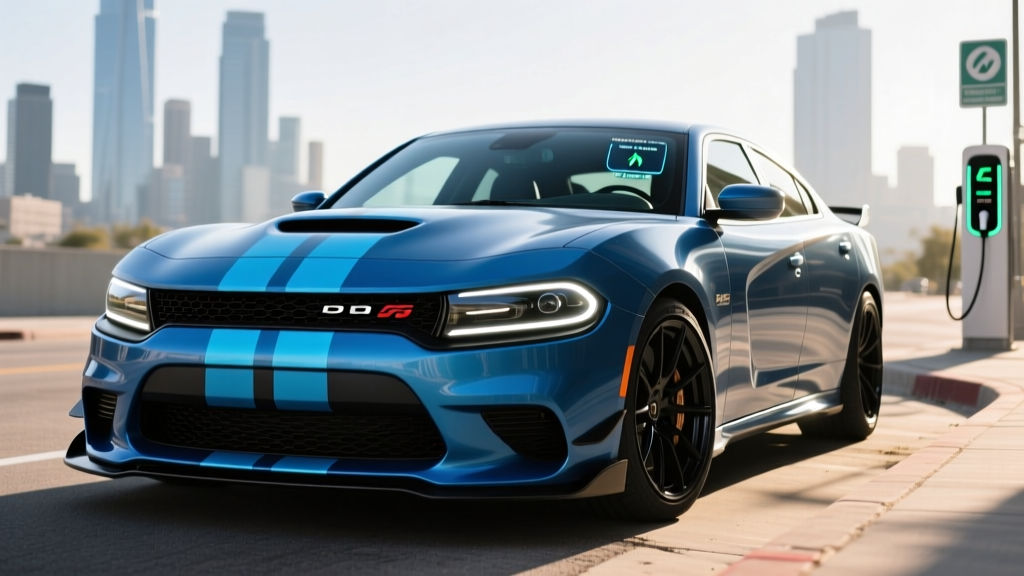
The Electric Scat Pack: What You Need to Know Before You Buy
Bottom Line: The 2026 Dodge Charger Daytona Scat Pack EV delivers 496 horsepower, a 317-mile EPA range, and a 0-60 time of 4.3 seconds starting at $61,990. It's a legitimate muscle car reimagined as a battery-electric coupe — but with real trade-offs in charging speed, weight, and eligibility for federal tax credits. If you have Level 2 home charging and want electric torque with Dodge attitude, it's compelling. If you road-trip frequently through rural areas or lack home charging access, the ownership experience requires more planning than a gas Challenger ever did.
Dodge retired the Hemi-powered Challenger after the 2023 model year, and the Charger Daytona EV is its spiritual successor. The Scat Pack trim sits above the R/T in the lineup, trading a supercharged 6.2L V8 for a dual-motor all-wheel-drive powertrain and a 100.6 kWh (usable) battery pack using NMC (nickel manganese cobalt) chemistry. The result is instant torque, a low center of gravity, and a car that can still do a quarter-mile in the low 12s — but one that weighs over 5,800 pounds and charges at a peak rate that lags behind competitors like the Hyundai Ioniq 5 N.
This guide breaks down the exact specs, real-world range expectations, charging logistics, total cost of ownership, and the decision framework you need to determine whether the electric Scat Pack fits your garage.
Spec Sheet: 2026 Dodge Charger Daytona Scat Pack at a Glance
| Specification | 2026 Charger Daytona Scat Pack |
|---|---|
| Base MSRP | $61,990 (before destination, incentives) |
| EPA Range | 317 miles |
| Real-World Range (highway/cold) | ~250–280 mi highway; ~220–250 mi in freezing temps |
| Battery Capacity (usable) | 100.6 kWh, NMC chemistry |
| Drivetrain | Dual-motor AWD |
| Horsepower | 496 hp (590 hp with PowerShot on R/T; Scat Pack tuned to 496) |
| Torque | 404 lb-ft |
| 0-60 mph | 4.3 seconds |
| DC Fast Charge Peak | ~155 kW (CCS1/NACS adapter available) |
| 10-80% DC Fast Charge | ~32 minutes |
| Level 2 Charge Rate | 11.5 kW (~44 mi/hr) |
| MPGe (combined) | 91 MPGe |
| Curb Weight | ~5,838 lbs |
| Battery Warranty | 8 years / 100,000 miles (≥70% capacity retention) |
| Federal Tax Credit (§30D) | Likely ineligible — assembled in US but battery sourcing rules disqualify most Stellantis EVs for 2026 |
Sources: fueleconomy.gov, Dodge official specs, IRS §30D guidance.
Range Reality: EPA Sticker vs. What You'll Actually Get
EPA: 317 miles | Real-world highway (70+ mph): ~250–280 miles | Cold weather (below 32°F): ~220–250 miles
The 317-mile EPA rating is respectable for a 5,800-pound performance coupe, but EPA testing includes a mix of city and highway driving at moderate speeds. On a sustained highway run at 75 mph — the kind of trip where range matters most — expect the Charger Daytona Scat Pack to deliver roughly 250 to 280 miles before you need to plug in. That's a 12-20% reduction from the sticker, consistent with most EVs at highway speeds due to aerodynamic drag.
Cold weather compounds the loss. NMC batteries experience increased internal resistance in freezing temperatures, and the Charger Daytona uses a resistive heating element rather than a heat pump for cabin warmth. In sub-32°F conditions, plan on 220-250 miles of usable range. Preconditioning the battery while plugged in at home mitigates some of this loss, but it won't eliminate it.
For context, the final 2023 Challenger Scat Pack with the 6.4L Hemi had an EPA combined range of roughly 340 miles on its 18.5-gallon tank (16 city/25 highway mpg). The EV version is close in mixed driving but falls behind on highway-only trips and significantly behind in cold weather.
Charging: The Scat Pack's Biggest Compromise
The Charger Daytona's peak DC fast-charging rate of approximately 155 kW is the car's most debated specification. In a 2026 market where the Hyundai Ioniq 5 N peaks at 240 kW and the Porsche Taycan can sustain over 270 kW, the Dodge's charging speed feels like a generation behind.
| Charging Level | Power (kW) | Rate | Time |
|---|---|---|---|
| Level 1 (120V household) | ~1.4 kW | ~5 mi/hr | Full charge: ~72 hours |
| Level 2 (240V home) | 11.5 kW | ~44 mi/hr | Full charge: ~9 hours |
| DC Fast Charge (peak) | ~155 kW | ~600 mi/hr (peak) | 10-80%: ~32 minutes |
What the charge curve actually looks like: The 155 kW peak only holds between roughly 10-40% state of charge. From 40-60%, the rate tapers to approximately 110 kW. Above 80%, it drops further to around 50-60 kW as the battery management system protects cell longevity. A 10-80% session takes about 32 minutes at a properly rated charger — not terrible, but you'll notice the gap versus competitors on road trips when you're making multiple stops.
Connector compatibility: The Charger Daytona ships with a CCS1 inlet. Dodge offers a NACS adapter for Tesla Supercharger access, which is critical given that the Supercharger network remains the most reliable DC fast-charging option in the US. Without that adapter, you're relying on Electrify America, EVgo, and ChargePoint stations — networks with more variable uptime.
Home charging reality: At 11.5 kW on a Level 2 home charger (requiring a 60-amp circuit on a 240V outlet), the Scat Pack adds about 44 miles of range per hour. An overnight charge from 20% to 80% takes roughly 5-6 hours — perfectly practical for daily driving. A licensed electrician will typically charge $800-$2,000 for a Level 2 installation, depending on whether your electrical panel needs an upgrade to support a new 60-amp circuit.
EV vs. Gas: Charger Daytona Scat Pack vs. the Challenger It Replaces
The emotional comparison is the 2023 Challenger R/T Scat Pack (485 hp, 6.4L Hemi V8). Here's how the numbers stack up when you account for real ownership costs over five years:
| Factor | 2026 Charger Daytona Scat Pack EV | 2023 Challenger R/T Scat Pack (6.4L) |
|---|---|---|
| MSRP (base) | $61,990 | $48,590 (final MSRP) |
| Federal Tax Credit | $0 (likely ineligible) | $0 |
| 0-60 mph | 4.3 sec | 4.2 sec |
| Horsepower | 496 hp | 485 hp |
| EPA Range / Tank Range | 317 mi | ~340 mi |
| Fuel/Energy Cost (5 yr, 15k mi/yr) | ~$4,800 (at $0.14/kWh avg) | ~$12,750 (at $3.50/gal, 18 mpg combined) |
| Maintenance (5 yr estimate) | ~$1,200 (tires, cabin filter, fluid top-offs) | ~$3,500 (oil, brakes, belts, spark plugs) |
| Estimated Insurance (annual avg) | ~$2,800/yr | ~$2,400/yr |
| 5-Year Total Cost (purchase + fuel + maint + ins) | ~$81,990 | ~$86,790 |
The EV costs more upfront — roughly $13,400 more at MSRP — but recoups about $8,000 in fuel savings and $2,300 in maintenance savings over five years. Insurance runs higher on the EV due to repair costs for battery-adjacent collision damage. Net result: the five-year total cost of ownership is roughly comparable, with the EV slightly ahead if electricity rates stay moderate and gas prices stay above $3/gallon.
The gap narrows further if you lack home charging and rely on public DC fast charging, where costs can reach $0.35-$0.48/kWh on networks like Electrify America — pushing your per-mile energy cost closer to that of gasoline.
Real-World Ownership: What First-Time EV Buyers Must Plan For
If this is your first EV, the Charger Daytona Scat Pack demands the same homework as any battery-electric vehicle — plus a few muscle-car-specific considerations:
Home Charging Access Is Non-Negotiable
Without a Level 2 home charger, living with a 5,800-pound EV becomes a chore. Public Level 2 chargers at shopping centers deliver 6-8 kW — meaning a full charge takes 12+ hours. DC fast charging daily accelerates battery degradation and costs 2-3x more per kWh than home electricity. Before buying, confirm you can install a 240V/60A circuit in your garage or driveway. Renters and apartment dwellers face a genuine barrier here.
Tire Wear Will Surprise You
EVs are heavy, and the Scat Pack's instant 404 lb-ft of torque accelerates tire wear significantly. Expect to replace tires every 20,000-25,000 miles rather than the 40,000+ miles typical of a lighter gas coupe. Budget $1,200-$1,600 for a set of performance all-season or summer tires sized for the Charger's 20-inch wheels.
The Sound Debate
Dodge's Fratzonic Chambered Exhaust system generates synthetic engine-like sound through external speakers. It's adjustable and can be turned off entirely. Some owners appreciate the theater; others find it gimmicky. Test it in person before committing — this is a polarizing feature that affects daily satisfaction.
Cargo and Practicality
The Charger Daytona is a liftback coupe, offering roughly 14.5 cubic feet of cargo space with the rear seats folded. There's no front trunk (frunk) — the space is occupied by power electronics. For a two-door performance car, the liftback design is practical, but don't expect SUV-like utility.
Tax Credits, Incentives, and the $61,990 Question
The federal §30D Clean Vehicle Credit offers up to $7,500 for qualifying new EVs, but eligibility hinges on three criteria that the Charger Daytona Scat Pack struggles to meet in 2026:
- MSRP cap: Sedans/coupes must be under $55,000. The Scat Pack at $61,990 exceeds this cap, immediately disqualifying it. (The lower R/T trim at approximately $52,990 may qualify if other criteria are met.)
- Battery sourcing: Critical minerals and battery components must meet escalating domestic-content thresholds. Stellantis has not confirmed that the Charger Daytona's battery pack meets 2026 sourcing requirements.
- Buyer income limits: Modified adjusted gross income must be ≤$150,000 (single) or ≤$300,000 (joint). This applies regardless of the vehicle.
State incentives may help. States like California, Colorado, and New York offer additional rebates of $2,000-$7,500 for EV purchases, often with higher MSRP caps or no cap at all. Check your state's energy office or AFDC state incentive database for current programs.
Used market workaround: The §25E used EV credit offers up to $4,000 (30% of sale price) on pre-owned EVs under $25,000. As 2024-2025 Charger Daytonas enter the used market in 2027-2028, this could become a path to owning one at a significant discount — though the MSRP cap on used credits is very restrictive.
Common Misconceptions About the Electric Scat Pack
| Myth | Fact |
|---|---|
| "It charges as fast as a Tesla." | The Charger Daytona peaks at ~155 kW. A Tesla Model 3 Performance charges at up to 250 kW on V3 Superchargers. The gap is significant on road trips. |
| "317 miles means I'll always get 317 miles." | Highway driving at 75+ mph reduces range to ~250-280 miles. Cold weather drops it further to ~220-250 miles. Always plan trips around 80% of the EPA figure. |
| "No oil changes means it's maintenance-free." | Tires wear faster due to weight and torque. Brake fluid, cabin filters, coolant, and 12V battery still require periodic service. Budget ~$250-$400/year. |
| "It's eligible for the $7,500 federal tax credit." | The Scat Pack exceeds the $55,000 sedan/coupe MSRP cap. Even the R/T may not qualify due to battery sourcing rules. Verify on IRS.gov before relying on the credit. |
| "I can tow with it." | The Charger Daytona is not rated for towing. If you need a tow-capable EV, look at trucks and SUVs. |
| "The battery will need replacing in 5 years." | NMC batteries with proper thermal management typically retain 85-90% capacity at 100,000 miles. Dodge warrants the pack for 8 years/100,000 miles at ≥70% retention. Full replacement, if ever needed, runs $15,000-$22,000 out of warranty. |
Decision Framework: Should You Buy the Electric Scat Pack?
Buy the Charger Daytona Scat Pack EV if:
- You have Level 2 home charging (or can install it for under $2,000)
- Your daily commute is under 100 miles round-trip, and you road-trip less than 4-5 times per year
- You want a performance coupe with instant torque, low running costs, and Dodge's design language
- You can absorb the $61,990 price without relying on the federal tax credit
- You live in a state with additional EV incentives that offset the purchase price
Look elsewhere if:
- You rent or live in an apartment without charging access — public-only charging will cost you time and money
- You regularly drive 300+ miles in a single day through areas with sparse DC fast-charging infrastructure
- You need the absolute fastest charging in the EV segment (consider the Ioniq 5 N or Taycan)
- The $55,000 MSRP cap for the federal tax credit is a dealbreaker — look at the R/T trim or competing EVs under that threshold
- You prioritize exhaust-note authenticity over performance — the Hemi is gone, and no synthetic system fully replaces it
Consider a PHEV compromise if:
- You want electric daily driving with gas-engine road-trip freedom. The BMW M340e or upcoming electrified Dodge models (if announced) may offer a bridge between the two worlds — though nothing in the PHEV segment matches the Scat Pack's straight-line performance.
Frequently Asked Questions
How long does it take to charge the Charger Daytona Scat Pack at home?
On a Level 2 (240V) home charger at 11.5 kW, a full charge from empty takes approximately 9 hours. In practice, most owners charge from 20-80% overnight, which takes about 5-6 hours. A standard 120V outlet (Level 1) adds only about 5 miles per hour — far too slow for daily use on a car with a 100.6 kWh battery.
Is the Charger Daytona Scat Pack faster than a Tesla Model 3 Performance?
In a straight line, no. The Model 3 Performance does 0-60 in approximately 2.9 seconds versus the Scat Pack's 4.3 seconds. The Tesla also charges faster (250 kW peak), costs less (~$54,990), and qualifies for the federal tax credit. The Dodge trades outright speed for muscle-car presence, a liftback coupe design, and the Fratzonic exhaust experience.
What happens to the battery in very cold weather?
NMC batteries lose efficiency in freezing temperatures. Expect 20-30% range reduction below 32°F, primarily due to increased internal resistance and energy used for cabin heating. Preconditioning the battery while plugged in at home recovers some of this loss. The Charger Daytona's battery thermal management system actively warms the pack, but it's not as aggressive as Tesla's or Hyundai's systems.
Can I use Tesla Superchargers with the Charger Daytona?
Yes, with a NACS adapter (available from Dodge or third-party suppliers like Lectron). The Charger Daytona has a CCS1 inlet natively, so the adapter is required for Supercharger access. Charging speed on a V3 Supercharger will be limited by the car's ~155 kW peak, not the station's 250 kW capability.
What does battery replacement cost if it fails out of warranty?
Full battery pack replacement for a 100+ kWh NMC pack currently runs $15,000-$22,000 at a dealership, including labor. However, catastrophic pack failure is rare — most degradation is gradual, and modules can sometimes be replaced individually at lower cost. Dodge's 8-year/100,000-mile warranty covers capacity loss below 70%.
Does the Charger Daytona have one-pedal driving?
Yes, the Charger Daytona offers adjustable regenerative braking with a one-pedal driving mode. Max regen setting recovers significant energy in stop-and-go traffic and reduces brake wear. However, the regen feel is less aggressive than a Tesla or Nissan Leaf — Dodge tuned it for a more traditional driving experience.