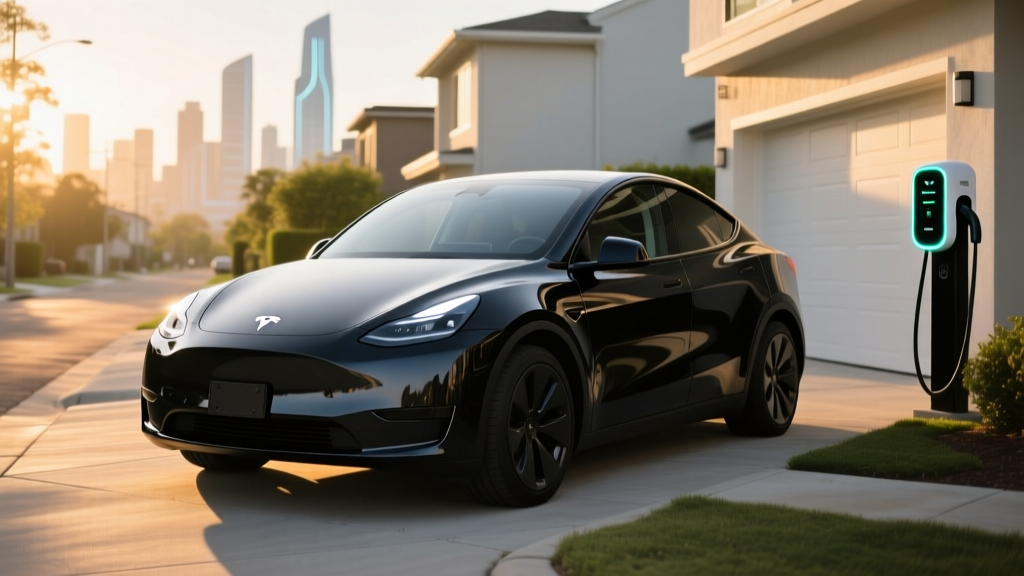
If you're researching 2026 Tesla Model Y lease deals, you're likely weighing Tesla's refreshed "Juniper" crossover against a growing field of electric SUVs. The 2026 Model Y arrives with a restyled exterior, a quieter cabin, a rear touchscreen, and revised suspension tuning — but the core question for lessees remains the same: what does it actually cost to drive, charge, and live with this EV for 36 months?
This profile breaks down every number that matters for a lease decision — EPA range, real-world efficiency, DC fast-charge curves, monthly cost math, and the federal tax credit rules that can (or can't) apply to your lease. We've driven the Juniper Model Y, charged it on multiple networks, and cross-referenced Tesla's spec sheets against EPA data at fueleconomy.gov to give you the figures marketing materials gloss over.
2026 Model Y at a Glance: Full Spec Sheet
| Spec | Long Range AWD | Performance |
|---|---|---|
| Base MSRP | $44,990 | $51,490 |
| EPA Range | 320 miles | 298 miles |
| Battery (usable) | ~75 kWh, NMC | ~75 kWh, NMC |
| Drivetrain | Dual-motor AWD | Dual-motor AWD |
| Horsepower | 384 hp | 456 hp |
| 0-60 mph | 4.8 sec | 3.5 sec |
| Peak DC Charge Rate | 250 kW | 250 kW |
| 10-80% DCFC Time | ~25 min | ~25 min |
| Level 2 Home Rate | 11.5 kW (~44 mi/hr) | 11.5 kW (~44 mi/hr) |
| MPGe (combined) | 111 MPGe | 102 MPGe |
| Efficiency | 30 kWh/100 mi | 33 kWh/100 mi |
| Cargo (rear seats up) | 30.2 cu ft | 30.2 cu ft |
| Cargo (rear seats down) | 72.1 cu ft | 72.1 cu ft |
| Frunk | 4.1 cu ft | 4.1 cu ft |
| Rear Legroom | 40.5 in | 40.5 in |
| Battery Warranty | 8 yr / 120,000 mi | 8 yr / 120,000 mi |
| Basic Warranty | 4 yr / 50,000 mi | 4 yr / 50,000 mi |
Real-World Range: What the EPA Number Doesn't Tell You
Real-World Highway (70 mph, 72°F): ~270–285 miles
Real-World Cold Weather (30°F, mixed driving): ~220–250 miles
City / Suburban Commute: 290–310 miles achievable
The 320-mile EPA figure for the Long Range AWD is a solid baseline, but your actual range depends heavily on driving style and climate. At sustained highway speeds above 70 mph, expect to use 33–35 kWh/100 mi, which drops effective range to roughly 270 miles on a full charge. That's still enough for most road-trip legs between Supercharger stops, but it's a meaningful 15% reduction from the sticker.
Cold weather compounds this. In sub-freezing temperatures, the battery's internal resistance increases and cabin heating draws significant energy — even with the Juniper's standard heat pump. Plan for 25–30% range loss in winter if you're in the northern U.S. Preconditioning the battery while plugged in (via the Tesla app's scheduled departure feature) mitigates some of this, but it won't eliminate it.
The 75 kWh NMC (nickel manganese cobalt) pack provides strong energy density, which is why Tesla achieves this range in a relatively compact crossover. However, NMC chemistry is more sensitive to sustained high states of charge than LFP. Tesla recommends daily charging to 80% for NMC packs and saving 100% for road trips — a habit that meaningfully extends long-term battery health.
Charging Speed: DC Fast, Level 2, and the Supercharger Advantage
Charging speed is where the Model Y's Tesla ecosystem advantage is most tangible. The Juniper retains the 250 kW peak DC fast-charge rate, and while that's no longer class-leading (the Hyundai Ioniq 5 peaks at 350 kW), Tesla's Supercharger network reliability compensates heavily.
| Charging Level | Power (kW) | Speed (miles added/hr) | Typical Use Case |
|---|---|---|---|
| Level 1 (120V household) | ~1.4 kW | ~5 mi/hr | Emergency / overnight trickle |
| Level 2 (240V, 48A Wall Connector) | 11.5 kW | ~44 mi/hr | Daily home charging (7–8 hr for full) |
| Level 2 (public, 7.2 kW) | 7.2 kW | ~28 mi/hr | Workplace / destination charging |
| DC Fast (Supercharger V3/V4) | Up to 250 kW | ~1,000 mi/hr at peak | Road trips, 10-80% in ~25 min |
| DC Fast (above 80% SoC) | Tapers to 30–50 kW | ~120 mi/hr | Top-off — avoid unless needed |
Understanding the charge curve matters. The 250 kW peak is only sustained roughly between 10% and 35% state of charge. From 35–60%, expect ~175–200 kW; from 60–80%, it drops to ~100–120 kW. Above 80%, charging slows dramatically to protect the NMC cells. On a road trip, the optimal strategy is charging in the 10–80% window (~25 minutes) and driving on, rather than waiting for a full charge.
For home charging, Tesla's Wall Connector at 48 amps on a 60A circuit delivers 11.5 kW — enough to replenish a full day's driving in about an hour. Installation costs typically range from $800–$2,000 depending on your panel capacity and conduit run (a 200A panel is recommended; older 100A panels may need an upgrade for $1,500–$3,000).
The Juniper Model Y ships with the NACS (North American Charging Standard) connector natively. This is now the dominant standard — Ford, GM, Rivian, Hyundai, and others have adopted it — so you'll have native access to 25,000+ Superchargers without an adapter.
2026 Model Y Lease Pricing and Tax Credit Math
Leasing a Model Y in 2026 involves a different tax-credit calculus than buying. Under IRS §30D rules, the $7,500 federal credit applies to purchases and has strict requirements: buyer income caps ($150K single / $300K joint), vehicle MSRP caps ($80K for SUVs), and battery critical-mineral and component sourcing rules that have tightened significantly since 2024.
However, leases operate under a different code section (§45W) — the commercial clean vehicle credit. The leasing company (the legal owner) claims the credit and may pass savings to you as a reduced monthly payment or capitalized-cost reduction. Tesla has historically passed this through, but it is not guaranteed by law. Always confirm the lease quote includes the credit pass-through before signing.
| Cost Factor | Long Range AWD | Performance |
|---|---|---|
| Base MSRP | $44,990 | $51,490 |
| Destination Fee | $1,390 | $1,390 |
| Typical Lease (36 mo / 10K mi, w/ credit pass-through) | ~$449–$529/mo | ~$569–$649/mo |
| Due at Signing (est.) | $3,500–$5,000 | $4,000–$5,500 |
| Money Factor (est.) | 0.0020–0.0028 | 0.0020–0.0028 |
| Residual Value (36 mo) | ~55–58% | ~52–55% |
Key lease considerations for 2026:
- Mileage penalties: Tesla Financial leases typically charge $0.20–$0.25 per excess mile. If you drive more than 12,000 miles/year, negotiate a 15K lease upfront — it's cheaper than paying penalties.
- Disposition fee: Expect a $395–$495 fee at lease-end if you don't purchase or lease another Tesla.
- Wear-and-tear: Tesla's lease-end inspection standards are moderate, but wheel curb rash and windshield chips are common charge items.
- State incentives: Some states (CA, CO, NY, MA) offer additional rebates that may apply to leases — check your state's energy office for current programs.
For the most current federal credit rules, always cross-reference the IRS clean vehicle credit page, as sourcing requirements and eligible vehicle lists update periodically.
Tech, Interior, and Driver Assistance: What's New for Juniper
The Juniper refresh brought meaningful interior upgrades. The cabin is noticeably quieter thanks to acoustic glass and additional sound deadening. A ventilated front seat row is now standard, and the rear gets its own 8-inch touchscreen for climate and entertainment — a welcome fix for rear passengers who previously had no control.
The 15.4-inch front touchscreen runs Tesla's latest software with improved navigation, trip planning, and Supercharger routing. Wireless phone charging pads (two, side by side) are standard. Ambient lighting runs the full width of the dash, and the updated steering wheel integrates turn-signal buttons (replacing the stalk) — a polarizing change that takes adaptation.
Autopilot and FSD (Supervised): Every Model Y includes basic Autopilot — traffic-aware cruise control and lane centering. Full Self-Driving (Supervised) remains a $8,000 option or $99/month subscription. FSD adds automatic lane changes, traffic light and stop sign recognition, and Navigate on Autopilot. Critically, FSD is SAE Level 2 — you must keep your hands on the wheel and eyes on the road at all times. It is not autonomous driving.
Tesla Autopilot and FSD (Supervised) require continuous driver engagement. The system can steer, accelerate, and brake, but the driver is legally and operationally responsible. Hands-off systems like GM's Super Cruise (on mapped highways) offer similar Level 2 capability with slightly more relaxed monitoring, but no consumer vehicle sold in the U.S. is Level 4 autonomous. Only Waymo and Zoox robotaxis operate at Level 4 — and only in geofenced areas.
How the 2026 Model Y Stacks Up Against Competitors
The mid-size electric SUV segment is crowded in 2026. Here's how the Model Y Long Range compares on the numbers that matter most to lease shoppers:
| Spec | Tesla Model Y LR | Hyundai Ioniq 5 Limited | Ford Mustang Mach-E Premium | Kia EV6 GT-Line |
|---|---|---|---|---|
| Price (base) | $44,990 | $52,600 | $46,995 | $52,400 |
| EPA Range | 320 mi | 305 mi | 320 mi | 310 mi |
| Peak DCFC | 250 kW | 350 kW | 150 kW | 350 kW |
| 10-80% Time | ~25 min | ~18 min | ~38 min | ~18 min |
| 0-60 mph | 4.8 sec | 5.1 sec | 5.1 sec | 5.0 sec |
| Cargo (rear up) | 30.2 cu ft | 27.2 cu ft | 29.7 cu ft | 24.4 cu ft |
| Charging Network | NACS (Supercharger) | NACS (adapter) | NACS (adapter) | NACS (adapter) |
The Model Y's lease advantage often comes down to three factors: (1) native Supercharger access without adapters, (2) higher residual values that keep monthly payments competitive despite similar MSRPs, and (3) Tesla's over-the-air update track record, which has historically kept older vehicles feeling current.
Where competitors win: The Ioniq 5 and EV6 charge significantly faster on 350 kW-capable stations (18 min vs. 25 min, 10–80%). The Mach-E offers a more traditional crossover driving feel and physical controls. If road-trip charging speed is your top priority, the Hyundai/Kia 800V architecture is measurably quicker.
Pros and Cons: Honest Assessment
Pros
- 320-mile EPA range covers most commutes and road-trip legs comfortably
- Native NACS / Supercharger network — no adapter needed, highest reliability
- Spacious cargo area (72.1 cu ft max) with practical frunk
- Juniper cabin is significantly quieter with improved ride quality
- Strong resale/residual values reduce lease payments
- Heat pump standard — better cold-weather efficiency
- Over-the-air updates continuously add features
Cons
- 250 kW peak charge rate trails 800V competitors (Ioniq 5, EV6 at 350 kW)
- Turn signals on steering wheel buttons take significant adaptation
- No physical instrument cluster — everything on center screen
- FSD (Supervised) costs $8K extra and is still Level 2, not autonomous
- NMC battery requires 80% daily charge limit for longevity
- Insurance premiums run 15–25% higher than segment average
- Lease-end disposition fee and potential wear charges
Who Should Lease the 2026 Model Y — And Who Shouldn't
- You have home Level 2 charging and drive 200–350 miles per week
- You road-trip 3+ times per year and value Supercharger reliability
- You want a family EV with strong cargo space and rear-seat room
- You prefer lower monthly payments via lease + credit pass-through vs. buying
- You want to avoid long-term battery degradation risk (warranty covers 8 years, but you'll be out at 3)
- Maximum DC fast-charge speed is your priority (Ioniq 5/EV6 charge ~30% faster)
- You prefer physical buttons and a traditional instrument cluster
- You drive more than 15,000 miles/year — high-mileage leases get expensive
- You want LFP chemistry for daily 100% charging flexibility (consider the RWD Model Y, lower range)
For families with two or more road trips per year, the Model Y's combination of range, Supercharger access, and cargo volume is hard to beat. The lease structure also lets you upgrade when Tesla eventually introduces a higher-capacity battery or next-generation platform — a genuine consideration given the pace of EV development.
Frequently Asked Questions
What is the real-world range of the 2026 Tesla Model Y?
The EPA rates the Long Range AWD at 320 miles. In real-world highway driving at 70 mph, expect 270–285 miles. In freezing weather with mixed driving, plan for 220–250 miles. City and suburban driving with regenerative braking can approach 290–310 miles.
How fast does the 2026 Model Y charge at home and on the road?
At home on a Level 2 Wall Connector (11.5 kW), the Model Y adds roughly 44 miles of range per hour — a full overnight charge from 20% takes about 7 hours. On a Tesla Supercharger (up to 250 kW DC), a 10–80% charge takes approximately 25 minutes. Charging slows significantly above 80% due to the NMC battery's charge-curve taper.
Does the 2026 Model Y qualify for the $7,500 federal EV tax credit?
When purchased, the Model Y is eligible under IRS §30D if you meet income caps ($150K single / $300K joint) and the vehicle meets battery-sourcing requirements, which tighten annually. For leases, the credit is claimed by the leasing company under §45W and may be passed through as a cap-cost reduction — confirm this with Tesla Financial before signing. Always verify current eligibility at irs.gov.
Is it better to buy or lease the 2026 Model Y?
Leasing makes sense if you want lower monthly payments, plan to drive 10,000–12,000 miles per year, and want to avoid long-term depreciation risk. Buying makes sense if you drive high annual miles, want to keep the vehicle 5+ years, and qualify for the purchase tax credit directly. Lease pass-through of the $7,500 credit is common but not legally guaranteed.
How does the Model Y compare to the Ioniq 5 and Mach-E for leasing?
The Model Y typically offers the strongest residual values, keeping lease payments competitive. The Ioniq 5 and EV6 charge faster (350 kW vs. 250 kW) and may offer more aggressive lease incentives from Hyundai/Kia. The Mach-E is a strong value play but has slower DC charging. Supercharger network reliability remains Tesla's strongest differentiator.
What is the battery warranty on the 2026 Model Y?
Tesla covers the battery and drive unit for 8 years or 120,000 miles (whichever comes first) on the Long Range and Performance trims. The warranty guarantees at least 70% capacity retention. In a 36-month lease, you'll remain well within warranty coverage, eliminating long-term degradation risk.
Can I charge a 2026 Model Y at non-Tesla charging stations?
Yes. The Model Y uses the NACS connector, which is now the industry standard. Electrify America, EVgo, and ChargePoint are adding NACS cables to new and upgraded stations. You can also use a CCS-to-NACS adapter for older CCS stations. For Level 2 public charging, the included J1772 adapter works with all standard public Level 2 stations.
Specs and pricing reflect Tesla's published figures and EPA data as of early 2026. Lease terms vary by region, creditworthiness, and Tesla Financial's current programs. Federal tax credit rules are subject to change — consult irs.gov and a tax professional for your specific situation.