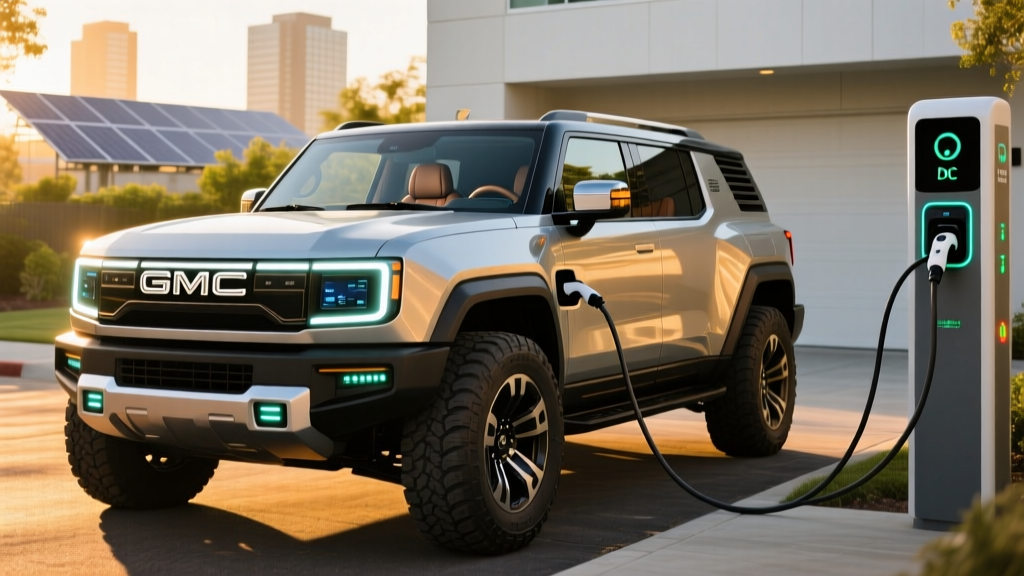
The GMC Hummer EV SUV is a 9,000-pound electric super-truck wrapped in a family-hauler silhouette. It carries one of the largest battery packs ever fitted to a production vehicle, produces up to 830 horsepower, and offers genuinely novel party tricks like CrabWalk and Extract Mode. But with a starting price near $100,000 and efficiency that makes it one of the thirstiest EVs on the road, it demands a careful look at whether the specs translate into daily-driver satisfaction. This review breaks down every number that matters — from real-world range and charging curves to tax-credit eligibility and total ownership cost.
Range and Efficiency: Massive Battery, Modest Miles
Real-World Expectation: ~250–275 miles highway at 70 mph; ~210–230 miles in freezing weather with cabin heat. The Hummer EV SUV's 5,300-lb curb weight (without passengers or cargo) and brick-like aerodynamics mean highway efficiency drops sharply above 65 mph.
The headline number is the EPA's 314-mile combined estimate for the 3X trim equipped with the full 24-module Ultium battery pack. That's impressive until you consider the battery doing the work: a 212.7 kWh gross capacity (approximately 205 kWh usable), which is roughly double what a Tesla Model X or Rivian R1S carries.
Efficiency lands at 47 MPGe combined, or about 73 kWh per 100 miles. For context, the Rivian R1S achieves roughly 3.0–3.2 kWh/mi, while the Hummer EV SUV sits closer to 2.1–2.4 kWh/mi in mixed driving but can exceed 3.0 kWh/mi at sustained highway speeds. In plain terms, you'll spend significantly more on electricity per mile than in almost any other electric SUV.
| Spec | 3X (24-module) | 2X (20-module) |
|---|---|---|
| EPA Range | 314 mi | ~250 mi (est.) |
| Battery (gross / usable) | 212.7 kWh / ~205 kWh | ~170 kWh / ~164 kWh |
| Chemistry | NMC (Nickel Manganese Cobalt) | NMC |
| Drivetrain | Tri-motor AWD (1 front, 2 rear) | Dual-motor AWD |
| Horsepower | 830 hp (Watts to Freedom) | 625 hp |
| 0–60 mph | ~3.5 seconds | ~4.5 seconds |
| Efficiency (combined) | 47 MPGe / 73 kWh/100mi | ~50 MPGe (est.) |
| Max DC Fast Charge | 350 kW (peak) | 350 kW (peak) |
| Level 2 Charge Rate | 11.5 kW (~19 mi/hr) | 11.5 kW (~19 mi/hr) |
| Cargo (behind 2nd row) | 81.8 cu ft | 81.8 cu ft |
| Towing Capacity | 7,500 lbs | 7,500 lbs |
Charging Speed: 350 kW Peak, but the Curve Tells the Real Story
GMC equips the Hummer EV SUV with an 800-volt Ultium architecture capable of accepting up to 350 kW at a DC fast charger — among the highest peak rates available in any production SUV. On a compatible 350 kW station (such as Electrify America's latest stalls), GMC claims a 10–80% charge in approximately 32 minutes for the 24-module pack.
However, the enormous battery capacity means that even at peak rate, you're moving a lot of electrons. The charge curve tapers meaningfully above 60% state of charge (SoC), and sustaining 350 kW is a brief phenomenon — expect an average rate closer to 200–240 kW across the full 10–80% session. Preconditioning the battery via the onboard navigation routing to a charger is essential; without it, peak rates can drop below 150 kW, especially in cold weather.
| Charging Level | Power | Miles Added per Hour | Notes |
|---|---|---|---|
| Level 1 (120V) | ~1.4 kW | ~2 mi/hr | Emergency/trickle only |
| Level 2 (240V, 48A) | 11.5 kW | ~19 mi/hr | Full charge in ~18 hours |
| DC Fast (peak) | 350 kW | ~500+ mi/hr (peak) | 10–80% in ~32 min |
| DC Fast (avg 10–80%) | ~220 kW | ~350 mi/hr (avg) | With preconditioning |
For home charging, the 11.5 kW onboard charger adds roughly 19 miles of range per hour — meaning a full 0–100% charge on Level 2 takes about 18 hours. Most owners will charge overnight from 20–80% daily, which takes roughly 10–11 hours on a home Level 2 station. A 60-amp dedicated circuit (hardwired) is strongly recommended; a NEMA 14-50 outlet on a 50-amp circuit will deliver about 9.6 kW, adding ~16 mi/hr.
Performance and Driving Dynamics
The 3X trim's tri-motor setup — one motor on the front axle, two on the rear — produces 830 horsepower and an estimated 1,200 lb-ft of torque in Watts to Freedom (WTF) launch mode. The 0–60 mph sprint takes approximately 3.5 seconds, which is astonishing for a vehicle with a 9,046-pound gross vehicle weight rating.
The dual-motor 2X trim delivers 625 hp and a 0–60 time around 4.5 seconds — still firmly in sports-sedan territory for a three-row SUV.
Driving dynamics defy physics to a point. The available four-wheel steering enables CrabWalk, which diagonally shifts the vehicle at low speeds — useful on tight trails and a guaranteed conversation starter. Extract Mode raises the adaptive air suspension by nearly 6 inches for 15.9 inches of ground clearance, genuinely capable for off-road use. The rear torque-vectoring dual motors can simulate a locking differential by braking the inside wheel.
On pavement, the ride is composed and surprisingly quiet thanks to extensive sound deadening, but you feel the mass in corners and during hard braking. The regenerative braking system offers adjustable levels, including a one-pedal driving mode, though the brake pedal feel remains somewhat vague under the blended regen/friction braking transition.
Interior, Tech, and Cargo Space
The Hummer EV SUV seats five passengers across two rows. Front-seat occupants enjoy generous headroom and legroom (42.5 inches front legroom), and the wide cabin provides true three-across shoulder room up front. The second row accommodates adults comfortably, though at 38.2 inches of rear legroom, it trails some competitors like the Rivian R1S.
Cargo volume behind the second row measures 81.8 cubic feet, which is exceptional — aided by the flat floor and the absence of a transmission tunnel. The power-folding second row expands this further. There is also a front trunk (frunk) offering additional sealed storage.
The infotainment system runs on a 13.4-inch diagonal touchscreen with Google Built-In (Google Maps, Google Assistant, Play Store). A 12.3-inch driver display handles instrumentation. The UltraVision camera system provides up to 18 exterior camera views — invaluable for off-road navigation and tight-space maneuvering. Wireless Apple CarPlay and Android Auto are standard.
Driver assistance is handled by Super Cruise, GM's hands-off highway driving system, on compatible mapped roads. Super Cruise is a SAE Level 2 system — the driver must remain attentive and ready to take over at all times, monitored by a driver-facing camera. It is not autonomous driving, but it is among the most polished Level 2 highway assists available, covering over 750,000 miles of compatible roads in North America.
Pricing, Trims, and Federal Tax Credit Eligibility
The 2026 GMC Hummer EV SUV lineup starts just under six figures and climbs steeply with options:
| Trim | Base MSRP | As-Tested (typical) | §30D Credit Eligible? |
|---|---|---|---|
| 2X (dual-motor) | $99,995 | $108,000–$115,000 | No — exceeds SUV MSRP cap |
| 3X (tri-motor) | $106,695 | $118,000–$135,000 | No — exceeds SUV MSRP cap |
| Edition 1 (sold out) | $112,595 | N/A | No |
Under current IRS §30D rules, the federal clean vehicle credit has an MSRP cap of $80,000 for SUVs. Every Hummer EV SUV trim exceeds this threshold, making the vehicle ineligible for the $7,500 federal tax credit regardless of buyer income or battery-sourcing compliance. Buyers should also be aware that §30D includes modified adjusted gross income limits ($300,000 joint / $150,000 single) and critical-mineral/battery-component sourcing requirements — but for the Hummer EV SUV, the MSRP cap alone disqualifies it.
Some states offer their own EV incentives that may partially offset the cost; check your state's energy or DMV website for current programs. Point-of-sale transfer of the federal credit is irrelevant here since the vehicle does not qualify.
Battery Warranty and Long-Term Ownership
GMC covers the Hummer EV SUV's Ultium battery pack with an 8-year / 100,000-mile warranty, guaranteeing a minimum of 70% capacity retention over that period. The powertrain (motors, power electronics) carries the same 8-year/100,000-mile coverage. The limited bumper-to-bumper warranty is 3 years / 36,000 miles.
The NMC (nickel manganese cobalt) chemistry in the Ultium platform offers high energy density — necessary to hit 314 miles in such a heavy vehicle — but historically shows slightly faster calendar degradation than LFP (lithium iron phosphate) chemistries. Real-world degradation data for the Ultium platform is still maturing given the vehicle's 2024 market entry, but GM's thermal management system (active liquid cooling/heating) should mitigate accelerated wear. Owners who regularly charge to 100% and let the vehicle sit at full SoC in hot weather may see above-average degradation; keeping daily SoC between 20–80% is recommended for longevity.
Hummer EV SUV vs. Key Competitors
- You want maximum off-road capability with features no competitor offers (CrabWalk, Extract Mode, torque vectoring rear axle)
- Towing capacity (7,500 lbs) and cargo volume (81.8 cu ft) are priorities
- You value the statement-car factor and genuinely enjoy being noticed
- Home Level 2 charging is available, and you can tolerate ~18-hour full charges
- You want similar three-row SUV utility with better efficiency (~3.0 kWh/mi vs. the Hummer's ~2.1–3.0+ kWh/mi depending on speed)
- A lower starting price ($79,900 for the Dual-Motor Standard) matters — and some R1S trims qualify for the §30D credit
- You prefer a more refined on-road ride with less mass-induced body roll
- Supercharger network access and charging speed are your top priorities
- You want three rows with lower energy consumption and faster 10–80% charging
- Long-term software updates and OTA improvements matter to you
Pros and Cons
- 314-mile EPA range despite 9,000-lb weight
- 350 kW peak DC fast-charging capability
- CrabWalk and Extract Mode — genuinely unique off-road tech
- 830 hp tri-motor performance (3X) — 0-60 in ~3.5 seconds
- 81.8 cu ft cargo space; 7,500-lb towing
- Super Cruise hands-free highway driving on mapped roads
- UltraVision 18-camera system for trail and parking visibility
- No federal tax credit eligibility (MSRP exceeds $80K SUV cap)
- Very high energy consumption — ~73 kWh/100mi means costly road-trip charging
- ~18-hour Level 2 full charge demands disciplined overnight routine
- Mass is felt in corners, braking, and tire wear
- Starting at $99,995 — premium even among luxury EV SUVs
- Real-world highway range drops to ~250 mi at sustained 70+ mph
- Five seats only — no third-row option unlike Rivian R1S
Who Is the Hummer EV SUV For?
This vehicle makes the most sense for buyers who need serious towing and off-road capability in an electric package and who aren't budget-constrained. If you tow a boat or camper on weekends, hit trails regularly, and want to do it without burning fossil fuels, the Hummer EV SUV is one of the few EVs that can genuinely deliver. It also works as a daily driver for households with home Level 2 charging and commutes under 150 miles round-trip — the 314-mile range provides ample buffer.
It's a poor fit for efficiency-focused buyers, anyone without reliable home charging (public-charging costs add up fast at 73 kWh/100mi), or families needing a third row. The Rivian R1S covers most of the same use cases with better efficiency and a lower entry price, and the Model X wins on charging infrastructure.
Frequently Asked Questions
What is the real-world range of the Hummer EV SUV?
The EPA rates the 3X trim at 314 miles combined. In real-world highway driving at 70 mph, expect roughly 250–275 miles. In freezing temperatures with cabin heating, that can drop to 210–230 miles. The enormous 205 kWh usable battery provides a buffer, but the vehicle's weight and aerodynamics work against efficiency at speed.
How fast does the Hummer EV SUV charge?
On a 350 kW DC fast charger with battery preconditioning, the 24-module pack charges from 10–80% in approximately 32 minutes, though the charge curve tapers significantly above 60% SoC. At home on a Level 2 (240V, 48A) charger, the 11.5 kW onboard charger adds about 19 miles per hour, meaning a full charge takes roughly 18 hours.
Does the Hummer EV SUV qualify for the federal EV tax credit?
No. Under current IRS §30D rules, the federal clean vehicle credit caps SUV eligibility at an MSRP of $80,000. The Hummer EV SUV starts at $99,995, making every trim ineligible regardless of buyer income or battery sourcing. Check your state for potential local incentives.
Is the Hummer EV SUV worth buying over the Rivian R1S?
It depends on priorities. The Hummer EV SUV wins on raw towing capacity (7,500 lbs), off-road hardware (CrabWalk, Extract Mode), and the sheer presence factor. The Rivian R1S wins on efficiency, price (starting ~$20K lower), available third-row seating, and potential federal tax credit eligibility on lower trims. For most families, the R1S is the more practical choice; for off-road enthusiasts and tow-heavy users, the Hummer's unique capabilities justify the premium.
What are the biggest drawbacks of owning a Hummer EV SUV?
The top concerns are high electricity costs per mile due to poor efficiency, very long home charging times (~18 hours for a full charge), significant tire wear due to extreme vehicle weight, and the inability to access the federal tax credit. Insurance premiums also trend higher than average for the segment due to the vehicle's repair costs and mass.
How long will the Hummer EV SUV battery last?
GMC warranties the Ultium battery for 8 years or 100,000 miles with a minimum 70% capacity retention guarantee. With proper care (avoiding regular 100% charges, minimizing DC fast-charging frequency, preconditioning in cold weather), NMC packs of this type typically retain 80–85% capacity at 100,000 miles based on industry averages. Full battery replacement cost, if ever needed out of warranty, is estimated at $25,000–$35,000 given the pack's enormous capacity.
Can the Hummer EV SUV tow a trailer?
Yes. The Hummer EV SUV is rated to tow up to 7,500 pounds when properly equipped. However, towing will significantly reduce range — expect a 40–50% range reduction when pulling a heavy, non-aerodynamic trailer at highway speeds, dropping effective range to approximately 150–180 miles between charges.