Quick Verdict: The Benchmark Compact EV, Refined for 2026
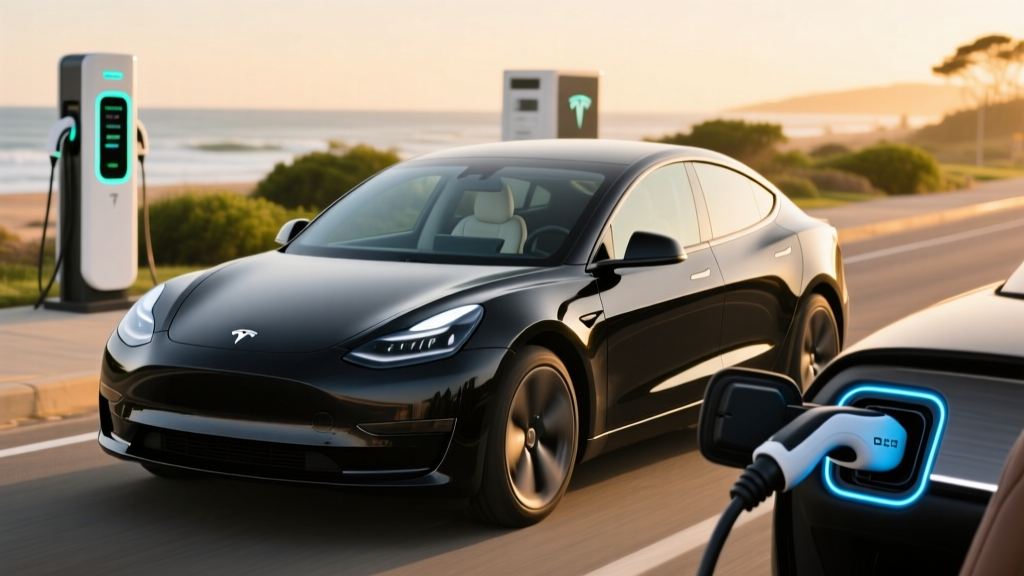
The 2026 Tesla Model 3 remains the compact electric sedan against which all others are measured. After a comprehensive refresh that improved cabin quietness, suspension tuning, and efficiency, the Model 3 Long Range AWD delivers an EPA-estimated 363 miles of range — enough for most owners to road-trip without obsessive charging planning. The base Rear-Wheel Drive variant starts at $38,990 before incentives, undercutting rivals like the Hyundai Ioniq 6 and BMW i4 on price-to-range ratio. But the Model 3 isn't flawless: its minimalist interior polarizes, the touchscreen-only controls demand a learning curve, and insurance costs run 15-25% higher than comparable gas sedans. For buyers who prioritize efficiency, charging infrastructure access, and over-the-air updates, it's still the default recommendation.
Range, Battery & Efficiency: What the EPA Number Doesn't Tell You
Real-World Expectation: ~290-320 miles highway at 70 mph; ~240-270 miles in freezing weather with cabin heat. City driving with regenerative braking often exceeds EPA estimates.
The 2026 Model 3 Long Range AWD packs a 79 kWh usable battery (82 kWh gross) using nickel-manganese-cobalt (NMC) chemistry, chosen for its higher energy density and cold-weather performance. The base RWD variant uses a 60 kWh lithium iron phosphate (LFP) battery — heavier per kWh but more durable, with Tesla recommending 100% state-of-charge for daily use on LFP packs (unlike NMC, which benefits from staying between 20-80% SoC for longevity).
Efficiency is where Tesla's engineering shines. The Long Range AWD achieves 130 MPGe combined (26 kWh/100mi) per EPA data, among the best in its class. The RWD variant posts 132 MPGe combined. These numbers translate to roughly $0.04-$0.05 per mile when charging at home on a $0.13/kWh utility rate — about one-third the per-mile fuel cost of a 30 MPG gas sedan.
| Spec | RWD | Long Range AWD | Performance AWD |
|---|---|---|---|
| EPA Range | 341 mi | 363 mi | 315 mi |
| Battery (usable) | 60 kWh (LFP) | 79 kWh (NMC) | 79 kWh (NMC) |
| 0-60 mph | 5.8 sec | 4.2 sec | 2.9 sec |
| Horsepower | 271 hp | 346 hp | 510 hp |
| Drivetrain | RWD | Dual-Motor AWD | Dual-Motor AWD |
| MPGe (combined) | 132 | 130 | 113 |
| Base MSRP | $38,990 | $45,490 | $52,990 |
Charging Speed: DC Fast, Level 2 & Home Setup
Charging infrastructure is Tesla's strongest competitive moat. The Supercharger network exceeds 6,500 stations and 60,000 connectors across North America, and with NACS becoming the industry standard, Tesla owners enjoy native compatibility without adapters.
| Charging Level | Power | Speed | Typical Use |
|---|---|---|---|
| Level 1 (120V) | ~1.4 kW | ~4-5 mi/hr | Emergency/trickle |
| Level 2 (240V, 48A) | 11.5 kW | ~44 mi/hr | Home overnight |
| DC Fast (V3 Supercharger) | Peak 250 kW | 10-80% in ~25 min | Road trips |
| DC Fast (V4 Supercharger) | Peak 250 kW | 10-80% in ~25 min | Newer stations |
The Long Range AWD peaks at 250 kW on DC fast chargers, though sustained rates taper significantly above 60% SoC. Expect 10-80% in roughly 25 minutes under optimal conditions (battery preconditioned via navigation routing to a Supercharger). Above 80%, the charge curve flattens — adding the final 20% can take as long as the first 80%. This is why road-trip strategy focuses on shorter, more frequent stops between 10-80% rather than topping off completely.
Home Level 2 charging at 11.5 kW (48 amps on a 60-amp circuit) adds roughly 44 miles per hour of charging, easily replenishing a full day's driving overnight. A professional Level 2 installation typically costs $800-$2,000 depending on panel proximity and local permit fees. Tesla's Wall Connector retails for $475 and includes a 24-foot cable.
Performance & Driving Dynamics
The 2026 Model 3 Long Range AWD delivers 346 horsepower from its dual-motor setup, hitting 0-60 mph in 4.2 seconds — quick enough for confident highway merging without the neck-snapping aggression of the Performance variant (2.9 seconds, 510 hp). The updated Highland suspension tuning reduces body roll and improves ride compliance over rough pavement, addressing one of the pre-refresh model's most common complaints.
Regenerative braking remains strong, enabling one-pedal driving in most conditions. Tesla removed the user-adjustable regen setting; the system is always active and intuitive after a brief adaptation period. The RWD variant, at 271 hp and 5.8 seconds to 60, feels adequately quick for commuting but noticeably less urgent than AWD variants.
Interior, Tech & Cargo: Minimalism With Tradeoffs
The 2026 Model 3 cabin is quieter than its predecessor — acoustic glass and additional insulation reduce wind and road noise measurably. The 15.4-inch center touchscreen handles nearly all vehicle functions, including climate controls, mirror adjustment, and glovebox release. There is no instrument cluster; speed and navigation appear on the touchscreen's left edge. A rear 8-inch screen provides climate and entertainment controls for back-seat passengers.
Cargo space totals 23 cubic feet (trunk plus frunk), competitive with the Hyundai Ioniq 6 but less than the Model Y's hatchback versatility. Rear legroom measures 35.3 inches — adequate for adults under 6 feet but tight for taller passengers on long trips. The ventilated front seats and panoramic glass roof (with improved UV-blocking tint for 2026) enhance summer comfort, though the glass roof still increases cabin heat soak on 100°F days — preconditioning via the Tesla app mitigates this effectively.
Standard tech includes Tesla's Autopilot (SAE Level 2 driver assistance with adaptive cruise and lane centering), over-the-air updates, and a built-in dashcam using the vehicle's external cameras. Full Self-Driving (Supervised) remains a $8,000 option or $99/month subscription — it's still Level 2 automation requiring active driver supervision, despite the aspirational name.
Pricing, Tax Credit & Total Cost of Ownership
| Trim | MSRP | §30D Credit (max) | Effective Price |
|---|---|---|---|
| RWD | $38,990 | Up to $7,500* | ~$31,490* |
| Long Range AWD | $45,490 | Up to $7,500* | ~$37,990* |
| Performance AWD | $52,990 | Up to $7,500* | ~$45,490* |
*Federal EV tax credit (§30D) eligibility depends on multiple factors per IRS rules: buyer AGI must not exceed $150K single/$300K joint; vehicle MSRP must be under $55K (sedans); battery components and critical minerals must meet domestic-sourcing thresholds that tighten annually. The credit can now be transferred to the dealer at point of sale, reducing your purchase price directly. Always confirm eligibility with a tax professional before relying on credit amounts.
The RWD and Long Range trims fall under the $55K sedan MSRP cap; the Performance variant exceeds it and is ineligible for the federal credit. State incentives (California's CVRP, Colorado's tax credit, etc.) vary by jurisdiction — check your state energy office for current programs.
Five-year ownership costs benefit from minimal maintenance (no oil changes, brake pads last 100K+ miles thanks to regen), but insurance premiums average $1,800-$2,400 annually — 20-30% above a comparable Camry or Accord. Tesla's own insurance product, available in most states, uses real-time driving data and can be cheaper for low-risk drivers.
Pros, Cons & Who Should Buy
- Best-in-class Supercharger network access (native NACS)
- 363-mile EPA range on Long Range AWD eliminates most range anxiety
- 130+ MPGe efficiency keeps per-mile cost under $0.05
- Over-the-air updates add features post-purchase
- Strong safety ratings (NHTSA 5-star, IIHS Top Safety Pick+)
- 8-year/120,000-mile battery & drivetrain warranty
- Touchscreen-only controls frustrate some drivers
- Rear seat legroom tight for tall adults
- Insurance costs 20-30% higher than gas sedans
- FSD (Supervised) remains Level 2 despite the name and $8K price
- Glass roof increases summer heat soak without preconditioning
- No Apple CarPlay or Android Auto integration
Best for: Tech-forward commuters and small families who have home charging access, take occasional road trips (Supercharger network makes this viable), and value efficiency and software innovation over traditional luxury materials. If you regularly carry four adults or need maximum cargo space, consider the Model Y or Hyundai Ioniq 5 instead.
Warranty & Long-Term Battery Outlook
Tesla covers the Model 3's battery and drive unit for 8 years or 120,000 miles (whichever comes first), with a guaranteed minimum 70% capacity retention over that period. Real-world data from Tesla's fleet suggests NMC packs degrade roughly 10-12% over 100,000 miles, with the steepest loss occurring in the first 10,000 miles before stabilizing. The LFP pack in the RWD variant shows even slower degradation — typically 5-8% over the same distance — making it an underrated choice for high-mileage drivers who don't need AWD.
The basic vehicle warranty is 4 years/50,000 miles, matching industry norms. Tesla's mobile service and roadside assistance handle many repairs without a service-center visit.
Frequently Asked Questions
What is the real-world range of the 2026 Tesla Model 3?
The EPA rates the Long Range AWD at 363 miles, but expect 290-320 miles on highway road trips at 70+ mph, and 240-270 miles in freezing temperatures with cabin heating active. City driving with regenerative braking can match or exceed the EPA number.
How fast does the Model 3 charge at home and on road trips?
At home on a Level 2 (240V, 48A) charger, it adds ~44 miles per hour — a full overnight charge. On DC fast chargers (V3/V4 Supercharger), it peaks at 250 kW and charges 10-80% in approximately 25 minutes with battery preconditioning.
Does the 2026 Model 3 qualify for the federal EV tax credit?
The RWD ($38,990) and Long Range AWD ($45,490) are under the $55K sedan MSRP cap and may qualify for up to $7,500, depending on buyer income limits, battery-sourcing requirements, and point-of-sale transfer rules. The Performance ($52,990) is close to the cap — verify current eligibility on fueleconomy.gov.
Is the Model 3 worth buying over the Hyundai Ioniq 6 or BMW i4?
The Model 3 wins on charging infrastructure (Supercharger network), efficiency (130+ MPGe), and software. The Ioniq 6 offers a more traditional interior with physical buttons and Apple CarPlay; the BMW i4 provides a more premium cabin and conventional driving feel but at a higher price and lower range. Choose the Model 3 if Supercharger access and OTA updates matter most.
What are the biggest ownership costs beyond the purchase price?
Insurance ($1,800-$2,400/year), home charger installation ($800-$2,000 one-time), and electricity (roughly $600-$900/year for 12,000 miles at $0.13/kWh). Maintenance is minimal — expect $200-$400/year for cabin air filters, wiper fluid, and tire rotation.