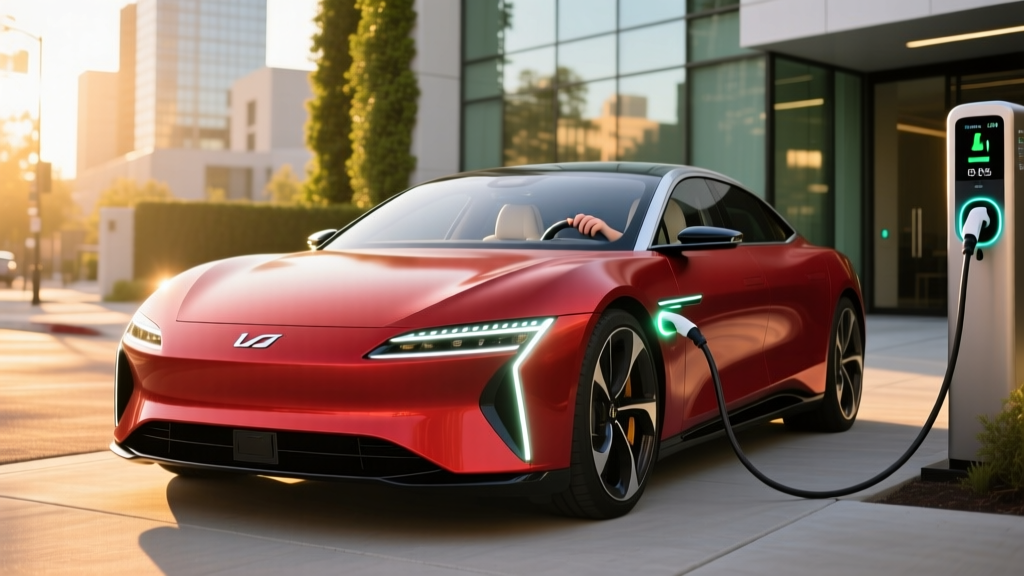
The Lucid Air Pure in Stellar Red — often searched simply as "Lucid Red" — is the entry point into one of the most efficient electric vehicle platforms on the market. For 2026, the Air Pure retains its class-leading efficiency and range while Lucid has refined its software stack and expanded its service center footprint. If you've been eyeing that eye-catching red Lucid on social media or in review videos, here's the complete data-driven breakdown of what you're actually buying.
2026 Lucid Air Pure: Full Specification Overview
| Spec | Value |
|---|---|
| EPA Range | 419 miles |
| Battery (usable) | 88 kWh (NMC lithium-ion) |
| Drivetrain | Rear-Wheel Drive (single motor) |
| Horsepower | 430 hp |
| 0–60 mph | 5.0 seconds |
| Top Speed | 145 mph |
| Efficiency | 146 MPGe / 24 kWh/100mi |
| Max DC Fast Charge | 200+ kW (peak) |
| 10–80% DC Charge | ~15 minutes (peak conditions) |
| Level 2 Home Charging | 19.2 kW onboard (up to ~75 mi/hr) |
| Cargo Volume | 32 cu ft (rear seats up) |
| Rear Legroom | 37.6 inches |
| Battery/Powertrain Warranty | 8 years / 100,000 miles |
| Base MSRP | $69,900 (before incentives) |
Real-World Range: What 419 EPA Miles Actually Means
Real-World Highway (70–75 mph): ~340–365 miles
Real-World Mixed Driving: ~360–390 miles
Cold Weather (below 32°F): ~280–320 miles (30–35% reduction)
Hot Weather w/ AC (above 95°F): ~350–375 miles
The Lucid Air Pure's 419-mile EPA rating (source: fueleconomy.gov) is among the highest of any production EV sold in the U.S. But as with every EV, the EPA number reflects a blended city/highway test cycle that favors stop-and-go regenerative braking.
On sustained highway runs at 70–75 mph — the scenario that matters most for road-trip planning — expect to use roughly 340 to 365 miles before needing a charge. The Air Pure's exceptional 0.20 drag coefficient and efficient powertrain help it hold range better at speed than most competitors, but physics still applies. In freezing temperatures, the NMC battery's usable capacity drops, and cabin heating draws significant energy. Budget 280–320 miles in deep winter and plan charging stops accordingly.
Lucid's heat pump system (standard on 2026 models) partially mitigates cold-weather loss compared to resistive heating, but no EV is immune. The real advantage here is the massive starting buffer — even at 30% winter loss, you still have more usable range than most EVs at full charge.
Charging Performance: DC Fast, Level 2, and the Charge Curve Reality
| Charging Level | Power / Rate | Miles Added per Hour | Notes |
|---|---|---|---|
| Level 1 (120V) | ~1.4 kW | ~3–4 mi/hr | Emergency/trickle only |
| Level 2 (240V, 48A) | ~11.5 kW | ~48 mi/hr | Standard home wall connector |
| Level 2 (240V, 80A) | 19.2 kW | ~75 mi/hr | Requires 100A circuit; full overnight fill |
| DC Fast Charge | 200+ kW peak | ~300 mi in 15 min (peak) | 10–80% ~15 min; tapers above 80% |
The Air Pure supports DC fast charging at up to 200+ kW on compatible CCS or NACS chargers (2026 models ship with a NACS port natively, following Lucid's adoption of the Tesla charging standard). On a 350 kW-rated Electrify America or Tesla Supercharger V4 stall, the Air Pure can recover roughly 200 miles in about 10 minutes under ideal conditions — battery preconditioned, SoC between 10–40%.
However, the charge curve matters more than peak kW. The Air Pure sustains strong charging rates between 10% and 60% SoC, but the rate tapers noticeably above 80%. This is standard NMC behavior to protect battery longevity. Plan to charge to 80% on road trips and move on — sitting for the last 20% can add 15–20 extra minutes for diminishing returns.
At home, the Air Pure's 19.2 kW onboard charger is one of the most powerful in the industry. Most home Level 2 chargers deliver 11.5 kW (48 amps on a 60A circuit), adding about 48 miles per hour — enough to fully replenish overnight. If you invest in a hardwired 80A/100A circuit (electrician cost: typically $1,200–$2,500 depending on panel proximity), you can unlock the full 19.2 kW rate and add 75 miles per hour, filling the entire 88 kWh battery from empty in roughly 5 hours.
Performance, Efficiency, and Daily Drivability
The single-motor RWD Air Pure delivers 430 horsepower and hits 0–60 mph in 5.0 seconds. That's brisk by any measure — faster than a BMW 330i and comparable to a Tesla Model 3 Long Range RWD. The instant torque delivery makes highway merging effortless, and the low center of gravity (battery pack mounted under the floor) gives the Air confident, flat cornering for a full-size luxury sedan.
Where Lucid truly differentiates is efficiency. At 146 MPGe combined (24 kWh/100 miles), the Air Pure sips electricity at a rate that shames heavier, less aerodynamic EVs. For context, that's roughly 25% more efficient per mile than the Mercedes EQS 450+ and about 15% better than the BMW i5 eDrive40. Over 12,000 miles of annual driving, this efficiency gap saves real money on electricity and extends the practical range between charges.
Ride quality is composed and quiet. The Air Pure uses a multi-link front and rear suspension with passive dampers (adaptive air suspension is reserved for the Grand Touring trim). Road noise is minimal at highway speeds, and the cabin remains conversation-friendly even above 80 mph.
Pricing, Trims, and Federal Tax Credit Eligibility
| Trim | MSRP | §30D Credit Eligibility | Effective Price (est.) |
|---|---|---|---|
| Air Pure (RWD) | $69,900 | See eligibility notes below | Varies |
| Air Touring (AWD) | $77,900 | See eligibility notes below | Varies |
| Air Grand Touring (AWD) | $110,900 | Exceeds MSRP cap | $110,900 |
| Air Sapphire (AWD) | $249,000 | Exceeds MSRP cap | $249,000 |
The Air Pure at $69,900 clears the IRS §30D MSRP cap for sedans ($55,000 for new clean vehicles classified as sedans, per IRS guidelines). This is the most critical point for buyers: as a sedan, the Air Pure and Air Touring exceed the $55,000 MSRP cap, which means they do not qualify for the full $7,500 new-vehicle federal tax credit under current §30D rules.
However, there are pathways to incentives:
- Leasing: Vehicles leased through a dealership may qualify for the commercial clean vehicle credit (§45W), which the lessor can pass on as a lease capital cost reduction — effectively a $7,500 discount. This "lease loophole" remains active as of 2026 but is subject to legislative change.
- State incentives: States like California, Colorado, and Massachusetts offer additional rebates that stack independently of federal rules. Check your state's energy office for current programs.
- Used Air models: If purchasing a pre-owned Air Pure, the §25E used clean vehicle credit offers up to $4,000 (or 30% of sale price, whichever is less) for vehicles priced under $25,000 — though finding a used Air at that price is unlikely in the near term.
Buyer income caps also apply under §30D: AGI must not exceed $150,000 (single), $225,000 (head of household), or $300,000 (joint). Always consult a tax professional and verify current-year rules before purchase.
Interior Space, Technology, and Notable Drawbacks
The Air Pure's cabin is minimalist in the way only Lucid can execute it. A 34-inch curved glass cockpit display spans the dashboard, replacing traditional gauges and center stack with a single panoramic interface. Below it sits a retractable lower touchscreen for climate and media controls — a clever touch that opens up dashboard space when not in use.
Space: The Air is a genuine full-size sedan. Rear legroom measures 37.6 inches — generous for adults on long trips. Cargo volume behind the rear seats is 32 cubic feet, including the front trunk (frunk). The frunk alone holds roughly 10 cu ft, useful for charging cables or a carry-on.
DreamDrive Pro (ADAS): Lucid's driver-assistance suite includes adaptive cruise control, lane-centering, automatic emergency braking, blind-spot monitoring, and surround-view cameras. This is an SAE Level 2 system — the driver must remain fully engaged with hands on the wheel and eyes on the road. It performs competently on highways but does not approach autonomous driving capability.
Drawbacks worth noting:
- Service center availability: Lucid has expanded its service network, but coverage remains thin in the Midwest, Mountain West, and rural areas compared to legacy automakers. Mobile service handles many issues, but body repair and major diagnostics may require a tow to a distant center.
- Software maturity: While vastly improved for 2026, Lucid's infotainment still lacks the app ecosystem and third-party integration depth of Tesla. No native Apple CarPlay or Android Auto — everything runs through Lucid's proprietary interface (which does support phone mirroring for basic functions).
- No air suspension on Pure: The Pure trim uses conventional coil springs. If you want the plush, adjustable ride of the Grand Touring, you'll need to step up significantly in price.
- Towing: The Air Pure is not rated for towing. If you need to pull a trailer, look at an SUV-based EV.
Pros and Cons: The Honest Scorecard
Pros
- Class-leading 419-mile EPA range — real-world highway still exceeds 340 mi
- Best-in-class efficiency at 146 MPGe / 24 kWh/100mi
- 19.2 kW onboard Level 2 charger — fastest home charging available
- Genuine full-size sedan interior with adult-friendly rear seats
- Stunning design; Stellar Red is a head-turner
- Quiet, refined highway ride quality
Cons
- Exceeds §30D MSRP cap — no $7,500 federal credit on purchase
- Limited service center network outside major metros
- No Apple CarPlay / Android Auto native integration
- No air suspension on Pure trim
- Not rated for towing
- Insurance premiums run higher than average for the segment
How the Lucid Air Pure Compares to Key Rivals
The Air Pure's closest competitors by price and segment are the Tesla Model S Long Range, BMW i5 eDrive40, and Mercedes-Benz EQS 450+ Sedan. Here's how the data stacks up:
- vs. Tesla Model S Long Range ($74,990): The Model S offers AWD, a Supercharger network advantage, and more mature software — but at 402 miles EPA, it falls slightly short on range and trails significantly on efficiency (124 MPGe vs. 146). The Air Pure is also $5,000 less expensive at base.
- vs. BMW i5 eDrive40 ($66,800): The i5 is a strong driver's car with excellent build quality, but its 295-mile EPA range is a dealbreaker for road-trippers. The Air Pure's 124 additional miles of range is not a marginal advantage — it fundamentally changes trip planning.
- vs. Mercedes EQS 450+ ($104,400): The EQS offers more opulent materials and a smoother ride, but at nearly $35,000 more and with 390 miles EPA, the value proposition heavily favors Lucid for range-per-dollar.
Who Should Buy the Lucid Air Pure (in Red or Any Color)?
Buy the Air Pure if: You prioritize maximum range and efficiency above all else, regularly drive 300+ miles between charges, want a genuinely spacious full-size EV sedan, and live within reasonable distance of a Lucid service center or are comfortable with mobile service.
Look elsewhere if: You need AWD for snow-belt commuting (consider the Air Touring or a Tesla Model S), require a robust dealer service network in a rural area, want Apple CarPlay, or need towing capability.
The Air Pure is an outstanding commuter and road-trip vehicle. Its efficiency means lower electricity costs over ownership, and its range means fewer charging stops. For a single professional or a couple who takes regular long-distance trips, it's arguably the best sedan in the EV market on pure capability-per-dollar. Families with young children may prefer the SUV form factor for easier car-seat loading, but the Air's rear space is genuinely accommodating.
Warranty Coverage and Long-Term Battery Outlook
Lucid covers the Air Pure's battery pack and electric powertrain for 8 years or 100,000 miles (whichever comes first), with a capacity retention threshold of 70% — consistent with industry standards. The basic vehicle warranty is 4 years / 50,000 miles.
The NMC (nickel manganese cobalt) chemistry in the Air Pure's 88 kWh pack is proven in high-mileage applications. Lucid's thermal management system actively conditions the battery during charging and driving, which is critical for long-term health. Based on early high-mileage reports from 2022–2023 Air owners, degradation appears to be in line with or slightly better than industry averages — roughly 5–8% capacity loss over the first 50,000 miles, with the curve flattening significantly afterward.
Battery replacement cost, should it ever be needed out of warranty, is estimated in the $15,000–$22,000 range based on current Lucid service quotes — significant, but comparable to other premium EV platforms.
Frequently Asked Questions
What is the real-world range of the 2026 Lucid Air Pure?
Expect 340–365 miles on sustained highway driving at 70–75 mph, 360–390 miles in mixed city/highway use, and 280–320 miles in freezing winter conditions. The 419-mile EPA rating reflects an idealized blended cycle with generous regenerative braking.
How fast does the Lucid Air Pure charge at home and on the road?
On DC fast chargers, it peaks above 200 kW and can go from 10–80% in approximately 15 minutes under optimal conditions. At home on a standard 48A Level 2 charger, it adds about 48 miles per hour. With a dedicated 80A circuit, the 19.2 kW onboard charger adds up to 75 miles per hour — among the fastest home charging rates available in any EV.
Does the 2026 Lucid Air Pure qualify for the $7,500 federal EV tax credit?
No — under current IRS §30D rules, the MSRP cap for sedans is $55,000, and the Air Pure's $69,900 base price exceeds that limit. However, leasing may unlock a $7,500 credit via the §45W commercial vehicle provision, which lessors can pass through as a capitalized cost reduction. State incentives may also apply. Verify with a tax professional and the IRS clean vehicle credit page.
Is the Lucid Air Pure worth buying over a Tesla Model S?
If range, efficiency, and interior space are your top priorities, the Air Pure offers more miles per charge, better MPGe, and a lower base price. If you prioritize Supercharger network access, over-the-air software maturity, and AWD availability, the Model S has advantages. Both are excellent — the choice depends on your use case.
What are the biggest drawbacks of the Lucid Air Pure?
The main limitations are the limited service center network (especially outside coastal metros), lack of native Apple CarPlay/Android Auto, no air suspension on the Pure trim, no towing capability, and ineligibility for the federal purchase tax credit due to MSRP cap rules. Insurance costs also tend to run above segment averages.
What color options are available, and is "Stellar Red" a premium paint?
Stellar Red is one of Lucid's available exterior colors for the Air lineup. Lucid offers several standard and premium paint options; metallic and special-finish paints may carry an upcharge of $1,000–$2,500 depending on the selection. Confirm current availability with Lucid's configurator, as color offerings can change by model year.
How does the Air Pure's warranty compare to competitors?
Lucid's 8-year/100,000-mile battery and powertrain warranty matches Tesla and BMW. Hyundai and Kia offer 10-year/100,000-mile coverage on their EVs, which is the current segment best. The 70% capacity retention threshold is standard across the industry.
Sources: EPA fuel economy data via fueleconomy.gov, Lucid Motors official specifications, IRS §30D clean vehicle credit guidelines via irs.gov. All pricing and specifications reflect 2026 model year information available at time of publication. Tax credit eligibility is subject to change — consult a tax professional for your specific situation.