The 2026 Tesla Model 3 remains the benchmark against which every compact electric sedan is measured. With the recent "Highland" refresh now fully integrated into the lineup, Tesla's entry-level offering delivers up to 363 miles of EPA-estimated range, a refined interior, and access to the industry's most reliable DC fast-charging network. But with rivals like the Hyundai Ioniq 6, BMW i4, and Chevrolet Equinox EV closing the gap, does the original Tesla compact still earn its reputation?
We've spent extended time behind the wheel of the 2026 Model 3 across multiple trims, charging at everything from home Level 2 setups to 250 kW Superchargers, and crunching the total-cost-of-ownership numbers. Here's what real buyers need to know.
2026 Tesla Model 3 Core Specifications
| Spec | Long Range RWD | Long Range AWD | Performance AWD |
|---|---|---|---|
| EPA Range | 363 mi | 341 mi | 315 mi |
| Battery (usable) | ~75 kWh (NMC) | ~75 kWh (NMC) | ~75 kWh (NMC) |
| MPGe (combined) | 132 MPGe | 125 MPGe | 118 MPGe |
| kWh/100 mi | 25 | 27 | 29 |
| 0–60 mph | 5.8 sec | 4.2 sec | 2.9 sec |
| Horsepower | 271 hp | 346 hp | 510 hp |
| Drivetrain | RWD | Dual-Motor AWD | Dual-Motor AWD |
| Max DC Charge Rate | 250 kW | 250 kW | 250 kW |
| 10–80% DC Time | ~25 min | ~25 min | ~25 min |
| Level 2 Rate | 11.5 kW (~44 mi/hr) | 11.5 kW (~44 mi/hr) | 11.5 kW (~44 mi/hr) |
| Base MSRP | $42,380 | $47,380 | $54,380 |
| Battery Warranty | 8 yr / 120,000 mi | 8 yr / 120,000 mi | 8 yr / 120,000 mi |
Real-World Range: What the EPA Sticker Doesn't Tell You
EPA Estimate: 363 miles
Real-World Highway (70 mph, moderate climate): ~290–310 miles
Real-World City / Mixed Driving: ~320–345 miles
Cold Weather (below 32°F, highway): ~240–270 miles
Highway efficiency drops at sustained speeds above 70 mph due to aerodynamic drag. Cold temperatures reduce battery chemical efficiency and increase cabin heating load. Tesla's heat pump mitigates some loss, but expect 20–30% range reduction in deep winter.
The Long Range RWD variant's 132 MPGe combined rating, per fueleconomy.gov, makes it one of the most efficient EVs sold in the U.S. Its 25 kWh/100 mi consumption figure translates to roughly $0.04–$0.05 per mile on average residential electricity rates — a fraction of the $0.12–$0.15/mile a comparable 30 MPG gas sedan costs at $3.50/gallon.
For daily commuting under 60 miles round-trip, any Model 3 trim provides ample buffer. Road-trippers should plan Supercharger stops every 250 miles or so for comfort — pushing to 10% State of Charge (SoC) adds anxiety and forces a longer charge stop due to the slow charge curve below 10%.
Charging Speed: Supercharger Network and Home Setup
The 2026 Model 3 peaks at 250 kW on DC fast chargers using the native NACS (North American Charging Standard) connector — the same plug now adopted by Ford, GM, Rivian, and most major automakers. Tesla's Supercharger network remains the gold standard for reliability and uptime.
| Charging Level | Power (kW) | Miles Added per Hour | Typical Use Case |
|---|---|---|---|
| Level 1 (120V household) | ~1.2 kW | ~5 mi/hr | Emergency / overnight trickle |
| Level 2 (240V, 48A) | 11.5 kW | ~44 mi/hr | Home daily charging |
| DC Fast (Supercharger V3) | Peak 250 kW | ~1,000+ mi/hr (peak) | Road trips, 10–80% in ~25 min |
| DC Fast (Supercharger V4) | Peak 250 kW | ~1,000+ mi/hr (peak) | Newer stations, same vehicle cap |
Understanding the charge curve: The Model 3 does not sustain 250 kW for the entire session. Peak power occurs between roughly 10–30% SoC, then tapers progressively. By 60% SoC, you're typically seeing 120–150 kW; above 80%, the rate drops to under 50 kW. This is why the 10–80% metric matters more than peak kW alone. Preconditioning the battery — which the car does automatically when you navigate to a Supercharger — is essential for hitting peak rates.
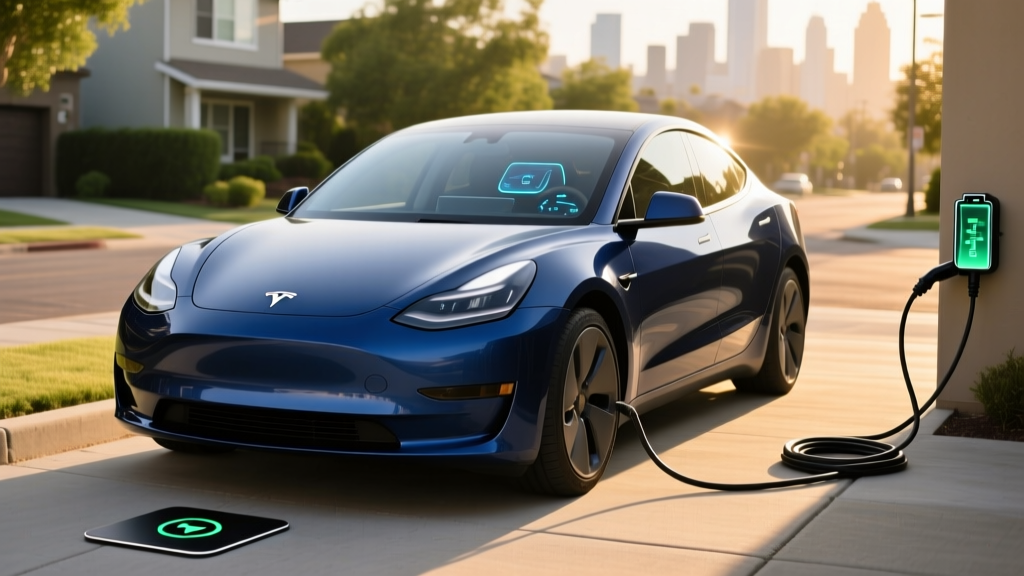
At home on a 48-amp Level 2 wall connector (which Tesla sells for $420), a full overnight charge adds roughly 350 miles in 8 hours — more than enough for any daily routine. Installation costs for a 240V/60A circuit typically run $500–$2,000 depending on panel proximity and local permitting. Homes with older 100A electrical panels may require a $1,500–$3,000 panel upgrade.
Performance and Driving Dynamics
Even the base Long Range RWD Model 3 hits 60 mph in 5.8 seconds — quick by any sedan standard. The dual-motor Long Range AWD drops that to 4.2 seconds with the security of all-weather traction. The Performance trim's 2.9-second sprint puts it in supercar territory, aided by adaptive dampers, track-mode software, and sticky Michelin Pilot Sport 4S tires.
Ride quality improved dramatically with the Highland refresh. The updated suspension tuning absorbs highway expansion joints and potholes with composure the pre-2024 Model 3 lacked. Cabin noise is substantially lower thanks to acoustic glass all around — a meaningful upgrade for long-distance comfort.
Regenerative braking remains one-pedal driving at its best: lift off the accelerator and the car decelerates smoothly to a stop. Tesla does not offer adjustable regen levels, which some drivers transitioning from other EVs miss.
Interior, Tech, and Cargo Space
The minimalist cabin centers on a 15.4-inch touchscreen that handles everything from navigation and media to climate and mirror adjustments. A rear 8-inch screen for back-seat passengers was added with the Highland update. Ventilated front seats, ambient lighting, and a panoramic glass roof are now standard across trims.
Cargo and passenger dimensions:
- Front legroom: 42.4 inches
- Rear legroom: 35.3 inches
- Trunk (rear cargo): 21.0 cu ft
- Frunk (front trunk): 3.1 cu ft
- Total cargo: 24.1 cu ft
The rear seat fits two adults comfortably on longer drives, though the sloping roofline limits headroom for anyone over 6 feet. The 21 cu ft trunk is competitive with compact sedans like the BMW 3 Series but trails hatchback EVs like the Hyundai Ioniq 5 (27 cu ft behind rear seats).
Standout tech: Tesla's infotainment is the most responsive in the industry, with over-the-air updates adding features regularly. The Tesla app provides best-in-class remote preconditioning, location tracking, and charge monitoring. However, the absence of Apple CarPlay and Android Auto remains a dealbreaker for some buyers.
Pricing, Trims, and Federal Tax Credit Eligibility
| Trim | Base MSRP | Destination | Est. After §30D Credit* |
|---|---|---|---|
| Long Range RWD | $42,380 | $1,390 | ~$36,270 (if eligible) |
| Long Range AWD | $47,380 | $1,390 | ~$41,270 (if eligible) |
| Performance AWD | $54,380 | $$1,390 | ~$48,270 (if eligible) |
*The IRS §30D federal tax credit provides up to $7,500 for eligible buyers. Eligibility depends on:
- Buyer income caps: Modified AGI ≤ $150,000 (single), $225,000 (head of household), $300,000 (joint)
- MSRP cap: Sedans must be ≤ $55,000 (all Model 3 trims qualify)
- Battery sourcing: Critical minerals and battery components must meet phased-in domestic/free-trade-partner thresholds — Tesla's U.S.-built battery packs have largely met these requirements, but verify at purchase
- Point-of-sale transfer: As of 2024+, you can transfer the credit to the dealer at purchase for an immediate price reduction, rather than waiting for tax filing
The Long Range RWD at ~$36,270 after the credit is exceptional value for a 363-mile EV. The Performance trim crosses $55K only with significant options (Ultra Red paint, 20" wheels), so most configurations remain under the MSRP cap. Always confirm current-year sourcing compliance with your Tesla advisor at order time — rules evolve annually.
How Does It Compare to Rival Compact EVs?
The Model 3's competitive set has expanded significantly. Here's how the key alternatives stack up:
- Hyundai Ioniq 6 (Long Range RWD): 361 mi EPA, 123 MPGe, starts at ~$42,000. Slightly more efficient, offers CarPlay, but charges slower (peak ~235 kW on 800V architecture) and has less Supercharger-equivalent infrastructure.
- BMW i4 eDrive40: 301 mi EPA, starts at ~$57,000. Premium badge and build quality, but costs substantially more for less range. Qualifies for partial credit only.
- Chevrolet Equinox EV (3RS): 319 mi EPA, starts at ~$43,000. A crossover rather than a sedan, with more cargo space but less efficiency.
- Polestar 2 (Long Range Single Motor): 320 mi EPA, starts at ~$49,900. Scandinavian design, Google-based infotainment, but pricier and less range.
The Model 3's combination of range, charging speed, Supercharger access, and software integration remains unmatched at its price point. Where it loses ground: the Ioniq 6 offers CarPlay and a more conventional interior layout; the BMW i4 delivers traditional luxury materials; and crossover buyers may prefer the Equinox EV's ride height.
Pros, Cons, and Who Should Buy
✅ Pros
- Class-leading 363-mile EPA range (LR RWD)
- 250 kW DC fast charging with proven Supercharger network
- Best-in-class infotainment and OTA updates
- Strong federal tax credit eligibility across all trims
- Low cost of ownership — minimal maintenance, high efficiency
- Significantly improved ride comfort post-Highland refresh
❌ Cons
- No Apple CarPlay / Android Auto
- Rear headroom tight for tall passengers
- Turn-signal buttons on steering wheel (no stalks) take adjustment
- No adjustable regen — one-pedal only
- Insurance premiums run 15–30% above segment average
- Service center wait times can be long in some metro areas
🎯 Who the 2026 Model 3 Suits Best
Buy this if: You want maximum range per dollar, access to the most reliable fast-charging network, and a tech-forward daily commuter that handles road trips effortlessly. Ideal for solo drivers or couples who prioritize efficiency and software integration over traditional luxury cues.
Look elsewhere if: You need maximum rear-seat headroom for tall passengers, insist on Apple CarPlay, prefer a crossover ride height, or want adjustable regenerative braking.
Frequently Asked Questions
What is the real-world range of the 2026 Tesla Model 3?
The EPA rates the Long Range RWD at 363 miles. In real-world mixed driving, expect 320–345 miles. Sustained highway driving at 75 mph drops this to roughly 290–310 miles, and cold weather (below freezing) can reduce range to 240–270 miles depending on cabin heating use and driving style.
How fast does the Model 3 charge at home and on road trips?
On a home Level 2 charger (11.5 kW / 48A), the Model 3 adds about 44 miles of range per hour — a full overnight charge covers any daily commute. On a Tesla Supercharger, it peaks at 250 kW and charges from 10–80% in approximately 25 minutes. Non-Tesla DC fast chargers with NACS connectors deliver similar speeds.
Does the 2026 Tesla Model 3 qualify for the $7,500 federal tax credit?
All three trims fall under the $55,000 MSRP cap for sedans, making them potentially eligible for the full $7,500 under IRS §30D rules. Buyer income must not exceed $150K (single) / $300K (joint), and battery component/critical mineral sourcing must meet 2026 thresholds. The credit can be transferred at point of sale for an immediate price reduction. Confirm eligibility with your tax professional.
Is the Model 3 worth buying over competitors in 2026?
For most compact EV sedan buyers, yes — the Model 3 Long Range RWD at ~$36,270 after the tax credit offers 363 miles of range, 250 kW charging, and Supercharger access that no rival matches at this price. The Hyundai Ioniq 6 is its closest competitor, offering comparable range and CarPlay but lacking equivalent charging infrastructure. If you value a traditional luxury badge, the BMW i4 is compelling but costs $15K+ more for less range.
What is the Tesla Model 3 battery warranty?
Tesla covers the Model 3's battery and drive unit for 8 years or 120,000 miles (whichever comes first), with a guaranteed minimum 70% capacity retention over that period. Tesla's NMC battery packs have demonstrated strong longevity in fleet data, with typical degradation of 10–12% over the first 100,000 miles.
Does Autopilot make the Model 3 self-driving?
No. Tesla's Autopilot and Full Self-Driving (Supervised) are SAE Level 2 driver-assistance systems. The driver must remain actively engaged, hands on the wheel, and eyes on the road at all times. These systems assist with steering, acceleration, and braking but do not replace driver attention. True Level 4 autonomous driving (no driver required) is currently available only in geofenced robotaxi services like Waymo.