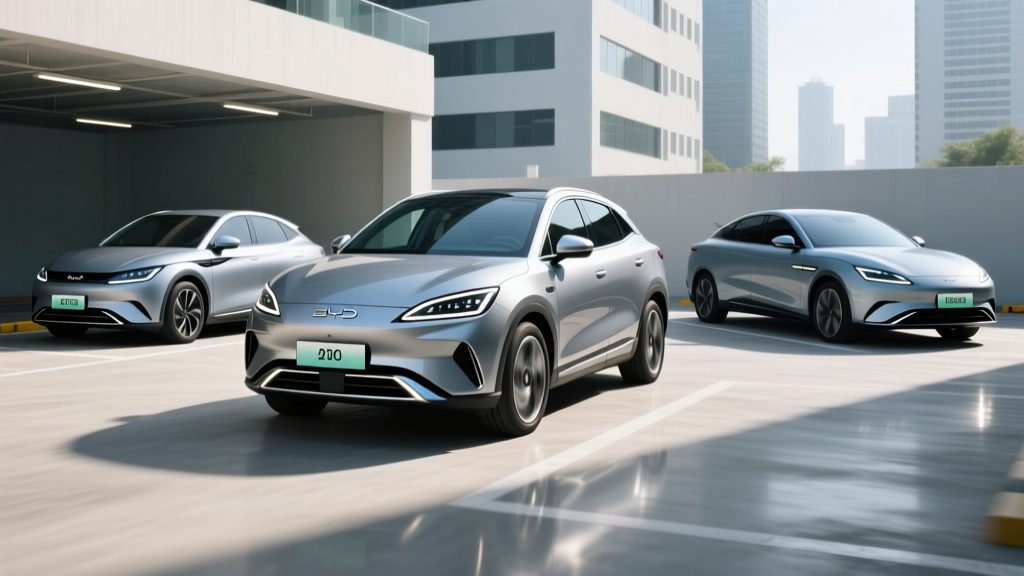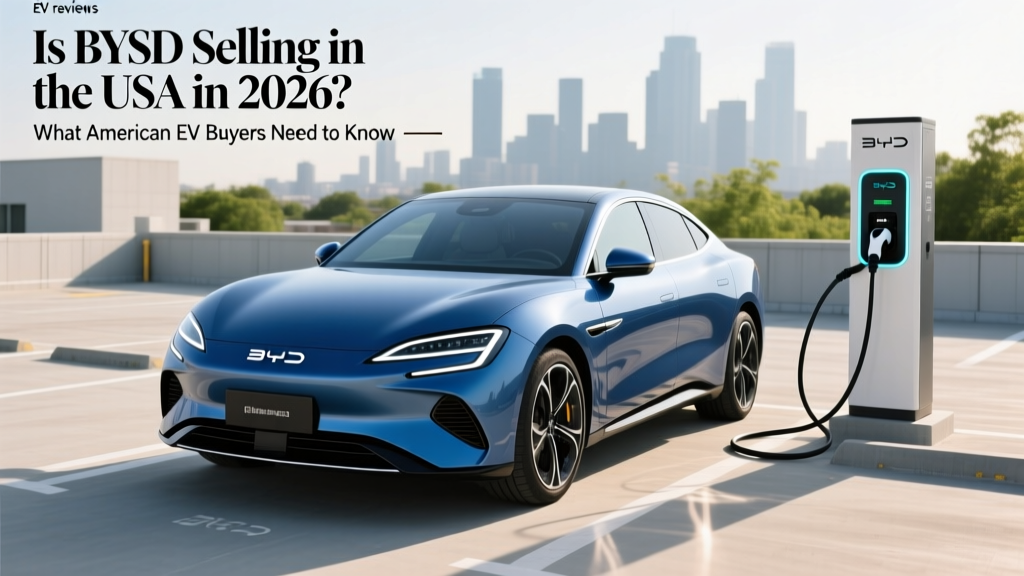
If you have followed the global electric vehicle market over the past few years, you have likely seen BYD surpass Tesla in global BEV sales volume and dominate headlines with aggressively priced models across Europe, Southeast Asia, and Latin America. That success naturally leads to a question we hear constantly from readers: Is BYD selling in the USA?
The short answer as of 2026: No, BYD does not currently sell passenger electric vehicles to consumers in the United States. The company sells electric buses and commercial vehicles stateside, but its passenger EV lineup — including the popular Seal sedan, Atto 3 crossover, and Dolphin hatchback — remains unavailable to American buyers.
The reasons are a complex intersection of tariffs, geopolitics, and strategic market prioritization. In this guide, we unpack exactly why BYD is absent from US showrooms, examine the models American buyers are missing, analyze the barriers to entry, and identify which currently available EVs offer the closest value proposition to what BYD delivers overseas.
Why BYD Passenger EVs Are Not Sold in the United States
BYD's absence from the US passenger car market is not an accident or an oversight — it is the result of deliberate policy barriers and corporate strategy.
The Tariff Wall: 100%+ Duties on Chinese EVs
In May 2024, the Biden administration announced a dramatic increase in Section 301 tariffs on Chinese-made electric vehicles, raising the duty from 25% to 100%. This tariff took effect in August 2024 and remains in place through 2026. When you layer on the existing 2.5% standard auto import tariff, a Chinese-built EV faces an effective import duty exceeding 102% before it even reaches a US port.
What does that mean in practice? A BYD Seal that retails for roughly €40,000 (~$43,000) in Germany would effectively double in cost before factoring in dealer margins, logistics, and compliance modifications. The price advantage that makes BYD disruptive globally evaporates at the US border.
National Security and Data Concerns
Beyond tariffs, the US government has raised concerns about connected-vehicle data collection by Chinese automakers. In 2024, the Commerce Department initiated rulemaking that would effectively ban Chinese-made connected vehicle hardware and software on US roads, citing national security risks. This proposed rule targets the telematics, infotainment, and ADAS systems that are integral to modern EVs — making compliance a significant additional hurdle even if tariff barriers were somehow navigated.
BYD's Strategic Prioritization
BYD has been transparent about its market priorities. The company is aggressively expanding in markets where it faces lower tariff barriers and stronger demand growth: Europe (despite EU countervailing duties of up to 35.3% imposed in 2024), Southeast Asia, Australia, Brazil, and the Middle East. Building a US dealer network, homologating vehicles to FMVSS standards, and navigating the litigious American product-liability environment represent enormous investments for a market where tariffs make their core value proposition untenable.
BYD's Global Lineup: What American Buyers Are Missing
To understand what US buyers would gain if BYD entered the market, we need to look at the models currently available overseas. Below are specifications for BYD's most prominent global passenger EVs, using the latest available data from BYD's international press materials.
| Model | Body Style | Battery (kWh) | Chemistry | WLTP Range | Peak DC Charge | 0-100 km/h | Intl. Price (approx.) |
|---|---|---|---|---|---|---|---|
| BYD Dolphin | Hatchback | 60.4 kWh | LFP (Blade) | 265 mi (427 km) | 88 kW | 7.0 s | ~$30,000 |
| BYD Atto 3 | Compact SUV | 60.48 kWh | LFP (Blade) | 260 mi (420 km) | 88 kW | 7.3 s | ~$38,000 |
| BYD Seal | Sedan | 82.5 kWh | LFP (Blade) | 354 mi (570 km) | 150 kW | 3.8 s (AWD) | ~$48,000 |
| BYD Han | Full-size Sedan | 85.4 kWh | LFP (Blade) | 323 mi (521 km) | 120 kW | 3.9 s (AWD) | ~$55,000 |
| BYD Tang | 3-Row SUV | 108.8 kWh | LFP (Blade) | 330 mi (530 km) | 120 kW | 4.6 s (AWD) | ~$60,000 |
Note: WLTP range figures are generally 10-20% higher than EPA estimates. International pricing varies by market and does not include US tariffs or destination charges. All models use BYD's proprietary Blade Battery (LFP chemistry).
The Blade Battery Advantage
Every BYD passenger EV uses the company's proprietary Blade Battery, a lithium iron phosphate (LFP) cell in a cell-to-pack configuration that eliminates modules. The Blade design uses long, thin cells arranged like blades in a sheath, improving pack-level volumetric efficiency and thermal stability.
LFP chemistry offers distinct advantages for cost-conscious buyers:
- Longer cycle life: LFP cells typically sustain 3,000+ full charge cycles before reaching 80% capacity — roughly double that of NMC cells
- Thermal stability: LFP is significantly less prone to thermal runaway, reducing fire risk
- No cobalt or nickel: Eliminates supply-chain ethics concerns and reduces raw-material cost exposure
- 100% SoC charging: LFP batteries tolerate regular charging to 100% without accelerated degradation, unlike NMC which benefits from an 80% daily limit
The trade-off: LFP has lower energy density than NMC, meaning heavier packs for equivalent range, and reduced performance in extreme cold (below 20°F / -7°C).
Could BYD Enter the US Market? Barriers and Workarounds
Building a US Factory: The Mexico Question
BYD has explored manufacturing outside China to mitigate tariff exposure. The company opened a factory in Thailand (2024), is building one in Brazil (expected 2025-2026), and announced a Hungary plant. However, a North American factory — which could potentially allow BYD vehicles to qualify for USMCA trade provisions and avoid the Section 301 tariff — has not materialized.
A proposed BYD factory in Mexico was widely discussed in 2023-2024, but as of 2026, BYD has not committed to a Mexican production facility for vehicles destined for the US market. Even if built, vehicles from a Mexican plant would still face scrutiny under the connected-vehicle data rules and would need to meet USMCA rules of origin (75% regional content) to avoid standard tariffs.
FMVSS Homologation and Dealer Network Costs
Entering the US market requires more than just shipping cars. Every vehicle must comply with Federal Motor Vehicle Safety Standards (FMVSS), which differ from the UNECE standards used in most other markets. Differences span lighting, crash-test protocols, bumper standards, and mirror requirements. Homologating an entire lineup typically costs hundreds of millions of dollars and takes 2-3 years.
Additionally, most US states require a franchised dealer network for new-car sales. Building that network from scratch — or fighting legal battles to adopt a direct-sales model like Tesla — represents another multi-year, multi-billion-dollar investment.
What US EVs Compete With BYD's Global Pricing?
Since BYD isn't an option for American buyers, which currently available EVs come closest to matching BYD's global value proposition? We compared key BYD models against their closest US-market equivalents.
| Category | BYD Model (Global) | US Alternative | US MSRP | EPA Range | §30D Credit Eligible? |
|---|---|---|---|---|---|
| Budget Hatchback | Dolphin (~$30K) | Chevrolet Equinox EV 2LT | $33,600 | 319 mi | Yes (up to $7,500) |
| Compact SUV | Atto 3 (~$38K) | Hyundai Kona Electric SEL | $34,975 | 261 mi | No (Korea-sourced) |
| Mid-Size Sedan | Seal (~$48K) | Tesla Model 3 Long Range AWD | $47,740 | 341 mi | Yes (up to $7,500) |
| Full-Size Sedan | Han (~$55K) | Hyundai Ioniq 6 SEL AWD | $49,250 | 290 mi | No (Korea-sourced) |
| 3-Row SUV | Tang (~$60K) | Kia EV9 Land AWD | $63,900 | 283 mi | Yes (up to $7,500, GA-built) |
BYD's Blade Battery Tech: How It Compares
BYD's vertical integration is arguably its biggest competitive advantage. Unlike most automakers that source cells from CATL, LG, Samsung SDI, or SK On, BYD manufactures its own batteries, semiconductors, and electric motors. This gives the company extraordinary cost control.
| Attribute | LFP (BYD Blade) | NMC (Typical US EVs) |
|---|---|---|
| Energy Density (cell-level) | ~170 Wh/kg | ~250-300 Wh/kg |
| Cycle Life (to 80% SoH) | 3,000-5,000 cycles | 1,000-2,000 cycles |
| Thermal Runaway Risk | Very low | Moderate (requires active BMS) |
| Cold-Weather Performance | Weaker (20-35% range loss at 20°F) | Better (15-25% range loss at 20°F) |
| Recommended Daily Charge Limit | 100% SoC acceptable | 80% SoC recommended |
| Cobalt/Nickel Content | None | Contains both |
| Cost per kWh (pack-level) | ~$80-100 | ~$110-140 |
It is worth noting that BYD is not alone in adopting LFP. Tesla uses CATL-supplied LFP cells in the Model 3 RWD and Model Y Standard Range built for the US market. Ford also uses LFP in the Mustang Mach-E Select. The chemistry is gaining ground globally as automakers prioritize cost reduction and longevity over maximum energy density.
The Bottom Line: Should You Wait for BYD?
Verdict: Don't Wait
Based on the current tariff environment, regulatory trajectory, and BYD's own stated market priorities, there is no realistic scenario in which BYD sells passenger EVs in the United States before 2028 at the earliest — and even that timeline would require a dramatic shift in trade policy or a significant BYD investment in North American manufacturing.
American EV buyers in 2026 are better served by the growing selection of competitively priced domestic and allied-market EVs. The Chevrolet Equinox EV starts under $34,000 with 319 miles of range. The Tesla Model 3 Long Range delivers 341 miles and Supercharger access for under $48,000. The Hyundai Ioniq 5 and Kia EV6 offer 800V fast-charging architecture that outpaces anything in BYD's current global lineup.
If trade relations between the US and China shift substantially — or if BYD commits to a US or Mexico factory with sufficient local content — we will update this analysis. Until then, BYD's impressive global lineup remains a spectator sport for American consumers.
Frequently Asked Questions
Is BYD selling in the USA in 2026?
No. BYD sells electric buses and commercial vehicles in the US, but its passenger car lineup (Dolphin, Atto 3, Seal, Han, Tang) is not available to American consumers. A 100% Section 301 tariff on Chinese-made EVs, combined with proposed connected-vehicle data restrictions, effectively blocks Chinese passenger EVs from the US market.
Does BYD qualify for the $7,500 federal EV tax credit?
This is a moot question since BYD vehicles cannot be purchased in the US. Even if they could, Chinese-built EVs would not qualify for the IRS §30D credit, which requires final assembly in North America and strict battery-component and critical-mineral sourcing requirements designed to reduce reliance on Chinese supply chains.
What is the cheapest EV I can buy in the US that competes with BYD?
The closest value competitor to BYD's global pricing is the Chevrolet Equinox EV, starting at $33,600 with an EPA-estimated 319 miles of range. After the §30D credit (if eligible), the effective price can drop below $27,000 — competitive with what a BYD Atto 3 would cost even without tariffs.
Will BYD ever build cars in the US or Mexico?
As of 2026, BYD has not announced a US or Mexico passenger-vehicle factory. The company has discussed a potential Mexico plant, but no commitment has been made. BYD's confirmed factory plans outside China include Thailand (operational), Brazil (under construction), Hungary (announced), Indonesia, and Turkey. A North American plant is possible but not currently in BYD's public roadmap.
Are BYD Blade Batteries better than what's in US EVs?
It depends on your priorities. BYD's LFP Blade Battery excels in cycle life (3,000+ cycles vs. 1,000-2,000 for NMC), thermal safety, and cost. However, NMC batteries (used in most long-range US EVs) offer higher energy density for greater range per pound and better cold-weather performance. Neither is universally "better" — LFP is ideal for daily commuting and longevity; NMC is better for maximum range and cold climates. Tesla and Ford already use LFP in some US models.
What BYD models are most likely to come to the US first?
If BYD were to enter the US market, the BYD Seal sedan and BYD Atto 3 compact SUV would be the most logical candidates — they compete in high-volume segments and have already been homologated for multiple international markets. However, any US launch would require significant modifications for FMVSS compliance, NACS charging port adoption (required by 2025 industry shift), and a dealer or direct-sales infrastructure.
Sources: BYD international press materials, IRS §30D Clean Vehicle Credit guidelines, fueleconomy.gov for US-market EPA ratings, USTR Section 301 tariff documentation.