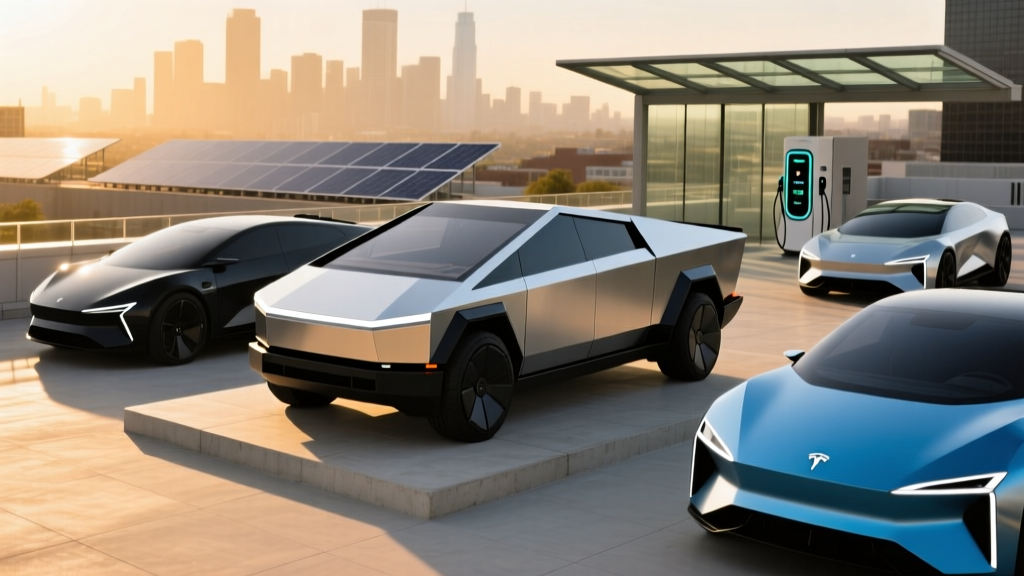
The angular, stainless-steel pickup that polarized the automotive world has settled into its role as one of the most talked-about EVs on the road. If you've been searching for a cybertruck inspired electric truck — whether that means the Tesla Cybertruck itself or competitors drawing from its bold design language — this review covers exactly what the 2026 Cybertruck delivers in range, charging, performance, and ownership reality. No hype, just the numbers and the real-world ownership picture you need before signing a lease or purchase agreement.
2026 Tesla Cybertruck: At-a-Glance Specs
| Spec | AWD (Dual-Motor) | Cyberbeast (Tri-Motor) |
|---|---|---|
| EPA Range | 340 mi | 320 mi |
| Battery Capacity | ~123 kWh usable (NMC) | ~123 kWh usable (NMC) |
| Max DC Fast Charge | 250 kW | 250 kW |
| 10–80% Charge Time | ~28 min | ~28 min |
| Level 2 Home Charging | 11.5 kW (~44 mi/hr) | 11.5 kW (~44 mi/hr) |
| 0–60 mph | 3.9 sec | 2.6 sec |
| Horsepower | 600 hp | 845 hp |
| Drivetrain | Dual-Motor AWD | Tri-Motor AWD |
| MPGe (Combined) | ~60 MPGe | ~56 MPGe |
| Towing Capacity | 11,000 lbs | 11,000 lbs |
| Base MSRP | $79,990 | $99,990 |
| Battery Warranty | 8 yr / 120,000 mi | 8 yr / 120,000 mi |
Sources: EPA fueleconomy.gov, Tesla Cybertruck specs.
Real-World Range: What the EPA Sticker Doesn't Tell You
EPA Estimate: 340 mi (AWD) / 320 mi (Cyberbeast)
Real-World Highway (70 mph): Expect ~260–290 mi
Cold Weather (below 32°F): Expect ~220–260 mi
Mixed City/Suburban: Closest to EPA — ~300–330 mi
The Cybertruck's brick-like aerodynamics (a drag coefficient around 0.335 Cd) punish it at highway speeds far more than a sleek sedan like the Model S. In our experience and consistent with independent testing, sustained 70–80 mph driving drops range roughly 15–20% below the EPA figure. In freezing temperatures, the NMC battery's internal resistance increases and cabin heating draws significant power — even with the heat pump, expect a 20–30% reduction. If your commute is mostly stop-and-go city driving where regenerative braking recaptures energy, you'll come closest to the 340-mile sticker. For road trips, plan charging stops around 240–260 miles apart to maintain a safety buffer.
Charging: DC Fast Charging and Home Level 2 Setup
The Cybertruck uses the NACS (North American Charging Standard) connector natively — no adapter needed for Tesla Superchargers. It supports a peak DC fast-charge rate of 250 kW at V3/V4 Supercharger stalls. Here's what that means in practice:
| Charging Level | Power (kW) | Speed (mi/hr added) | Typical Use Case |
|---|---|---|---|
| Level 1 (120V outlet) | ~1.4 kW | ~5 mi/hr | Emergency/overnight trickle |
| Level 2 (240V, 48A) | 11.5 kW | ~44 mi/hr | Home daily charging |
| DC Fast (Supercharger V3) | Peak 250 kW | Up to ~1,000 mi/hr (at peak) | Road trips, 10–80% in ~28 min |
A critical ownership note: the 250 kW figure is a peak, not a sustained rate. The Cybertruck's charge curve tapers significantly above 60% state of charge (SoC). You'll see 250 kW only in the 10–30% SoC window, dropping to ~150 kW by 50%, and ~60 kW by 80%. This is standard NMC battery behavior — charging fast generates heat, and the battery management system (BMS) throttles power to protect cell longevity. Always precondition the battery by navigating to a Supercharger in the Tesla app or navigation; this warms the cells to optimal temperature and can shave 5–8 minutes off your session.
For home charging, a 48-amp Level 2 wall connector on a 60-amp circuit delivers the full 11.5 kW, adding roughly 44 miles of range per hour. A full 10–100% charge takes about 10–11 hours — plug in at night, wake up full. Installation typically runs $800–$2,000 depending on panel capacity and conduit distance (consult a licensed electrician for your specific setup).
Performance and Drivetrain: The Numbers Behind the Stainless Steel
The dual-motor AWD Cybertruck produces 600 hp and hits 0–60 mph in 3.9 seconds — quick enough to embarrass most sports cars at stoplights while hauling a bed full of lumber. The tri-motor Cyberbeast pushes 845 hp and a 2.6-second 0–60 time, making it one of the fastest production pickups ever built. Both variants use steer-by-wire and rear-wheel steering (up to 10 degrees), which shrinks the turning circle to a surprisingly manageable 34.8 feet despite the truck's 231-inch length.
Towing capacity is rated at 11,000 lbs for both trims — competitive with the Ford F-150 Lightning and Rivian R1T. However, towing at max capacity cuts range roughly in half. Plan on ~150–170 miles of range when towing 10,000+ lbs, with frequent Supercharger stops.
Pricing, Trims, and Federal Tax Credit Eligibility
| Trim | Base MSRP | Est. After §30D Credit* | Delivery Status (2026) |
|---|---|---|---|
| AWD (Dual-Motor) | $79,990 | ~$72,490 | Available / 2–6 month wait |
| Cyberbeast (Tri-Motor) | $99,990 | ~$92,490 | Available / 3–8 month wait |
*Tax credit estimates assume buyer eligibility. See IRS rules below.
The original $40,000 Cybertruck promise from 2019 is long dead. The 2026 lineup starts at $79,990 for the AWD and $99,990 for the Cyberbeast. A rear-wheel-drive (RWD) variant was announced at a lower price point but has not entered volume production as of mid-2026.
- Maximum credit: $7,500 if both battery-component and critical-mineral requirements are met; $3,750 if only one is met.
- MSRP cap: Pickup trucks must be ≤$80,000 MSRP to qualify. The AWD at $79,990 barely clears this; the Cyberbeast at $99,990 does NOT qualify.
- Buyer income caps: AGI ≤$150,000 (single), ≤$300,000 (joint), ≤$225,000 (head of household).
- Battery sourcing: Increasingly strict critical-mineral and component sourcing requirements apply; verify current-year compliance on IRS.gov.
- Point-of-sale transfer: Eligible buyers can transfer the credit to the dealer at purchase, reducing the upfront price directly.
Cargo, Interior, and Daily Usability
The Cybertruck's 6-foot bed offers 74 cu ft of cargo volume, with a motorized tonneau cover that Tesla claims can support 300 lbs of distributed weight. The vault includes built-in 120V and 240V outlets, enabling vehicle-to-load (V2L) capability — you can power tools, a campsite, or even a small appliance directly from the truck's battery. The frunk adds 7 cu ft of lockable storage.
Inside, the cabin seats five (not six — no front bench). Rear legroom is adequate at ~38 inches but the upright seatback and high floor mean taller passengers will find long rides less comfortable than in a Rivian R1T or Ford F-150 Lightning. The 18.5-inch center touchscreen runs Tesla's latest UI with navigation, streaming, and gaming. There are no physical buttons for climate or mirrors — everything routes through the screen, which draws strong opinions in both directions.
Driver Assistance, Tech, and Notable Drawbacks
Tesla Autopilot and Full Self-Driving (Supervised) are Level 2 driver-assist systems. The driver must remain fully engaged, hands on the steering yoke, eyes on the road. This is NOT autonomous driving. Only Level 4 services like Waymo operate without a human driver.
The Cybertruck ships with Tesla's Hardware 4 suite: cameras providing 360-degree vision, enabling Autopilot (standard) and FSD Supervised ($8,000 option or $99/month subscription). FSD handles highway lane changes, on/off-ramp navigation, and some city-street maneuvers, but requires constant supervision. It's impressive technology that reduces fatigue on long drives, but it does not eliminate the driver's responsibility.
Notable drawbacks:
- Stainless-steel panels: Highly resistant to dents but show fingerprints and scratches; panel gaps remain inconsistent on some units.
- Steer-by-wire learning curve: The yoke and variable-ratio steering require adaptation, especially in parking lots.
- No Apple CarPlay/Android Auto: Tesla's proprietary infotainment only.
- Insurance costs: Cybertruck insurance premiums run 30–50% higher than comparable F-150 Lightning policies, driven by repair costs for the steel exoskeleton and parts availability.
- Visibility: The angular design and thick A-pillars create blind spots; rely heavily on camera views.
Who Should Buy the Cybertruck — and Who Should Look Elsewhere
- You want a distinctive, high-performance electric truck for daily driving and weekend towing (<8,000 lbs typical).
- You live within reliable Supercharger network coverage for road trips.
- You value V2L capability for job-site or camping use.
- Your AGI is under $150K/$300K and the AWD's $79,990 MSRP clears the §30D cap.
- You need a true work truck for daily heavy towing — the F-150 Lightning or Silverado EV offer more fleet infrastructure.
- You want a comfortable, quiet family hauler — the Rivian R1T or even a 3-row SUV like the Kia EV9 offer better rear-seat comfort.
- You're on a budget below $60K — consider the used EV market or wait for the RWD Cybertruck (announced, not yet in volume production).
Cybertruck Inspired: How It Stacks Up Against Key Rivals
The "cybertruck inspired" search trend reflects buyers drawn to the angular, futuristic truck aesthetic. While no mainstream competitor has adopted the Cybertruck's stainless-steel exoskeleton, the electric truck segment has matured with strong alternatives:
| Spec | Tesla Cybertruck AWD | Ford F-150 Lightning (Ext. Range) | Rivian R1T (Dual-Motor Max) |
|---|---|---|---|
| EPA Range | 340 mi | 320 mi | 410 mi |
| Battery (kWh) | ~123 (NMC) | ~131 (NMC) | ~141 (NMC) |
| Max DC Charge | 250 kW | 150 kW | 220 kW |
| 0–60 mph | 3.9 sec | ~4.5 sec | ~3.5 sec |
| Towing | 11,000 lbs | 10,000 lbs | 11,000 lbs |
| Base MSRP | $79,990 | ~$74,995 | ~$79,900 |
| §30D Eligible | AWD only (borderline) | Yes (select trims) | Yes (select trims) |
The Rivian R1T Max Pack wins on range (410 mi EPA) and interior refinement. The F-150 Lightning wins on familiarity, dealer service network, and fleet-friendliness. The Cybertruck wins on raw performance, Supercharger network access, and sheer presence. Your priority ranking among range, charging speed, comfort, and style determines the right choice.
Frequently Asked Questions
What is the real-world range of the Tesla Cybertruck?
The EPA rates the AWD at 340 miles and the Cyberbeast at 320 miles. In real-world highway driving at 70+ mph, expect 260–290 miles. In freezing weather, that drops to 220–260 miles. City driving with regenerative braking gets you closest to the sticker number.
How fast does the Cybertruck charge at home and on the road?
At a 250 kW Supercharger, 10–80% takes approximately 28 minutes (with battery preconditioning). At home on a 48-amp Level 2 charger (11.5 kW), you'll add about 44 miles per hour, fully recharging overnight in ~10–11 hours. A standard 120V outlet adds only ~5 miles per hour — adequate only for emergencies or low-mileage days.
Does the Cybertruck qualify for the $7,500 federal EV tax credit?
Only the AWD trim at $79,990 MSRP potentially qualifies under the §30D $80,000 truck cap. The Cyberbeast at $99,990 exceeds the cap and does not qualify. Even for the AWD, you must meet income caps (≤$150K single, ≤$300K joint) and the vehicle must satisfy battery-component and critical-mineral sourcing requirements, which change annually. Verify on IRS.gov and consult a tax professional.
Is the Cybertruck worth buying over the F-150 Lightning or Rivian R1T?
If you prioritize acceleration, Supercharger network reliability, and V2L capability, the Cybertruck is compelling. If you need maximum range (Rivian R1T Max at 410 mi), better rear-seat comfort, or a traditional dealer service experience (Ford Lightning), those alternatives are stronger fits. The Cybertruck's insurance costs and polarizing design are legitimate factors to weigh.
What are the biggest pros and cons of owning a Cybertruck?
Pros: 2.6–3.9 sec 0–60 performance, native NACS/Supercharger access, 11,000-lb towing, V2L power outlets, stainless-steel dent resistance, strong over-the-air update cadence.
Cons: Highway range falls well short of EPA, high insurance premiums, yoke steering learning curve, no CarPlay/Android Auto, inconsistent panel gaps, limited service center capacity in some regions, Cyberbeast priced out of tax credit eligibility.
What is the battery warranty?
Tesla covers the Cybertruck's battery and drive unit for 8 years or 120,000 miles, whichever comes first, with a minimum 70% capacity retention threshold. This is slightly better than the industry-standard 8yr/100,000mi and reflects the expected duty cycle of a pickup truck.