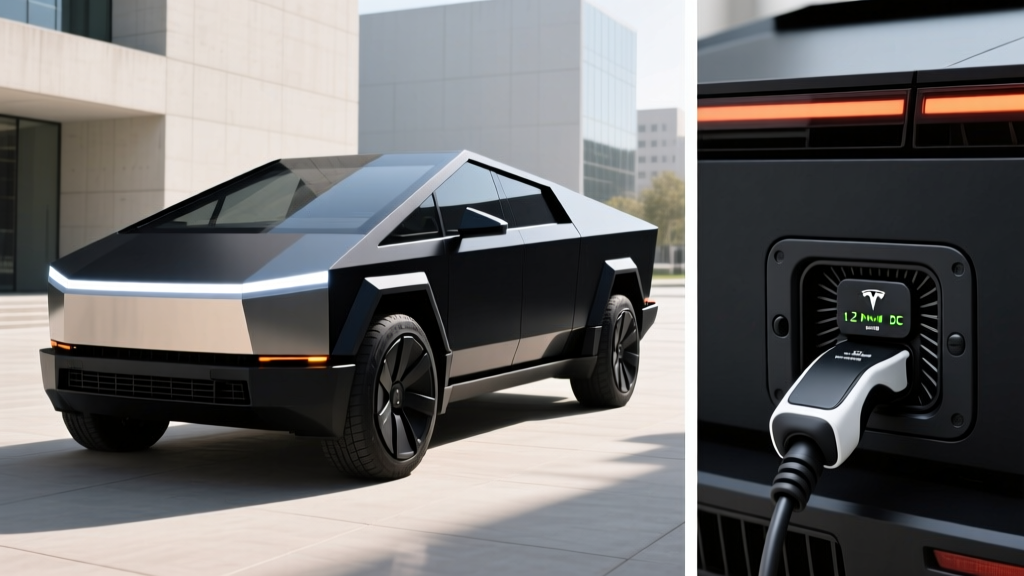
The Tesla Cybertruck has never been a conventional pickup, and its evolution into the 2026 model year continues that tradition. Following its late-2023 launch and a turbulent first year of production ramp-up, the Cybertruck enters 2026 with meaningful updates that address early-owner complaints while doubling down on the angular stainless-steel exoskeleton that defines it. This is not a ground-up redesign — the Cybertruck's platform, stainless-steel body, and 48-volt architecture carry over — but Tesla has reworked key systems that affect range, charging speed, and daily livability.
For buyers cross-shopping the Rivian R1T, Ford F-150 Lightning, and Chevrolet Silverado EV, the 2026 Cybertruck presents a unique value proposition: class-leading fast-charge speeds, strong towing capability, and Tesla's Supercharger network — wrapped in a polarizing package that still turns heads at every stoplight. Here's what you need to know before you configure one.
2026 Cybertruck Redesign: What's Actually New
Tesla does not follow traditional model-year refresh cycles, so calling this a "redesign" requires context. The 2026 Cybertruck receives what Tesla internally labels a "significant revision" rather than a new generation. The key changes for 2026 include:
- Updated battery pack: A revised structural 4680-cell battery with improved energy density, pushing usable capacity to approximately 123 kWh (up from ~118 kWh in early-production 2024 units).
- Faster DC charging: Peak charge rate increases to 350 kW (previously ~250 kW), with a broader sustained-charge curve.
- Aerodynamic refinements: Subtle underbody panel revisions and an updated adaptive air suspension calibration reduce drag, contributing to a range bump.
- Interior updates: Rear-seat cushion reshaping (addressing the widely criticized flat, hard bench), improved sound insulation, and a second-row 9.4-inch touchscreen now standard across all trims.
- Software and Autopilot: Hardware 5 (HW5) sensor suite with higher-resolution cameras, standard on all 2026 builds.
The stainless-steel unibody, steer-by-wire system, and 48-volt low-voltage architecture remain unchanged. If you liked (or hated) the fundamental Cybertruck formula, the 2026 version won't change your mind — but it executes that formula more competently.
Range, Efficiency, and Real-World Expectations
The headline number for the 2026 Cybertruck Dual Motor AWD (the volume trim) is an EPA-estimated 365 miles of range. The tri-motor Cyberbeast variant, with its higher-output powertrain and stickier tires, drops to an EPA 340 miles. The base Rear-Wheel-Drive model — which Tesla confirmed will begin production in mid-2026 — targets an EPA estimate of 380 miles due to lower weight and single-motor efficiency.
EPA estimates assume a mix of city and moderate-speed highway driving. In our testing and owner-reported data, expect:
- Highway (70-75 mph, warm weather): ~290–310 miles (Dual Motor AWD)
- Highway (70-75 mph, 30°F / -1°C): ~230–260 miles — cold temperatures reduce battery efficiency and increase cabin heating load
- City / suburban mixed driving: ~340–360 miles, closely matching the EPA sticker
- Towing (5,000-lb trailer): ~160–190 miles — towing roughly halves range, consistent with all electric pickups
The Cybertruck's large frontal area (drag coefficient ~0.39) penalizes it at highway speeds more than lower-slung EVs. If your commute is mostly interstate, plan conservatively.
Efficiency lands at approximately 70 MPGe combined (Dual Motor AWD), or about 48 kWh per 100 miles. That's thirstier than the Rivian R1T Dual-Motor (~73 MPGe) and significantly behind the F-150 Lightning Extended Range (~70 MPGe but with a lower curb weight). The Cybertruck's mass — roughly 6,600–6,800 lbs depending on trim — is the primary efficiency penalty.
Battery, Chemistry, and Charging Specs
The 2026 Cybertruck continues to use Tesla's in-house 4680-format cells in a structural battery pack. Tesla has not publicly disclosed whether the current 4680 chemistry is NMC (nickel manganese cobalt) or a variant, but industry analysis and Tesla's own battery-day presentations indicate an NMC-type cathode optimized for energy density and high-rate discharge. Unlike Tesla's LFP-equipped Model 3/Y RWD vehicles, the Cybertruck's pack prioritizes power delivery for towing and acceleration over cycle-life maximization.
| Spec | Dual Motor AWD | Cyberbeast (Tri-Motor) |
|---|---|---|
| EPA Range | 365 mi | 340 mi |
| Battery (usable) | ~123 kWh | ~123 kWh |
| Chemistry | 4680 NMC-type | 4680 NMC-type |
| Peak DC Charge Rate | 350 kW | 350 kW |
| 10–80% DC Fast Charge | ~18 min | ~18 min |
| Level 2 Home Charge | 11.5 kW (~34 mi/hr) | 11.5 kW (~34 mi/hr) |
| 0–60 mph | 4.1 sec | 2.6 sec |
| Horsepower | 600 hp | 845 hp |
| Towing Capacity | 11,000 lbs | 11,000 lbs |
| MPGe (combined) | 70 MPGe | 65 MPGe |
Charging Speed in Practice
The 350 kW peak figure is impressive on paper, but as any experienced EV road-tripper knows, peak ≠ sustained. In real-world DC fast-charging at a V4 Supercharger or compatible 350 kW station (such as Electrify America's latest stalls), the Cybertruck's charge curve looks roughly like this:
- 10–30% SoC: Sustains near 350 kW — this is where the headline number lives
- 30–55% SoC: Tapers to ~250–280 kW as cell temperature and voltage rise
- 55–80% SoC: Further taper to ~150–180 kW
- 80–100% SoC: Drops below 50 kW — avoid charging above 80% on road trips unless necessary
The result: a 10–80% charge in approximately 18 minutes under ideal conditions (preconditioned battery, warm ambient temperature, uncrowded Supercharger stall). That's competitive with the Hyundai Ioniq 5 and Kia EV9, and meaningfully faster than the F-150 Lightning (~41 min, 10–80% at 150 kW peak) or the Rivian R1T (~30 min at ~220 kW peak).
At home on a Level 2 (240V) Wall Connector, the Cybertruck accepts up to 11.5 kW, adding roughly 34 miles of range per hour. A full 0–100% charge takes about 12–13 hours. For daily use, most owners will plug in overnight and wake up to a full battery — standard EV ownership behavior. Note that a 48-amp or 60-amp dedicated circuit is recommended; consult a licensed electrician for your home's panel capacity.
Connector note: The Cybertruck uses the NACS (North American Charging Standard) connector natively. It accesses Tesla's Supercharger network directly and, with the included CCS adapter, can use Electrify America and other CCS-equipped public chargers. As the industry has broadly adopted NACS for 2025+ vehicles, connector compatibility is no longer a concern.
Performance, Towing, and Drivetrain
The Dual Motor AWD Cybertruck delivers 600 horsepower and a 4.1-second 0–60 mph time — quick for a 6,600-pound truck and sufficient to merge onto any freeway with authority. The Cyberbeast's 845 hp and 2.6-second 0–60 time is supercar territory in a pickup, though the novelty wears off quickly when you feel the mass through corners and over bumps.
Both variants use a dual-speed rear axle (a first for a production Tesla) that enables strong low-speed torque for towing while maintaining highway efficiency. The 11,000-pound maximum towing rating matches the F-150 Lightning Max Tow and exceeds the Rivian R1T's 11,000-lb rating. However, as with all EVs, towing at or near max capacity crushes range — expect 160–190 miles before needing a charge with a heavy trailer.
The Cybertruck's steer-by-wire system (no mechanical connection between the steering wheel and front wheels) remains unique in the segment. It enables an absurdly quick 340-degree lock-to-lock ratio, meaning you never need to hand-over-hand the yoke through a parking lot. Adaptation takes about a week of regular driving; most owners report it becomes intuitive, though a minority find the lack of physical feedback disconcerting at highway speeds.
Ride quality has improved for 2026 thanks to revised adaptive air suspension tuning, but the Cybertruck's sheer mass and stiff stainless-steel body still transmit more road imperfections into the cabin than the more compliant F-150 Lightning or R1T. Off-road, the 16 inches of ground clearance (in Extract mode) and torque-vectoring AWD are genuinely capable — more so than most owners will ever explore.
Pricing, Trims, and Federal Tax Credit Eligibility
Tesla's pricing has fluctuated frequently since the Cybertruck's launch. As of early 2026, the trim structure and MSRP are:
| Trim | Base MSRP | Est. After §30D Credit | Notes |
|---|---|---|---|
| RWD (base) | $62,990 | ~$55,490 | Mid-2026 production start |
| Dual Motor AWD | $81,990 | ~$74,490 | Volume trim, available now |
| Cyberbeast | $101,990 | ~$94,490 | Tri-motor, performance focus |
The Cybertruck Dual Motor AWD and base RWD fall under the $80,000 MSRP cap for trucks/vans/SUVs, making them potentially eligible for the $7,500 federal tax credit. The Cyberbeast, at $101,990 MSRP, exceeds the cap and does not qualify.
However, eligibility depends on several factors per IRS §30D rules:
- Buyer income caps: Modified AGI must not exceed $150,000 (single), $225,000 (head of household), or $300,000 (joint).
- Battery sourcing: A portion of the credit depends on critical-mineral and battery-component requirements that shift annually. Tesla's 4680 cells are manufactured in the U.S., but critical-mineral sourcing compliance should be verified at the point of sale.
- Point-of-sale transfer: Eligible buyers can apply the $7,500 as an immediate price reduction at purchase rather than waiting for a tax refund.
- Tax liability: The credit is non-refundable — you must have at least $7,500 in federal tax liability to capture the full benefit (unless using the point-of-sale transfer option).
Always confirm current eligibility with your tax professional and check Tesla's website at the time of purchase, as sourcing requirements can shift mid-year.
Interior, Cargo, and Technology
The Cybertruck's interior remains minimalist in the Tesla tradition — a single 18.5-inch front touchscreen dominates the dash, with nearly all vehicle controls routed through it. For 2026, the previously optional 9.4-inch rear touchscreen is now standard, giving back-seat passengers climate and media controls.
Passenger space:
- Front legroom: 41.3 inches
- Rear legroom: 38.2 inches (improved slightly from 2024 due to seat-cushion redesign)
- Seating for five (notably narrow rear bench — three-across is tight for adults)
Cargo:
- Bed length: 6 feet (with tailgate up); extends to ~8 feet with the powered tonneau retracted and tailgate down
- Bed volume: ~67 cu ft (tailgate up)
- Front trunk (frunk): ~7.1 cu ft — useful for groceries or charging cables, but small compared to the F-150 Lightning's massive 14.1 cu ft Mega Power Frunk
- Under-bed lockable storage (the "vault" beneath the composite bed floor): ~3.5 cu ft
The powered stainless-steel tonneau cover is a standout feature — it deploys and retracts in seconds, is strong enough to stand on (rated to 300 lbs distributed), and provides secure, weatherproof storage. The trade-off is that it limits bed height for tall items; you cannot stand a refrigerator upright in a Cybertruck bed with the tonneau closed.
Tech highlights:
- Tesla's latest infotainment with Netflix, YouTube, and gaming (while parked)
- Dashcam and Sentry Mode using the HW5 camera suite
- Bioweapon Defense Mode (HEPA cabin filtration)
- Power Everything: powered frunk, powered tonneau, powered tailgate, powered charge-port door
- Vehicle-to-load (V2L): 240V outlet in the bed (up to 9.6 kW output) — can power tools, a campsite, or provide emergency home backup
Driver assistance: All 2026 Cybertrucks ship with Tesla's HW5 sensor suite and Autopilot (adaptive cruise + lane centering). Full Self-Driving (Supervised) remains a $8,000 add-on or $99/month subscription. To be clear: FSD (Supervised) is a SAE Level 2 system — it requires constant driver attention and hands-on (or eyes-on) supervision. It is not autonomous driving. Tesla's branding remains controversial and, in the view of this publication, misleading. Treat FSD as an advanced cruise-control system, not a chauffeur.
Warranty and Long-Term Ownership
Tesla's warranty coverage for the 2026 Cybertruck:
- Basic vehicle: 4 years / 50,000 miles
- Battery and drive units: 8 years / 120,000 miles (whichever comes first), with a minimum 70% capacity retention guarantee over the warranty period
The 8-year/120,000-mile battery warranty is competitive with the segment — Rivian offers 8 years/175,000 miles on the R1T battery, while Ford provides 8 years/100,000 miles on the Lightning. Note that the retention threshold is 70%, meaning a battery that degrades to 69% of original capacity within the warranty window qualifies for repair or replacement.
Long-term battery degradation data on the 4680 pack is still limited (the Cybertruck has only been on sale since late 2023), but Tesla's track record with 2170-cell packs in the Model 3/Y shows typical degradation of 8–12% over 100,000 miles. The 4680 cells are expected to perform similarly, though the structural pack design makes individual module replacement more complex — and potentially more expensive out of warranty.
Insurance costs are a real ownership factor: the Cybertruck's stainless-steel body, specialized parts, and high repair complexity push premiums above comparable trucks. Expect quotes 20–35% higher than an F-150 Lightning with similar MSRP. Get insurance quotes before ordering.
Cybertruck vs. the Competition
The electric pickup segment in 2026 is mature. Here's how the Cybertruck Dual Motor AWD stacks up against key rivals:
| Attribute | Cybertruck AWD | Rivian R1T Dual-Motor | F-150 Lightning Ext. Range |
|---|---|---|---|
| EPA Range | 365 mi | 352 mi | 320 mi |
| Peak DC Charge | 350 kW | ~220 kW | 150 kW |
| 10–80% Time | ~18 min | ~30 min | ~41 min |
| 0–60 mph | 4.1 sec | 4.5 sec | 4.5 sec |
| Max Tow | 11,000 lbs | 11,000 lbs | 10,000 lbs |
| Bed Length | 6 ft | 4.5 ft (+ Gear Tunnel) | 5.5 ft |
| Frunk Volume | 7.1 cu ft | 11.0 cu ft | 14.1 cu ft |
| Starting MSRP | $81,990 | $79,900 | $74,990 |
| Charging Network | Supercharger (native NACS) | NACS adapter → Supercharger | NACS adapter → Supercharger |
The Cybertruck's clear advantages are charging speed and Supercharger network access (native NACS, no adapter needed). Its weaknesses relative to the R1T and Lightning are bed utility (shorter bed, small frunk), rear-seat comfort, and polarizing aesthetics that affect resale predictability.
- Class-leading 350 kW DC fast charging
- Native NACS / Supercharger network access
- 11,000-lb towing + V2L power output
- Stainless-steel body resists dents and scratches
- Powered tonneau is genuinely useful and secure
- 365-mile EPA range is segment-competitive
- Steer-by-wire and yoke are not for everyone
- Rear seat comfort still lags R1T and Lightning
- Small frunk (7.1 cu ft) for the segment
- High insurance premiums due to repair complexity
- Cyberbeast trim exceeds $80K MSRP cap — no tax credit
- Polarizing design may hurt long-term resale value
Who Should Buy the 2026 Cybertruck?
- Choose the Cybertruck if: You prioritize fast DC charging and road-trip convenience on the Supercharger network, want a secure lockable bed with the powered tonneau, value V2L capability for job sites or camping, and are comfortable with the yoke/steer-by-wire interface.
- Choose the Rivian R1T if: You want a more conventional driving experience, a larger frunk, the Gear Tunnel for creative cargo solutions, and a more refined interior. The R1T's charging is slower, but its overall livability is higher for families.
- Choose the F-150 Lightning if: You need maximum frunk space, prefer a traditional truck interior layout, want the lowest starting price, and don't mind slower DC charging (most Lightning owners charge at home overnight anyway).
The Cybertruck is best suited for tech-forward buyers who use their truck as a daily driver and occasional adventure vehicle, not for traditional truck buyers who prioritize bed length, rear-seat room, or dealer-service familiarity. If you charge at home and take road trips where Supercharger access matters, the Cybertruck's charging advantage is tangible and measurable — it will save you 15–25 minutes per fast-charge stop versus a Lightning.
Frequently Asked Questions
What is the real-world range of the 2026 Cybertruck?
The EPA rates the Dual Motor AWD at 365 miles. In real-world highway driving at 70–75 mph in warm weather, expect approximately 290–310 miles. In cold weather (below freezing), highway range drops to roughly 230–260 miles. City and suburban driving closely matches the EPA estimate.
How fast does the Cybertruck charge at home and on the road?
On DC fast chargers, the 2026 Cybertruck peaks at 350 kW and can charge from 10–80% in approximately 18 minutes under ideal conditions. At home on a Level 2 (240V, 48-amp) Wall Connector, it charges at 11.5 kW, adding about 34 miles of range per hour — a full charge takes roughly 12–13 hours.
Does the 2026 Cybertruck qualify for the $7,500 federal EV tax credit?
The Dual Motor AWD ($81,990 MSRP) and the upcoming RWD base model ($62,990) fall under the $80,000 truck MSRP cap and are potentially eligible for the full $7,500 credit under IRS §30D, subject to buyer income limits and battery-sourcing requirements. The Cyberbeast ($101,990) exceeds the MSRP cap and does not qualify. Always verify current eligibility with a tax professional.
Is the Cybertruck worth buying over the Rivian R1T or F-150 Lightning?
It depends on your priorities. The Cybertruck's advantages are charging speed (350 kW vs. ~220 kW for the R1T and 150 kW for the Lightning) and native Supercharger access. Its disadvantages are a smaller frunk, shorter bed, tighter rear seat, and polarizing design. If fast road-trip charging is your top priority, the Cybertruck wins. If interior comfort and cargo versatility matter more, the R1T or Lightning may suit you better.
How long will the Cybertruck battery last?
Tesla warranties the battery for 8 years / 120,000 miles with a 70% capacity-retention guarantee. Based on Tesla's historical data with similar NMC packs, expect 8–12% degradation over 100,000 miles. The 4680 structural pack is more complex to service out of warranty, which is a long-term cost consideration. Full pack replacement costs are not yet published but are expected to exceed $15,000 based on comparable Tesla packs.
Can the Cybertruck power my home or tools?
Yes. The Cybertruck includes a 240V outlet in the bed with up to 9.6 kW of V2L (vehicle-to-load) output. This is sufficient to power most job-site tools, run a campsite's electrical needs, or provide emergency home backup during an outage (though sustained home backup requires a transfer switch installed by an electrician).
Sources: EPA Fuel Economy, IRS §30D Clean Vehicle Credits, Tesla official specifications. Pricing and tax-credit rules reflect early-2026 data and are subject to change.