Quick Verdict: The Most Capable Electric Pickup, With Trade-Offs
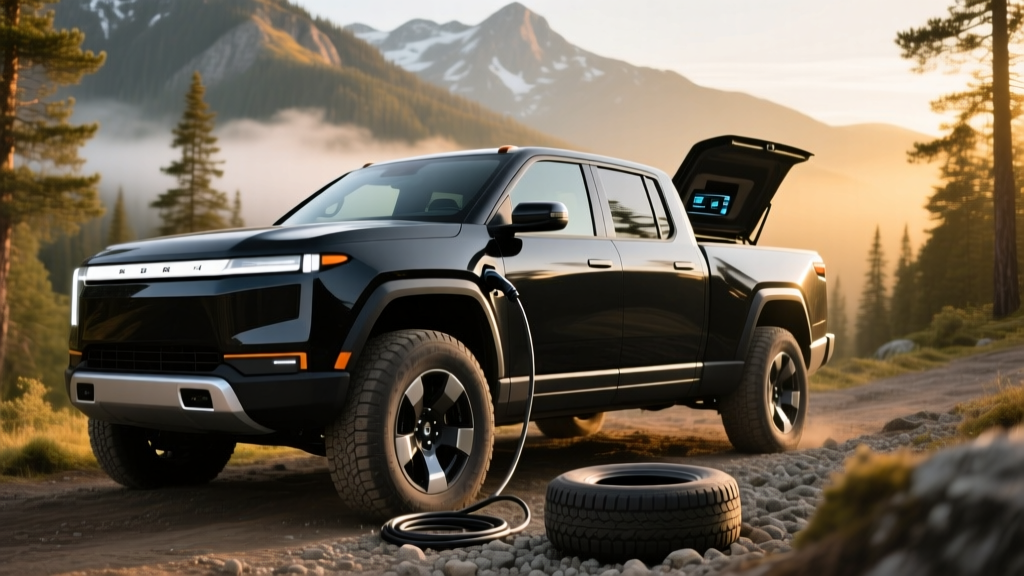
The 2026 Rivian R1T Quad-Motor occupies a singular position in the EV market: a 1,025-horsepower electric truck that can genuinely off-road, tow 11,000 pounds, and still serve as a daily driver. Rivian's second-generation R1T platform, introduced for the 2025 model year and carried into 2026, brought meaningful upgrades to the electrical architecture, battery chemistry, and thermal management — all of which matter more than the headline horsepower figure.
But capability comes at a cost. The Quad-Motor variant starts above $99,000, consumes electricity at a prodigious rate, and — despite its enormous 149 kWh Max battery pack — delivers real-world highway range well below its EPA sticker. If you need the ultimate electric adventure truck and can charge at home, it has no equal. If you're primarily commuting or counting miles per dollar, the Dual-Motor R1T or a rival like the Ford F-150 Lightning may serve you better.
Range, Battery, and Real-World Efficiency
The 2026 R1T Quad-Motor is available exclusively with the Max battery pack — a 149 kWh (usable) unit using 2170-format NMC (nickel manganese cobalt) cylindrical cells supplied by Samsung SDI. Rivian moved to a 400V architecture in the second-generation platform, optimizing the pack for better thermal management and sustained power delivery.
| Spec | 2026 R1T Quad-Motor (Max Pack) |
|---|---|
| Battery Capacity (usable) | 149 kWh |
| Cell Chemistry | NMC (Samsung SDI 2170) |
| EPA Range | 420 miles (Adventure trim, 20" All-Season) |
| MPGe (combined) | 70 MPGe |
| Efficiency | 48 kWh / 100 mi |
| Drivetrain | Quad-Motor AWD (independent torque vectoring) |
| Horsepower | 1,025 hp |
| Torque | 1,198 lb-ft |
| 0–60 mph | 2.5 seconds |
| Max Tow Rating | 11,000 lbs |
The EPA estimates 420 miles for the Quad-Motor on 20-inch all-season tires. In our experience and consistent with third-party testing, expect ~340–360 miles at sustained highway speeds (70–75 mph) in mild weather. Switch to the available 22-inch Sport wheels and all-season tires, and EPA range drops to roughly 390 miles; real-world highway drops proportionally. In cold weather (below 30°F), plan for a 20–30% reduction — putting you in the 250–290 mile range on the highway without preconditioning. Towing a 7,000-lb trailer cuts range roughly in half, to approximately 200 miles or less depending on terrain and speed.
The 48 kWh/100 mi efficiency figure is typical for a heavy, powerful electric truck. For context, the Dual-Motor R1T with the Large pack achieves roughly 37 kWh/100 mi — meaning the Quad-Motor costs about 30% more per mile to operate. At the national average residential electricity rate of ~$0.16/kWh, a full 149 kWh charge costs approximately $23.84 at home.
Charging Speed: DC Fast, Level 2, and Home Setup
Rivian equipped the second-generation R1T with an upgraded onboard charger and improved DC fast-charge capability. The Quad-Motor Max Pack can accept a peak DC rate of 220 kW on compatible chargers, with the charge curve optimized to sustain higher rates deeper into the session compared to the first-generation truck.
| Charging Method | Max Power | Speed / Time |
|---|---|---|
| DC Fast Charge (CCS/NACS) | 220 kW peak | 10–80% in ~42 minutes |
| Level 2 (Home, 48A / 11.5 kW) | 11.5 kW | ~16 miles of range per hour; 0–100% in ~14 hours |
| Level 2 (Home, 32A / 7.7 kW) | 7.7 kW | ~11 miles per hour; 0–100% in ~20 hours |
| Level 1 (120V, 12A) | 1.4 kW | ~2 miles per hour (emergency/trickle only) |
A few things to understand about the R1T Quad-Motor's charging profile:
- Peak vs. sustained rate: The 220 kW peak is achievable between roughly 10–30% state of charge. Above 50%, the curve tapers significantly — expect 120–140 kW through the mid-range and a steep drop above 80%. This is normal for NMC chemistry protecting cell longevity, but it means the last 20% takes nearly as long as the first 60%.
- Preconditioning matters: When you navigate to a DC fast charger using the Rivian's built-in navigation, the battery thermal management system preconditions the pack. Skip this step (for example, by driving to a charger without using nav) and your peak charge rate could be 30–50 kW lower, especially in cold weather.
- Home charging is essential: With a 149 kWh pack, relying on Level 1 or even a lower-amperage Level 2 charger means overnight charging won't fully replenish the battery. We strongly recommend a 48-amp (11.5 kW) Level 2 home charger on a 60-amp dedicated circuit. Expect $800–$1,500 for the charger and professional installation, with a possible $1,500–$3,000 panel upgrade if your home has a 100-amp service panel.
- NACS compatibility: Rivian transitioned to the NACS (Tesla-style) charge port starting with the 2025 model year. The 2026 R1T ships with NACS natively and includes access to Tesla Supercharger stations via Rivian's agreement with Tesla. A CCS adapter is available for non-Tesla networks like Electrify America.
Performance, Drivetrain, and Driving Dynamics
The Quad-Motor powertrain uses four independent motors — one at each wheel — delivering precise torque vectoring that no mechanical differential can match. The result is a 6,800-pound truck that hits 60 mph in 2.5 seconds, rivaling sports cars that weigh half as much.
But the performance story isn't just straight-line speed. The independent motors allow the R1T to:
- Tank turns: Spin the left and right wheels in opposite directions for tight low-speed pivots off-road.
- True torque vectoring: Send power to individual wheels in real time, improving traction on loose surfaces without the lag of mechanical locking differentials.
- Regen modulation: Each wheel's regenerative braking can be adjusted independently, smoothing one-pedal driving and maximizing energy recovery.
The second-generation R1T uses a new zonal electrical architecture that reduces wiring harness weight by roughly 44 pounds and improves software update speed and reliability. The air suspension provides up to 14.4 inches of ground clearance in Off-Road mode and drops to 6.7 inches in Park for easier entry. Water fording depth is rated at over 3 feet.
On pavement, the ride is firm but well-controlled. The Quad-Motor's weight (curb weight exceeds 7,100 lbs) is noticeable in transitions and braking distances. The regenerative braking system is strong enough for genuine one-pedal driving in most conditions, though the friction brakes are needed for hard stops and the pedal feel takes some acclimation.
Interior, Cargo, and Technology
The R1T's cabin is a step above typical truck interiors, with standard vegan leather, real wood accents, and a minimalist design anchored by a 15.6-inch center touchscreen and a 12.3-inch digital instrument cluster. The second-generation truck upgraded materials, improved seat comfort, and refined the software interface.
Cargo and passenger dimensions:
| Measurement | Specification |
|---|---|
| Front Legroom | 41.3 inches |
| Rear Legroom | 38.2 inches |
| Bed Length | 54.0 inches (4.5 ft) |
| Bed Width (between wheel wells) | 50.0 inches |
| Gear Tunnel Volume | 11.0 cu ft |
| Front Trunk (Frunk) | 11.0 cu ft |
| Max Payload | 1,760 lbs |
The Gear Tunnel — a pass-through storage compartment behind the rear seats — remains the R1T's signature feature. It's ideal for skis, camping gear, or the available Gear Tunnel Kitchen. Combined with the frunk, bed, and under-bed storage, the R1T offers more enclosed cargo versatility than any other pickup on the market.
Driver Assistance and Tech:
The R1T comes with Rivian's Driver+ suite, which includes adaptive cruise control, lane centering, and automatic lane changes on divided highways. This is a Level 2 SAE driver-assist system — meaning the driver must remain fully engaged and keep hands on the wheel at all times. It is not autonomous driving. The system works well on highways but can be hesitant in construction zones and doesn't handle complex urban intersections.
The infotainment system runs Rivian's proprietary software (not Android Automotive), which is responsive and well-designed but lacks Apple CarPlay and Android Auto. Phone integration is limited to Bluetooth audio and calls. For some buyers, this is a dealbreaker; for others, the native system's deep EV integration (route planning with charge stops, battery preconditioning, energy monitoring) makes it a non-issue.
Pricing, Trims, and Federal Tax Credit Eligibility
The 2026 R1T Quad-Motor is offered in three trims, all with the Max battery pack:
| Trim | Base MSRP | As-Tested (Typical Options) | Federal §30D Credit Eligible? |
|---|---|---|---|
| Adventure (Quad-Motor Max) | $99,900 | $104,000–$108,000 | See eligibility notes below |
| Adventure w/ Off-Road Pkg | $99,900 + $3,850 | $108,000–$115,000 | See eligibility notes below |
| Ascend (Quad-Motor Max) | $114,900 | $118,000–$125,000 | See eligibility notes below |
Destination charge adds $1,800. The Rivian Shop offers accessories (crossbars, tonneau cover, camp kitchen) that can add $2,000–$8,000+.
- MSRP cap: Trucks, vans, and SUVs must have an MSRP at or below $80,000. The R1T Quad-Motor exceeds this cap and does NOT qualify for the new-vehicle §30D credit.
- Buyer income cap: AGI limits of $150,000 (single), $225,000 (head of household), $300,000 (joint) — moot here since the MSRP cap is already exceeded.
- Battery sourcing: Critical minerals and battery component requirements phase in annually. Even if the R1T were under the MSRP cap, sourcing compliance would need verification per IRS guidelines.
- Point-of-sale transfer: Eligible vehicles can transfer the credit to the dealer for an immediate price reduction. Not applicable for the Quad-Motor due to MSRP cap.
- Used EV credit (§25E): If purchasing a qualifying used R1T (2+ years old, under $25,000 MSRP cap for used — unlikely for this model), up to $4,000 may be available.
Bottom line: The 2026 R1T Quad-Motor does not qualify for the $7,500 federal new-vehicle tax credit due to its MSRP exceeding the $80,000 truck cap. Consult a tax professional for state/local incentives, which vary by jurisdiction.
Ownership Costs and Warranty
Rivian covers the R1T with a competitive warranty package:
- Battery & Drive Unit Warranty: 8 years / 175,000 miles (whichever comes first), with a guaranteed minimum 70% capacity retention over that period. This is above the industry-standard 8yr/100,000mi and reflects confidence in the Samsung SDI cells and thermal management system.
- Vehicle Limited Warranty: 5 years / 60,000 miles bumper-to-bumper.
- Corrosion Warranty: 12 years, unlimited miles.
- Roadside Assistance: 5 years / 60,000 miles, including towing to the nearest charger if the battery is depleted.
Insurance premiums for the Quad-Motor are notably high — expect $2,800–$4,200 annually depending on your profile and location, per industry data. Rivian has partnered with select insurers to offer competitive rates, but the truck's repair costs, performance, and MSRP push premiums well above average.
Maintenance costs are low relative to gas trucks: no oil changes, no transmission fluid, minimal brake wear thanks to regenerative braking. Rivian recommends annual cabin air filter replacement and periodic tire rotation. The biggest recurring cost will be tires — the R1T's weight and torque chew through rubber, and replacement 275/65R20 all-terrain tires run $300–$400 each.
Pros, Cons, and Who Should Buy
- 1,025 hp and 2.5-second 0–60 — fastest production pickup ever made
- 420-mile EPA range (340+ real-world highway) with 149 kWh Max pack
- Genuine off-road capability with tank turns, air suspension, 14.4" ground clearance
- Gear Tunnel + frunk provide unmatched enclosed storage
- 11,000-lb tow rating with integrated trailer brake controller
- 8yr/175,000mi battery warranty exceeds industry standard
- NACS native with Tesla Supercharger access
- Over-the-air updates continuously add features
- Starts at $99,900 — does not qualify for federal §30D tax credit
- 48 kWh/100mi efficiency means high electricity costs per mile
- Real-world towing range ~200 miles or less with a heavy trailer
- 42-minute 10–80% DC charge time is slower than Hyundai/Kia 800V platforms
- No Apple CarPlay or Android Auto
- 7,100+ lb curb weight affects tire wear and braking distances
- Rivian service center network still expanding — rural owners may face long drives for warranty work
- Insurance premiums are steep
- Adventure enthusiasts who need off-road capability, towing, and cargo versatility without burning fossil fuels — and who can charge at home.
- Performance seekers who want supercar acceleration in a functional truck.
- Homeowners with Level 2 charging who can absorb the 14-hour 0–100% charge cycle overnight.
- Budget-conscious buyers: The Dual-Motor R1T with the Standard pack starts around $69,900 and may qualify for the tax credit. The Ford F-150 Lightning starts under $55,000.
- High-mileage commuters: The efficiency penalty adds up. A Dual-Motor or a PHEV like the Ford Maverick Hybrid will cost far less per mile.
- Frequent long-distance towers: 200 miles of towing range means stopping every 2.5–3 hours to charge for 40+ minutes.
How It Compares to Key Competitors
The R1T Quad-Motor's closest rival is the Tesla Cybertruck Cyberbeast, which offers similar performance (845 hp, 2.6-sec 0–60) at a lower starting price (~$99,990) but with a smaller bed, controversial styling, and a less proven service network. The Cybertruck's stainless-steel exoskeleton is polarizing and harder to repair.
The Ford F-150 Lightning Platinum is the volume-play alternative: 580 hp, 320-mile EPA range, lower efficiency, and a starting price around $96,000 for the top trim — but with Ford's dealer network and a more traditional truck experience. It charges faster (up to ~150 kW but with a smaller 131 kWh pack, meaning shorter absolute charge times).
The GMC Hummer EV Pickup offers comparable excess (1,000 hp, 3,000+ watt-hours of battery) but weighs over 9,000 lbs, starts above $110,000, and is far less practical as a daily driver.
Frequently Asked Questions
What is the real-world range of the 2026 Rivian R1T Quad-Motor?
The EPA rates it at 420 miles on 20-inch all-season tires. In real-world highway driving at 70–75 mph, expect 340–360 miles in mild weather. Cold weather (below 30°F) drops that to 250–290 miles. Towing a mid-weight trailer (~7,000 lbs) cuts range to roughly 200 miles or less.
How fast does the R1T Quad-Motor charge?
On a DC fast charger, it peaks at 220 kW and charges from 10–80% in approximately 42 minutes. At home on a 48-amp Level 2 charger (11.5 kW), expect about 16 miles of range per hour and a full charge in roughly 14 hours. Plan to charge overnight.
Does the 2026 R1T Quad-Motor qualify for the federal EV tax credit?
No. The IRS §30D credit caps truck MSRP at $80,000. The R1T Quad-Motor starts at $99,900, disqualifying it. State and local incentives may still apply — check your jurisdiction's programs. Always verify current rules at IRS.gov or with a tax professional.
Is the Rivian R1T Quad-Motor worth it vs. the Cybertruck or F-150 Lightning?
If you value off-road capability, the Gear Tunnel, air suspension, and proven build quality, the R1T is the most well-rounded electric adventure truck. The Cybertruck Cyberbeast offers similar performance at a comparable price but with less practical cargo space and a less refined interior. The F-150 Lightning is more traditional and backed by Ford's service network but can't match the R1T's off-road chops or storage versatility.
Can the R1T Quad-Motor use Tesla Superchargers?
Yes. The 2026 R1T ships with a native NACS charge port and has access to the Tesla Supercharger network. For CCS-based chargers (Electrify America, EVgo, etc.), Rivian offers a CCS adapter.
How long will the battery last?
Rivian warranties the battery for 8 years / 175,000 miles with a minimum 70% capacity retention guarantee. Based on NMC chemistry degradation data from similar packs, expect 85–90% capacity after 100,000 miles with normal use. Avoiding repeated DC fast charging above 90% and frequent deep discharges to 0% will extend longevity.
What's the towing range with a trailer?
Towing range depends heavily on trailer weight, speed, terrain, and weather. With a 7,000-lb enclosed trailer at highway speeds, expect approximately 180–220 miles before needing to charge. Rivian's navigation system estimates trailer range when a trailer profile is configured, and it factors in elevation changes along your route.
Sources: EPA Fuel Economy, Rivian R1T Specifications, IRS Clean Vehicle Credits.