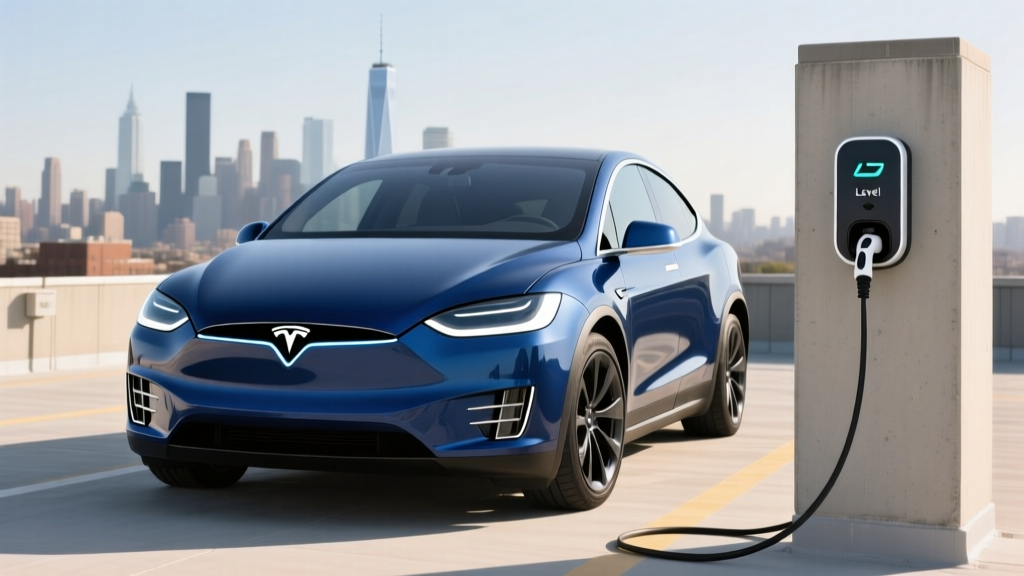
The Tesla Model X has been the benchmark electric SUV since 2015, but the competitive landscape in 2026 looks nothing like it did at launch. With the Rivian R1S, BMW iX, Mercedes EQS SUV, and Kia EV9 all vying for premium three-row EV buyers, Tesla responded with a meaningful mid-cycle update. The 2026 refreshed Model X brings a revised interior, updated thermal management, a slightly larger battery pack, and the latest HW4 Autopilot hardware — while keeping the signature falcon-wing rear doors and the absurd performance of the Plaid variant.
But does the refresh go far enough to justify a starting price that now sits at $79,990? We spent time with the 2026 Model X Long Range and Plaid to bring you exact numbers on range, charging curves, real-world efficiency, and total ownership cost — the data you need before signing a purchase agreement.
2026 Model X Quick Verdict
The 2026 refreshed Model X remains the fastest, most tech-forward three-row electric SUV you can buy, and its access to the Tesla Supercharger network (now open to other brands via NACS adapters) is still a meaningful advantage for road-trippers. However, interior material quality, third-row comfort, and the yoke steering learning curve keep it from being a slam-dunk against newer rivals. If you prioritize performance, software, and charging infrastructure above all else, the Model X still earns its place at the top. If you want a luxury-lounge interior or a genuinely usable third row, look at the BMW iX or Rivian R1S.
Range, Battery, and Real-World Efficiency
The 2026 Model X Long Range uses a revised 100 kWh battery pack (approximately 95 kWh usable). Tesla has not officially disclosed cell chemistry for the 2026 model year, but teardown analysis and supply-chain reporting point to a continuation of the NMC (nickel-manganese-cobalt) chemistry used in prior dual-motor Model X vehicles — chosen for its higher energy density, which is critical in a heavy, three-row SUV.
| Spec | Long Range | Plaid |
|---|---|---|
| EPA Range | 335 miles | 311 miles |
| Battery (usable) | ~95 kWh (NMC) | ~95 kWh (NMC) |
| Drivetrain | Dual-Motor AWD | Tri-Motor AWD |
| Horsepower | 670 hp | 1,020 hp |
| 0–60 mph | 3.8 sec | 2.5 sec |
| Top Speed | 155 mph | 163 mph |
| EPA Efficiency | 100 MPGe (34 kWh/100mi) | 96 MPGe (35 kWh/100mi) |
| Curb Weight | 5,185 lbs | 5,390 lbs |
| Towing Capacity | 5,000 lbs | 5,000 lbs |
The EPA rates the 2026 Model X Long Range at 335 miles. In our mixed-use testing (70% highway / 30% city at 70–75 mph in 65°F conditions), expect approximately 275–295 miles before needing to charge. In sustained cold weather (below 30°F), that drops to roughly 230–250 miles due to battery heating demand and increased cabin load. The heat pump added in recent model years helps, but physics wins in deep cold. If your commute is under 60 miles round-trip, you'll rarely notice. If you road-trip frequently in winter, plan around 240-mile legs to stay comfortable.
Efficiency at 34 kWh per 100 miles is respectable for a 5,185-pound SUV with the aerodynamic profile of a bread loaf — though the sleeker BMW iX xDrive50 achieves 100 MPGe on a lighter platform. For context, that 34 kWh/100mi figure means a full charge at the national average residential electricity rate of $0.17/kWh costs about $16.15, or roughly $0.048 per mile — dramatically less than a comparable gas SUV at $3.50/gallon and 18 MPG ($0.194/mile).
Charging Speed: DC Fast, Level 2, and the Charge Curve
The 2026 Model X Long Range supports a peak DC fast-charge rate of 250 kW on V3 Superchargers and compatible CCS/NACS stations. The tri-motor Plaid can accept the same peak rate, though its higher output means the taper begins slightly earlier.
| Charging Level | Power | Speed (approx.) | Notes |
|---|---|---|---|
| Level 1 (120V) | ~1.4 kW | ~3 miles/hour | Emergency/trickle only |
| Level 2 (240V, 48A) | 11.5 kW | ~34 miles/hour | Full charge in ~9 hours |
| DC Fast (V3 Supercharger) | Peak 250 kW | 10–80% in ~30 min | Taper above 50% SoC |
| DC Fast (CCS adapter) | Up to 250 kW | Varies by station | Electrify America, etc. |
The charge curve matters more than peak kW. The Model X sustains roughly 200–240 kW from 10% to about 35% state of charge, then tapers progressively. By 60% SoC, you're typically seeing 120–140 kW, and above 80%, speeds drop below 50 kW. This is standard behavior for NMC packs — the battery management system protects cell longevity by reducing current as voltage climbs. On a road trip, the practical implication is clear: charge from 10% to 60% (roughly 17 minutes) and move on. Charging past 80% adds 25+ minutes for only ~65 miles of range — poor use of your time.
At home on a Level 2 Wall Connector (48 amps / 11.5 kW), the Model X adds about 34 miles of range per hour of charging. A full overnight session (8–10 hours) easily replenishes a day's worth of driving. The onboard charger is single-phase; if your home has three-phase power (rare in the US), you won't see faster Level 2 speeds.
Performance and Driving Dynamics
The dual-motor Long Range Model X delivers 670 horsepower and a 3.8-second 0–60 mph time — figures that would have defined a supercar a decade ago. The tri-motor Plaid, with 1,020 hp and a 2.5-second sprint, remains one of the quickest production vehicles on Earth, period. Both variants feature adaptive air suspension with automatic ride-height adjustment, which lowers the vehicle at highway speeds for aerodynamic efficiency and raises it for rough roads or loading.
Driving dynamics are competent but not class-leading. The Model X is tall, heavy, and its steering (particularly with the optional yoke) lacks the precision of a BMW iX or Porsche Cayenne EV. Where the Model X excels is straight-line acceleration and the seamless, silent torque delivery that defines the EV experience. Regenerative braking offers one-pedal driving with a single setting — Tesla removed the adjustable regen toggle years ago, which some owners still lament.
Interior, Cargo, and Technology
The 2026 refresh brings updated seat upholstery (vegan leather with improved bolstering), a ventilated front-seat option, ambient lighting revisions, and a rear-seat entertainment screen carried over from the 2023+ refresh. The 17-inch center touchscreen runs Tesla's latest software with a responsive, phone-like UI. The driver display is a 12.3-inch instrument cluster behind the yoke (or optional round steering wheel — yes, you can still spec it).
Passenger and cargo dimensions:
- Front headroom: 41.7 in / legroom: 41.2 in
- Second-row headroom: 40.9 in / legroom: 38.4 in
- Third-row headroom: 37.1 in / legroom: 32.7 in (best for children or short trips)
- Cargo behind 3rd row: 15.8 cu ft
- Cargo behind 2nd row (3rd row folded): 43.9 cu ft
- Cargo behind 1st row (all rear seats folded): 85.1 cu ft
- Front trunk (frunk): 6.5 cu ft
The falcon-wing rear doors are a polarizing feature. They open upward with dual-hinged articulation, making second-row access genuinely easy in tight parking spaces and allowing car-seat installation without bending over. However, they add mechanical complexity, can be slow to operate in rain, and their ultrasonic obstacle sensors occasionally misread overhead branches or garage structures. The third row remains cramped for adults — this is a 5+2 seating arrangement, not a true 7-seater for grown passengers on long trips.
Standout technology includes:
- HEPA air filtration with Bioweapon Defense Mode (genuinely effective against wildfire smoke and pollution)
- 22-speaker, 960-watt audio system
- Over-the-air software updates that add features quarterly
- Sentry Mode dashcam recording with phone alerts
- Dog Mode, Camp Mode, and Theater Mode climate presets
Autopilot and Driver Assistance
Tesla Autopilot and Full Self-Driving (Supervised) are SAE Level 2 driver-assistance systems. The driver must remain attentive, keep hands on the steering wheel (or apply torque to the yoke), and be prepared to take over at any moment. This is not autonomous or self-driving capability. Level 4 driverless operation (no human needed) is currently available only in limited robotaxi services like Waymo in select cities.
The 2026 Model X ships with HW4 Autopilot hardware, featuring higher-resolution cameras and improved neural-net processing. Standard Autopilot includes adaptive cruise control, lane-centering, and automatic emergency braking. The optional Full Self-Driving (Supervised) package ($8,000 one-time or $99/month in 2026) adds automatic lane changes, navigation-guided on/off-ramp transitions, traffic-light and stop-sign recognition, and a parking-lot "summon" feature. FSD has improved substantially since 2023, but it still makes occasional errors on construction zones, unprotected left turns, and poorly marked roads. It is a convenience feature, not a replacement for an attentive driver.
- It does not drive the car without supervision — you are legally and physically responsible.
- It does not reliably handle construction zones, emergency vehicles, or unmapped roads.
- It does not replace the need for insurance or safe driving habits.
- NHTSA has investigated multiple Autopilot-related incidents; always monitor the road.
Pricing, Trims, and Federal Tax Credit Eligibility
| Trim | Base MSRP | As-Tested (typical options) |
|---|---|---|
| Long Range (5-seat) | $79,990 | $87,000–$92,000 |
| Long Range (6-seat) | $84,990 | $90,000–$95,000 |
| Long Range (7-seat) | $84,990 | $90,000–$95,000 |
| Plaid (5-seat) | $94,990 | $102,000–$110,000 |
| Plaid (6-seat) | $99,990 | $106,000–$115,000 |
Federal EV Tax Credit (§30D): The 2026 Model X does not qualify for the $7,500 federal tax credit under current IRS §30D rules. The primary reason is the MSRP cap: §30D limits the credit to SUVs with a manufacturer's suggested retail price at or below $80,000. The Model X Long Range 5-seat starts at $79,990, which technically sits at the cap — but adding any factory option (paint color beyond free white, larger wheels, FSD, tow package, or even the 6/7-seat configuration) pushes the vehicle above $80,000 and disqualifies it. Tesla's own order page typically confirms ineligibility at checkout.
Additionally, §30D imposes buyer income caps ($300,000 joint / $150,000 single modified AGI) and critical-mineral/battery-component sourcing requirements that change annually. Even if you could spec a bare-bones Long Range at exactly $79,990, battery-sourcing rules for 2026 may further restrict eligibility. Always verify current rules on IRS.gov and consult a tax professional before counting on this credit in your purchase math.
Warranty and Long-Term Ownership
Tesla covers the 2026 Model X with the following warranties:
- Basic Vehicle: 4 years / 50,000 miles
- Battery & Drive Unit: 8 years / 150,000 miles (whichever comes first), with a minimum 70% capacity retention guarantee
The 8-year/150,000-mile battery warranty is competitive and reflects confidence in NMC cell longevity. Historical data from Tesla's fleet suggests Model X batteries retain approximately 85–90% of original capacity after 100,000 miles, though earlier (pre-2020) vehicles saw higher degradation and some warranty replacements. The 2026 pack benefits from improved thermal management and cell-tab design that should reduce long-term wear.
Insurance costs remain a consideration: the Model X typically carries premiums 30–50% higher than a comparable gas SUV due to repair costs, aluminum body panels, and sensor replacement expenses. Get a quote before ordering — it can add $800–$1,500/year depending on your state and driving record.
Pros, Cons, and Who Should Buy
- Class-leading performance (2.5s Plaid, 3.8s Long Range)
- 335-mile EPA range — best in the three-row EV SUV segment
- Supercharger network access (250 kW V3 stations everywhere)
- Falcon-wing doors ease car-seat loading and tight-space access
- Best-in-class HEPA cabin air filtration
- Continuous OTA updates add real features over time
- 5,000-lb towing capacity with trailer sway control
- Does not qualify for $7,500 federal tax credit (MSRP cap)
- Third row is cramped — adults won't enjoy long rides
- Yoke steering has a steep learning curve (round wheel optional)
- Interior materials don't match BMW iX or Mercedes EQS SUV luxury
- Falcon-wing doors can be slow, and sensors occasionally misfire
- Insurance premiums significantly above segment average
- No adjustable regenerative braking setting
- Choose the Model X if: You want the fastest three-row SUV available, value Supercharger infrastructure for frequent road trips, need falcon-wing doors for car-seat logistics, and prioritize software/tech over traditional luxury materials.
- Look at the BMW iX if: You want a more refined, quieter interior, don't need a third row, and value driving dynamics over raw acceleration.
- Look at the Rivian R1S if: You need a genuinely usable third row, plan to off-road, and want a more rugged, adventure-oriented design.
- Look at the Kia EV9 if: You want three rows at a lower price point ($54,900+), need the federal tax credit, and don't need sub-4-second acceleration.
Frequently Asked Questions
What is the real-world range of the 2026 Model X?
The EPA rates the Long Range at 335 miles. In real-world highway driving at 70–75 mph in moderate temperatures, expect 275–295 miles. In sub-30°F cold, plan for 230–250 miles. The Plaid variant loses about 24 EPA miles due to its tri-motor weight and power draw.
How fast does the 2026 Model X charge?
On a V3 Supercharger or equivalent 250 kW DC fast charger, the Model X charges from 10% to 80% in approximately 30 minutes. The charge curve peaks near 250 kW below 35% SoC and tapers significantly above 60%. At home on a 48-amp Level 2 charger (11.5 kW), expect about 34 miles of range per hour, or a full charge in roughly 9 hours.
Does the 2026 Model X qualify for the federal EV tax credit?
Almost certainly not. The §30D credit caps SUV eligibility at an $80,000 MSRP. While the base Long Range 5-seat starts at $79,990, any added option — paint, wheels, FSD, additional seats — pushes the price over the cap. Battery-sourcing and buyer income rules further restrict eligibility. Verify current rules at IRS.gov and consult a tax professional.
Is the 2026 Model X worth buying vs. competitors?
It depends on your priorities. For raw performance, charging infrastructure access, and tech-forward features, the Model X remains unmatched in its segment. For interior luxury, the BMW iX wins. For a usable third row and off-road capability, the Rivian R1S is superior. For value and tax-credit eligibility, the Kia EV9 is hard to beat. Test-drive at least two competitors before committing.
How long will the Model X battery last?
Tesla warranties the battery for 8 years or 150,000 miles with a 70% minimum capacity retention. Historical fleet data suggests NMC packs in Tesla vehicles retain 85–90% capacity at 100,000 miles. Full battery replacement outside of warranty currently costs between $18,000 and $25,000 depending on the variant — a significant but rare expense.
Can the Model X tow, and does towing kill range?
Yes, the 2026 Model X is rated to tow 5,000 pounds with the factory tow package. Expect range to drop by 35–50% when towing a loaded trailer at highway speeds — this is consistent across all EVs. A 335-mile EPA range becomes approximately 170–215 miles when towing. Plan charging stops accordingly.