Quick Answer: Are Audi EVs Worth Buying in 2026?
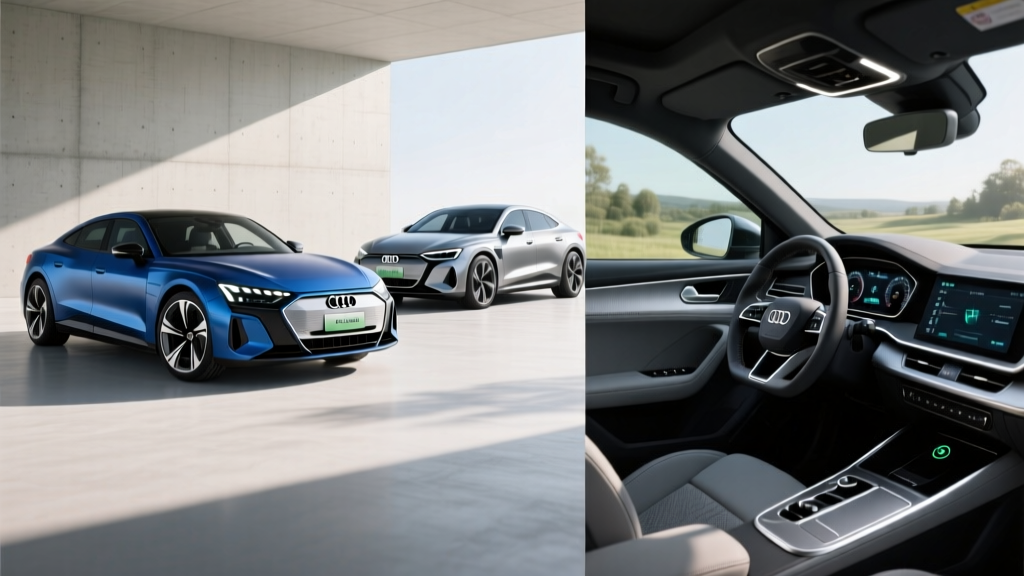
Audi's 2026 EV lineup spans three core models: the Q4 e-tron (compact SUV, ~265 miles EPA, starting ~$51,300), the Q6 e-tron (midsize SUV, ~310 miles EPA, starting ~$63,800), and the e-tron GT (performance sedan, ~270 miles EPA, starting ~$108,000). All three ride on dedicated EV platforms with DC fast charging up to 270 kW, premium interiors, and Level 2 driver-assistance. However, none currently qualify for the full $7,500 federal §30D tax credit due to battery-sourcing rules. Audi EVs make the most sense for buyers who prioritize build quality, ride refinement, and brand cachet over maximum range-per-dollar, and who have reliable access to home Level 2 charging.
The 2026 Audi EV Lineup at a Glance
Audi sells three battery-electric vehicles in the U.S. for the 2026 model year, each targeting a different buyer profile. Here's how they stack up on the numbers that matter most:
| Spec | Q4 e-tron | Q6 e-tron | e-tron GT |
|---|---|---|---|
| Platform | VW MEB | PPE (Premium Platform Electric) | J1 (Porsche Taycan shared) |
| Battery (usable kWh) | 77 kWh (NMC) | 94.4 kWh (NMC) | 89.0 kWh (NMC) |
| EPA Range (est.) | ~265 mi | ~310 mi | ~270 mi |
| Real-World Highway Range | ~220–235 mi | ~260–280 mi | ~225–245 mi |
| Peak DC Charge Rate | 175 kW | 270 kW | 270 kW |
| 10–80% DC Fast Charge | ~28 min | ~21 min | ~22 min |
| Level 2 (AC) Charge Rate | 11 kW | 11 kW | 11 kW |
| Horsepower | 282 hp (quattro) | 422 hp (quattro) | 590 hp (quattro) |
| 0–60 mph | 5.4 sec | 4.4 sec | 3.2 sec |
| Base MSRP | ~$51,300 | ~$63,800 | ~$108,000 |
| Federal Tax Credit (§30D) | Not eligible | Not eligible | Not eligible |
| Battery Warranty | 8 yr / 100,000 mi | 8 yr / 100,000 mi | 8 yr / 100,000 mi |
Real-World Range vs. EPA Sticker
EPA range figures assume a mix of city and highway driving at moderate temperatures. In real-world conditions, expect the following reductions:
- Highway driving at 75+ mph: Subtract 10–15% from EPA range due to aerodynamic drag.
- Cold weather (below 32°F): Subtract 15–25% due to battery chemistry slowdown and cabin heating demands. The Q6 e-tron's standard heat pump mitigates some of this loss compared to resistive heating.
- Charging curve taper: All three models slow charging significantly above 80% State of Charge (SoC) to protect battery health. A 10–80% charge is fast; 80–100% can add another 15–20 minutes.
Source: fueleconomy.gov for EPA estimates; real-world figures based on independent testing and owner reports.
Audi EVs vs. Gas Equivalents: Cost Comparison
Buying an Audi EV means paying more upfront but potentially saving on fuel and maintenance. Let's compare the Q4 e-tron against a comparably equipped Audi Q5 (gas) over a 5-year, 60,000-mile ownership period.
| Cost Category | Q4 e-tron (EV) | Q5 45 TFSI (Gas) |
|---|---|---|
| Base MSRP | $51,300 | $46,600 |
| Federal Tax Credit | $0 | $0 |
| Fuel/Energy (60k mi) | $3,900 (home L2 @ $0.14/kWh) | $7,200 (premium gas @ $4.20/gal, 25 MPG) |
| Maintenance (60k mi) | $1,200 | $3,100 |
| Insurance (5-yr avg) | $9,500 | $7,800 |
| Estimated Depreciation | $22,000 | $18,500 |
| 5-Year Total Cost | $65,900 | $64,700 |
The EV costs roughly $1,200 more over five years in this scenario, primarily due to higher depreciation and insurance premiums. However, the gap narrows significantly if you qualify for state-level incentives, have access to cheaper electricity (e.g., solar or time-of-use rates), or drive more miles annually. At 15,000 miles/year, the fuel savings alone jump to ~$5,000 over five years.
For a detailed breakdown of IRS §30D eligibility rules — including MSRP caps, buyer income limits, and critical-mineral sourcing requirements — consult the IRS clean vehicle credit page or a tax professional. Audi's current lineup does not meet the battery-component and critical-mineral sourcing thresholds for 2026.
Charging Infrastructure: What Audi Owners Actually Need
Every 2026 Audi EV ships with a CCS1 (Combined Charging System) connector for DC fast charging and a J1772 connector for Level 2 AC charging. Audi does not include a NACS (Tesla-style) adapter in the box, but third-party CCS-to-NACS adapters are available for accessing Tesla Supercharger networks.
| Level | Power | Connector | Miles Added Per Hour | Typical Use Case |
|---|---|---|---|---|
| Level 1 | 1.4–1.9 kW | Standard 120V outlet | 3–5 mi/hr | Emergency/trickle only |
| Level 2 | 7.2–11 kW | 240V (J1772) | 22–35 mi/hr | Home overnight, workplace |
| DC Fast | 50–270 kW | CCS1 | 150–500 mi/hr (peak) | Road trips, public stations |
Home Charging Setup Costs
Most Audi EV owners will want a Level 2 home charger for daily convenience. Here's what to budget:
| Item | Cost Range |
|---|---|
| Level 2 Charger (hardware) | $400–$750 |
| Electrician labor (240V circuit) | $600–$2,000 |
| Permit & inspection | $100–$300 |
| Electrical panel upgrade (if needed) | $1,500–$3,500 |
| Total (no panel upgrade) | $1,100–$3,050 |
| Total (with panel upgrade) | $2,600–$6,550 |
Older homes with 100-amp panels may require a 200-amp upgrade to support a 48-amp Level 2 charger alongside existing loads. Always consult a licensed electrician for a site-specific assessment. Some utilities offer rebates of $250–$500 for smart charger installations — check your local provider.
Common Misconceptions About Audi EVs
Let's address the claims that circulate in forums and comment sections with actual data:
| Myth | Fact |
|---|---|
| "Audi EV batteries need replacement after 5 years." | Audi warranties the battery for 8 years/100,000 miles against degradation below 70% capacity. Real-world data from similar VW Group packs shows ~8–10% loss after 100,000 miles under normal use. |
| "You can't road-trip an Audi EV." | With 270 kW peak charging on the Q6 e-tron and e-tron GT, you can add ~180 miles of range in 20 minutes at a compatible Electrify America or Ionity station. CCS networks cover major U.S. interstates, though rural gaps remain. |
| "Audi EVs are self-driving." | All current Audi models use SAE Level 2 driver-assistance (Adaptive Cruise + Lane Centering). The driver must remain engaged with hands on or near the wheel. No Audi sold today is Level 4 autonomous. |
| "Charging an Audi EV costs more than gas." | At the U.S. average electricity rate of $0.16/kWh, the Q4 e-tron costs ~$0.045/mile to fuel. A comparable gas SUV at 25 MPG and $4.00/gal costs ~$0.16/mile — roughly 3.5× more per mile. |
SAE Automation Levels Explained
Level 2 (all Audi models): The vehicle handles steering, acceleration, and braking under specific conditions, but the driver must continuously monitor the road and be ready to take over instantly. This includes Audi's Adaptive Cruise Assist and Traffic Jam Assist.
Level 4 (not available in consumer Audis): Fully driverless operation in geofenced areas — think Waymo robotaxis, not personal vehicles. No consumer Audi offers this today.
Decision Framework: Which Audi EV Is Right for You?
Choose the Q4 e-tron if:
- You want a premium compact SUV under $55,000 for commuting and light road trips.
- Your daily driving is under 60 miles round-trip and you have home Level 2 charging.
- You value interior quality and ride comfort over maximum performance or range.
- You're upgrading from a gas Q3 or Q5 and want to electrify without a massive price jump.
Choose the Q6 e-tron if:
- You need midsize SUV space (rear seat, cargo) with 300+ miles of real-world range.
- You take regular road trips and want the fastest charging (270 kW, ~21 min 10–80%).
- You're cross-shopping the BMW iX, Mercedes EQE SUV, or Tesla Model X and want an Audi alternative.
- Budget allows $65,000–$75,000 after options.
Choose the e-tron GT if:
- Performance is the priority (590 hp, 3.2-sec 0–60) and you're cross-shopping the Porsche Taycan or Tesla Model S Plaid.
- You want a low-slung grand touring sedan, not an SUV.
- Price is secondary to driving dynamics and exclusivity ($108,000+ starting).
- You accept ~225 miles of real-world highway range as the trade-off for performance.
Skip Audi EVs entirely if:
- Federal tax credit eligibility is a dealbreaker — look at the Hyundai Ioniq 5, Ford F-150 Lightning, or Tesla Model Y instead.
- You lack home charging access and your area has sparse public CCS infrastructure.
- Maximum range-per-dollar is your top priority — the Hyundai Ioniq 6 (360 mi EPA) or Tesla Model 3 Long Range (341 mi EPA) deliver more miles per dollar.
First-Time Audi EV Buyer Checklist
Before signing a purchase agreement, verify the following:
- Home charging feasibility: Confirm your electrical panel can support a 240V/48A circuit. Get at least two electrician quotes.
- Local utility rates: Ask about time-of-use (TOU) plans — charging overnight at off-peak rates can cut fuel costs by 40–60%.
- State and local incentives: Some states (California, Colorado, New York) offer additional rebates of $1,000–$5,000 for EV purchases. Rules vary by jurisdiction; check official state energy office websites.
- Insurance quotes: EV insurance premiums run 15–25% higher than gas equivalents for the same coverage. Get quotes before committing.
- Dealer charging network access: Some Audi dealers include complimentary Electrify America charging credits (e.g., 250 kWh) with new EV purchases. Ask what's included.
- Tax professional consultation: While Audi EVs don't currently qualify for the federal §30D credit, a CPA can advise on any state credits, utility rebates, or future rule changes that might apply to your situation.
Frequently Asked Questions
Do Audi EVs qualify for the $7,500 federal tax credit?
No. As of 2026, no Audi EV meets the IRS §30D battery-sourcing and critical-mineral requirements. The rules require that a percentage of battery components be manufactured in North America and that critical minerals are sourced from the U.S. or free-trade-agreement partners. Audi's supply chain does not currently meet these thresholds. Always verify current rules at irs.gov.
How long does it take to charge an Audi EV at home?
On a Level 2 (240V) home charger at 11 kW, the Q4 e-tron (77 kWh) charges from 0–100% in roughly 7 hours — easily overnight. The Q6 e-tron (94.4 kWh) takes about 8.5 hours. Most owners charge from 20–80% daily, which takes 4–6 hours.
Are Audi EVs reliable?
Audi's EV reliability has been average to slightly below average in J.D. Power and Consumer Reports surveys, with most complaints centered on software glitches (infotainment freezes, phantom braking in driver-assist) rather than powertrain failures. The battery and electric motors themselves have proven robust. The 8-year/100,000-mile battery warranty provides long-term coverage.
Can I use Tesla Superchargers with an Audi EV?
Not natively. Audi EVs use the CCS1 connector, while Tesla Superchargers use NACS. However, third-party CCS-to-NACS adapters (e.g., from Lectron or A2Z) are available for ~$150–$250 and allow access to Tesla's V3 (250 kW) Superchargers. Charging speed will be limited by the adapter and the vehicle's peak rate. Audi has not announced a factory NACS port for U.S. models.
What happens if the battery degrades significantly?
Audi's battery warranty covers capacity loss below 70% of original capacity for 8 years or 100,000 miles, whichever comes first. If your battery falls below this threshold, Audi will repair or replace it at no cost. Out-of-warranty battery replacement for the Q4 e-tron is estimated at $12,000–$18,000; for the Q6 e-tron and e-tron GT, expect $18,000–$28,000 based on current parts pricing. However, real-world degradation data from similar VW Group packs suggests most batteries retain 85–92% capacity at 100,000 miles.
How does cold weather affect Audi EV range?
Expect a 15–25% range reduction in sustained temperatures below 32°F. The Q6 e-tron and e-tron GT include a heat pump, which is more efficient than resistive cabin heating and recovers some of this loss. Preconditioning the battery while plugged in (via the myAudi app) before driving can mitigate cold-weather range loss by warming the battery to optimal operating temperature using grid power rather than battery energy.