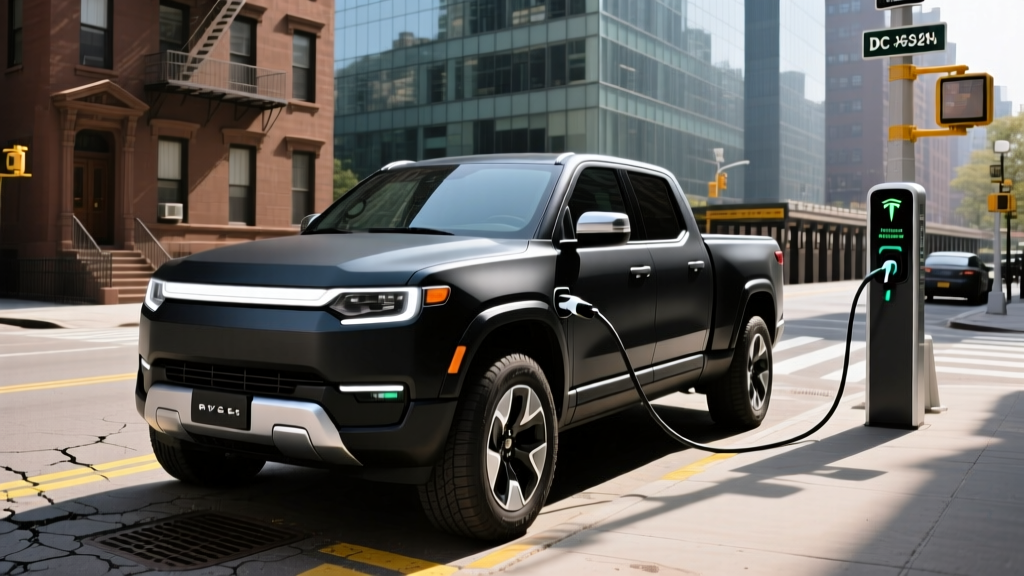
New York City is the ultimate stress test for any electric vehicle. Between stop-and-go gridlock on the BQE, cramped parking garages in Midtown, winter cold that saps battery range, and a public charging network that's improving but still uneven, an EV in the five boroughs lives a very different life than one in suburban California. Rivian's R1S SUV and R1T pickup have developed a cult following among urban adventurers, but how do they actually fare when the adventure is a Tuesday commute through Manhattan?
This review evaluates the 2026 Rivian R1S and R1T (Dual-Motor and Tri-Motor configurations) through the lens of a New York City owner — covering real-world range in urban and highway driving, the realities of charging without a private garage, curb-weight implications for parking structures, and the current federal tax credit landscape.
Rivian R1S & R1T: 2026 Specs at a Glance
| Spec | R1S Dual-Motor (Large) | R1S Tri-Motor (Large) |
|---|---|---|
| EPA Range | 352 miles | 410 miles |
| Battery (usable) | ~128.9 kWh (NMC) | ~128.9 kWh (NMC) |
| Horsepower | 665 hp | 850 hp |
| 0–60 mph | 4.5 sec | 2.9 sec |
| Drivetrain | AWD (Dual-Motor) | AWD (Tri-Motor) |
| MPGe (combined) | 73 MPGe | 70 MPGe |
| Efficiency | 46 kWh/100 mi | 48 kWh/100 mi |
| Max DC Fast Charge | 220 kW peak | 220 kW peak |
| 10–80% DC Time | ~30 min | ~30 min |
| Level 2 Home Rate | 11.5 kW (~25 mi/hr) | 11.5 kW (~25 mi/hr) |
| Curb Weight | ~7,149 lbs | ~7,400 lbs |
| Cargo (R1S, behind 3rd row) | 10.6 cu ft (46.7 cu ft folded) | 10.6 cu ft (46.7 cu ft folded) |
| Towing Capacity | 7,700 lbs | 7,700 lbs |
| Base MSRP (R1S) | $75,900 | $99,900 |
| Battery/Powertrain Warranty | 8 yr / 175,000 mi | 8 yr / 175,000 mi |
Rivian's R1T pickup shares nearly identical powertrain specs with the R1S but offers a 4.5-foot bed and a gear tunnel (11.7 cu ft) in place of third-row seating. The R1T starts at $69,900 for the Dual-Motor Standard and climbs past $99,000 for the Tri-Motor Max.
EPA Range vs. Real-World NYC Driving
Real-World NYC Expectation: 270–310 miles in mixed city/highway; expect 220–260 miles in sub-30°F winter conditions with cabin heat and stop-and-go traffic.
The EPA numbers on the Rivian R1S are genuinely impressive for a 7,000+ lb vehicle, but NYC driving introduces variables the sticker doesn't capture. Stop-and-go traffic is actually favorable for EVs — regenerative braking recovers energy that a gas car would waste as heat — and in mild weather, you'll see efficiency close to or even slightly better than the EPA's 46 kWh/100mi combined figure on Manhattan surface streets.
The range killers in New York are highway stints (I-87 to the Hudson Valley, the Turnpike to Jersey) and winter cold. At 70+ mph on the Thruway, aerodynamic drag dominates, and the R1S's boxy SUV profile doesn't help. Expect a 15–20% range reduction on sustained highway trips compared to the EPA combined number. In January and February, when temperatures regularly dip below freezing, battery chemistry slows and cabin heating draws heavily from the pack. Rivian's heat pump (standard on 2025+ models) mitigates this substantially compared to resistive heating, but you should still budget 25–35% range loss in deep cold.
For context: a round trip from the Upper West Side to Montauk is roughly 300 miles. In July, a Dual-Motor R1S with a full charge can do it without stopping. In January, you'll want a DC fast-charge stop in Riverhead or Hampton Bays.
Charging in NYC: Home, Curb, and Fast-Charge Options
| Level | Power | Miles Added per Hour | NYC Availability |
|---|---|---|---|
| Level 1 (120V outlet) | 1.4 kW | ~3 mi/hr | Rare — garage outlets, slow |
| Level 2 (Home Wall Connector) | 11.5 kW (48A) | ~25 mi/hr | Condo/co-op garages, private homes |
| Level 2 (Public) | 7.2–19.2 kW | 16–42 mi/hr | NYC DOT curbside, garages, workplaces |
| DC Fast Charge (peak) | 220 kW | ~650 mi/hr (peak) | Electrify America, Tesla Supercharger (NACS adapter) |
The single biggest question for any prospective EV owner in NYC is: where do I charge? Unlike suburban owners who plug in at home every night, most New Yorkers park on the street or in shared garages without dedicated charging infrastructure.
Home charging in a private garage or driveway (outer boroughs, Westchester, NJ suburbs): This is the ideal scenario. Rivian's Wall Connector delivers up to 11.5 kW on a 60A circuit, adding roughly 25 miles of range per hour. A full overnight charge (10 hours) restores ~250 miles — more than enough for any NYC driving day. Installation typically runs $1,200–$3,000 including panel assessment, conduit, and a licensed electrician. If your home has a 200A panel with spare capacity, you're in good shape. Older 100A panels may need an upgrade ($2,000–$4,000 additional).
Condo/co-op garage charging: Many NYC co-op and condo boards are now installing shared Level 2 chargers in parking garages, driven partly by Local Law 120 requirements for EV readiness. Charge rates in shared garages typically run 7.2–11.5 kW. The challenge is availability — if your garage has 4 chargers for 80 spots, you'll compete for plug time. Rivian's app lets you schedule charging to off-peak hours (overnight, when ConEd rates are lowest).
Curbside and public Level 2: NYC has expanded its curbside charging network through partnerships with ChargePoint and the NYC DOT EV Charging Program. As of early 2026, there are over 200 curbside Level 2 ports across the five boroughs, concentrated in Brooklyn, Queens, and Manhattan's west side. These deliver 7–19 kW and cost roughly $0.30–$0.50/kWh. They're practical for topping up during a workday or while running errands, but not for a full charge from empty.
DC Fast Charging: Rivian vehicles now ship with the North American Charging Standard (NACS) port, granting native access to Tesla's Supercharger network — a significant advantage over CCS-only vehicles. In the NYC metro area, Supercharger stations in Brooklyn (Atlantic Terminal), Queens (Rego Park), NJ (Secaucus, Paramus), and Westchester provide reliable 150–250 kW charging. Electrify America and EVgo stations supplement coverage, though reliability remains inconsistent at non-Tesla networks.
On a 220 kW-capable Supercharger V4 stall, the Rivian R1S peaks near 200–220 kW up to roughly 30% State of Charge, then tapers progressively. The 10–80% charge takes approximately 30 minutes in optimal battery-temperature conditions. Preconditioning the battery (automatic when you navigate to a charger in the Rivian infotainment system) is essential — without it, cold-soaked batteries may peak at only 50–80 kW, extending charge time to 50+ minutes.
NYC Ownership Realities: Parking, Size, and Curb Weight
The R1S is 195.8 inches long and 81.8 inches wide (with mirrors folded). That's roughly 16 inches longer than a Toyota RAV4 and significantly wider. In practice:
- Parking garages: Most Midtown and residential garages accommodate the R1S, but tight spiral ramps and narrow spaces in older structures can be stressful. The curb weight of 7,149+ lbs also matters — some older garages post weight limits of 6,000–6,500 lbs per level. Check your garage's posted limits.
- Street parking: Parallel parking a 16-foot SUV on a crowded Brooklyn block is doable (the 360-degree camera system and automated parking assist help), but you'll think twice about it daily. Door dings from neighboring cars are a near-certainty.
- Ground clearance: Rivian's adjustable air suspension offers 6.7 to 14.9 inches of ground clearance. In the city, you'll run it in Low or Standard mode. The ability to raise for flooded streets during nor'easters is a genuine NYC advantage.
- Congestion and tolls: The R1S qualifies as a zero-emission vehicle for NYC congestion pricing exemptions (when applicable) and E-ZPass Green discounts, though program specifics change — verify with MTA before relying on it.
Performance and Daily Driving in the City
The dual-motor R1S delivers 665 horsepower and a 4.5-second 0–60 time — genuinely quick for a three-row SUV, and more than sufficient for merging onto the FDR or punching through a gap on the Cross Bronx. The tri-motor's 850 hp and 2.9-second 0–60 is supercar territory, though largely irrelevant at NYC speed limits.
What matters more day-to-day is the regenerative braking. Rivian offers adjustable regen levels; set to maximum, you can drive in near-one-pedal mode through Manhattan traffic, rarely touching the friction brakes. This reduces brake wear significantly — a real cost savings in a city where brake jobs come frequently due to constant stop-and-go.
Ride quality on NYC's notoriously rough roads is surprisingly compliant in the default suspension setting. The air suspension absorbs potholes and expansion joints better than most luxury SUVs, and the 20-inch All-Season tires (standard) offer reasonable sidewall cushioning. Opt for the 22-inch wheels if aesthetics matter, but expect a firmer ride on broken pavement.
Price, Trims, and Federal Tax Credit Eligibility
| Trim | Base MSRP | Federal §30D Credit Eligible? | Est. After-Credit Price |
|---|---|---|---|
| R1T Dual-Motor Standard | $69,900 | Potentially (subject to sourcing/income) | ~$62,400 |
| R1S Dual-Motor Standard | $75,900 | Potentially (subject to sourcing/income) | ~$68,400 |
| R1S Dual-Motor Large | $82,900 | Potentially (subject to sourcing/income) | ~$75,400 |
| R1S Tri-Motor Large | $99,900 | No — exceeds SUV MSRP cap | $99,900 |
The IRS §30D Clean Vehicle Credit offers up to $7,500 for qualifying new EVs, but eligibility hinges on three moving targets that change frequently:
- MSRP Cap: SUVs/pickups must be ≤$80,000 MSRP. This disqualifies the Tri-Motor Large and most Max Pack configurations.
- Buyer Income Cap: Modified AGI ≤$300,000 (joint) / $225,000 (head of household) / $150,000 (single).
- Battery Component Sourcing: Increasing percentages of battery components must be manufactured or assembled in North America, and critical minerals must be sourced from the US or FTA partners. Rivian's US-built packs have generally qualified, but rules tighten annually.
- Point-of-Sale Transfer: Eligible buyers can transfer the credit to the dealer at purchase, reducing the purchase price directly rather than waiting for a tax refund.
As of early 2026, the Dual-Motor Standard and Dual-Motor Large configurations of the R1S and R1T typically qualify for the full $7,500 credit for eligible buyers, but you must verify current battery-sourcing compliance on the fueleconomy.gov credit lookup tool before purchasing. Rules have shifted multiple times since 2023, and a vehicle that qualified in January may not in June.
New York State also offers the Drive Clean Rebate of up to $2,000 for eligible EVs, stackable with the federal credit. Income-based eligibility applies; check NYSERDA for current status.
Tech, Driver Assists, and the Rivian Software Experience
Rivian's infotainment system runs on a custom 15.6-inch landscape touchscreen with an integrated navigation system that includes real-time charger routing (similar to Tesla's trip planner). The UI is clean and responsive, with over-the-air updates that have meaningfully improved the system since launch. Wireless Apple CarPlay and Android Auto are supported.
The Rivian Driver+ system is a Level 2 (SAE) driver-assistance suite combining adaptive cruise control, lane centering, and automatic lane changes on divided highways. It is not a hands-free system like GM's Super Cruise or Ford's BlueCruise — you must keep your hands on the wheel. In practice on I-87 and the NJ Turnpike, Driver+ handles lane-keeping and speed management competently, reducing fatigue on longer drives. However, it occasionally struggles with faded lane markings and construction zones common around NYC infrastructure projects.
Other standout tech features include:
- Camp Kitchen (R1T): A slide-out kitchen module for the gear tunnel — niche, but beloved by overlanders.
- Powered tonneau cover (R1T): Secures the bed with app-controlled operation.
- Vehicle-to-Home (V2H) readiness: Rivian has announced bidirectional charging capability for home backup power, though full V2H integration requires compatible home equipment and is still rolling out.
- 360-degree camera + automated parking: Essential for NYC parallel parking and tight garage maneuvers.
Pros, Cons, and the Bottom Line for NYC Buyers
- Class-leading range for a 3-row electric SUV (352–410 mi EPA)
- NACS port = native Tesla Supercharger access in the metro area
- Air suspension handles NYC potholes and flooded streets well
- Strong regen braking reduces brake wear in stop-and-go traffic
- 8 yr / 175,000 mi battery warranty exceeds industry standard
- Qualifies for §30D credit on Dual-Motor trims (if sourcing/income eligible)
- Large footprint (195.8" L × 81.8" W) is challenging for street parking
- 7,149+ lb curb weight exceeds some parking garage limits
- Tri-Motor and Max Pack trims exceed the $80K MSRP cap — no federal credit
- Home charging requires private garage/driveway (rare in Manhattan)
- Public Level 2 infrastructure in NYC still inconsistent for sole-charging
- Driver+ is competent but not class-leading vs. Super Cruise or FSD
Look elsewhere if: You rely exclusively on street parking and public charging, want the smallest possible footprint for Manhattan life, or need a sub-$50K price point. Consider the Tesla Model Y, Hyundai Ioniq 5, or a compact PHEV like the Toyota RAV4 Prime for tighter urban logistics.
Frequently Asked Questions
What is the real-world range of a Rivian in New York City?
In mild weather with mixed city/highway driving, expect 270–310 miles from a Dual-Motor Large R1S (EPA rated 352). In winter (sub-30°F), plan for 220–260 miles due to battery chemistry slowdown and cabin heating demand. Pure city driving at low speeds is actually efficient for EVs, so surface-street-only days in Brooklyn or Manhattan will yield range near or slightly above EPA figures.
How fast does the Rivian charge at home and on DC fast chargers?
On a home Level 2 Wall Connector (11.5 kW), the R1S adds roughly 25 miles of range per hour — a full overnight charge covers any NYC driving day. On a DC fast charger (220 kW peak), the 10–80% charge takes approximately 30 minutes with battery preconditioning. Without preconditioning in cold weather, expect 45–55 minutes.
Does the Rivian qualify for the $7,500 federal EV tax credit?
The Dual-Motor Standard and Dual-Motor Large trims (MSRP ≤$80,000 for SUVs) generally qualify for eligible buyers meeting income caps (≤$300K joint / $150K single) and battery-sourcing requirements. Tri-Motor and Max Pack trims exceed the MSRP cap and do not qualify. Always verify current eligibility on fueleconomy.gov and consult a tax professional before relying on the credit.
Is Rivian worth buying in NYC vs. a Tesla Model Y or Hyundai Ioniq 5?
If you need three rows, serious ground clearance, or a pickup bed, Rivian has no direct competitor in the EV space. If you're a 1–2 person household prioritizing easy parking, lowest charging cost, and the densest fast-charger network, the Tesla Model Y is more practical for Manhattan. The Ioniq 5 offers faster 800V charging and a lower price point. Rivian wins on adventure capability and build quality; it loses on urban compactness and price.
Can I own a Rivian in NYC without home charging?
It's possible but challenging. You'd rely on a combination of public Level 2 chargers (NYC DOT curbside, garage chargers, workplace charging) and weekly DC fast-charge sessions. This adds time cost (30–60 min per session) and higher per-kWh expense versus home rates. Most NYC Rivian owners we've spoken to have home or garage charging; without it, ownership friction increases substantially.
What's the battery warranty, and how long will it last?
Rivian covers the battery and powertrain for 8 years or 175,000 miles, whichever comes first, with a capacity retention threshold of 70%. This is above the industry-standard 8yr/100,000mi. Rivian uses NMC (nickel manganese cobalt) chemistry in the Large and Max packs, which offers high energy density. Expect typical degradation of 8–12% over the first 100,000 miles based on current fleet data — meaning a 352-mile pack would retain roughly 310–320 miles of range at that point.
Sources: EPA range and efficiency data via fueleconomy.gov; Rivian specifications from rivian.com; IRS §30D credit rules from irs.gov.