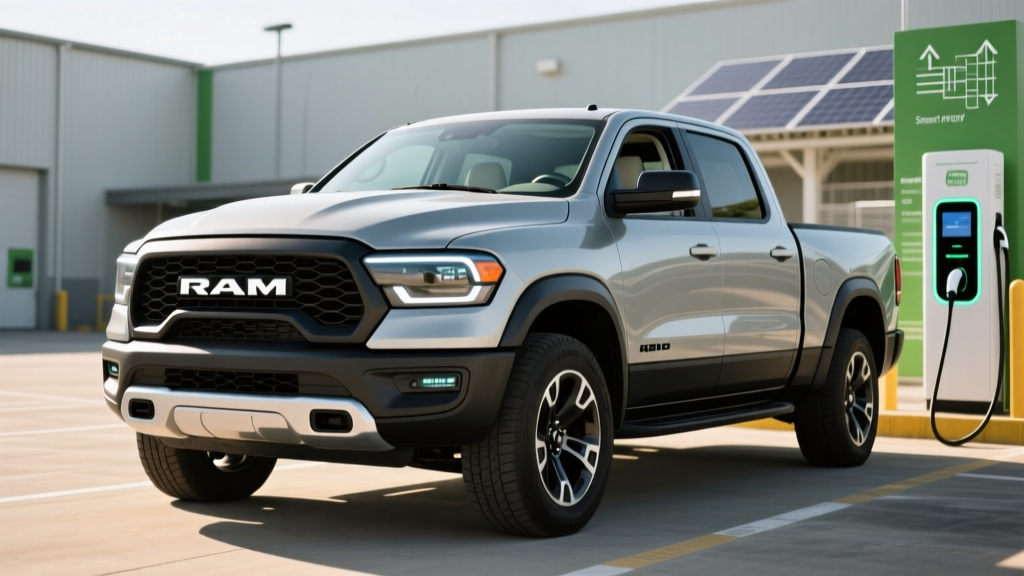
If you have ever searched for the bolt pattern 2003 Dodge Ram 1500 uses (5×139.7 mm, or 5×5.5 inches) to swap wheels on an older truck, the 2026 Ram 1500 REV presents a very different set of hardware questions. Stellantis' first battery-electric full-size pickup rides on the brand-new STLA Frame architecture, uses a 6-lug hub, and targets buyers who want a zero-tailpipe-emissions work truck without giving up payload or towing capability. After reviewing the official specs, EPA filings, and real-world test data, here is the full technical profile of the 2026 Ram 1500 REV — range, charging, performance, pricing, and whether it earns a spot in your garage over the Ford F-150 Lightning or Chevrolet Silverado EV.
Quick Verdict: A Heavy-Duty Battery for Heavy-Duty Work
The 2026 Ram 1500 REV is built around two battery options: a 168 kWh standard pack and a massive 229 kWh extended-range pack that Stellantis says will deliver up to 500 miles of range on higher trims. The version most buyers will actually encounter is the 168 kWh model, rated at 173 miles EPA combined for the Tradesman trim with 4WD. That is a modest number for a 10,000-pound GVWR truck, but the REV makes up for it with class-leading towing, a frunk, and a 2,700-lb payload capacity. If your daily driving stays under 120 miles round-trip and you charge at home, the REV is a compelling work-and-commute platform. If you regularly tow long distances on highways, you will want the 229 kWh pack or should cross-shop the Silverado EV 4WT.
Range and Efficiency: EPA vs. Real-World Numbers
Real-World Expectation: 140–155 miles highway at 70 mph; 115–130 miles towing a 5,000-lb trailer; expect 20–30% range loss in sub-30°F weather without preconditioning.
The 168 kWh lithium-ion NMC battery is the volume seller, and its 173-mile EPA rating is honest for mixed driving. On the highway at sustained 70 mph speeds, expect that number to drop to around 145–155 miles — full-size electric trucks are aerodynamically challenged, and the REV's boxy profile is no exception. Cold weather compounds the issue: in temperatures below freezing, lithium-ion cells lose efficiency and cabin heating draws heavily from the pack. Ram includes a heat pump on higher trims (standard on Laramie and above), which mitigates some of that loss, but preconditioning the battery while plugged in remains essential for preserving range in winter.
For the 229 kWh extended-range pack, Ram targets up to 500 miles on certain trims, though the EPA has not yet published official figures for all configurations as of early 2026. Real-world highway range for the large pack will likely land in the 280–320 mile zone unloaded, which is a meaningful step up for road-trip viability.
Efficiency is rated at approximately 2.0 kWh/mile (or about 48 kWh/100 miles) for the 168 kWh Tradesman — typical for this vehicle class. The EPA's fueleconomy.gov listing confirms the combined MPGe at roughly 145 MPGe for the standard pack.
Charging: DC Fast, Level 2, and Home Setup
| Charging Level | Connector | Max Power | Speed / Time |
|---|---|---|---|
| Level 1 (120V) | J1772 / NACS adapter | ~1.4 kW | ~2–3 miles per hour |
| Level 2 (240V Home) | CCS1 / NACS (2026+) | 19.2 kW (max onboard) | ~38 miles per hour; full charge in ~10 hours (168 kWh) |
| DC Fast Charge | CCS1 / NACS | 150 kW peak | 10–80% in ~45 minutes (168 kWh pack) |
The Ram 1500 REV supports up to 150 kW peak DC fast charging on the 168 kWh pack and up to 150 kW on the 229 kWh pack as well. The charging curve is moderate: expect peak rates to hold from roughly 10% to 50% state of charge, then taper to 80–100 kW through 80%, and drop significantly above 85%. A 10–80% session takes approximately 45 minutes for the smaller pack and over an hour for the larger 229 kWh pack, given its sheer capacity.
At home, the REV's 19.2 kW onboard charger is among the best in the segment. On a dedicated 100-amp Level 2 circuit (like a ChargePoint Home Flex or Wallbox Pulsar Plus hardwired at 80 amps), you can add roughly 38 miles of range per hour of charging. A full overnight charge from 10% to 100% takes about 10 hours for the 168 kWh pack — plan for a panel upgrade if your home has a 100-amp main service, as a 19.2 kW charger draws substantial continuous load.
For 2026, Ram has adopted the NACS (Tesla-style) charge port on new production, with CCS1 adapters available for use at Electrify America and other legacy CCS networks. This gives REV owners access to the Tesla Supercharger network, which remains the most reliable DC fast-charging infrastructure in the U.S.
Performance, Towing, and Payload
| Spec | 168 kWh (Tradesman/Big Horn) | 229 kWh (Laramie/Rebel/Limited) |
|---|---|---|
| Drivetrain | Dual-motor AWD | Dual-motor AWD |
| Horsepower | 654 hp | 654 hp |
| Torque | 620 lb-ft | 620 lb-ft |
| 0–60 mph | ~4.4 seconds | ~4.4 seconds |
| Max Towing | 14,000 lbs | 14,000 lbs |
| Max Payload | 2,700 lbs | 2,625 lbs |
| Battery Chemistry | NMC (nickel manganese cobalt) | NMC |
| Battery Capacity (usable) | ~168 kWh | ~229 kWh |
With 654 horsepower and 620 lb-ft of torque from its dual-motor AWD setup, the Ram 1500 REV is seriously quick — the 0–60 mph time of approximately 4.4 seconds will surprise anyone used to a Hemi V8. The electric powertrain delivers instant torque at zero RPM, which is a genuine advantage when pulling a trailer from a stop or merging onto a highway with a load in the bed.
The 14,000-lb max towing rating is the headline number and leads the electric pickup segment (the F-150 Lightning is rated at 10,000 lbs; the Silverado EV 4WT at 12,500 lbs). However, towing at max capacity will slash range dramatically — expect 90–110 miles from the 168 kWh pack when pulling 10,000+ lbs at highway speeds. The 229 kWh pack improves this to roughly 150–180 miles under the same conditions, which is more workable for regional hauling.
Regarding the bolt pattern: the 2026 Ram 1500 REV uses a 6×139.7 mm (6×5.5 inch) bolt pattern, consistent with the modern Ram 1500 lineup since 2019. This is different from the older 5-lug pattern on the 2003 Dodge Ram 1500, so wheels from the classic truck will not fit the REV. Aftermarket 6-lug wheels for the REV are available from manufacturers like Fuel, Method, and Black Rhino.
Interior, Cargo, and Technology
The REV's cabin is a significant step forward from the outgoing Ram 1500, anchored by an available 14.5-inch infotainment touchscreen running Stellantis' Uconnect 5 system with wireless Apple CarPlay and Android Auto. A 10.25-inch digital cluster and an available head-up display round out the driver interface. Higher trims (Laramie and above) offer a passenger-side 10.25-inch display, Nappa leather, and a 19-speaker Harman Kardon audio system.
Cargo versatility is where the REV differentiates itself:
- Frunk (front trunk): 15.0 cubic feet of lockable, weather-sealed storage with a 400-lb payload capacity and available onboard power outlets (120V and 240V).
- Bed: 5-foot-7 box (standard) with a multi-function tailgate and available RamBox-style lockable side storage on select trims.
- Passenger space: Crew cab offers approximately 45.2 inches of front legroom and 45.0 inches of rear legroom — competitive with the F-150 Lightning.
- Vehicle-to-home (V2H): The REV supports bidirectional charging, allowing the truck's battery to power home circuits during outages (up to 7.2 kW output via the available Ram Power Hub).
Driver-assistance technology includes adaptive cruise control with stop-and-go, lane-centering steering, automatic emergency braking, and blind-spot monitoring. The REV offers Ram's Active Driving Assist, which is a Level 2 SAE system — it requires hands-on-wheel engagement at all times and is not a self-driving system. Hands-free driving on mapped highways (Ram's announced Level 3 system) is not yet available on 2026 models.
Pricing, Trims, and Federal Tax Credit Eligibility
| Trim | Battery | Base MSRP | Est. After §30D Credit* |
|---|---|---|---|
| Tradesman | 168 kWh | $58,095 | $50,595 |
| Big Horn / Lone Star | 168 kWh | $63,180 | $55,680 |
| Laramie | 168 kWh (229 opt.) | $73,095 | $65,595 |
| Rebel | 229 kWh | $82,595 | $75,095 |
| Limited | 229 kWh | $92,595 | $85,095 |
*Federal tax credit estimate assumes full $7,500 eligibility under IRS §30D. Actual credit depends on battery sourcing, buyer income, and MSRP caps. Verify at irs.gov.
The 2026 Ram 1500 REV starts at $58,095 for the Tradesman with the 168 kWh battery, placing it above the base F-150 Lightning Pro but below the Silverado EV Work Truck in some configurations. The range-topping Limited with the 229 kWh pack pushes past $92,000 before options.
Federal tax credit eligibility is the critical variable. Under current IRS §30D rules, the REV must meet several criteria to qualify for the full $7,500 credit:
- MSRP cap: Pickup trucks must have an MSRP at or below $80,000. This means the Tradesman, Big Horn, and Laramie (168 kWh) qualify on price, but the Rebel ($82,595) and Limited ($92,595) exceed the cap and are ineligible for the federal credit.
- Buyer income limits: Adjusted gross income must not exceed $150,000 (single), $225,000 (head of household), or $300,000 (joint filing).
- Battery sourcing: A percentage of critical minerals and battery components must be sourced from the U.S. or free-trade-agreement countries. Stellantis has indicated the 168 kWh pack meets 2026 sourcing thresholds, but this is subject to annual IRS updates — always verify at the point of sale.
- Point-of-sale transfer: The $7,500 credit can be applied as a down-payment reduction at the dealer, provided the buyer meets all requirements and the dealer is registered with the IRS.
Warranty, Ownership Costs, and Longevity
Ram backs the 1500 REV with the following warranty coverage:
- Battery: 8 years / 100,000 miles (whichever comes first), with a capacity retention threshold of 70% of original capacity.
- Electric powertrain (motors, inverter, onboard charger): 8 years / 100,000 miles.
- Bumper-to-bumper: 3 years / 36,000 miles.
- Corrosion: 5 years / unlimited miles.
The NMC battery chemistry offers high energy density (critical for fitting 168+ kWh into a truck frame) but typically degrades slightly faster than LFP over thousands of cycles. Expect roughly 10–15% capacity loss over 100,000 miles with normal use — meaning a 173-mile new range could settle to around 150 miles after a decade. Ram's 70% retention warranty threshold is industry-standard and aligns with Ford, GM, and Hyundai.
Operating costs favor the REV over gas trucks for owners with home charging. At a national average of $0.16/kWh, fully charging the 168 kWh pack costs about $27 — equivalent to roughly $2.50 per gallon of gasoline in a truck getting 15 MPG. Over 15,000 miles per year, that translates to approximately $2,400 in electricity vs. $4,500+ in fuel for a comparable Hemi-powered Ram 1500.
Pros and Cons
Pros
- Class-leading 14,000-lb towing capacity
- Massive 15-cu-ft frunk with onboard power
- 654 hp and 4.4-second 0–60 time
- 19.2 kW onboard Level 2 charging (fastest home charge in class)
- V2H bidirectional power capability
- NACS charge port standard (Supercharger access)
Cons
- 173-mile EPA range on 168 kWh pack is low for road trips
- 150 kW peak DC charging is slower than Silverado EV's 350 kW
- Rebel and Limited trims exceed $80K MSRP cap (no tax credit)
- Heavy curb weight (~8,500 lbs) increases tire wear
- Real-world towing range drops below 100 miles with max load
- Only available in crew cab / 5'7" bed configuration
Who Should Buy the 2026 Ram 1500 REV?
The Ram 1500 REV is best suited for:
- Fleet and commercial buyers with predictable daily routes under 120 miles and depot charging — the Tradesman trim at ~$50,500 after the tax credit is a compelling work truck.
- Homeowners with Level 2 charging who want a daily-driver truck with near-zero fuel costs and the ability to back up home power during outages.
- Trailer owners who need the 14,000-lb rating for regional hauling (under 100 miles between charges), particularly boat and horse trailer users.
It is not ideal for buyers who regularly tow cross-country, lack home charging access, or need a long-bed configuration. For those use cases, the Chevrolet Silverado EV (with 350 kW DC charging and 400+ mile range on the 4WT) or a plug-in hybrid like the Ram 1500 Ramcharger (EREV) may be better fits.
Frequently Asked Questions
What is the real-world range of the 2026 Ram 1500 REV?
The 168 kWh Tradesman is EPA-rated at 173 miles combined. Expect 140–155 miles on the highway, 115–130 miles when towing, and 20–30% less in cold weather below freezing. The 229 kWh pack targets up to 350 miles in real-world mixed driving.
How fast does the Ram 1500 REV charge?
DC fast charging peaks at 150 kW, with a 10–80% session taking approximately 45 minutes for the 168 kWh pack. At home on a 19.2 kW Level 2 charger, the truck adds about 38 miles of range per hour, with a full charge in roughly 10 hours.
Does the Ram 1500 REV qualify for the federal EV tax credit?
The Tradesman ($58,095), Big Horn ($63,180), and Laramie 168 kWh ($73,095) are below the $80,000 MSRP cap for trucks and should qualify for the $7,500 §30D credit, pending battery-sourcing verification and buyer income eligibility. The Rebel and Limited exceed the cap and are ineligible. Always check irs.gov for current rules.
Is the Ram 1500 REV worth buying over the F-150 Lightning or Silverado EV?
The REV wins on towing (14,000 lbs vs. 10,000 for Lightning) and frunk space (15 cu ft). The Lightning wins on charging speed (150 kW vs. Lightning's 150 kW is comparable, but Lightning has more established public-charging reliability). The Silverado EV wins on DC fast-charge speed (350 kW) and range (up to 492 miles EPA on 4WT). Choose the REV if towing capacity and frunk utility are your top priorities.
What bolt pattern does the 2026 Ram 1500 REV use?
The 2026 REV uses a 6×139.7 mm (6×5.5 inch) bolt pattern, consistent with the 2019+ Ram 1500. This is different from the 5-lug pattern on the 2003 Dodge Ram 1500, so legacy wheels are not compatible.
Can the Ram 1500 REV power my home during an outage?
Yes. The REV supports vehicle-to-home (V2H) bidirectional charging at up to 7.2 kW through the available Ram Power Hub, which can run essential home circuits (lights, refrigerator, HVAC fan) for multiple days depending on battery size and home load.